


Titanium turbo manifold?


Evolving Member
Joined: Jul 2005
Posts: 274
Likes: 0
From: Davis, California
Originally Posted by Zeus
Sorry, I was in a  stupor at the time... SaabTuner is absolutely correct! The first time you lean out the mixture and run much over 1700 degrees, you may also induce Alpha-case (sp?). Basically oxidation of your manifold material. Read not good. Inconel would be the way to go, but talk about cost prohibitive!
stupor at the time... SaabTuner is absolutely correct! The first time you lean out the mixture and run much over 1700 degrees, you may also induce Alpha-case (sp?). Basically oxidation of your manifold material. Read not good. Inconel would be the way to go, but talk about cost prohibitive! Most Titanium exhausts are commercially pure Titanium. Burn's Stainless used to sell Grade 2. Commercially pure Titanium is already alpha phase. That phase is the strongest at high temperatures and the most corrosion resistant. But, at about 1600*F, commercially pure alpha-phase titanium undergoes a phase change to beta-phase, which is much much weaker at those temperatures. In general, titanium isn't really that strong at high temperatures anyway, despite its very high melting point.
Azom has a decent page on Titanium alloys: http://www.azom.com/details.asp?ArticleID=915
I forgot to mention why inconel would let you make lighter headers. Many Inconel grades are actually more dense than most stainless metals. However, because they are so much more heat and corrosion resistant, they can be made from a much thinner gauge tubing without risk of cracking or breaking.

There is another option as well: if you trust your ceramic coating to adhere to the inside of the headers, the thermal-isulation and anti-corrosion properties of the coating would allow you to use a thinner gauge of stainless steel and, possibly, even a lower grade. (You might be able to get away with 304 instead of 321, or 321 instead of Inconel, at the same temps.) The coating Crucial Racing uses seems to be able to adhere permanently as I know they have not so far had a single case of it spalling or chipping.

Worth thinking about, at any rate.

i know when i had titanium exhaust on my R6 it stayed way cooler than the exact same exhaust in stainless steel. i wrecked and messed up the ti one so i went with the less than half the price stainless version. the titanium i could touch after riding and it was just warm, the stainless would burn the s#%t out of you if you touch it!



Originally Posted by SaabTuner
I think you mean Alpha-phase? Most Titanium exhausts are commercially pure Titanium. Burn's Stainless used to sell Grade 2. Commercially pure Titanium is already alpha phase. That phase is the strongest at high temperatures and the most corrosion resistant.
But, at about 1600*F, commercially pure alpha-phase titanium undergoes a phase change to beta-phase, which is much much weaker at those temperatures. In general, titanium isn't really that strong at high temperatures anyway, despite its very high melting point.
Azom has a decent page on Titanium alloys: http://www.azom.com/details.asp?ArticleID=915
I forgot to mention why inconel would let you make lighter headers. Many Inconel grades are actually more dense than most stainless metals. However, because they are so much more heat and corrosion resistant, they can be made from a much thinner gauge tubing without risk of cracking or breaking.
There is another option as well: if you trust your ceramic coating to adhere to the inside of the headers, the thermal-isulation and anti-corrosion properties of the coating would allow you to use a thinner gauge of stainless steel and, possibly, even a lower grade. (You might be able to get away with 304 instead of 321, or 321 instead of Inconel, at the same temps.) The coating Crucial Racing uses seems to be able to adhere permanently as I know they have not so far had a single case of it spalling or chipping.
Worth thinking about, at any rate.
Most Titanium exhausts are commercially pure Titanium. Burn's Stainless used to sell Grade 2. Commercially pure Titanium is already alpha phase. That phase is the strongest at high temperatures and the most corrosion resistant. But, at about 1600*F, commercially pure alpha-phase titanium undergoes a phase change to beta-phase, which is much much weaker at those temperatures. In general, titanium isn't really that strong at high temperatures anyway, despite its very high melting point.
Azom has a decent page on Titanium alloys: http://www.azom.com/details.asp?ArticleID=915
I forgot to mention why inconel would let you make lighter headers. Many Inconel grades are actually more dense than most stainless metals. However, because they are so much more heat and corrosion resistant, they can be made from a much thinner gauge tubing without risk of cracking or breaking.
There is another option as well: if you trust your ceramic coating to adhere to the inside of the headers, the thermal-isulation and anti-corrosion properties of the coating would allow you to use a thinner gauge of stainless steel and, possibly, even a lower grade. (You might be able to get away with 304 instead of 321, or 321 instead of Inconel, at the same temps.) The coating Crucial Racing uses seems to be able to adhere permanently as I know they have not so far had a single case of it spalling or chipping.
Worth thinking about, at any rate.
between the 80's and now may have effected my memory 
Evolving Member
Joined: Jul 2005
Posts: 274
Likes: 0
From: Davis, California
Originally Posted by Zeus
Actually what I was talking about was the oxidation that could erroneously occur in the Ti alloys we used in the manufacture of nozzles when I worked for Rohr around 1990. We used a honey comb sandwiched between two Ti skins. I'll not go into grand detail, but the assembly was assembled, and placed in a vacuum furnace. It was drawn down to -23 tore, and argon was introduce to help prevent oxidation that occurred when the alloy reached temperatures in excess of 1780 degrees (I really can't remember as it has been about 16 years) in the presence of O2. Anyway, my memory is not what it used to be, and you probably are correct in that it was called "Alpha Phase"... however, it was in their class literature that the phase change was not for the better, and if the seal failed the parts were scrap as they became quite brittle, etc, etc. We used this on the RB211 line and the V2500 lines if i recall correctly. Again, this has been a celebration weekend for me and the family, and between all the between the 80's and now may have effected my memory
between the 80's and now may have effected my memory "Alpha case" is a special form of "alpha phase" which is oxygen rich, though not specifically titanium oxide: http://www.met-tech.com/motorsports.htmIt's somewhat obscure jargon, but worth commiting to memory. Thanks!
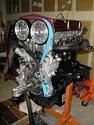


The reason titanium is actually not recomended for a turbo manifold is that it is, in fact, extremely porous.
I remember John Force's funny car engineers handed him a set of 12 pound headers for the car. He and his crew chief said "You sure about this?" The engineers said "Definitely"
Half way down the first run, right at the 1/8th mile the headers shearThe ed off at the bend and the forces of the exhaust and blew the car over the top.
Even though we dont run nitro methane, the hot, pressurized exhaust gases would attack the hell out of and it would disintegrate a short time later, I feel.
Titanium is awesome. Light and strong, but....it has its weakness'
I remember John Force's funny car engineers handed him a set of 12 pound headers for the car. He and his crew chief said "You sure about this?" The engineers said "Definitely"
Half way down the first run, right at the 1/8th mile the headers shearThe ed off at the bend and the forces of the exhaust and blew the car over the top.
Even though we dont run nitro methane, the hot, pressurized exhaust gases would attack the hell out of and it would disintegrate a short time later, I feel.
Titanium is awesome. Light and strong, but....it has its weakness'
why does it work for streetbike exhausts then? i'm confused. a japanese superbike such as a GSX-R 1000 or R1 have pretty hot exhaust gases and run extremely high compression and titanium exhausts maintain a cooler temp than stainless and aluminum. why is titanium good enough for a bike but not a car?
turbocharged cars run much higher compression than even the highest compresion naturally aspirated engine. ok... i take that back, f1 might rival it.
that said bikes also have more access to cooling, as the header is right out there in the air.
that said bikes also have more access to cooling, as the header is right out there in the air.