


Question about Compressor Map for 35R


Thread Starter
Evolved Member
Joined: Oct 2002
Posts: 2,788
Likes: 1
Question about Compressor Map for 35R
I've been trying to wrap my head around some of the maths involved in reading compressor maps. From what I can tell so far, it requires a number of assumptions about the engine in question, like it's VE. But at any rate, I have a basic question... if you look at the following compressor map from Garrett's catalog, of a 3582R compressor:
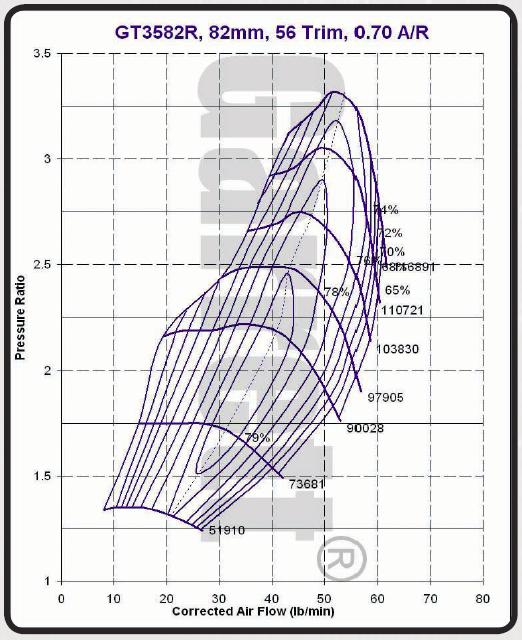
Now if you assume the Evo engine in question makes 10 hp per lb/min, and we know 35R cars make over 700 engine power, and we know they run boost close to 40 psi (PR of 3.7). Well 70 lb/min and PR of 3.7 is way out of the efficiency of the compressor apparently isn't it?
Second question is, what would you approximate your typical Buschur setup VE to be?
Now if you assume the Evo engine in question makes 10 hp per lb/min, and we know 35R cars make over 700 engine power, and we know they run boost close to 40 psi (PR of 3.7). Well 70 lb/min and PR of 3.7 is way out of the efficiency of the compressor apparently isn't it?
Second question is, what would you approximate your typical Buschur setup VE to be?

This is the compressor map of a regular GT35R, not a HTA35R, which is a different compressor wheel, making this particular compressor map useless for most of the 10 second "cookie cutter" builds BR does.
Thread Starter
Evolved Member
Joined: Oct 2002
Posts: 2,788
Likes: 1
My question about Buschur was regarding VE.

Thread Starter
Evolved Member
Joined: Oct 2002
Posts: 2,788
Likes: 1
Am I correct in saying, that to determine the volume of air which flows through a 4G63 N/A, you would use a formula roughly like:
volume = displacement * RPM * .5 * VE
The ".5" being because the cylinders only fill fully over 2 crank rotations.
But then this is a measure of volume, not density, and that the "lb/min" measure in the x-axis of the compressor map is a measure of density?
Am I further correct that the ideal gas law will help us get from volume to density?
But does VE change at different RPM's and boost pressures?
Sorry for all the questions, it's just that I've read so many different explanations on reading compressor maps I'm a bit lost.
volume = displacement * RPM * .5 * VE
The ".5" being because the cylinders only fill fully over 2 crank rotations.
But then this is a measure of volume, not density, and that the "lb/min" measure in the x-axis of the compressor map is a measure of density?
Am I further correct that the ideal gas law will help us get from volume to density?
But does VE change at different RPM's and boost pressures?
Sorry for all the questions, it's just that I've read so many different explanations on reading compressor maps I'm a bit lost.

Thread Starter
Evolved Member
Joined: Oct 2002
Posts: 2,788
Likes: 1
But I'm also curious about the other methods of computing air flow, starting with engine rpm and VE etc...
Trending Topics
Thread Starter
Evolved Member
Joined: Oct 2002
Posts: 2,788
Likes: 1
I just re-read the Garrett stuff, I should not have said Garrett's site assumes 10 hp per lb/min, but it is a different approach, in that you start with your target hp, AFR, and make a guess at BSFC and then get lb/min. This is a diff approach to the starting with VE and engine RPM, which my second question was based on.

To answer your first question. Compressor maps are drawn more for comparison purposes. They are good for getting you into the ballpark. Any time you push the limits of the turbo you will be operating in an area on the map that is not drawn. Being in those less efficient areas is not a problem for todays intercoolers. Just means the IC will have to work a little harder at removing the extra heat.
Am I correct in saying, that to determine the volume of air which flows through a 4G63 N/A, you would use a formula roughly like:
volume = displacement * RPM * .5 * VE
The ".5" being because the cylinders only fill fully over 2 crank rotations.
But then this is a measure of volume, not density, and that the "lb/min" measure in the x-axis of the compressor map is a measure of density?
Am I further correct that the ideal gas law will help us get from volume to density?
But does VE change at different RPM's and boost pressures?
Sorry for all the questions, it's just that I've read so many different explanations on reading compressor maps I'm a bit lost.
volume = displacement * RPM * .5 * VE
The ".5" being because the cylinders only fill fully over 2 crank rotations.
But then this is a measure of volume, not density, and that the "lb/min" measure in the x-axis of the compressor map is a measure of density?
Am I further correct that the ideal gas law will help us get from volume to density?
But does VE change at different RPM's and boost pressures?
Sorry for all the questions, it's just that I've read so many different explanations on reading compressor maps I'm a bit lost.
From a simplicity standpoint....this is an easy way to do it. I have a spreadsheet at home that I calculated approximate lbs/min up to 45psi and its pretty darn close when you use 10-12hp per lb/min.
Volume is technically 122 cubic inches.
From volume and RPM/2 we can get CFM.
From CFM we can get the mass of the air (lb/min) going through the engine using the Ideal Gas Law.
So by only changing "P", we can find out what the mass flow rate is at different RPM's and different boost pressures. Finally, throw in a general VE (85% for example) and we get the spreadsheet I have at home.


You bet it does.
VE approximately mirrors the engine's mechanical torque curve.
To get lb/min or kg/min from estimated VE, one has to use gas law to estimate mass. Since temp is a factor, one has to consider IC efficiency, so the picture becomes slightly complicated.
There are spreadsheets floating around to help you do this.
VE approximately mirrors the engine's mechanical torque curve.
To get lb/min or kg/min from estimated VE, one has to use gas law to estimate mass. Since temp is a factor, one has to consider IC efficiency, so the picture becomes slightly complicated.
There are spreadsheets floating around to help you do this.

I'm pretty sure most 35r run 30-35 psi and make power reflective of around 60lb/min of air. And even though it gets out of the efficiency part of the map and you can find a better suited turbo for the peak power production, you should probably remember that these cars are actually driven, so you need to have a turbo that spools before 7000 rpms - when you actually start using those 60lb/min.
Besides a good core intercooler makes up for a lot of efficiency loss by increasing density ratio anyway. So being out of the range is not all THAT important.
Besides a good core intercooler makes up for a lot of efficiency loss by increasing density ratio anyway. So being out of the range is not all THAT important.
Last edited by mplspilot; Jul 31, 2008 at 10:27 AM.


Like others have mentioned, many times people will simply run the compressor in a region that right off its map. It doesn't do wonders for longterm durability or compressor discharge temps / comp power req't, but it can be (and is) done.

So 40+14.7/14.7 = 3.7 PR