


Piston Comparison



Thread Starter


Joined: Jan 2004
Posts: 11,406
Likes: 78
From: Northwest
Yeah he ran the 10:1 with 22psi of boost (all it would take with reasonable timing) and ran some low 12's high 11's. The race that got publicised of him losing to a new GTR was when he was on pumpgas. It was a fair race, but the Evo obviously wasnt in race trim during the race.


Compression Height
Some more stuff to look at 
This is the 87mm long rod 10:1 piston that is going in my motor. It maintains some dish since its larger displacement and a IX head, has big valve reliefs and if you look close it has the accumulator groove cut in between the 1st and 2nd ring land. I wanted lateral gas ports but the wrist pin is so high it was apparently not wise. Total piston weight is 315g.
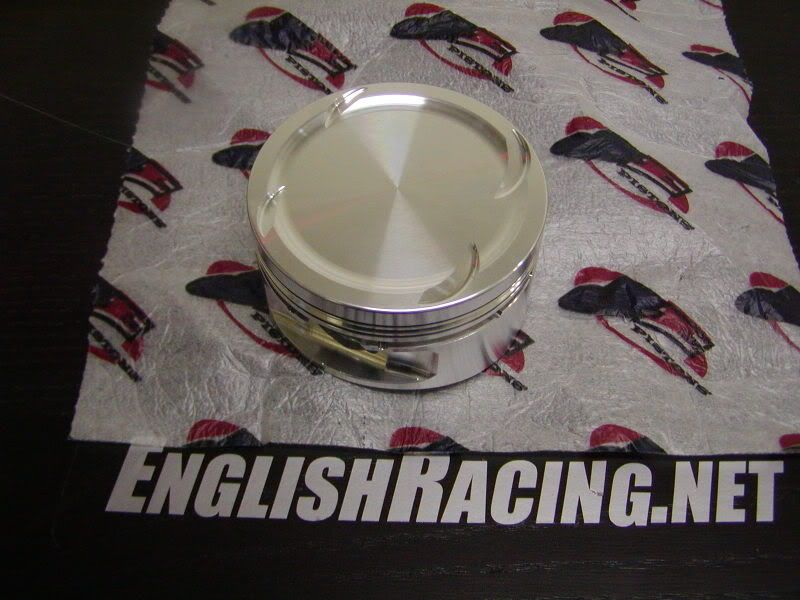
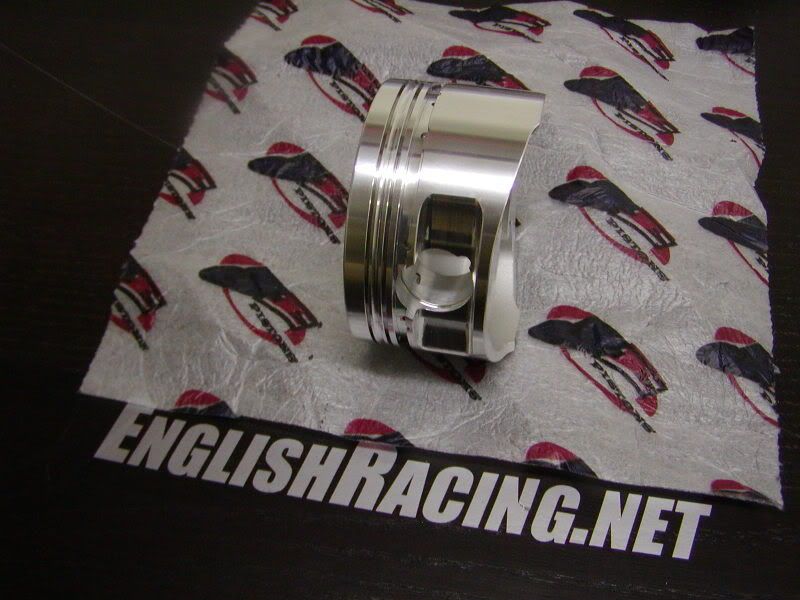
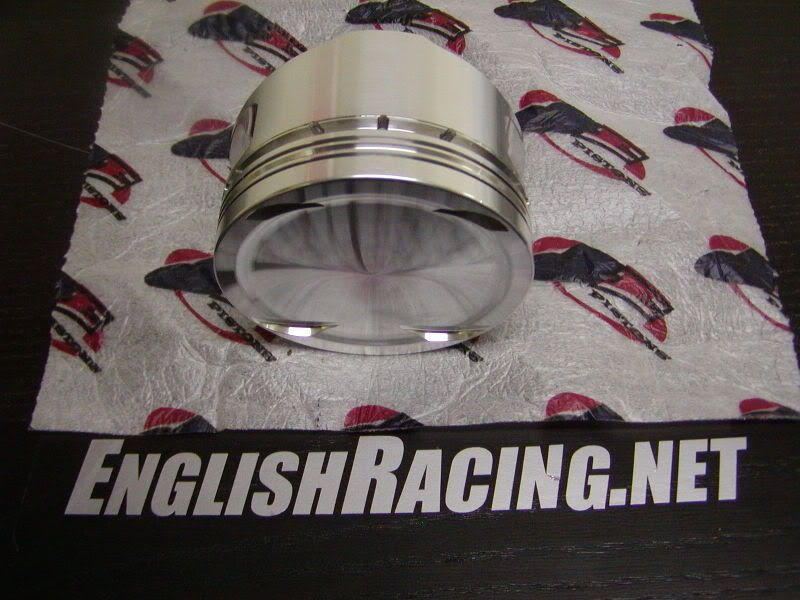
This is the 87mm long rod 10:1 piston that is going in my motor. It maintains some dish since its larger displacement and a IX head, has big valve reliefs and if you look close it has the accumulator groove cut in between the 1st and 2nd ring land. I wanted lateral gas ports but the wrist pin is so high it was apparently not wise. Total piston weight is 315g.
Kenny Duttweiler who always has the race/max horsepower point of view stated, “I always like the pin as high in the piston as possible. Heck, the ideal place would probably be above the piston if that were possible. A high pin location adds to piston stability and reduces thrust on the piston skirt.”

Kenny Duttweiler who always has the race/max horsepower point of view stated, “I always like the pin as high in the piston as possible. Heck, the ideal place would probably be above the piston if that were possible. A high pin location adds to piston stability and reduces thrust on the piston skirt.”

Thread Starter
Joined: Jan 2004
Posts: 11,406
Likes: 78
From: Northwest
What company did you go with on these custom pistons? I am looking at JE for mine. I estimate the compression height of your pistons to be around 1.06" give or take...would you say that is correct? You would have to make the oil groove larger to accept an oil support rail that will bridge the gap near the pin ends. I am getting a similar piston made but in a 9:1 for the street primarily run on 93 octane. Do you think I should go with a similar 10:1 as you and go with a thicker head gasket to reduce the compression to 9.5ish? As far as shifting the pin way up in the piston, I found a quote on line which proves positive in this case.
Kenny Duttweiler who always has the race/max horsepower point of view stated, “I always like the pin as high in the piston as possible. Heck, the ideal place would probably be above the piston if that were possible. A high pin location adds to piston stability and reduces thrust on the piston skirt.”
Kenny Duttweiler who always has the race/max horsepower point of view stated, “I always like the pin as high in the piston as possible. Heck, the ideal place would probably be above the piston if that were possible. A high pin location adds to piston stability and reduces thrust on the piston skirt.”
Duttweiler and my friend Mardy share the same outlook as do many on the pin height. I think the thing is keeping it down far enough to keep the ring lands thick, maintain oil control, but still give a centered wrist pin (or over centered if possible) to keep it together.
I am still researching that HG btw but havent found any info on it in actual use. The other thing is the rod weight you told me about, which is awesome, but the harmonics will still be in effect on the bearings.


These are JE's as well since our timeframes and their production time usually seem to coincide well. The compression height ended up at 25.9mm (1.021). These do have the oil support rail as well (I just didnt take that pic). I think for the 91-79 and pump I would run 9:1 if that was going to be the primary fuel.
Duttweiler and my friend Mardy share the same outlook as do many on the pin height. I think the thing is keeping it down far enough to keep the ring lands thick, maintain oil control, but still give a centered wrist pin (or over centered if possible) to keep it together.
I am still researching that HG btw but havent found any info on it in actual use. The other thing is the rod weight you told me about, which is awesome, but the harmonics will still be in effect on the bearings.
Duttweiler and my friend Mardy share the same outlook as do many on the pin height. I think the thing is keeping it down far enough to keep the ring lands thick, maintain oil control, but still give a centered wrist pin (or over centered if possible) to keep it together.
I am still researching that HG btw but havent found any info on it in actual use. The other thing is the rod weight you told me about, which is awesome, but the harmonics will still be in effect on the bearings.
Aaron,
Call SCE Gaskets at (661) 728-9200 and hit extension #223 and talk to Steve. He's real nice and very knowledgable. Use the Original TITAN copper gasket, which is part # T92674 and costs $127.04 They can make these any size and depth and come with silicone seals around the water and oil passages. RA finish can be 80 or better.
HEAD GASKET, TITAN MITSU 4G63 EVO
Competition Head Gaskets
Gasket Thickness: .043; MATERIAL: Copper
Machine a figure "8" pattern and O-ring the block with .041 Stainless steel wire. Add matching Receiver Grooves in the head and install AMS's L-19 Head Studs and you're set! Click on the link to read some of their tech tips and their comparison to MLS gaskets etc and check out their website from there. By the way, my set-up will end up with a 1.063 Compression Height and similar weight.
http://www.scegasketsonline.com/techtips.html


The worst thing anyone can do with an engine that depends upon quench area for detonation suppression is to attempt to lower compression by installing a headgasket that gives more than 0.060" clearance between the piston surface and head deck at TDC.

The quench area is effectively the area that lies outside the combustion chamber but inside the periphery of the piston. In a nutshell, when the piston is at TDC, the clearance between the piston surface and the head deck should be <0.060". When it is engineered this way, it reduces the size of the combustion area, which effectively prevents a second flame front from originating from outside the combustion chamber. This retards uncontrolled combustion, which causes detonation. This is one big reason why modern engines can tolerate compression ratios that were impractical even 25 years ago.
If one increases the clearance to >0.060", he effectively kills the quench, and that isn't a good thing if detonation control is desired.
Here is a good article that explains it thoroughly:
Quench Explained
If one increases the clearance to >0.060", he effectively kills the quench, and that isn't a good thing if detonation control is desired.
Here is a good article that explains it thoroughly:
Quench Explained


Quench area also tends to force the mixture inward (radially) in a rapid fashion. This increases the turbulence intensity of the combusting gases, which quickens the burn, which allows less time for heat to transfer into the end gas region, reducing the likelihood of knock.
The quench area is effectively the area that lies outside the combustion chamber but inside the periphery of the piston. In a nutshell, when the piston is at TDC, the clearance between the piston surface and the head deck should be <0.060". When it is engineered this way, it reduces the size of the combustion area, which effectively prevents a second flame front from originating from outside the combustion chamber. This retards uncontrolled combustion, which causes detonation. This is one big reason why modern engines can tolerate compression ratios that were impractical even 25 years ago.
If one increases the clearance to >0.060", he effectively kills the quench, and that isn't a good thing if detonation control is desired.
Here is a good article that explains it thoroughly:
Quench Explained
If one increases the clearance to >0.060", he effectively kills the quench, and that isn't a good thing if detonation control is desired.
Here is a good article that explains it thoroughly:
Quench Explained
Ted,
What would be the perfect thickness for a head gasket in a 9:1 Long stroke motor with "0" deck height and giving you the best quench area?
If I were going to engineer a piston from scratch, I would try to use one with a piston relief that exactly matched the shape of the combustion chamber, like the 9:1 piston pictured in the OP. The flat crown surfaces on either side of that piston (near the valve reliefs) provide plenty of quench area. Of course, it would require sufficient valve relief to give 0.060" piston/valve clearance on the intake, and 0.080" on the exhaust (for steel rods). I would set the deck height to around 0.004-0.005", and use a MLS gasket of around 1.0mm and not more than 1.5mm uncompressed thickness.
Actually, this is almost exactly what is in my long rod 2.0 engine right now. It is fitted with the lighter stroker pistons, and yields a rod/stroke ratio of 1.77.
Actually, this is almost exactly what is in my long rod 2.0 engine right now. It is fitted with the lighter stroker pistons, and yields a rod/stroke ratio of 1.77.