


Cylinder head testing - Part 1 - 823 whp base line on HTA88


Thread Starter
Account Disabled
iTrader: (91)
Joined: Sep 2003
Posts: 16,850
Likes: 0
From: 2003 Evo VIII - Silver
AHH,,, no, you sir are incorrect. Just plain wrong. First off, the ports in the head are subject to the EXACT same pressure waves as the manifolds. Your "pulse wave tuning" which I believe is called "resonance tuning" that you speak of is not isolated to the runners of the intake manifold. The pressure waves "bounce" off the back of a a valve and the low pressure zone ( as relative to the runners) in the plenum ( as an example of one sort of resonance). The entire length is subject to this phenomenon. A gasket between the head and manifold doesn't effect these waves. You are correct, however when you mention how complex these waves can be. In most four valve cylinders, there is multiple waves bouncing through the intake system. The closing of the exhaust valve causes a wave, scavenging from valve overlap can cause one, the intake valve closing can cause one as well. These waves happen in both the intake ports and exhaust ports. Further more, there can be yet another wave forms from the plenum through TB and intake ducting. Any area where volumes, and ducts come together is surely to create a resonance of some kind. The trick is to get all the resonance waves working in harmony and the rpm you want. This is how F1 cars achieve 140% VE. It's not magic, its science.
There are many ways to actually calculate these resonances, the easiest being some quick formulas for a helmholtz reso, while software packages like Ricardo Wave, and AVL boost, GT power, can calculate these based on 1D estimations, or be coupled to a decent 3D CFD package to get more accurate results.
Since I use the Ricardo Wave and Vectis package a lot, I can speak to the terrific correlation between the simulations and actual dyno results. The rough hand calculations, usually get you in the ballpark, but not nearly as close as Good software..
One more thing, If AL gets to test a lot of cylinder heads, I would wager that the best performing heads are those with more work focused on the valve seats and combustion chamber, rather than the ports themselves....
There are many ways to actually calculate these resonances, the easiest being some quick formulas for a helmholtz reso, while software packages like Ricardo Wave, and AVL boost, GT power, can calculate these based on 1D estimations, or be coupled to a decent 3D CFD package to get more accurate results.
Since I use the Ricardo Wave and Vectis package a lot, I can speak to the terrific correlation between the simulations and actual dyno results. The rough hand calculations, usually get you in the ballpark, but not nearly as close as Good software..
One more thing, If AL gets to test a lot of cylinder heads, I would wager that the best performing heads are those with more work focused on the valve seats and combustion chamber, rather than the ports themselves....
Prior to the recent economic melt down an entire industry has sprung up in North Carlolina and also in Indy to support the NASACR racers. I have read extensively in the Performance Racing Magazine and other trade publications of the great expense involved with even wind tunnel testing to gain slight advantages.
I agree with you, certainly when it comes to the extreme VE of say a pro stock or F1 engine, a lot of science and technology goes into finding more power.
I have seen the kind of computer applications and equipment which Ramone uses and he certainly has the right equipment to do the job properly. All that remains to be seen is what kind of results such efforts will yield in an application like mine.
In the past, the heads I used were all generated by old school head guys who did most of their work by past experience and eye. The head I am going to test is supposed to be a result of extensive testing and R & D.
Hopefully, I will continue to be able to afford to invest in additional testing and development on my Evo and continue to take it racing. The $$$'s keep adding up and its certainly not an inexpensive hobby.
Thread Starter
Account Disabled
iTrader: (91)
Joined: Sep 2003
Posts: 16,850
Likes: 0
From: 2003 Evo VIII - Silver
Which is exactly why I refrained from initiating a lengthy, heavy treatise on the complexity of resonance smack in the middle of Al's topic. Resonance is a tremendously interesing topic, and worthy of months of discussion and speculation, but not necessarily here.
Carry on . . .
Carry on . . .
While I do all my own tuning and wrenching, I would like to seek outside support on the more complex areas such as machine work and head design which require huge investments in costly equipment to do properly.
My goal is to try and team up with others who share the same commitment to excellence and passion for doing a great job in those areas such as head porting, cam design, body work, cage and safety equipment installation and machine shop services.
I can honestly say that my time in this sport compact field has met with a lot of disappointment and frustrations those times when I have had to reply on the services of outside vendors for those services. This was particularly the case back when I first started to modify my Subaru in 2001 and was dealing with a lot of people who were used to working on traditional V8 Detroit Iron.
I guess what I am saying is that the very complexity of the subject matter at hand dictates that very skilled and experienced experts be utilized in this area of the hobby.
Al

Good luck Al.
Too much book work in here for me, I previously had some respect for it but over the last few months have found it to be more worthless than I had ever imagined. Either there are a bunch of people with software and educations who are using it all incorrectly or it just simply doesn't work, I don't know which.
There is ONE way to find out what works. Build it and test it and by testing it needs to be on a dyno or track.
Good luck with your testing Al.
Too much book work in here for me, I previously had some respect for it but over the last few months have found it to be more worthless than I had ever imagined. Either there are a bunch of people with software and educations who are using it all incorrectly or it just simply doesn't work, I don't know which.
There is ONE way to find out what works. Build it and test it and by testing it needs to be on a dyno or track.
Good luck with your testing Al.
Thread Starter
Account Disabled
iTrader: (91)
Joined: Sep 2003
Posts: 16,850
Likes: 0
From: 2003 Evo VIII - Silver
Good luck Al.
Too much book work in here for me, I previously had some respect for it but over the last few months have found it to be more worthless than I had ever imagined. Either there are a bunch of people with software and educations who are using it all incorrectly or it just simply doesn't work, I don't know which.
There is ONE way to find out what works. Build it and test it and by testing it needs to be on a dyno or track.
Good luck with your testing Al.
Too much book work in here for me, I previously had some respect for it but over the last few months have found it to be more worthless than I had ever imagined. Either there are a bunch of people with software and educations who are using it all incorrectly or it just simply doesn't work, I don't know which.
There is ONE way to find out what works. Build it and test it and by testing it needs to be on a dyno or track.
Good luck with your testing Al.
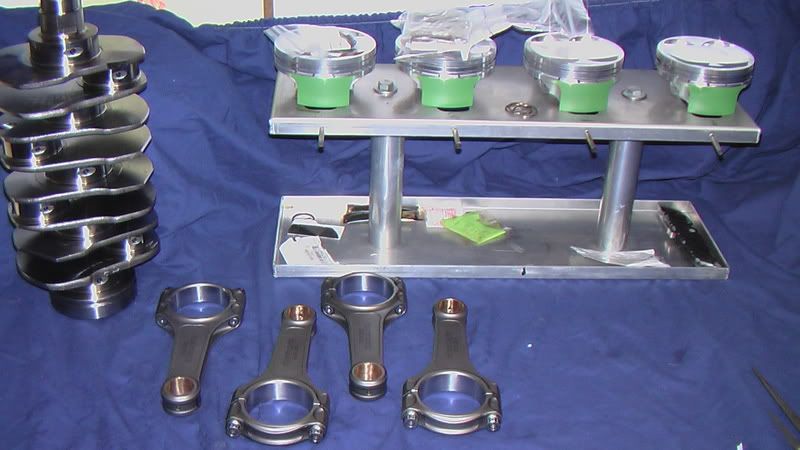
Sadly, as I have explored and continued in my Subaru STI addiction, Buschur is no longer there to supply me with with proven and tested products and I have been chasing my tail now to find the right parts and partners to work with to get Subaru set ups which can make 700 whp on pump gas and hold together. It sure is a lot easier being able to just pick up the phone and simply order a Buschur short block. Can't do that in the Subaru world. If you want a serious Subaru engine you have to build it yourself.
[IMG]
 [/IMG]
[IMG]
 [/IMG]
Of course in doing so I have tried to apply what I have learned from Buschur into the Subaru - again sadly no race fmic for Subarus - I tired to find the next best thing. They don't make Buschur race fmic's for Turbo BMW's either. hint hint.
It was through one of these new connections that the concept of this cnc Evo head came to realization and in my hands - not to mention the generous support of Super Tech valves - a great company
Being an open minded guy, I am always open to new ideas.
Al

Evolving Member
Joined: Mar 2007
Posts: 272
Likes: 0
From: In front of a Catia screen
Which is exactly why I refrained from initiating a lengthy, heavy treatise on the complexity of resonance smack in the middle of Al's topic. Resonance is a tremendously interesing topic, and worthy of months of discussion and speculation, but not necessarily here.
Carry on . . .
We can only hope..
On a different note:
David B., If people are using the software packages and getting crappy results from it, its pretty clear they are using the software incorrectly. On a well calibrated model as compared to a real dyno test, I have seen margin of differences of only 3-4%. ( ricardo 1D wave and 3D cfd vectis coupled simulations)
But that doesn't mean you can't actually test to confirm.. the simulations should be used to predict changes and get inthe ball park of the desired results you want... There is no subsitute for real testing... but sims can make that testing quicker...

Evolved Member
Joined: Oct 2002
Posts: 2,788
Likes: 1
4G63DSM, what aspects of the engine need to be simulated in order to properly design an intake manifold for an evo? Do you need to model valve events, cam profiles, cylinder head ports, etc?
Or is just whiping up a 3d model of an intake manifold and running some relatively cheap CFD software enough? Because from listening to you and Ted, it sounds like the real meat of knowing if an intake manifold is good is how it handles the pressure waves created from valves closing, and I don't think anyone in the Evo world is simulating that are they?
Or is just whiping up a 3d model of an intake manifold and running some relatively cheap CFD software enough? Because from listening to you and Ted, it sounds like the real meat of knowing if an intake manifold is good is how it handles the pressure waves created from valves closing, and I don't think anyone in the Evo world is simulating that are they?
Evolving Member
Joined: Mar 2007
Posts: 272
Likes: 0
From: In front of a Catia screen
4G63DSM, what aspects of the engine need to be simulated in order to properly design an intake manifold for an evo? Do you need to model valve events, cam profiles, cylinder head ports, etc?
Or is just whiping up a 3d model of an intake manifold and running some relatively cheap CFD software enough? Because from listening to you and Ted, it sounds like the real meat of knowing if an intake manifold is good is how it handles the pressure waves created from valves closing, and I don't think anyone in the Evo world is simulating that are they?
Or is just whiping up a 3d model of an intake manifold and running some relatively cheap CFD software enough? Because from listening to you and Ted, it sounds like the real meat of knowing if an intake manifold is good is how it handles the pressure waves created from valves closing, and I don't think anyone in the Evo world is simulating that are they?
Now I admit, you can get close, and look for some problems using steady state methods as above, and even make a few improvements. Time and effort wise, it's a little bit better than trial and error. But only because you might be able to cut a few iterations out before the trial and error starts.
Yes, Crcain. Basically you would need Crank radius, rod length, piston diameter, compression ratio, ( to work out the kinematics of your swept volumes,) rpms, valve lift and duration, some idea of discharge coefficients at the valves. .mmm i thinks thats about the basics.... (and I may be forgetting something here......) Something like GT power or Ricardo Wave can take these and calculate the pressure drop that would occur in the cylinder when the valves open and close. This rapid pressure drop is the driving force of all the air that goes through that cylinder of the engine.
Do it more than one cycle, (720 degrees) and you get some waves. Make these waves bounce when and where you need them to and you can actually force more air and at a greater density into the cylinders than otherwise could get in. Do that and you just achieved over 100% VE via the resonance tuning mentioned among the previous posts. On V6's, and such, depending on firing order and angle between banks, a wave from one cylinder can actually bounce into the next one firing if it's on the opposite bank. Even more resonance, pulse wave or ram tuning, or whatever you call it. Now clearly, this is most important with NA cars.
On turbo's, this is clearly not the largest factor in making power. Psi is. On turbo cars are safe assumption is that nearly all the intake piping is darn close to a steady state affair. It's mostly OK to design this way. Simulations of a steady state nature will be match to some effect the results on a motor. A to B improvements are easily seen.
Don't throw out the first few paragraphs though, The Waves and Resonance tuning can still be used for additional improvements on turbo cars. Although, How, is up to you. You could choose to get that extra little of air in where you want your peak power to be. Or, do something a little bit different. Time those waves to NOT have a high pressure peak when the valves are open. Have the low pressure part of the wave at the valve seat before it closes. Let the boost take up the slack of pushing air into the cylinder, and take advantage of the low pressure, i.e. low density charge going in. Now that doesn't really make sense does it? Maybe, maybe not, but a change a gas' density, and the temp may change too. Some times a little colder temp of air can do wonders. It might be enough to slide under a knock threshold, or squeeze an extra psi out or two. Just maybe. Or maybe not. Believe it or not, both ideas are currently being used by real OEMs!
(This just turned into a rather long rant.... oh well.......)


Newbie
Joined: Jul 2007
Posts: 6
Likes: 0
From: NY
throat diameter can sometimes be the deciding factor. You could run the smaller valve with big boost, but the valve job has to be on point and you have to play with throat diameter to see what the engine likes.
We have used stock size valves in Toyota's up to 1100whp 40psi, Honda's up to 1080whp 50psi, Nissan VQ's up to 1400 50psi...
We have used stock size valves in Toyota's up to 1100whp 40psi, Honda's up to 1080whp 50psi, Nissan VQ's up to 1400 50psi...
The throat diameter dictates the velocity across the seat, you can make a big throat over 92% of the valve and you will pick up a lot of CFM but you will diminish the velocity which will reduce the KE and in turn will also cause a loss in the ram effect of the air filling the cylinder. Therefore, throat diameter is NOT something that you want to be playing with.
134 CFM per square inch of the throat is what you see in Indy or a well developed cylinder head. Formula 1 reaches up to 138 CFM per square inch of the throat. To achieve perfect flow one would have to get 146 CFM at 28" of water, which is simply an empty path of air with no valves, guides, or seat.
On the topic of making 1100rwhp at 40PSI with the Toyota engine (which I assume is a 2JZ), you are making 183rwhp per cylinder while Al is making 196rwhp per cylinder with a stock head.
 I remember that when Headway Performance built Justin Humphries' 2JZ they made 1600hp at 40 PSI. If my memory serves me right, that car went 7.0 @ 200 MPH weighing in at 2890 pounds.
  I always remember how Ramon used to brag that the cylinder head never once failed in two years.
 All a flow bench can do is tell you that a hole got bigger. Steady state measurements are nice, but hardly represent what really happens in an engine. The dyno is a much better way to test these heads, I hope you get to test a lot of heads for this thread. Although porting looks terrific, I would wager that the changes to the combustion chamber are way more important to making more HP, and dyno testing is the only way to measure that.
As far as the combustion chamber is concerned, I disagree very much. Look at this way, if you can't get the air into the combustion chamber there is no power. Remember that the CFM alone doesn't make power, it's just air which allows you to use more fuel which in turn allows you to make more horsepower. Combustion chambers have a very small role in 4 valve heads. Power is found in a combustion chamber when one anyalyzes the swirl and tumble which we call mixing motion. This allows an increase or decrease in flame travel which allows you to either use more or less timing.
Dave are you saying you seen nothing from a increase of flow in the manifold from the bencg to the dyno?
I have flowed a bunch of manifolds over the years, and always flow them on the head. Usually it will knock the cfm down, sometimes as much as 40cfm. Port it, pick up a bunch of cfm on the bench, but only in the LS1 did we not see a increase of power. I also seen in rare occasions the manifold would actually only knock the head down 3-10 cfm. and porting did nothing. I like Ted's explanation. It makes sense, what doesn't to me is why it seems to not always be consistant from motor to motor.
I have flowed a bunch of manifolds over the years, and always flow them on the head. Usually it will knock the cfm down, sometimes as much as 40cfm. Port it, pick up a bunch of cfm on the bench, but only in the LS1 did we not see a increase of power. I also seen in rare occasions the manifold would actually only knock the head down 3-10 cfm. and porting did nothing. I like Ted's explanation. It makes sense, what doesn't to me is why it seems to not always be consistant from motor to motor.
The inconsistency from motor to motor is usually directly related to inconsistencies in each manifold.
I actually have some pictures which I can dig up to show what I am talking about.
I'm not so much interested in what vendor has the best head, as to what extent the work is done to. I tend to concentrate on velocity and low lift numbers more than anything on 4g63 heads. One look at the 1500hp ecotecs out there, and how tiny there ports aren really got me thinking. Especially after working hand in hand later with a r&d guy for katech an roush, which had a hand in head development on the gm sport compact program. I think for the majority of the people around here, a good valve job, short turn radius, and bowl work is the most important part. Have seen flow bench results, but definitely have not seen back to back dyno results..
Last time I spoke to Fritz Kayl at Katech, he outsourced the cylinder heads from CFE.
Red Johnson at Rousch Racing has said that Don Losito is reponsible for most of the major port design. From what I was told, Rousch simply cleans up or tunes the port to their specific application.
Being that it's a small world when it comes to head porting, I am curious to know who your friend is.
Last edited by m3jasper; Mar 24, 2009 at 10:17 AM. Reason: Added another quote.
Thread Starter
Account Disabled
iTrader: (91)
Joined: Sep 2003
Posts: 16,850
Likes: 0
From: 2003 Evo VIII - Silver
Simply by switching turbine wheels I picked up nearly 700 prms faster spool up
Al
Thread Starter
Account Disabled
iTrader: (91)
Joined: Sep 2003
Posts: 16,850
Likes: 0
From: 2003 Evo VIII - Silver
Throat diamter is something that you don't play with. There's a direct relationship between the bore and throat, which doesn't change. An example being that when you use larger valves you need to have a larger bore. Also, the size of the valve exposed to the bore is directly related to the RPM at which the engine is going to be operating at.
The throat diameter dictates the velocity across the seat, you can make a big throat over 92% of the valve and you will pick up a lot of CFM but you will diminish the velocity which will reduce the KE and in turn will also cause a loss in the ram effect of the air filling the cylinder. Therefore, throat diameter is NOT something that you want to be playing with.
134 CFM per square inch of the throat is what you see in Indy or a well developed cylinder head. Formula 1 reaches up to 138 CFM per square inch of the throat. To achieve perfect flow one would have to get 146 CFM at 28" of water, which is simply an empty path of air with no valves, guides, or seat.
On the topic of making 1100rwhp at 40PSI with the Toyota engine (which I assume is a 2JZ), you are making 183rwhp per cylinder while Al is making 196rwhp per cylinder with a stock head. I remember that when Headway Performance built Justin Humphries' 2JZ they made 1600hp at 40 PSI. If my memory serves me right, that car went 7.0 @ 200 MPH weighing in at 2890 pounds. I always remember how Ramon used to brag that the cylinder head never once failed in two years.
I disagree as far as the flow bench only telling you that "hole got bigger". A flowbench is very powerful tool that allows to measure velocity, choose different cross section areas, and choose between different valve jobs. Even in this day and age, with so many power computers major manufacturers still use a flow bench. AFAIK, even NASA uses their manual wind tunnel which is essential a large flow bench.
As far as the combustion chamber is concerned, I disagree very much. Look at this way, if you can't get the air into the combustion chamber there is no power. Remember that the CFM alone doesn't make power, it's just air which allows you to use more fuel which in turn allows you to make more horsepower. Combustion chambers have a very small role in 4 valve heads. Power is found in a combustion chamber when one anyalyzes the swirl and tumble which we call mixing motion. This allows an increase or decrease in flame travel which allows you to either use more or less timing.
I disagree with what you are saying because you are not measuring velocity. Keep in mind that velocity is what controls the ram effect when the piston is at BDC and the valve is open, air is stilling moving into the cylinder. This fills the cylinder beyond its capability, which in turn is essentially what a turbo does (increase the engine's VE to over 100%)
The inconsistency from motor to motor is usually directly related to inconsistencies in each manifold.
Funny that mention that the valve seats and combustion chamber are more important than the ports, and then you mention that a formula 1 engine has 140% VE. When a Formula 1 engines acheives 140% VE it's at peak torque, which is about a 98% result of the port work. A Formula 1 cylinder head barely has a combustion chamber and essentially has no valve angles.
I actually have some pictures which I can dig up to show what I am talking about.
The 1500hp ECOTEC runs on 13.0:1 compression and more than 50 PSI. The reason why the port is not bigger is because the casting itself doesnt allow it, the ECOTEC is not an efficient motor.
Last time I spoke to Fritz Kayl at Katech, he outsourced the cylinder heads from CFE.
Red Johnson at Rousch Racing has said that Don Losito is reponsible for most of the major port design. From what I was told, Rousch simply cleans up or tunes the port to their specific application.
Being that it's a small world when it comes to head porting, I am curious to know who your friend is.
The throat diameter dictates the velocity across the seat, you can make a big throat over 92% of the valve and you will pick up a lot of CFM but you will diminish the velocity which will reduce the KE and in turn will also cause a loss in the ram effect of the air filling the cylinder. Therefore, throat diameter is NOT something that you want to be playing with.
134 CFM per square inch of the throat is what you see in Indy or a well developed cylinder head. Formula 1 reaches up to 138 CFM per square inch of the throat. To achieve perfect flow one would have to get 146 CFM at 28" of water, which is simply an empty path of air with no valves, guides, or seat.
On the topic of making 1100rwhp at 40PSI with the Toyota engine (which I assume is a 2JZ), you are making 183rwhp per cylinder while Al is making 196rwhp per cylinder with a stock head.
I remember that when Headway Performance built Justin Humphries' 2JZ they made 1600hp at 40 PSI. If my memory serves me right, that car went 7.0 @ 200 MPH weighing in at 2890 pounds. I always remember how Ramon used to brag that the cylinder head never once failed in two years. I disagree as far as the flow bench only telling you that "hole got bigger". A flowbench is very powerful tool that allows to measure velocity, choose different cross section areas, and choose between different valve jobs. Even in this day and age, with so many power computers major manufacturers still use a flow bench. AFAIK, even NASA uses their manual wind tunnel which is essential a large flow bench.
As far as the combustion chamber is concerned, I disagree very much. Look at this way, if you can't get the air into the combustion chamber there is no power. Remember that the CFM alone doesn't make power, it's just air which allows you to use more fuel which in turn allows you to make more horsepower. Combustion chambers have a very small role in 4 valve heads. Power is found in a combustion chamber when one anyalyzes the swirl and tumble which we call mixing motion. This allows an increase or decrease in flame travel which allows you to either use more or less timing.
I disagree with what you are saying because you are not measuring velocity. Keep in mind that velocity is what controls the ram effect when the piston is at BDC and the valve is open, air is stilling moving into the cylinder. This fills the cylinder beyond its capability, which in turn is essentially what a turbo does (increase the engine's VE to over 100%)
The inconsistency from motor to motor is usually directly related to inconsistencies in each manifold.
Funny that mention that the valve seats and combustion chamber are more important than the ports, and then you mention that a formula 1 engine has 140% VE. When a Formula 1 engines acheives 140% VE it's at peak torque, which is about a 98% result of the port work. A Formula 1 cylinder head barely has a combustion chamber and essentially has no valve angles.
I actually have some pictures which I can dig up to show what I am talking about.
The 1500hp ECOTEC runs on 13.0:1 compression and more than 50 PSI. The reason why the port is not bigger is because the casting itself doesnt allow it, the ECOTEC is not an efficient motor.
Last time I spoke to Fritz Kayl at Katech, he outsourced the cylinder heads from CFE.
Red Johnson at Rousch Racing has said that Don Losito is reponsible for most of the major port design. From what I was told, Rousch simply cleans up or tunes the port to their specific application.
Being that it's a small world when it comes to head porting, I am curious to know who your friend is.
If I wasn't having so much fun breaking in my STI with 17 psi of boost I would be surely swapping the heads right now
It sure is hard to decide which beast to play with at any given moment
Al


 , I just broke my tranny but unlike David Buschur I am not giving up on my suby. My new build tranny should be here in two weeks and I will be trying to break the VF series 1/4 record in a month
  .
.
Thread Starter
Account Disabled
iTrader: (91)
Joined: Sep 2003
Posts: 16,850
Likes: 0
From: 2003 Evo VIII - Silver
I grew frustrated with my 02 WRX and parted it out for my '03 Evo, I am glad to have the opportunity to now have both the STI and EVo as they are really totally different in character but both very rewarding when driven very fast
Not mcuh on the road can hang with my STI when I am in the mood
Al

Having a very fast Subaru takes more effort and skill than having a fast Evo. the Subaru can be very frustrating at times but when you have it well sorted its a very special feeling to have one as there are not many others with the determination and persistance to stick with it
I grew frustrated with my 02 WRX and parted it out for my '03 Evo, I am glad to have the opportunity to now have both the STI and EVo as they are really totally different in character but both very rewarding when driven very fast
Not mcuh on the road can hang with my STI when I am in the mood
Al
I grew frustrated with my 02 WRX and parted it out for my '03 Evo, I am glad to have the opportunity to now have both the STI and EVo as they are really totally different in character but both very rewarding when driven very fast
Not mcuh on the road can hang with my STI when I am in the mood
Al
Trust me, i feel your pain.. I am 5k deep in my M5 all for 50whp.. LOL
Mike