


autocross turbo?


stock turbo and e85 is what I am running for auto x. I have only ran a couple events but its done pretty well on the courses. I may look into going to a ix. I think the fastest I have been in auto x is 70mph and hair pin turns that need 1st gear to leave is where a small turbo will really shine. 37r kit would be far to large for a auto x car. A road course would better fit a 37r.

Autox is about getting response and power quickly because of the short distances between obstacles. Stock frame turbos are the ONLY way to go for quick response. In autox you also want to be in boost as quick as possible.. There are manuevers that can be 2nd gear at 5800 and hairpin turns that are 2nd gear at 3200, you also might get lucky to rev out 2nd to 7000 on a straight or even touch 3rd for a half a second.
I run a stock 9 turbo and sometimes i even question the response on it.. i am currently in the process of making mods to my car to get a quicker response time out of the turbo from off boost to boost.
IMHO the largest i would ever ever ever go for an autox turbo would be a FPgreen and i would only do that if i had a stroked motor to spool quicker...
6262 is out of the question... you would never see boost in the course
I run a stock 9 turbo and sometimes i even question the response on it.. i am currently in the process of making mods to my car to get a quicker response time out of the turbo from off boost to boost.
IMHO the largest i would ever ever ever go for an autox turbo would be a FPgreen and i would only do that if i had a stroked motor to spool quicker...
6262 is out of the question... you would never see boost in the course

i have a 6057 turbo 2.2L and i auto x with it but we do pretty big tracks down here closed air fields, solo tracks etc... i normally only use 1-2... lag is that bad but the peek tq when boost does hit can be a handful some times esp on exit on a turn lol


Evolving Member

Joined: Jun 2004
Posts: 371
Likes: 0
From: Australia
As many here would know there were a few different reverse rotation TD05 based turbos with Titanium alloy turbines .
There are I believe two for the Tomi Makinen versions of the Evolution 6 and the difference was the compressor wheel diameter , 68 and 65mm major diameter .
The evolution 9 MR was supposed to use a Titanium turbine and either an aluminium alloy or magnesium alloy compressor wheel .
Personally I think no matter how well you spec a turbo to an engine the last word in transient response of the rotating group is annular contact ball bearings . You simply cannot reproduce the low friction characteristics of ball bearings with bushes because of the surface area and oil sheer drag bush/plate cartridges have - all else being equal .
In my opinion low friction bearings and light weight wheels , mainly the turbine , is the way to improve turbine response .
Someone mentioned larger turbines in the case of I think an FP Green turbo .
It sounds good in theory but don't forget that part of what gives the low hot side pressure also often means a slower response and higher boost threshold . The real full turbine sized Garrett GT3071Rs can be a bit like that .
Ball bearing TD05 cartridges are an expensive option where the lighter than Inconel Titanium turbine is not so hard to arrange .
I think if I was doing this for a version 9 car I'd aim for the 9MR turbo though not so sure about the Magnesium compressor one .
I honestly don't know if there's any significant difference between the 4-8 and 9 cartridges friction wise though most seem to agree that the 9's larger diffuser and comp housing is an advantage .
If I was going inside the engine I look at a higher than std static compression ratio because this will help with low end torque and throttle response .
If you had the money to spend lightweight engine internals would help because in the lowest gears power is absorbed purely to accelerate the rotating and reciprocating mass of the engine .
I personally think the std 65 or 68mm 16G sized compressor matched with the lightest obtainable turbine AND the larger 10.5cm late turbine housing should work pretty well .
The rally people worked out ages ago that exhaust systems starting out large from the turbo and gradually reducing on the way to the tail can enhance low to medium torque output , makes sense because it gives the turbo a large volume to exhale into and the reducing size helps keep the exhaust gas speed up as it cools and contracts along the exhaust system .
Eleven years ago the works TME6's were making 650 Nm of torque and the turbo air restrictors were forcing the drivers to change up at around 5000 - 5500 revs which proves it can be done .
People who live and breathe twin scroll turbo systems generally find that smaller ratio turbine housings are not the way to go and reasonably big ones give the better overall results .
My opinions only , cheers A .
There are I believe two for the Tomi Makinen versions of the Evolution 6 and the difference was the compressor wheel diameter , 68 and 65mm major diameter .
The evolution 9 MR was supposed to use a Titanium turbine and either an aluminium alloy or magnesium alloy compressor wheel .
Personally I think no matter how well you spec a turbo to an engine the last word in transient response of the rotating group is annular contact ball bearings . You simply cannot reproduce the low friction characteristics of ball bearings with bushes because of the surface area and oil sheer drag bush/plate cartridges have - all else being equal .
In my opinion low friction bearings and light weight wheels , mainly the turbine , is the way to improve turbine response .
Someone mentioned larger turbines in the case of I think an FP Green turbo .
It sounds good in theory but don't forget that part of what gives the low hot side pressure also often means a slower response and higher boost threshold . The real full turbine sized Garrett GT3071Rs can be a bit like that .
Ball bearing TD05 cartridges are an expensive option where the lighter than Inconel Titanium turbine is not so hard to arrange .
I think if I was doing this for a version 9 car I'd aim for the 9MR turbo though not so sure about the Magnesium compressor one .
I honestly don't know if there's any significant difference between the 4-8 and 9 cartridges friction wise though most seem to agree that the 9's larger diffuser and comp housing is an advantage .
If I was going inside the engine I look at a higher than std static compression ratio because this will help with low end torque and throttle response .
If you had the money to spend lightweight engine internals would help because in the lowest gears power is absorbed purely to accelerate the rotating and reciprocating mass of the engine .
I personally think the std 65 or 68mm 16G sized compressor matched with the lightest obtainable turbine AND the larger 10.5cm late turbine housing should work pretty well .
The rally people worked out ages ago that exhaust systems starting out large from the turbo and gradually reducing on the way to the tail can enhance low to medium torque output , makes sense because it gives the turbo a large volume to exhale into and the reducing size helps keep the exhaust gas speed up as it cools and contracts along the exhaust system .
Eleven years ago the works TME6's were making 650 Nm of torque and the turbo air restrictors were forcing the drivers to change up at around 5000 - 5500 revs which proves it can be done .
People who live and breathe twin scroll turbo systems generally find that smaller ratio turbine housings are not the way to go and reasonably big ones give the better overall results .
My opinions only , cheers A .

Evolving Member


Joined: Apr 2009
Posts: 190
Likes: 4
From: Chesapeake, Virginia
^ I like the exhaust idea. That's why my first power part for my Evo will be a honking big downpipe. I want a cat-back exhaust too, but many of them look the same to me. It's much easier to see a difference between downpipes. Exhaust and an ECU might be all I do with my X.
I thought the X might come with a ball-bearing turbo, but I'm not 100% sure.
Can someone out there tell me?
It seems like my options for mixing and matching turbo parts are pretty limited.
Edit: Got a downpipe! It's an ATP "divorced and transformable" pipe which replaces the turbo outlet. Compared to the stock outlet, the new pipe has bends with twice the radius and half the angle. Still no software yet, but I think the turbo is spooling about 200rpm sooner than before.
I thought the X might come with a ball-bearing turbo, but I'm not 100% sure.
Can someone out there tell me?
It seems like my options for mixing and matching turbo parts are pretty limited.
Edit: Got a downpipe! It's an ATP "divorced and transformable" pipe which replaces the turbo outlet. Compared to the stock outlet, the new pipe has bends with twice the radius and half the angle. Still no software yet, but I think the turbo is spooling about 200rpm sooner than before.
Last edited by BluEvo210; Oct 27, 2011 at 11:06 AM. Reason: Commenting on emperical evidence from my downpipe installation.
I have my opinion on this about a year ago in this thread and it's very interesting how much my opinion has changed since then.
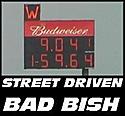
My RS, the BadBish, has gone as quick as 9.04 at 159.64 mph in the 1/4 mile. It currently makes more power than it ever has at over 700 whp on our dyno. The car is running a 2.1 liter engine and our custom forward facing turbo kit with the HTA86 on it. The car has always been more than a "drag car" to me and I've never intended to build a drag car out of it or ruin the car. As a matter of fact one thing that's kept the car from running 8's is my stubbornness and not taking extra weight out of it, running small brakes etc.
This year at the 18th Annual DSM/EVO Shootout we had a Max Effort class. This class combined your best time from four autocross runs and your best ET from four drag runs. The course was the tightest autocross course I've ever seen as we were required to keep the speeds BELOW 50 mph, so it was TIGHT!
I would have thought that on a course like that my car would have been way out of it's power band. I'd have guessed I would have been disgusted and pissed off from a lack of power. This was not he case though. At no point during the runs did I need more power or better response, the car in the power department I think worked flawlessly.
I was in the race tire class and in expert company. Jarrod Hoops who I have great respect for as he's got a few National Autocross championships under his belt was in my class along with Dave Sutton. I placed third behind these two guys who have small turbo and are set up as national level autocross cars.
I was racing on a drag alignment and on Mickey Thompson drag radials! The alignment and tires are what held me back from going faster, NOT the power of the car.
Is a small turbo going to be more responsive for instant power, obviously the answer to that is YES, but to be honest, I think my car set up like it is with an autocross tire/slick and a proper alignment would be phenomenal. I'll find out as that is the route the car is moving towards. One 8 second quarter mile pass and the drag racing days are over for the car with the exception of the DSM/EVO Shootout once a year. Even then it will end up in the Max Effort Class.
My suspension mods have already begun for next year.
The 37r turbo is WAY to laggy for reference and the 6262 is lagger than my HTA86 too. I feel the HTA86 is just the absolute best T3 turbo I've ever seen for an all around vehicle.
My RS, the BadBish, has gone as quick as 9.04 at 159.64 mph in the 1/4 mile. It currently makes more power than it ever has at over 700 whp on our dyno. The car is running a 2.1 liter engine and our custom forward facing turbo kit with the HTA86 on it. The car has always been more than a "drag car" to me and I've never intended to build a drag car out of it or ruin the car. As a matter of fact one thing that's kept the car from running 8's is my stubbornness and not taking extra weight out of it, running small brakes etc.
This year at the 18th Annual DSM/EVO Shootout we had a Max Effort class. This class combined your best time from four autocross runs and your best ET from four drag runs. The course was the tightest autocross course I've ever seen as we were required to keep the speeds BELOW 50 mph, so it was TIGHT!
I would have thought that on a course like that my car would have been way out of it's power band. I'd have guessed I would have been disgusted and pissed off from a lack of power. This was not he case though. At no point during the runs did I need more power or better response, the car in the power department I think worked flawlessly.
I was in the race tire class and in expert company. Jarrod Hoops who I have great respect for as he's got a few National Autocross championships under his belt was in my class along with Dave Sutton. I placed third behind these two guys who have small turbo and are set up as national level autocross cars.
I was racing on a drag alignment and on Mickey Thompson drag radials! The alignment and tires are what held me back from going faster, NOT the power of the car.
Is a small turbo going to be more responsive for instant power, obviously the answer to that is YES, but to be honest, I think my car set up like it is with an autocross tire/slick and a proper alignment would be phenomenal. I'll find out as that is the route the car is moving towards. One 8 second quarter mile pass and the drag racing days are over for the car with the exception of the DSM/EVO Shootout once a year. Even then it will end up in the Max Effort Class.
My suspension mods have already begun for next year.
The 37r turbo is WAY to laggy for reference and the 6262 is lagger than my HTA86 too. I feel the HTA86 is just the absolute best T3 turbo I've ever seen for an all around vehicle.

Your high finish probably has a lot to do with crazy driving. Pretty incredible placement given the lack of suspension and tires along with the biggy turbo. What exhaust housing is on your 86?
I don't want to judge my driving ability. Jarrod and Dave are obviously both very good AND have an HUGE amount of practice. The spread in times was large, so it's not like I was on their ***. If I remember right Dave was nearly 3 seconds ahead of Jarrod and Jarrod was about 2 seconds ahead of me.
My actual point is the powerband on my car was fine, I wasn't thinking how laggy it was and how I needed more low end. There was one corner that was so tight with my car that I downshifted back to 1st gear, at that point I just left it in 1st for the last half of the course and that worked really well. At the finish line I just let it hit the rev limiter at 10,800 and held it there.
My actual point is the powerband on my car was fine, I wasn't thinking how laggy it was and how I needed more low end. There was one corner that was so tight with my car that I downshifted back to 1st gear, at that point I just left it in 1st for the last half of the course and that worked really well. At the finish line I just let it hit the rev limiter at 10,800 and held it there.
Evolving Member
Joined: Apr 2009
Posts: 190
Likes: 4
From: Chesapeake, Virginia
You still didn't answer the question about your exhaust housing! 
...But, your mention of the rev limit says a lot. 10,800rpm?!?
Call it conservative, but I want my turbo to make power a little bit before that.
There's only so much I'll mess with on my daily driver!
...But, your mention of the rev limit says a lot. 10,800rpm?!?
Call it conservative, but I want my turbo to make power a little bit before that.
There's only so much I'll mess with on my daily driver!

Evolved Member
Joined: Dec 2003
Posts: 1,074
Likes: 0
From: UK
Its totally dependent on what you are building! for a full race car with a lightened body, exstensive suspension work, slick tyres, full stripped interior, windend trac, etc, etc, etc, then a GT42 might not be out of the ordanery (they aren't over here in the UK anyway). But for a lower budget car, try the stock turbo to start with and then work up from there......
Chris.
Chris.
Evolving Member
Joined: Apr 2009
Posts: 190
Likes: 4
From: Chesapeake, Virginia
I've noticed a lot of people with aftermarket turbos have hot cams as well. Some mention the cams as helping their turbo spool up faster. If that's true, I'd be tempted to swap out my cams and leave my stock turbo in place.
Can anyone explain why cams help with spool? Is it mostly the duration,or do you want more lift, as well? Does the exhaust cam make more difference than the intake cam?
I've searched several times for threads talking about spool and lag, and I'm still looking for more specific information.
Can anyone explain why cams help with spool? Is it mostly the duration,or do you want more lift, as well? Does the exhaust cam make more difference than the intake cam?
I've searched several times for threads talking about spool and lag, and I'm still looking for more specific information.
Evolving Member
Joined: Apr 2009
Posts: 190
Likes: 4
From: Chesapeake, Virginia
I've seen several tubular manifolds made to fit the stock turbo, and one vendor selling ported stock manifolds.
I can see where that would help, but has anyone sent a stock manifold to Extrude Hone?
If I have them do their "abrasive flow machining" on my manifold, I'd have to have my cylinder head and turbine inlet flange match-ported wouldn't I?
I can see where that would help, but has anyone sent a stock manifold to Extrude Hone?
If I have them do their "abrasive flow machining" on my manifold, I'd have to have my cylinder head and turbine inlet flange match-ported wouldn't I?