


Twin Scroll Turbos?? Monster Spool.. FACT or FICTION???


EFR's are not dyno queen turbos. They are set up for road racing. It is all about area under the curve and response. If you have a turbo that is online at 4k you don't need to run to 8k+ to put you back in the power band on shifts. Every negative thing w/ the EFR's (or any twin-scroll) is always - "single-scroll makes more power uptop" well duh...thats established. It is a trade off.
Me personally? I'd rather have killer transient response and spool allowing my powerband to shift farther left and not rev my motor so high. The extra (insert X hp here for turbo application) you gain from staying with a single scroll isn't worth much outside of bragging rights on a dyno or an all out drag car.
***and of course Buschur doesn't promote twin-scroll. They don't road race. They are largely drag/street pull centered and his personal cars see autoX every now and then. Look at ANYONE running a serious big-power time attack build in this day and age. They are all twin-scroll set ups. The single scroll performs adequately for a 0-Xmph. Lots of off/on/partial throttle input like on a road course, twin-scroll is more effective hands down (read: transient response)
Me personally? I'd rather have killer transient response and spool allowing my powerband to shift farther left and not rev my motor so high. The extra (insert X hp here for turbo application) you gain from staying with a single scroll isn't worth much outside of bragging rights on a dyno or an all out drag car.
***and of course Buschur doesn't promote twin-scroll. They don't road race. They are largely drag/street pull centered and his personal cars see autoX every now and then. Look at ANYONE running a serious big-power time attack build in this day and age. They are all twin-scroll set ups. The single scroll performs adequately for a 0-Xmph. Lots of off/on/partial throttle input like on a road course, twin-scroll is more effective hands down (read: transient response)
Last edited by SDevo13; Sep 16, 2013 at 07:38 PM.


See #332, chart 2 - 200whp by 3800 rpm, 743whp at 30psi, 700whp at 8k rpm. Because it's TS, it delivers superior transient response everywhere on the street. Want to extend the shift point? No problem, go to the next larger size housing. Testing shows the impact on low rpm performance is more often than not minimal.

Lol that guy is funny.
No one uses huge T4 TS housing for some reason? If people started using 1.2AR+ TS T4 housing it would be good night to the T3 open with similar or better spool and power(TQ per LB).
No one uses huge T4 TS housing for some reason? If people started using 1.2AR+ TS T4 housing it would be good night to the T3 open with similar or better spool and power(TQ per LB).

This is a no-brainer. Same average power but 1k rpm to the left = quicker, more responsive, more reliable 100% of the time.
The turbine housing was not a constriction. See #358.
See #332, chart 2 - 200whp by 3800 rpm, 743whp at 30psi, 700whp at 8k rpm. Because it's TS, it delivers superior transient response everywhere on the street. Want to extend the shift point? No problem, go to the next larger size housing. Testing shows the impact on low rpm performance is more often than not minimal.
The turbine housing was not a constriction. See #358.
See #332, chart 2 - 200whp by 3800 rpm, 743whp at 30psi, 700whp at 8k rpm. Because it's TS, it delivers superior transient response everywhere on the street. Want to extend the shift point? No problem, go to the next larger size housing. Testing shows the impact on low rpm performance is more often than not minimal.

that chart is perfect example of my point. (35r car drop 100hp from 6500-8500, EFR drops 80hp from 7400-8400)
out.
Last edited by 94AWDcoupe; Sep 18, 2013 at 08:13 AM.

Evolving Member
Joined: Dec 2012
Posts: 153
Likes: 11
From: Mattawan, MI
I think i said this three times now. Bushur who tested more parts than anyone I know for the 4g63 does not sell, use, or promote tubular twin scroll setups. They have been tested at his facility enough times. he just preferred not to get involved or post any results. the FP red has been dynoed at his place more times than you can imagine. When the same compressor wheel HTA3076 with single scroll header was pushed it absolutely demolished any twin scroll results. Ad that to FP black record was set by removing divider to free up horsepower.
The truth is twin scroll is fantastic for spool and response. but it just plain kills high rpm power. And ted you completely contradicted yourself by saying RTernies setup was laying down because it was clearly out of compressor wheel. Then you turn around and point out it was only at 26psi and wasnt pushed. I can only imagine how bad his graph would drop once run at 35psi. wholly heck...
The truth is twin scroll is fantastic for spool and response. but it just plain kills high rpm power. And ted you completely contradicted yourself by saying RTernies setup was laying down because it was clearly out of compressor wheel. Then you turn around and point out it was only at 26psi and wasnt pushed. I can only imagine how bad his graph would drop once run at 35psi. wholly heck...
It's already proven that a properly sized twin-scroll housing has more backpressure at low-rpm and less back-pressure at high-rpm.
As you can see in the 8374 setup John Bradley posted, the car is obviously out of turbine housing, and absolutely blows away the single-scroll setup he had. And we don't even know the rest of the setup. Find me a single-scroll setup that makes 330wtq at 4000rpm and 743whp at any rpm.
Last edited by RWD4G63; Sep 17, 2013 at 07:00 AM.



Jerry, we have data from Jeff's race car that when the housing is sized correctly there is no issue making high rpm power. His car runs a 1.44 T4 with a BIG turbine wheel in the HTA105. At 40psi it has 20psi of backpressure and makes peak power at 9800 on off the shelf S3s. At 55psi the backpressure has creeped up a little but is still way less than 1:1, 41psi of backpressure with the N2O on.
I know you have read my posts about the old White Evo that picked up both spool and power by going from a 1.15 to a 1.28 on the off the shelf 42 it ran. 200rpm and 70whp (mostly up top) where it needed it most made a tremendous difference.
RWD4G63-
His car was identical to mine other than the turbo. EnglishRacing LR2.4, head was ported by Jeff, Magnus V5, GSC R2 cams, Kiggly springs, Fuel Injector Clinic 2150s, ETS FMIC, E85, etc.
I know you have read my posts about the old White Evo that picked up both spool and power by going from a 1.15 to a 1.28 on the off the shelf 42 it ran. 200rpm and 70whp (mostly up top) where it needed it most made a tremendous difference.
RWD4G63-
His car was identical to mine other than the turbo. EnglishRacing LR2.4, head was ported by Jeff, Magnus V5, GSC R2 cams, Kiggly springs, Fuel Injector Clinic 2150s, ETS FMIC, E85, etc.

its safe to say that an open manifolds/turbo of equal size will flow roughly 10% more at peak but its equally safe to say that twinscroll manifolds/turbo setups spool faster, have better transient response and create a much better powerband all the way up till the peak 10% of the band.
ill take fatter powerband and better streetablilty over 10% more power, as it has been said you can go up in exhaust side sizes and lose almost no spool make more power than the open t3 at peak.
ill take fatter powerband and better streetablilty over 10% more power, as it has been said you can go up in exhaust side sizes and lose almost no spool make more power than the open t3 at peak.


Newbie
Joined: Sep 2005
Posts: 57
Likes: 0
From: Chicago
Interesting. I noticed through this entire thread that the "Twin scroll" concept hasn't been applied properly between those of a divided housing in T4 designation and that of a true twin scroll that was created by MHI, or the EFR series turbochargers. (This seems to happen a lot in this and several other forums where "twin scroll" seems to be used a bit too loosely)
A turbine housing with initial divided sections at the entry point is a necessity of being twin scroll, but not a sufficiency to operate the same way. So people seem to be applying the wrong application of the right principle when it comes to twin scroll design
For example, over the years, (lots of misuse of the term) have given people the false impression that a T4 .88A/R divided turbine housing will give better response and usability than a T3 .82A/R open housing using the same turbine wheel, and cartridge, because they think that the divided housing is a "twin scroll", when it really isn't. They then purchase said turbo with that expectation with undesired results. But because of the use of the term, the misconception continues.
It's just interesting to see is all.
A turbine housing with initial divided sections at the entry point is a necessity of being twin scroll, but not a sufficiency to operate the same way. So people seem to be applying the wrong application of the right principle when it comes to twin scroll design
For example, over the years, (lots of misuse of the term) have given people the false impression that a T4 .88A/R divided turbine housing will give better response and usability than a T3 .82A/R open housing using the same turbine wheel, and cartridge, because they think that the divided housing is a "twin scroll", when it really isn't. They then purchase said turbo with that expectation with undesired results. But because of the use of the term, the misconception continues.
It's just interesting to see is all.
Interesting. I noticed through this entire thread that the "Twin scroll" concept hasn't been applied properly between those of a divided housing in T4 designation and that of a true twin scroll that was created by MHI, or the EFR series turbochargers. (This seems to happen a lot in this and several other forums where "twin scroll" seems to be used a bit too loosely)
A turbine housing with initial divided sections at the entry point is a necessity of being twin scroll, but not a sufficiency to operate the same way. So people seem to be applying the wrong application of the right principle when it comes to twin scroll design
For example, over the years, (lots of misuse of the term) have given people the false impression that a T4 .88A/R divided turbine housing will give better response and usability than a T3 .82A/R open housing using the same turbine wheel, and cartridge, because they think that the divided housing is a "twin scroll", when it really isn't. They then purchase said turbo with that expectation with undesired results. But because of the use of the term, the misconception continues.
It's just interesting to see is all.
A turbine housing with initial divided sections at the entry point is a necessity of being twin scroll, but not a sufficiency to operate the same way. So people seem to be applying the wrong application of the right principle when it comes to twin scroll design
For example, over the years, (lots of misuse of the term) have given people the false impression that a T4 .88A/R divided turbine housing will give better response and usability than a T3 .82A/R open housing using the same turbine wheel, and cartridge, because they think that the divided housing is a "twin scroll", when it really isn't. They then purchase said turbo with that expectation with undesired results. But because of the use of the term, the misconception continues.
It's just interesting to see is all.
You mean a divided isn't a true twin scroll unless it has a paired header, correct? Just bolting a divided turbo on does jack, which we all know of course. However for the purposes of the test we had talked about going the other way round just to test. A paired header on a single scroll wont lose anymore than a normal collector.
Newbie
Joined: Sep 2005
Posts: 57
Likes: 0
From: Chicago
Confused a little.
You mean a divided isn't a true twin scroll unless it has a paired header, correct? Just bolting a divided turbo on does jack, which we all know of course. However for the purposes of the test we had talked about going the other way round just to test. A paired header on a single scroll wont lose anymore than a normal collector.
You mean a divided isn't a true twin scroll unless it has a paired header, correct? Just bolting a divided turbo on does jack, which we all know of course. However for the purposes of the test we had talked about going the other way round just to test. A paired header on a single scroll wont lose anymore than a normal collector.
This:

based upon its divided principles in the inlet, although helpful for the exhaust pulses (be they with a matched manifold or not, because of the fact that the divider web does NOT go through the full channel of the volute
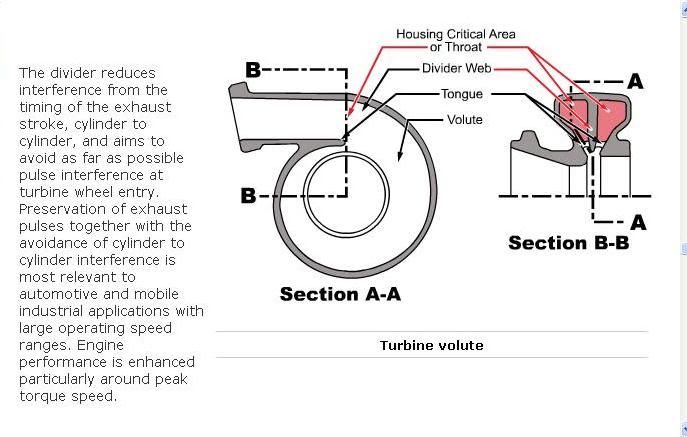

Is NOT the same as a true twin scroll from an MHI or Earth Friendly Race (EFR) turbo like this:

In which the the exhaust gasses truly enter independently into the volute of the turbine housing, which is essential in reaching peak torque efficiency. (which is why people want them so badly.. making a smaller engine act like a larger one, similar to the OEM design).. In the first example, peak torque SPEED is trying to be reached because the exhaust wheel is so large that it needs a higher moment of inertia in order to be effective for larger displacement engines to recover more effectively as they try to come to speed. (that's why its more used in diesel, tractor, and other applications that normally have a high stroke, low speed powerband. Torque speed, does not equal maximum torque creation.

This illustration shows a full separation of the volute past the initial tonque area where the benefits have more of a chance to be shown even in lower boost pressures.
there are so many cars I've worked with that have T4 divided housings , even when matched with the correct collector flange, that get upset because the larger wheel incorporated with such a large volute, gives POWER, likes its supposed to in the upper rpm band, but almost NEVER in the lower rpm band for any transient response (especially when outside of "dyno land") where more than one gear is used.
That's why I find this interesting.
Last edited by TheShodan; Sep 18, 2013 at 02:45 PM.
T4 divided housings , even when matched with the correct collector flange, that get upset because the larger wheel incorporated with such a large volute, gives POWER, likes its supposed to in the upper rpm band, but almost NEVER in the lower rpm band for any transient response (especially when outside of "dyno land") where more than one gear is used.
I have not examined an EFR turbine housing. I have scrutinized my own 1.06 A/R divided Garrett design T4 housing while performing an internal cleanup. The point where the divider ends lies well inside the housing - IIRC, ~90 degrees or so beyond the entry point, not just inside the throat. It ends well into the region where gases are applying torque to the turbine inducer. The internal area of the volute is small at that point. Could anything be gained by extending the divider to the very end? I don't know, but it clearly works as-is.

The Shodan, maybe it's just the diagram but MHI housings have the divider setup just the same as the Garrett housings. That diagram makes it look like only 180 degrees around the housing of the wheel is exposed to a given runner?
The only difference I have noticed with MHI is the flow area is different between each runner. I assume this is done to even the pressure drop between each side as one half effectively has to flow a longer distance through the turbine wheel than the other.
94AWDcoupe, something you seem to be neglecting is the higher peak torque of the TS setups in the first place. Even with the TS dropping 80hp in 1000 RPM, it's still ahead of the SS from 2000 RPM to 7600. It's not even down on peak HP, that peak just comes at a lower RPM. Lower engine speeds for the same HP is a good thing on a street car, as I'm sure you know. I don't get your argument as the TS has the same peak HP so trap speeds or freeway power will be the same. I will agree that most TS setups do seem to be exhaust flow limited by RPM more so than compressor limited. This usually means you've maxed out response though and having excess exhaust flow capability usually just means you've given up response for the same HP.
The only difference I have noticed with MHI is the flow area is different between each runner. I assume this is done to even the pressure drop between each side as one half effectively has to flow a longer distance through the turbine wheel than the other.
94AWDcoupe, something you seem to be neglecting is the higher peak torque of the TS setups in the first place. Even with the TS dropping 80hp in 1000 RPM, it's still ahead of the SS from 2000 RPM to 7600. It's not even down on peak HP, that peak just comes at a lower RPM. Lower engine speeds for the same HP is a good thing on a street car, as I'm sure you know. I don't get your argument as the TS has the same peak HP so trap speeds or freeway power will be the same. I will agree that most TS setups do seem to be exhaust flow limited by RPM more so than compressor limited. This usually means you've maxed out response though and having excess exhaust flow capability usually just means you've given up response for the same HP.
Newbie
Joined: Sep 2005
Posts: 57
Likes: 0
From: Chicago
Confused a little.
You mean a divided isn't a true twin scroll unless it has a paired header, correct? Just bolting a divided turbo on does jack, which we all know of course. However for the purposes of the test we had talked about going the other way round just to test. A paired header on a single scroll wont lose anymore than a normal collector.
You mean a divided isn't a true twin scroll unless it has a paired header, correct? Just bolting a divided turbo on does jack, which we all know of course. However for the purposes of the test we had talked about going the other way round just to test. A paired header on a single scroll wont lose anymore than a normal collector.
This:
based upon its divided principles in the inlet, although helpful for the exhaust pulses (be they with a matched manifold or not, because of the fact that the divider web does NOT go through the full channel of the volute

Is NOT the same as a true twin scroll from an MHI or Earth Friendly Race (EFR) turbo like this:
In which the the exhaust gasses truly enter independently into the volute of the turbine housing, which is essential in reaching peak torque efficiency. (which is why people want them so badly.. making a smaller engine act like a larger one, similar to the OEM design)..
This illustration shows a full separation of the volute past the initial tonque area where the benefits have more of a chance to be shown even in lower boost pressures.
there are so many cars I've worked with that have T4 divided housings , even when matched with the correct collector flange, that get upset because the larger wheel incorporated with such a large volute, gives POWER, likes its supposed to in the upper rpm band, but almost NEVER in the lower rpm band for any transient response (especially when outside of "dyno land") where more than one gear is used.
That's why I find this interesting.