


Twin Scroll Turbos?? Monster Spool.. FACT or FICTION???




35R and a 0.63 in 3rd gear loads up like it loads up.
So since the SAE paper talks about 60% of the spool time for twin scroll and this divided housing matches that formula, I dont see why you still separate the 2?
Not all divided housings have the scroll stop right after the divider. Sooner or later all twin scroll merge, its the point where it merges that it sounds like you are debating the separation between just divided and twin scroll?
Transient response on the street with the divided is far better than the single scroll and time between shifts is superior. Since I have neither car in my possession anymore I cant get datalogs to show the difference between load on the street and the dyno. If I had dyno's these cars in higher gear or turned the load control on we would have seen a definite separation.
I refer back to our HTA105 car with a 1.44 housing. Spool on the dyno doesnt match what it can do at the track with load. The Tial V-band 1.01 had to have a looser converter and more bottle to get it to launch rpm where it needed to be. With the 1.44 it can build 25psi at 4500 against some load and run a tighter converter with less spray. Not bad for a divided single scroll I guess.
So since the SAE paper talks about 60% of the spool time for twin scroll and this divided housing matches that formula, I dont see why you still separate the 2?
Not all divided housings have the scroll stop right after the divider. Sooner or later all twin scroll merge, its the point where it merges that it sounds like you are debating the separation between just divided and twin scroll?
Transient response on the street with the divided is far better than the single scroll and time between shifts is superior. Since I have neither car in my possession anymore I cant get datalogs to show the difference between load on the street and the dyno. If I had dyno's these cars in higher gear or turned the load control on we would have seen a definite separation.
I refer back to our HTA105 car with a 1.44 housing. Spool on the dyno doesnt match what it can do at the track with load. The Tial V-band 1.01 had to have a looser converter and more bottle to get it to launch rpm where it needed to be. With the 1.44 it can build 25psi at 4500 against some load and run a tighter converter with less spray. Not bad for a divided single scroll I guess.

This was my experience with going from a OS T3 to a TS T4 setup. The T3 OS was done with a RevHard manifold and the T4 TS was done with a short runner manifold I built. No other changes to the setup and the turbo was a GTX3076r.

When I swapped to the GTX3576r on the stock bottom end the turbo would surge in 3rd gear because it spooled so quick. Here is the spool data on the stock bottom end. 31psi @ 4156rpm in 3rd.

When I swapped to the GTX3576r on the stock bottom end the turbo would surge in 3rd gear because it spooled so quick. Here is the spool data on the stock bottom end. 31psi @ 4156rpm in 3rd.
Second, the car I was discussing earlier, first had a OS T3 .63 housing, then a OS T3 .82 housing and then a TS T4 1.06 housing. They all spooled nearly the same. The T3 .82 made the most power and was the least "knocky". My testing did not show giant improvements in spool like yours.
Ill post data later after I get home with my laptop.
Last edited by Boosted Tuning; Sep 20, 2013 at 11:31 AM.
You know... there's this thing called the 'internet' which has multiple search options. I decided to use something called 'Google'.
Found in 73 seconds:
https://www.evolutionm.net/forums/ev...onversion.html
https://www.evolutionm.net/forums/ev...xperiment.html
Having looked at the pictures, the Revhard is basically a log with a nasty sharp 90 degree turn into the turbo which is killing it on the topend. However, it is lower volume than the custom short runner manifold 240Z fabricated which does better manage the flow into the turbine housing. So 240z's manifold does have better flow which makes up the power gain, but the twin-scroll is what's improving the spool-up even with the larger volume turbine housing.
Found in 73 seconds:
https://www.evolutionm.net/forums/ev...onversion.html
https://www.evolutionm.net/forums/ev...xperiment.html
Having looked at the pictures, the Revhard is basically a log with a nasty sharp 90 degree turn into the turbo which is killing it on the topend. However, it is lower volume than the custom short runner manifold 240Z fabricated which does better manage the flow into the turbine housing. So 240z's manifold does have better flow which makes up the power gain, but the twin-scroll is what's improving the spool-up even with the larger volume turbine housing.
Second, the custom mani spooled faster because it most likely had more exhaust back pressure at the manifold, just like TheShodan said.

You TOTALLY MISSED the point
Corrected numbers-

The Shodan claimed that a Divided couldnt or wouldnt make the same results as a true twin scroll. The Garrett white paper says that a twin scroll housing (I looked it up, it doesnt use the word Divided) will spool like its 60% of its size and then make 5/6s the power of its size. It actually says that you need a twin scroll thats 1.2x larger than the single scroll for the power level, but thats inverse math at work, 1/1.2=5/6.
The slight difference in spool is that the 1.06T4 still has larger volute volume so it will still spool like a 0.63 T4 not a 0.63 T3. Since the 0.63 T3 was starting to run into flow issues this is where the 1.06 being able to make the power of a housing 5/6 it size comes in. 1.06 * 0.8333 = 0.88 T4. We get the best of both here, spool similar to a 0.63 and the power potential of a bigger 0.88 single scroll.
Corrected numbers-

The Shodan claimed that a Divided couldnt or wouldnt make the same results as a true twin scroll. The Garrett white paper says that a twin scroll housing (I looked it up, it doesnt use the word Divided) will spool like its 60% of its size and then make 5/6s the power of its size. It actually says that you need a twin scroll thats 1.2x larger than the single scroll for the power level, but thats inverse math at work, 1/1.2=5/6.
The slight difference in spool is that the 1.06T4 still has larger volute volume so it will still spool like a 0.63 T4 not a 0.63 T3. Since the 0.63 T3 was starting to run into flow issues this is where the 1.06 being able to make the power of a housing 5/6 it size comes in. 1.06 * 0.8333 = 0.88 T4. We get the best of both here, spool similar to a 0.63 and the power potential of a bigger 0.88 single scroll.
Also weather can still be playing a slight roll in the power difference, even when the charts are corrected (As when air is colder and denser, you can run more timing, which the correction factor cant correct for).
And as you can see, the corrected chart shows that the T3 run was done in hotter weather then STD standards (which is 60* F), since the power went up and that the T4 run was done in weather colder then STD standards, since the power went down. So your basically using two examples that had about a 20* difference when testing. Do it at the same weather, and Im sure the numbers would be even closer or the same.
Im not debating or worried about TheShodens claim that a divided housing is or is not true TS. Im just saying I dont see the spool improvement or power improvement of the TS T4 vs the OS T3 that the TS T4 supporters claim (least not from any dyno charts in this thread).
Last edited by Boosted Tuning; Sep 20, 2013 at 11:46 AM.


First of all, those charts are horrible. As an avid VD user, I can tell you need to use multiple pulls when using VD, to show that your results are consistent. Using one pull of each thing doesnt show any consistency and we dont know if those are 1 time flukes. (which they look like, from me just looking at the dyno chart)
Second, the car I was discussing earlier, first had a OS T3 .63 housing, then a OS T3 .82 housing and then a TS T4 1.06 housing. They all spooled nearly the same. The T3 .82 made the most power and was the least "knocky". My testing did not show giant improvements in spool like yours.
Ill post data later after I get home with my laptop.
Second, the car I was discussing earlier, first had a OS T3 .63 housing, then a OS T3 .82 housing and then a TS T4 1.06 housing. They all spooled nearly the same. The T3 .82 made the most power and was the least "knocky". My testing did not show giant improvements in spool like yours.
Ill post data later after I get home with my laptop.
Below is the spool in 3rd gear after swapping to the CB 10:1 2L and represents what I was able to achieve...30psi @ 3955rpm...and you can even see the surge since it spooled so quick. This is backed up with dyno graphs so it is not a fluke. Data was collected with the Haltech.


No... I mean that
This:

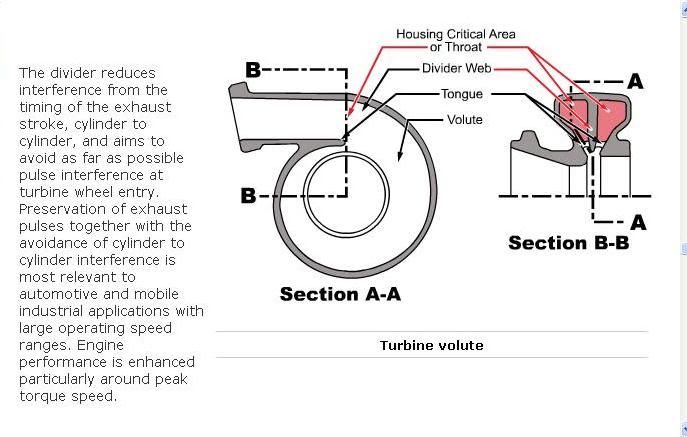
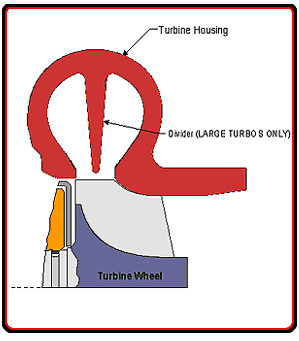
based upon its divided principles in the inlet, although helpful for the exhaust pulses (be they with a matched manifold or not, because of the fact that the divider web does NOT go through the full channel of the volute
Is NOT the same as a true twin scroll from an MHI or Earth Friendly Race (EFR) turbo like this:

In which the the exhaust gasses truly enter independently into the volute of the turbine housing, which is essential in reaching peak torque efficiency. (which is why people want them so badly.. making a smaller engine act like a larger one, similar to the OEM design)..
This:
based upon its divided principles in the inlet, although helpful for the exhaust pulses (be they with a matched manifold or not, because of the fact that the divider web does NOT go through the full channel of the volute
Is NOT the same as a true twin scroll from an MHI or Earth Friendly Race (EFR) turbo like this:
In which the the exhaust gasses truly enter independently into the volute of the turbine housing, which is essential in reaching peak torque efficiency. (which is why people want them so badly.. making a smaller engine act like a larger one, similar to the OEM design)..
What I see in the picture is the Garrett housing carrying the divider at least 180* around the volute and it carries the divider up through the tongue area, essentially creating two tongues (I have also seen this area referred to as the nozzle area)?
The EFR housing doesn't show a divider at all. I haven't had an EFR divided housing in hand so I'm just going off the picture. I assume the divider does exist around the entire length of the volute but it has a lower height thus the divider is not in the tongue area and thus you have one tongue area that both scrolls share?
The picture with the "twin flow" arrangement is throwing me off, but I'm assuming you only have that picture there for the words about the twin entry housing and the image of the housing cross section can be ignored? Otherwise, you are talking about "twin flow" vs. "twin scroll" and they are two different styles all together.

If we had revved both cars out another 500rpm I dont think there would be any question about what was working better up top. I am just used to looking at dyno data and I can see trends pretty well after all this time. I dont feel VD would necessarily give you the same amount of resolution because of the sampling rate in the Evo ECU. I am not saying its inaccurate about peak numbers but the shape and fine detail dont seem to be there as close as you get on a dyno.
The T4 car loses 5whp from peak power (7500) to redline (8100). The T3 car loses 20whp in the same span. If you look at peak power for the T3 car at 7400 the T4 makes continues to climb as it nears 8100. I could have pushed the timing on the T4 car because it seemingly allowed me to which is why it flatline right before 7500 and then bumps up if I had to guess.
If we had revved both cars out another 500rpm I dont think there would be any question about what was working better up top. I am just used to looking at dyno data and I can see trends pretty well after all this time. I dont feel VD would necessarily give you the same amount of resolution because of the sampling rate in the Evo ECU. I am not saying its inaccurate about peak numbers but the shape and fine detail dont seem to be there as close as you get on a dyno.
If we had revved both cars out another 500rpm I dont think there would be any question about what was working better up top. I am just used to looking at dyno data and I can see trends pretty well after all this time. I dont feel VD would necessarily give you the same amount of resolution because of the sampling rate in the Evo ECU. I am not saying its inaccurate about peak numbers but the shape and fine detail dont seem to be there as close as you get on a dyno.
Plus, from looking at the chart, the T4 car lost 20hp from 7500 to 8100, not the 5hp you said (522 @ 7.5K to 500 @ 8.1K = 22hp loss). The T3 also lost the same 20hp for the same area (495 @ 7.5K to 475hp @ 8.1K = 20hp loss). Seems like the fall off is the exact same to me.
I never mentioned VD, so dont know why you did. I have access to a Dyojet 424 LINX, that I do a lotta testing on. I dont just use VD.
Last edited by Boosted Tuning; Sep 20, 2013 at 04:06 PM.

Does it surprise you that almost no one does a back to back single WG open scroll to a t4 twin scroll dual WG set up back to back with no other change? Give me a freaking break. Who on earth is going to spend that kind of money (new manifold/dp/dumptubes/turbo/vacuum lines and no other changes...) without some biased interest in the results.
There is a reason twin-scroll is the norm for road racing. If transient response and spool makes a street car more enjoyable to you, then use one. If not stick with your open set up. It has been said 100x that dyno's do not show everything about how a car behaves. People nut-hugging open scrolls always concede the transient response is better and then go on about the 20whp at peak blah blah blah. It is a simple PERSONAL preference. Have that extra 20-30whp (if event that much) on dyno at high rpm or better transient response.
This is apparently similar to arguing about religion/politics.
***Also even you are conceding that you can tell the difference in transient response on the street...so yeah.
There is a reason twin-scroll is the norm for road racing. If transient response and spool makes a street car more enjoyable to you, then use one. If not stick with your open set up. It has been said 100x that dyno's do not show everything about how a car behaves. People nut-hugging open scrolls always concede the transient response is better and then go on about the 20whp at peak blah blah blah. It is a simple PERSONAL preference. Have that extra 20-30whp (if event that much) on dyno at high rpm or better transient response.
This is apparently similar to arguing about religion/politics.
***Also even you are conceding that you can tell the difference in transient response on the street...so yeah.
Last edited by SDevo13; Sep 20, 2013 at 04:40 PM.
Clicked on it again, 7900rpm not 8100 my bad. In that 400rpm the T3 loses 20whp where the T4 doesnt. I chopped throttle on both cars at 8k so really anything past that will just show a drop anyway. I brought up VD versus a DJ for a very simple reason. If your testing was all done via VD it wont have the resolution, thats all.
I dont think you still grasp why I compared the 1.06T4 to the 0.63T3 though, the point is they are supposed to spool almost identical thats why I picked those ones. Take a 0.82 and it might make the same top end but will lose a few hundred rpm compared to the T4 and then definitely lose between shifts. If I rev'd both of these cars either 500rpm higher or used 4th gear or 20% load this wouldnt even be a debate as the T4 would have taken over even harder.
This is about a LARGE housing vs a small housing where the larger twin scroll housing performs identical. If you can find me a 1.06T4 single scroll that performs identical to this twin scroll...heck even a 1.06 Single T3 then I will recant. We both know that you wont.
I dont think you still grasp why I compared the 1.06T4 to the 0.63T3 though, the point is they are supposed to spool almost identical thats why I picked those ones. Take a 0.82 and it might make the same top end but will lose a few hundred rpm compared to the T4 and then definitely lose between shifts. If I rev'd both of these cars either 500rpm higher or used 4th gear or 20% load this wouldnt even be a debate as the T4 would have taken over even harder.
This is about a LARGE housing vs a small housing where the larger twin scroll housing performs identical. If you can find me a 1.06T4 single scroll that performs identical to this twin scroll...heck even a 1.06 Single T3 then I will recant. We both know that you wont.
The T4 car was dyno'd in cool temps, arroxx 15-20*. That alone can make it have more power up top, not to mention this comparison is two different cars and there can be car to car variances.
Plus, from looking at the chart, the T4 car lost 20hp from 7500 to 8100, not the 5hp you said (522 @ 7.5K to 500 @ 8.1K = 22hp loss). The T3 also lost the same 20hp for the same area (495 @ 7.5K to 475hp @ 8.1K = 20hp loss). Seems like the fall off is the exact same to me.
I never mentioned VD, so dont know why you did. I have access to a Dyojet 424 LINX, that I do a lotta testing on. I dont just use VD.
Plus, from looking at the chart, the T4 car lost 20hp from 7500 to 8100, not the 5hp you said (522 @ 7.5K to 500 @ 8.1K = 22hp loss). The T3 also lost the same 20hp for the same area (495 @ 7.5K to 475hp @ 8.1K = 20hp loss). Seems like the fall off is the exact same to me.
I never mentioned VD, so dont know why you did. I have access to a Dyojet 424 LINX, that I do a lotta testing on. I dont just use VD.
Last edited by JohnBradley; Sep 20, 2013 at 04:47 PM.
So I pulled out the datalogs and went over all the info. So here we go:
03 EVO 8
SD
GTX3576
S2s
T3 SS .63 - 440hp on 91oct.
20psi @ 4400
28psi @ 4700
T3 SS .82 - 460hp on 91oct
20psi @ 4750
28psi @ 5000
T4 TS 1.06 - 470hp on approx 95oct (91/100 blend, couldnt find the straight 91oct logs)
20psi @ 4600
28psi @ 4900
This is just one test. There was some weather variations, but this is the same car with only the hotsides changing on the T3 setups and hotside/manifold change on the T4 setup. And the spool and power is not exactly the "same" as I said in previous post, but I feel its comparable and the differences are minor and not as much as the T4 TS supporters try to make it.
Also, based on this car, I would disagree that a T3 SS .63 spools the same as a T4 TS 1.06.
Another note, is that the T3 .82 was the least "knocky" outta the 3 (On 91oct).
And just to say, I don't really care which one is better, I was just sharing my opinion based on the data I have collected first hand.
03 EVO 8
SD
GTX3576
S2s
T3 SS .63 - 440hp on 91oct.
20psi @ 4400
28psi @ 4700
T3 SS .82 - 460hp on 91oct
20psi @ 4750
28psi @ 5000
T4 TS 1.06 - 470hp on approx 95oct (91/100 blend, couldnt find the straight 91oct logs)
20psi @ 4600
28psi @ 4900
This is just one test. There was some weather variations, but this is the same car with only the hotsides changing on the T3 setups and hotside/manifold change on the T4 setup. And the spool and power is not exactly the "same" as I said in previous post, but I feel its comparable and the differences are minor and not as much as the T4 TS supporters try to make it.
Also, based on this car, I would disagree that a T3 SS .63 spools the same as a T4 TS 1.06.
Another note, is that the T3 .82 was the least "knocky" outta the 3 (On 91oct).
And just to say, I don't really care which one is better, I was just sharing my opinion based on the data I have collected first hand.
Last edited by Boosted Tuning; Sep 20, 2013 at 07:18 PM.

are we still arguing about if TS works or not? IMO if you think it does not work or ''saw'' it does not work then whatever your doing is wrong, the setup is not properly done, or you just havent a clue of what your looking at.
TS works when setup right and in the proper hands.
ok next topic.
TS works when setup right and in the proper hands.
ok next topic.


I find myself having to agree with Dan here. It really isn't as complicated as we make it. Swap a .63 T3 for 1.06 TS T4, and even Helen Keller can tell something's different in the way the car behaves. Going back to what I said previously, dyno charts don't tell us how the car drives, responds, and recovers between shifts, and that matters.
As for any lingering concerns about power, we've seen 1.06 TS T3s with 600whp, 1.06 TS T4s and EFRs with 700+whp, and larger housings support even more power, with demonstrably minimal impact to spool and response as compared to open housings. The important thing is getting TS configured correctly, which until recently, was a bit like finding one's way in the dark. Now that the industry has jumped on board, with plenty of individuals having gone TS and reported the results, getting the turbine side right has become much easier.
As for any lingering concerns about power, we've seen 1.06 TS T3s with 600whp, 1.06 TS T4s and EFRs with 700+whp, and larger housings support even more power, with demonstrably minimal impact to spool and response as compared to open housings. The important thing is getting TS configured correctly, which until recently, was a bit like finding one's way in the dark. Now that the industry has jumped on board, with plenty of individuals having gone TS and reported the results, getting the turbine side right has become much easier.
are we still arguing about if TS works or not? IMO if you think it does not work or ''saw'' it does not work then whatever your doing is wrong, the setup is not properly done, or you just havent a clue of what your looking at.
TS works when setup right and in the proper hands.
ok next topic.
TS works when setup right and in the proper hands.
ok next topic.