


Almost killed by my cracked HKS manifold! BEWARE!


In Timeout
Joined: Jul 2003
Posts: 486
Likes: 0
From: Penn State University
Aren't you afraid of having this hastle again. It seems like a PITA. Why not just spend the 2500 on Buschur's kit and not have this hastle. Add up the time of renting a car, money lost in the time replacing parts, etc.


Thread Starter
Evolved Member
iTrader: (6)
Joined: Feb 2003
Posts: 1,690
Likes: 1
From: Stamford, CT
Originally posted by 5StarSuzuki
Aren't you afraid of having this hastle again. It seems like a PITA. Why not just spend the 2500 on Buschur's kit and not have this hastle. Add up the time of renting a car, money lost in the time replacing parts, etc.
Aren't you afraid of having this hastle again. It seems like a PITA. Why not just spend the 2500 on Buschur's kit and not have this hastle. Add up the time of renting a car, money lost in the time replacing parts, etc.
Thread Starter
Evolved Member
iTrader: (6)
Joined: Feb 2003
Posts: 1,690
Likes: 1
From: Stamford, CT
Originally posted by MYEVOVIII
Man, Al good to hear your Ok that sucks that you had such a problem. I know last weekend you where feeling pretty bad so I am sure this did not help any.
Man, Al good to hear your Ok that sucks that you had such a problem. I know last weekend you where feeling pretty bad so I am sure this did not help any.

Originally posted by MMLVMM
Alex Alex... do not speak in generalities... be specific. Cast is much more shock resistant. All of this stuff is for RACING. You are absolutely right on no prayer for liability. You cannot legislate common sense.
I have seen rally cars being built at rmr and they always use cast. I have personal experience seeing stainless manifolds crack also.
It is a lot easier to make a stainless manifold than cast one. less material, less in tools etc. the stainless saves weight and can be possibly more efficient. Not more durable.
Alex Alex... do not speak in generalities... be specific. Cast is much more shock resistant. All of this stuff is for RACING. You are absolutely right on no prayer for liability. You cannot legislate common sense.
I have seen rally cars being built at rmr and they always use cast. I have personal experience seeing stainless manifolds crack also.
It is a lot easier to make a stainless manifold than cast one. less material, less in tools etc. the stainless saves weight and can be possibly more efficient. Not more durable.
MMLVMM, my bad, i meant it the other way around. CAST ones are GOOD, the tubular kind are bad. I had a long talk with Roshon about this...
It's the shiny header-looking ones that always crack

Evolving Member
Joined: Jun 2003
Posts: 174
Likes: 0
From: santa monica
give anything enough heat and you can kill it... a quality cast will outlast a quality tube... why are no oem manifolds tube? They will not last 5-8 years an oem turbo has to live through...

Personally I prefer the tubular style as it is more power. My new GT35R turbo kit will feature stainless manifold. If need be we can always upgrade it to 321 stainless but I think 304 stainless should last the life of the car for most folks. I'm sure Al is not too gentle with his car and is among the more punishing of it's owners. I'm glad you're okay Al. Another option is maybe coating the header with high temp Jet Hot coating.

Originally posted by Guru
Personally I prefer the tubular style as it is more power. My new GT35R turbo kit will feature stainless manifold. If need be we can always upgrade it to 321 stainless but I think 304 stainless should last the life of the car for most folks. I'm sure Al is not too gentle with his car and is among the more punishing of it's owners. I'm glad you're okay Al. Another option is maybe coating the header with high temp Jet Hot coating.
Personally I prefer the tubular style as it is more power. My new GT35R turbo kit will feature stainless manifold. If need be we can always upgrade it to 321 stainless but I think 304 stainless should last the life of the car for most folks. I'm sure Al is not too gentle with his car and is among the more punishing of it's owners. I'm glad you're okay Al. Another option is maybe coating the header with high temp Jet Hot coating.
BTW - I was under the assumption that the ceramic coating did the exact opposite.
I was told by a trusted master ferrari tech that the heat coating keeps more heat inside the tubes - thereby creating more heat fatique and a shorter life span
Thats why I did not ceramic coat this manifold - thank god I didnt

Evolved Member
iTrader: (20)
Joined: Mar 2003
Posts: 4,941
Likes: 0
From: Danville/Blackhawk, California
One reason cast manifolds aren't popular or desireable on turbocharged race cars that run at WOT for more than a 1/4 mile at a time is the issue of thermal mass. A heavy cast manifold behaves like a giant heat sink. It retains a lot of btus and induces unnecessary thermal stresses to whatever it is coupled/bolted to (the cylinder head, in this case). You will see engines with cast manifolds running hotter oil, coolant and under hood temps than one with a tubular manifold-- all other things equal, of course. Yes, cast manifolds will induce more thermal stresses to engines than tubular manifolds. I'm surprised this point has not been brought up before.
Tubular manifolds of proper design will also offer better boost response due to the ability to run closer to "ideal" header lengths. Also, tubular manifolds retain less heat due to their much lower thermal masses which means more of the combustion heat is used to power the turbine which, of course, helps boost response and turbine efficiency.
Cast manifolds present a good compromise between cost and performance. They are exceptionally cheap to manufacture (once the molds are made). For example, a properly designed tubular manifold may cost a vendor $800-1000 to manufacture, between material and labor. A cast manifold, on the other hand, may only cost $150 to stamp out per unit. But as far as performance goes, cast manifolds do present a compromise. Anyone who suggests otherwise needs to brush up on engine tuning and turbocharger theory. I find it odd that people promote the merits of an low hanging exhaust systems based on "lightweight" construction yet promote the use of heavy cast manifolds which hang well above the car's roll center and in front of the front axles. Driving isn't all about going straight, a 1/4 mile at a time. If it were, we'd all be driving understeering pigs with radiators the size of dictionaries and one-shot air/water intercoolers stuffed with ice
My 2c,
shiv
Tubular manifolds of proper design will also offer better boost response due to the ability to run closer to "ideal" header lengths. Also, tubular manifolds retain less heat due to their much lower thermal masses which means more of the combustion heat is used to power the turbine which, of course, helps boost response and turbine efficiency.
Cast manifolds present a good compromise between cost and performance. They are exceptionally cheap to manufacture (once the molds are made). For example, a properly designed tubular manifold may cost a vendor $800-1000 to manufacture, between material and labor. A cast manifold, on the other hand, may only cost $150 to stamp out per unit. But as far as performance goes, cast manifolds do present a compromise. Anyone who suggests otherwise needs to brush up on engine tuning and turbocharger theory. I find it odd that people promote the merits of an low hanging exhaust systems based on "lightweight" construction yet promote the use of heavy cast manifolds which hang well above the car's roll center and in front of the front axles. Driving isn't all about going straight, a 1/4 mile at a time. If it were, we'd all be driving understeering pigs with radiators the size of dictionaries and one-shot air/water intercoolers stuffed with ice
My 2c,
shiv
Last edited by shiv@vishnu; Nov 26, 2003 at 09:31 PM.

Originally posted by shiv@vishnu
Driving isn't all about going straight, a 1/4 mile at a time. If it were, we'd all be driving understeering pigs with radiators the size of dictionaries and one-shot air/water intercoolers stuffed with ice
My 2c,
shiv
Driving isn't all about going straight, a 1/4 mile at a time. If it were, we'd all be driving understeering pigs with radiators the size of dictionaries and one-shot air/water intercoolers stuffed with ice
My 2c,
shiv
once again i'll post my fav link http://burnsstainless.com/
take a look on their site read what they say. I consider Burns one of the, if not the best company for exhaust.
tom
Evolved Member
iTrader: (20)
Joined: Mar 2003
Posts: 4,941
Likes: 0
From: Danville/Blackhawk, California
Originally posted by tom@kartboy
LMAO!!!
once again i'll post my fav link http://burnsstainless.com/
take a look on their site read what they say. I consider Burns one of the, if not the best company for exhaust.
tom
LMAO!!!
once again i'll post my fav link http://burnsstainless.com/
take a look on their site read what they say. I consider Burns one of the, if not the best company for exhaust.
tom
Last edited by shiv@vishnu; Nov 26, 2003 at 09:51 PM.
Evolved Member
iTrader: (20)
Joined: Mar 2003
Posts: 4,941
Likes: 0
From: Danville/Blackhawk, California
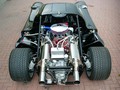
Another view...
Notice the dual symetric wastegate feeds off the manifold. Fantastic. On the other side of the spectrum, I've seen some aftermarket "racing" manfolds feeding the wastegate with exhaust from just one of the four runners-- not even from the main collector! The aftermarket never ceases to amaze me.
shiv
Notice the dual symetric wastegate feeds off the manifold. Fantastic. On the other side of the spectrum, I've seen some aftermarket "racing" manfolds feeding the wastegate with exhaust from just one of the four runners-- not even from the main collector! The aftermarket never ceases to amaze me.
shiv
Last edited by shiv@vishnu; Nov 26, 2003 at 09:55 PM.
Originally posted by shiv@vishnu
One reason cast manifolds aren't popular or desireable on turbocharged race cars that run at WOT for more than a 1/4 mile at a time is the issue of thermal mass. A heavy cast manifold behaves like a giant heat sink. It retains a lot of btus and induces unnecessary thermal stresses to whatever it is coupled/bolted to (the cylinder head, in this case). You will see engines with cast manifolds running hotter oil, coolant and under hood temps than one with a tubular manifold-- all other things equal, of course. Yes, cast manifolds will induce more thermal stresses to engines than tubular manifolds. I'm surprised this point has not been brought up before.
Tubular manifolds of proper design will also offer better boost response due to the ability to run closer to "ideal" header lengths. Also, tubular manifolds retain less heat due to their much lower thermal masses which means more of the combustion heat is used to power the turbine which, of course, helps boost response and turbine efficiency.
Cast manifolds present a good compromise between cost and performance. They are exceptionally cheap to manufacture (once the molds are made). For example, a properly designed tubular manifold may cost a vendor $800-1000 to manufacture, between material and labor. A cast manifold, on the other hand, may only cost $150 to stamp out per unit. But as far as performance goes, cast manifolds do present a compromise. Anyone who suggests otherwise needs to brush up on engine tuning and turbocharger theory. I find it odd that people promote the merits of an low hanging exhaust systems based on "lightweight" construction yet promote the use of heavy cast manifolds which hang well above the car's roll center and in front of the front axles. Driving isn't all about going straight, a 1/4 mile at a time. If it were, we'd all be driving understeering pigs with radiators the size of dictionaries and one-shot air/water intercoolers stuffed with ice
My 2c,
shiv
One reason cast manifolds aren't popular or desireable on turbocharged race cars that run at WOT for more than a 1/4 mile at a time is the issue of thermal mass. A heavy cast manifold behaves like a giant heat sink. It retains a lot of btus and induces unnecessary thermal stresses to whatever it is coupled/bolted to (the cylinder head, in this case). You will see engines with cast manifolds running hotter oil, coolant and under hood temps than one with a tubular manifold-- all other things equal, of course. Yes, cast manifolds will induce more thermal stresses to engines than tubular manifolds. I'm surprised this point has not been brought up before.
Tubular manifolds of proper design will also offer better boost response due to the ability to run closer to "ideal" header lengths. Also, tubular manifolds retain less heat due to their much lower thermal masses which means more of the combustion heat is used to power the turbine which, of course, helps boost response and turbine efficiency.
Cast manifolds present a good compromise between cost and performance. They are exceptionally cheap to manufacture (once the molds are made). For example, a properly designed tubular manifold may cost a vendor $800-1000 to manufacture, between material and labor. A cast manifold, on the other hand, may only cost $150 to stamp out per unit. But as far as performance goes, cast manifolds do present a compromise. Anyone who suggests otherwise needs to brush up on engine tuning and turbocharger theory. I find it odd that people promote the merits of an low hanging exhaust systems based on "lightweight" construction yet promote the use of heavy cast manifolds which hang well above the car's roll center and in front of the front axles. Driving isn't all about going straight, a 1/4 mile at a time. If it were, we'd all be driving understeering pigs with radiators the size of dictionaries and one-shot air/water intercoolers stuffed with ice
My 2c,
shiv