


Nerd talk: The magic of torque vectoring


What I mean by a "Haldex" is a device that connects one axle to the transmission via a clutch, instead of a differential. They are a huge step above the old method of using a viscous coupling for the same purpose because they don't wait for slip and react to it; they can lock before slip occurs. I'm tempted to add that I believe that VW is the maker who has made the most of these devices, but I need to stop talking about cars other than Mitsus (for obvious reasons).
I was embarrassed enough to spend/waste some time learning how the rear diff in an Acura's SH-AWD system works. It's pretty much the same as our AYC with one difference: while our system either speeds up or slows down the right rear wheel and lets the diff, itself, cause the opposite change to the left rear wheel, the SH-AWD rear either speeds up the right rear wheel or speeds up the left rear wheel, letting the diff slow down the opposite wheel. In other words, instead of having a faster-than-input and slower-than-input shaft both going to the right side of the rear end with both sets of clutches on the right, as we have, their rear is symmetrical, with one faster-than-input going to each side and one set of clutches on each side.
If you're hung-up on symmetry, I suppose you might like Honda's version better. Otherwise, it's six of one vs half-dozen of another.
If you're hung-up on symmetry, I suppose you might like Honda's version better. Otherwise, it's six of one vs half-dozen of another.
Maybe a better analogy would be to say that Mitsubishi uses vtec.
Last edited by sgtr275; Mar 30, 2014 at 06:19 PM.

Newbie
Joined: Oct 2012
Posts: 1
Likes: 0
From: California
Same with "Frito."
Should we just start calling SH-AWD (there was never a SH-AWD branded system without F-R and (rear) L-R torque vectoring), "dual Haldex," since apparently, Haldex invented clutch control AWD? Even though Honda's similar RT-AWD predates Haldex by nearly a decade?
The L/R torque split in the rear of the latest SH-AWD system is accomplished by a combination of a conventional diff and two speed-up clutches, one on each output. It has almost nothing in common with a Haldex center. You can, of course, call it whatever you wish, but if you're looking for a label that will help people understand how it works, then Haldex should be pretty far down the list.
As to the Frito analogy: I withdraw it. The parallel would be calling corn chips "Lays" so it fails.
As to the Frito analogy: I withdraw it. The parallel would be calling corn chips "Lays" so it fails.


The Audi S4 with sport diff has L/R torque vectoring. I believe it also came out in the RS5 first?
http://www.audi.com.au/au/brand/en/a...vectoring.html
- Additionally distributes drive torque in variable proportions between the wheels at the rear.
- If required, full propulsive power at the rear axle is applied to only one of the two rear wheels.
- Instead of braking the inside wheel, more power is directed to the outside wheel when steering or accelerating into a bend.
- Basic distribution of drive torque: 60% to the rear axle, 40% to the front – which permits high levels of traction and good handling characteristics.
- If one axle loses grip, up to 85% of the tractive power can be diverted to the rear axle and up to 70% to the front.
- Torque vectoring enables propulsive power to be distributed to each individual wheel.
- Power and torque are redistributed without any delay, even before a wheel starts to spin.
- Power is distributed according to the driving situation and driving style.
http://en.wikipedia.org/wiki/Quattro...quattro_system
Vectoring quattro system
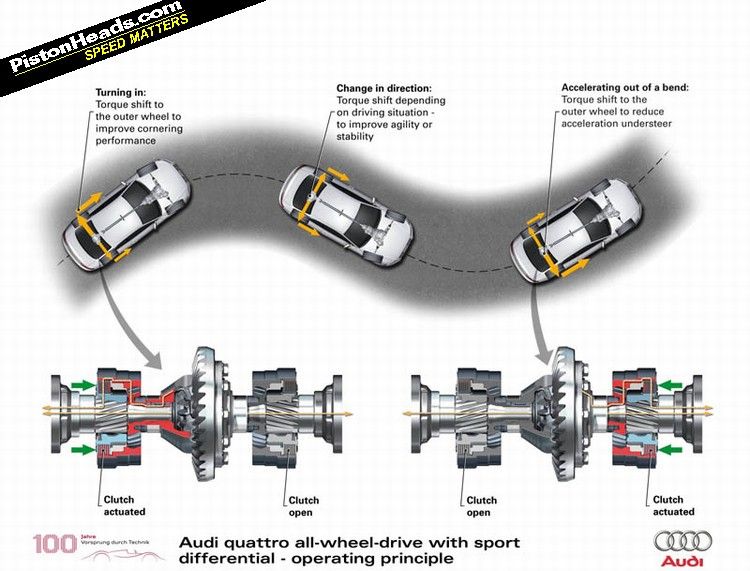
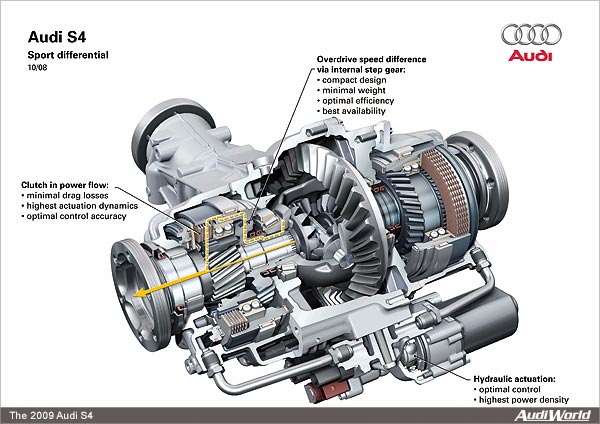
Audi's new sport differential, debuted 'torque vectoring' to quattro generation V. The Audi sport differential allowed the dynamic allocation of torque across the rear axle of the debut vehicle: the B8 (2008) S4, and is now an optional addition to all quattro vehicles, which continue to use the 40:60 asymmetric Torsen (Type "C") centre differential. The sport differential replaces the normal open rear differential while the front axle still rely on an open differential with EDL.[4]
The torque vectoring rear axle differential is designed and manufactured by Magna Powertrain,[5] and is being offered on Audi A4, A5, A6 and their derivatives (including RS models). The Sport Differential selectively distributes torque to the rear axle wheels thereby generating a yaw moment, which improves handling and also stabilizes the vehicle when it oversteers or understeers, thereby increasing safety.
The sport differential operates by using two superposition ("step up") gears at the differential, which are operated via multi-plate clutches each side of the differential crown wheel. When required by the software (using lateral and longitudinal yaw sensors, the ABS wheel sensors, and a steering wheel sensor), the control software (located in a control unit close to the rear differential), actuates the relevant clutch pack. This has the effect of taking the output shaft drive through the step-up gear to the attached wheel, while the other shaft continues to drive its wheel directly (i.e., the clutch pack not actuated). The higher speed output shaft produces increased torque to the wheel, producing a yaw (turning) moment. In normal operation increased torque is delivered to the wheel on the outside of the turn thereby increasing the vehicles turning moment, in other words, its willingness to turn in the direction pointed by the steering wheel.
http://www.audi.com.au/au/brand/en/a...vectoring.html
- Additionally distributes drive torque in variable proportions between the wheels at the rear.
- If required, full propulsive power at the rear axle is applied to only one of the two rear wheels.
- Instead of braking the inside wheel, more power is directed to the outside wheel when steering or accelerating into a bend.
- Basic distribution of drive torque: 60% to the rear axle, 40% to the front – which permits high levels of traction and good handling characteristics.
- If one axle loses grip, up to 85% of the tractive power can be diverted to the rear axle and up to 70% to the front.
- Torque vectoring enables propulsive power to be distributed to each individual wheel.
- Power and torque are redistributed without any delay, even before a wheel starts to spin.
- Power is distributed according to the driving situation and driving style.
http://en.wikipedia.org/wiki/Quattro...quattro_system
Vectoring quattro system
Audi's new sport differential, debuted 'torque vectoring' to quattro generation V. The Audi sport differential allowed the dynamic allocation of torque across the rear axle of the debut vehicle: the B8 (2008) S4, and is now an optional addition to all quattro vehicles, which continue to use the 40:60 asymmetric Torsen (Type "C") centre differential. The sport differential replaces the normal open rear differential while the front axle still rely on an open differential with EDL.[4]
The torque vectoring rear axle differential is designed and manufactured by Magna Powertrain,[5] and is being offered on Audi A4, A5, A6 and their derivatives (including RS models). The Sport Differential selectively distributes torque to the rear axle wheels thereby generating a yaw moment, which improves handling and also stabilizes the vehicle when it oversteers or understeers, thereby increasing safety.
The sport differential operates by using two superposition ("step up") gears at the differential, which are operated via multi-plate clutches each side of the differential crown wheel. When required by the software (using lateral and longitudinal yaw sensors, the ABS wheel sensors, and a steering wheel sensor), the control software (located in a control unit close to the rear differential), actuates the relevant clutch pack. This has the effect of taking the output shaft drive through the step-up gear to the attached wheel, while the other shaft continues to drive its wheel directly (i.e., the clutch pack not actuated). The higher speed output shaft produces increased torque to the wheel, producing a yaw (turning) moment. In normal operation increased torque is delivered to the wheel on the outside of the turn thereby increasing the vehicles turning moment, in other words, its willingness to turn in the direction pointed by the steering wheel.
Last edited by razorlab; Apr 1, 2014 at 10:24 AM.
I try to avoid reading descriptions of the effects unless, at some point, they get around to saying how it works. Thus, this is the key section:
At first, this was sounding like an AYC (or the Honda version thereof). But then it starts taking about one output going through a step-up while the other is being driven directly off the diff, which is quite different. Do you know which reading is correct?
The sport differential operates by using two superposition ("step up") gears at the differential, which are operated via multi-plate clutches each side of the differential crown wheel. When required by the software (using lateral and longitudinal yaw sensors, the ABS wheel sensors, and a steering wheel sensor), the control software (located in a control unit close to the rear differential), actuates the relevant clutch pack. This has the effect of taking the output shaft drive through the step-up gear to the attached wheel, while the other shaft continues to drive its wheel directly (i.e., the clutch pack not actuated). The higher speed output shaft produces increased torque to the wheel, producing a yaw (turning) moment. In normal operation increased torque is delivered to the wheel on the outside of the turn thereby increasing the vehicles turning moment, in other words, its willingness to turn in the direction pointed by the steering wheel.

The S-AWC is a unique but highly effective system when it comes to improving evo's track and everyday performance. The torque vectoring(TV) on our cars is simply brilliant. I have always wondered how it stacks up against quattro, honda's TV, suburu's awd.
Finally i found this. Its an interesting read, goes over your head at times. Check it out
Finally i found this. Its an interesting read, goes over your head at times. Check it out

Thread Starter
Newbie
Joined: Feb 2014
Posts: 23
Likes: 0
From: Detroit
Neither Audi nor Subaru have torque vectoring that I know of. The second generation of Honda's SH-AWD does have torque vectoring, but it's completely different from from our AYC and is really a component of the Honda's (gas/electric) hybrid driveline. In a nutshell, on the latest Acuras with SH-AWD, the separate electric motors on the rear wheels are not powered equally when turning, producing the desired yaw. It's not clear to me whether this really is better than the first generation of SH-AWD, which was a Haldex center.
The new WRX STI has 100%. That's something Subaru is bragging about.
Is 100% of that regret directed towards the post in which you corrected yourself or is there a 50/50 split between that and the original post? How would regret vectoring distribute the regret in a situation like this?