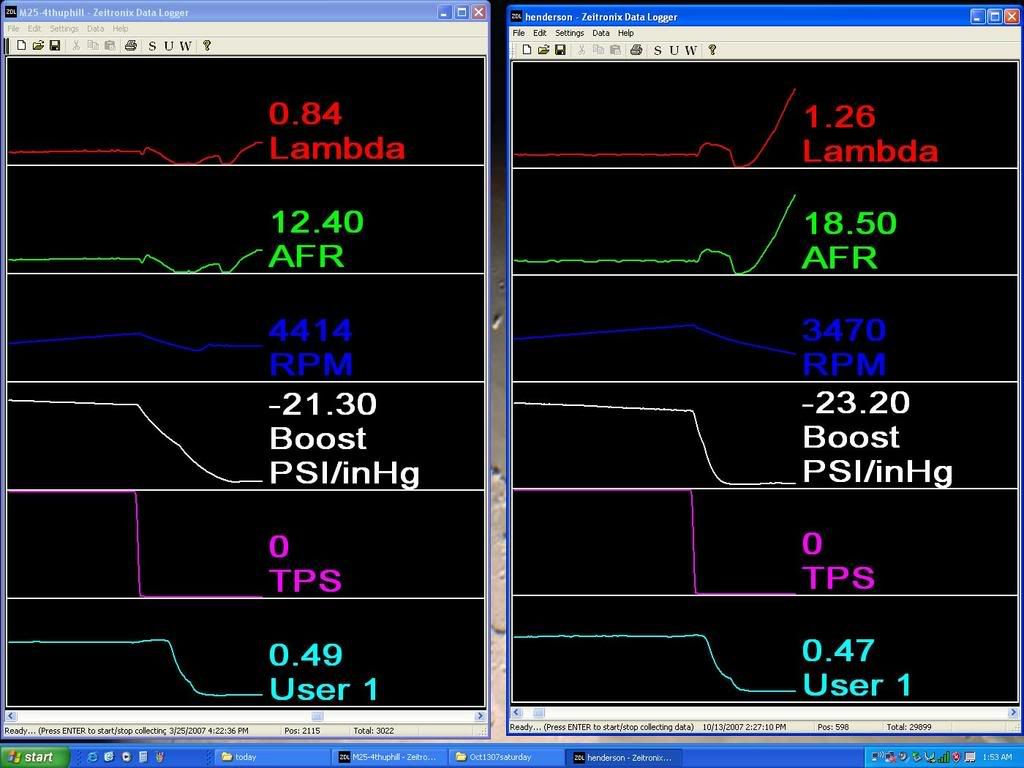
Zeitronix boost log - long decay time


Thread Starter
Evolved Member
iTrader: (4)
Joined: Sep 2003
Posts: 3,456
Likes: 0
From: Kingdom of Saudi Arabia
Zeitronix boost log - long decay time
I am logging boost after the throttle plate with the zeitronix MAP sensor and when the throttle plate is closed, TPS=0, the boost takes a while to come down...is other zeitronix owners seeing the same thing?
my boost plot looks exactly like Scotts - takes a while to decay when throttle plate is shut, TPS = 0.
https://www.evolutionm.net/forums/sh...3&postcount=26
Can anyone with the zt2 please post your plots?
Thanks!
my boost plot looks exactly like Scotts - takes a while to decay when throttle plate is shut, TPS = 0.
https://www.evolutionm.net/forums/sh...3&postcount=26
Can anyone with the zt2 please post your plots?
Thanks!

Thread Starter
Evolved Member
iTrader: (4)
Joined: Sep 2003
Posts: 3,456
Likes: 0
From: Kingdom of Saudi Arabia
it just seems strange....when i let off, TPS = 0, i hear the diverter valve open and "whoooooooooooooooooooossshhhhhhhhhhh" - pressure in the intake tract at this point should plummet down to 0 psig....
Thread Starter
Evolved Member
iTrader: (4)
Joined: Sep 2003
Posts: 3,456
Likes: 0
From: Kingdom of Saudi Arabia
the cavity after the throttle plate is not very big.....should be in vacuum in milliseconds instead of seconds......@7000rpm
Last edited by SlowCar; Feb 28, 2007 at 04:50 AM.
The blow off valve sound you hear releases pressure before the throttle saving your turbo from chewing itself to death. The blow off valve does not release the intake pressure. The pressure in the intake manifold still needs to go down from 20 + PSI to vacuum. It takes some time to pump that volume out.

haha it takes an extremely small amount of time to vacate the intake manifold.
for example, lets say it is a 2L intake manifold... therefor all the air inside of it can be consumed in only 2 revolutions of the engine. at at 7000rpm that happens in 17 milliseconds. granted this isn't totally correct (it will still technically be fed air from the intake system before the throttle plate via the idle valves)
the zeitronix must be smoothing the curve big time.
for example, lets say it is a 2L intake manifold... therefor all the air inside of it can be consumed in only 2 revolutions of the engine. at at 7000rpm that happens in 17 milliseconds. granted this isn't totally correct (it will still technically be fed air from the intake system before the throttle plate via the idle valves)
the zeitronix must be smoothing the curve big time.
Trending Topics
Kevin,
That's assuming the valves are the same bore as cylinders. Last time I looked at valves they are much smaller diameter than a piston
There is very little amount of filtering on the Zt-2 boost input. We have transient response logs for our MAP sensor connected to the Zt-2 input without a large chamber (no intake mani). The decay is pretty much immediate when pressure is released from the sensor.
Slow, can you pm me a log I can look at?
That's assuming the valves are the same bore as cylinders. Last time I looked at valves they are much smaller diameter than a piston
There is very little amount of filtering on the Zt-2 boost input. We have transient response logs for our MAP sensor connected to the Zt-2 input without a large chamber (no intake mani). The decay is pretty much immediate when pressure is released from the sensor.
Slow, can you pm me a log I can look at?
hey slow, i checked some of my logs as well and noticed the slow decay. then i checked some of my logs from a GM 3 bar map sensor logging at 500 hz and averaging 10 samples together for a 50Hz output on a edelbrock quickdata data acquisition system. here are the results of a street dyno pull on our race car:

notice that each point is .02 seconds, and the manifold pressure decays from 8psi to full vacuum in less then 8 samples... or about .15 seconds
there are some differences from what this was logged from an an evo though.
this is a 250cc 4 stroke 4 cylinder car. the total manifold volume was equal to about 3L due to the rules and throttlebody placement. also peak engine speed was 19,000 rpm. thus by the simple back of the envelope calculations that car should vacate the manifold in about 24 revolutions (manifold volume was 12x engine displacement) each rev takes .0032 seconds thus vacating the manifold in .077 seconds. we know that the throttle plate isn't closed instantly, and we also know the idle valves let air in so we know it wont vacate as fast as i calculated (we could use the differential pressures and orifice size and make it a more accurate model, but truth is i don't care that much).
regardless, i think it is shown that the manifold pressure goes from full boost to vacuum VERY quicky at high rpms when the throttle is shut. so fast in fact the pressure should closely follow the throttle position as seen in my plot.
and just to verify what i've said, i was monitoring my boost gauge as i lifted my throttle on boost, and the needle will drop as fast as it can move.
zeitronix: just because the valves aren't as big as the piston doesn't mean the valves are choking the flow into the cylinder :P for example, WRC cars are required to have a 34mm restrictor in the intake. all 4 cylinders must suck air past that single orifice. assuming 1 cylinder has a bore of 85mm, are you saying that not even a single cylinder is ever going to fill up? what if the engine were revving at 1 rpm? how about 20,000 rpm?
notice that each point is .02 seconds, and the manifold pressure decays from 8psi to full vacuum in less then 8 samples... or about .15 seconds
there are some differences from what this was logged from an an evo though.
this is a 250cc 4 stroke 4 cylinder car. the total manifold volume was equal to about 3L due to the rules and throttlebody placement. also peak engine speed was 19,000 rpm. thus by the simple back of the envelope calculations that car should vacate the manifold in about 24 revolutions (manifold volume was 12x engine displacement) each rev takes .0032 seconds thus vacating the manifold in .077 seconds. we know that the throttle plate isn't closed instantly, and we also know the idle valves let air in so we know it wont vacate as fast as i calculated (we could use the differential pressures and orifice size and make it a more accurate model, but truth is i don't care that much).
regardless, i think it is shown that the manifold pressure goes from full boost to vacuum VERY quicky at high rpms when the throttle is shut. so fast in fact the pressure should closely follow the throttle position as seen in my plot.
and just to verify what i've said, i was monitoring my boost gauge as i lifted my throttle on boost, and the needle will drop as fast as it can move.
zeitronix: just because the valves aren't as big as the piston doesn't mean the valves are choking the flow into the cylinder :P for example, WRC cars are required to have a 34mm restrictor in the intake. all 4 cylinders must suck air past that single orifice. assuming 1 cylinder has a bore of 85mm, are you saying that not even a single cylinder is ever going to fill up? what if the engine were revving at 1 rpm? how about 20,000 rpm?


Kevin,
I'm saying that when the TPS decay is almost instantaneous there will be a slight delay on the MAP since you are dealing with a gas mass. This specially applies if there is a kink on the vacuum tubing somewhere leading to the MAP sensor. I have not seen SlowCar log yet so cannot judge what kind of long decay are we talking about. You are right it should not take seconds if the setup is correct.
I'm saying that when the TPS decay is almost instantaneous there will be a slight delay on the MAP since you are dealing with a gas mass. This specially applies if there is a kink on the vacuum tubing somewhere leading to the MAP sensor. I have not seen SlowCar log yet so cannot judge what kind of long decay are we talking about. You are right it should not take seconds if the setup is correct.

Thread Starter
Evolved Member
iTrader: (4)
Joined: Sep 2003
Posts: 3,456
Likes: 0
From: Kingdom of Saudi Arabia
i have my kavlico map sensor mounted in the cabin, unhosed the stock gauges and put the map sensor in place of that....
probable cause of the delay?
dudical26: is your map sensor in the engine bay or in the cabin?
probable cause of the delay?
dudical26: is your map sensor in the engine bay or in the cabin?