When you click on links to various merchants on this site and make a purchase, this can result in this site earning a commission. Affiliate programs and affiliations include, but are not limited to, the eBay Partner Network.
External wastegate vs Internal wastegate + wastegate sizing
The Loft / EvoM Car Talk CornerThe landing pad for automotive discussions, news, articles, and opinions. A place for the community to kick back and chat.
External wastegate vs Internal wastegate + wastegate sizing
External wastegate vs Internal wastegate + wastegate sizing
Just wanted to share a little wastegate article should help shed some light on the 2 main types of wastegates most commonly used on 4g63 and 4b11 builds. I get a lot of message about this topic so i figured i'd share and hopefully people will find the thread on their own Internal VS External wastegates and wastegate sizing
I personally have 2 cars with external wastegates and 2 cars with internal wastegates. IMO a properly sized external wastegate is always the best way to go as they are able to flow more exhaust and always seem to do a better job of boost control (assuming they are sized correctly and in the correct location).
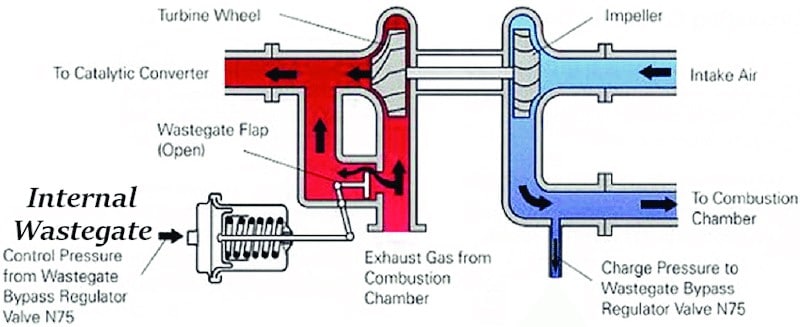
Internal wastegate diagram:
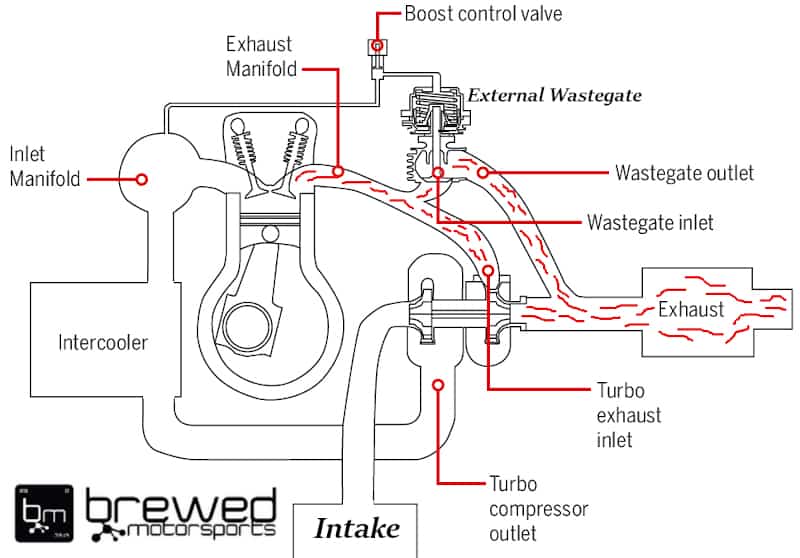
External wastegate diagram: (recirculated into exhaust)
One of the most common problems caused by a mis-sized wastegate is what people commonly refer to as “boost creep”. While boost creep is most common with internal wastegates it can also happen when the external wastegate used is to small. Boost creep happens when the wastegate is fully open BUT not able to bypass enough exhaust away from the turbine wheel. When this happens the exhaust is simply following the path of least resistance through the turbine housing NOT bypassing it through the wastegate.
An easy solution is to use a larger wastegate as well as position the wastegate more directly in the flow path of the exhaust. (This often referred to as wastegate priority and you can see it on a number of the turbo manifolds and turbo kits we offer.) In most cases though a simple upgrade to correctly sized wastegate will fix any boost creep issues and give you proper control of the boost.
Recirculating an external wastegate back into the exhaust/downpipe can also help to lower boost creep BUT this will only get you so far and if the wastegate is to small for the power level there will still be boost creep issues even if recirculated.
The most effective way to help prevent boost creep is to prioritize the wastegate, this means exhaust flow is directed more towards the wastegate than towards the turbo. (this a common solution you'll see on many honda K, B and F tubular turbo manifolds.
Here is a good example of boost creep on my KA24e engine. I've ran this engine on a G25 with tial 38mm external gate (little creep) as well as an EFR b1 with the internal gate (this also had some creep issues and IMO either turbo should be paired with a MV-R 44mm gate to avoid creep.
For those that have not experienced external wastegates that are vented to atmosphere in person here’s a little go pro footage up close and personal with the Tial MVS wastegates vented through the hood. **those that want the flow of external gates but also want to keep the noise down should recirculate the wastegate dump back into the downpipe/exhaust as this will keep the Db way down compared to open gates like in the video.
What's everyone's personal preference on wastegate routing here?
I personally notice as more time passes/i get old and grumpy i like to recirculate external wastegates but then again as long as you can use a boost solenoid to hold them shut under "normal driving" i do love to hear the scream of an external wastegate dumping to atmosphere under WOT...
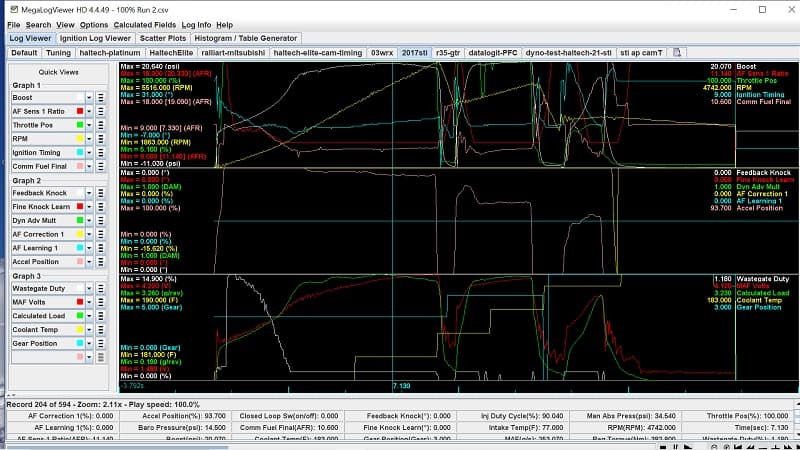
Recently tuned a STI EJ25 running a GTX3576R and a tial MVS wastegate. In this particular example the MVS wg was vented to atmosphere* While this is no 4g63 or 4b11 the boost creep concept still directly applies.
The log above shows less than 2% duty cycle to the boost solenoid which means the engine will run at the lowest possible boost AKA "wastegate spring pressure". You can see the white line (boost) climbs quickly then tries to "level off" as the wastegate opens at ~15psi. However do to the MVS wastegate being a bit to small for the EJ25 and GTX3576R turbo combination you can see the boost continues to climb from 15psi up to 20psi by 4800rpm at which point it starts to taper back down as the turbo/engine combo becomes less efficient. 15psi creeping to 20psi or 5psi of boost creep is more than ideal, at most 2-3psi of boost creep would be considered acceptable. Now keep in mind this 5psi of boost creep happened in only 3rd gear, as the engine is loaded up/ran at WOT (wide open throttle) in 4th, 5th and 6th gear the engine will be under load for longer resulting in even more boost creep than we can see happening in the 3rd gear pull. If you look further to the right in the log you can see as the car continues to accelerate in 4th gear the boost creep becomes more severe and boost creeps 6psi over wastegate spring pressure before 4800rpm while in 4th.
In this case there are 3 options:
-add a second MVS wastegate or replace the existing MVS with an MVR or other 44/45mm wastegate (more exhaust volume/flow can move out the wastegate/s)
-Lower the spring pressure in the wastegate. This will allow the wastegate to open earlier making it slightly easier to manage the boost creep and keep "peak boost" at the target. (this is a band-aid fix that simply accounts for the boost creep by opening the wastegate at a lower boost target, this is works but will limit the amount of boost you can target at lower RPM as you must still account for the creep.)
-recirculate the wastegate dump to the downpipe. (this will only help lower creep 1-2psi) as the wastegate bleeds pressure into the DP the pressure differential on the turbine wheel is decreased even further than if the wastegate was vented to atmosphere.
Nice write up. Gate size, and position are important for balanced cylinder pressure and the ability to bleed off enough air to control boost .
As far as recirculating vs not. I prefer a recirculated gate unless it’s making over 800whp or so.
Lower power with an open gate and long pulls isn’t that entertaining IMO.
Now, it’s also a party once your external gate is closed and the turbo is making all of it.
I'm an old man now and like the simplest solution possible, but I've always hated wastegate growl. No doubt that a dumped external wastegate is going to manage boost very well and make the most power, but turbo manufacturers (BW specifically) put a lot of thought into their internal wastegates lately. The EFR specifically is likely giving up nothing power-wise with its IWG compared to a recirculated external gate, and it's a very clean install. With a Turbosmart dual port wastegate actuator and modern boost control, it's going to have full control over boost creep, while maintaining an efficient duty cycle. Giving up a few hps for a bulletproof OEM solution that packages well is increasingly a good sacrifice to make.
I'm an old man now and like the simplest solution possible, but I've always hated wastegate growl. No doubt that a dumped external wastegate is going to manage boost very well and make the most power, but turbo manufacturers (BW specifically) put a lot of thought into their internal wastegates lately. The EFR specifically is likely giving up nothing power-wise with its IWG compared to a recirculated external gate, and it's a very clean install. With a Turbosmart dual port wastegate actuator and modern boost control, it's going to have full control over boost creep, while maintaining an efficient duty cycle. Giving up a few hps for a bulletproof OEM solution that packages well is increasingly a good sacrifice to make.
I tested the first B1 EFR with internal gate on my S13 way back when before they were released to the public (while I was working at Full-Race). Since then I've tuned a wide range of internally wastegated EFR's on more than a few different engines and i personally do not love the EFR with internal wastegate option. I find they really choke out the top end power (5-10% on cars with good flowing heads/cams). I've also had the internal gate cause a lot of boost creep issues on high flow cylinder heads running the internal wastegate EFR. All issues that can be tuned around but not ideal imo.
Not to say the internal wg EFR setup doesn't work, all the cars i've tuned using them besides my own are still using them and they are indeed reliable setups once dialed in that make good power. They are just not what i would personally use again on any of my cars. For me larger external gate/s that are recirculated are the best option if using an EFR you want to keep quiet. I'm still all about using the ecu/boost solenoid to hold an external wastegate shut until 4-5psi below target boost as i find this keeps things quiet 90% of the time and you only ever hear the WG when you are doing WOT pulls.
I am super interest to test one of the new Turbosmart straight gates, the straight gates should control boost extremely well vented or recirculated and they now offer mechanical straight gates as well as the electric straight gates. Might be time for a Motec M150 and electric wastegate on the next personal project
Funny enough this is the sound of an external Tial 38mm wastegate and the internal EFR gate. (haha did one day at the track with both gates plumbed/working, ended up running the internal EFR gate then switch back to running the tial gate and safety wired the internal EFR gate closed. Then swapped out to garrett turbo and Tial MVS wastegate in the end haha.
Any one here used a straight gate on their build? If so electric or boost actuated?
flow potential and wide boost range potential even on a boost actuated straight gate is very very attractive.