


EVO Aerodynamics Review


Do you guys think the APR front splitter works?
I know of at least 3 guys that ran it last year. I've heard good and bad reviews whether it really created downforce or not. I want to know if people run it because it works, or because it's a good option that's readily available, fits as shipped, etc.
Please speak up!
I know of at least 3 guys that ran it last year. I've heard good and bad reviews whether it really created downforce or not. I want to know if people run it because it works, or because it's a good option that's readily available, fits as shipped, etc.
Please speak up!
I'm wondering what happens in the middle 3' or so where the bumper is notched up?
Last edited by boomn29; Jan 21, 2011 at 08:28 AM.


I'd assume it'd slow you down rather then create downforce, based on shape alone. My thinking is i'm taking the points for the splitter anyway, i'd build out a smooth transition with enough extension if I didn't want to use the OEM lips. Never seen any race car with a "_\" always a "_/"


I'd assume it'd slow you down rather then create downforce, based on shape alone. My thinking is i'm taking the points for the splitter anyway, i'd build out a smooth transition with enough extension if I didn't want to use the OEM lips. Never seen any race car with a "_\" always a "_/"
The overhang detracts from the function of the splitter - the overall effectiveness of the splitter has more to do with how far it sticks out in front of the forwardmost part of the bumper rather than how far it extends from the bottom of the fascia where it mates up. If a vette has a splitter that sticks out 12" from the bottom of the fascia and 4" from the forwardmost part of the fascia - the splitter will not make the same DF as sticking a 12" splitter on the front of an EVO. . .
Last edited by EVOlutionary; Jan 22, 2011 at 12:29 PM.
Anyone have an APR front splitter - or any flat splitter - attached to a stock Evo IX bumper? And I mean directly to the bumper w/o incorporating an air dam or lip of any kind or dropping the splitter down lower than the stock bumper. (Stupid NASA rules....)
I'm wondering what happens in the middle 3' or so where the bumper is notched up?
I'm wondering what happens in the middle 3' or so where the bumper is notched up?
G. AERODYNAMICS:
1) Add, replace, or modify front fascia or air dam +3 (except as provided for in I.c.3), I.f.3), I.h.14) of the No-Points Modification list) (note: Additional points must be assessed below for any component of the added/replaced/modified fascia or air dam that performs the functions listed in G.2) and G.4) below)
2) Add, replace or modify a single front splitter/spoiler/wing/foil +3 (note: This part may
extend horizontally past the side of the vehicle no greater than five inches. If any portion of this part that protrudes from the side of vehicle is not parallel to the ground, then additional points must be assessed for canards in G.4) below.)(note: No material or part may extend the vertical reach of the OEM front fascia without taking fascia modification points above.)
3) Add, replace, or modify rear wing and/or spoiler +4 (a rear wing or spoiler may not exceed a height of eight (8) inches above the roofline (or OEM windshield height for convertibles), or a width greater than the width of the car body. (note: additional points must be assessed for end plates that are greater than twelve inches in height---G.8) below)
4) Add or modify canards/winglets (includes portions of an added/modified/replaced fascia that provide a downward force other than that listed in G.2) above) +2
5) Add or fabricate flat bottom/belly tray (rearward of the centerline of the front axle) +5
6) Add rear diffuser (note: additional points must be assessed for any vertical panels incorporated into a rear diffuser that are greater than five inches in height---G.8) below) +2
7) Replace or modify OEM rear diffuser, rear bumper cover, or rear “fascia” (note: additional points must be assessed for any vertical panels incorporated into a rear diffuser that are greater than five inches in height---G.8) below) +1
8) Add rear vertical panels in any location (note: see G.3), G.6), G.7), and G.10)) +2
9) Add or modify side skirts (side skirts must be vertical only, and cannot connect to any other aero component) +2
10) Add vortex generator to roof, rear window, or rear deck lid (note: additional points must be assessed for any vertical panels incorporated into a vortex generator that are greater than five inches in height---G.8) above) +1
11) Removal of the front windshield/windshield frame +7
12) Front side window frame air dams/diverters (driver and/or passenger side) +2
1) Add, replace, or modify front fascia or air dam +3 (except as provided for in I.c.3), I.f.3), I.h.14) of the No-Points Modification list) (note: Additional points must be assessed below for any component of the added/replaced/modified fascia or air dam that performs the functions listed in G.2) and G.4) below)
2) Add, replace or modify a single front splitter/spoiler/wing/foil +3 (note: This part may
extend horizontally past the side of the vehicle no greater than five inches. If any portion of this part that protrudes from the side of vehicle is not parallel to the ground, then additional points must be assessed for canards in G.4) below.)(note: No material or part may extend the vertical reach of the OEM front fascia without taking fascia modification points above.)
3) Add, replace, or modify rear wing and/or spoiler +4 (a rear wing or spoiler may not exceed a height of eight (8) inches above the roofline (or OEM windshield height for convertibles), or a width greater than the width of the car body. (note: additional points must be assessed for end plates that are greater than twelve inches in height---G.8) below)
4) Add or modify canards/winglets (includes portions of an added/modified/replaced fascia that provide a downward force other than that listed in G.2) above) +2
5) Add or fabricate flat bottom/belly tray (rearward of the centerline of the front axle) +5
6) Add rear diffuser (note: additional points must be assessed for any vertical panels incorporated into a rear diffuser that are greater than five inches in height---G.8) below) +2
7) Replace or modify OEM rear diffuser, rear bumper cover, or rear “fascia” (note: additional points must be assessed for any vertical panels incorporated into a rear diffuser that are greater than five inches in height---G.8) below) +1
8) Add rear vertical panels in any location (note: see G.3), G.6), G.7), and G.10)) +2
9) Add or modify side skirts (side skirts must be vertical only, and cannot connect to any other aero component) +2
10) Add vortex generator to roof, rear window, or rear deck lid (note: additional points must be assessed for any vertical panels incorporated into a vortex generator that are greater than five inches in height---G.8) above) +1
11) Removal of the front windshield/windshield frame +7
12) Front side window frame air dams/diverters (driver and/or passenger side) +2
Before going with the APR or DHP unit you had better ask for a rules clarification so you don't get dinged with +6 points. Based on my interpretation of the rules I think the best way to make the most downforce while only adding +3 points is to run a vertical Nascar style (pre-COT) air dam as low to the ground as possible, with a flat front undertray that does not stick out the front or the sides but does have diffuser/venturi tunnels . . .
Last edited by EVOlutionary; Jan 22, 2011 at 01:20 PM.
I see what we're talking about. If you add any vertical panel you have to add +3 points as well as the +3 points for the splitter element. After reading through the exact rules it seems as if the APR splitter will force you to have to take the +3 points for both the splitter and the +3 for "extending the vertical reach of the OEM front fascia" since it sits below the front fascia. . .
Before going with the APR or DHP unit you had better ask for a rules clarification so you don't get dinged with +6 points. Based on my interpretation of the rules I think the best way to make the most downforce while only adding +3 points is to run a vertical Nascar style (pre-COT) air dam as low to the ground as possible, with a flat front undertray that does not stick out the front or the sides but does have diffuser/venturi tunnels . . .
Before going with the APR or DHP unit you had better ask for a rules clarification so you don't get dinged with +6 points. Based on my interpretation of the rules I think the best way to make the most downforce while only adding +3 points is to run a vertical Nascar style (pre-COT) air dam as low to the ground as possible, with a flat front undertray that does not stick out the front or the sides but does have diffuser/venturi tunnels . . .
Originally Posted by NASA
There is nothing that prevents the splitter from being in front of the OEM fascia.
It must be attached directly to the OEM fascia. If you drop it down from the OEM fascia/bumper at all, it will incur points for Air Dam/Fascia modification.
(note: No material or part may extend the vertical reach of the OEM front fascia without taking fascia modification points above.)
Vertical means "up and down". If you drop the splitter down below the OEM fascia, you are creating a non-OEM air dam.
It must be attached directly to the OEM fascia. If you drop it down from the OEM fascia/bumper at all, it will incur points for Air Dam/Fascia modification.
(note: No material or part may extend the vertical reach of the OEM front fascia without taking fascia modification points above.)
Vertical means "up and down". If you drop the splitter down below the OEM fascia, you are creating a non-OEM air dam.
Last edited by boomn29; Jan 23, 2011 at 05:32 PM.

Do you guys think the APR front splitter works?
I know of at least 3 guys that ran it last year. I've heard good and bad reviews whether it really created downforce or not. I want to know if people run it because it works, or because it's a good option that's readily available, fits as shipped, etc.
Please speak up!
I know of at least 3 guys that ran it last year. I've heard good and bad reviews whether it really created downforce or not. I want to know if people run it because it works, or because it's a good option that's readily available, fits as shipped, etc.
Please speak up!
Im sure someone whos an aero expert can illustrate the math behind why certain designs/features are better than APR. Im not an expert, but i dont see how the APR splitter doesnt work/create downforce. Then again, im not sure what it actually means to say that a splitter works or not. Furthermore, i dont have the knowledge, nor do i have the ability to illustrate that it works. What i can say is what i feel with it on my car when im driving. Given my experience, what i can feel is that my front end is more planted in the high speed transitions. Does that mean that it works, or that it creates downforce? Im going to go out on a limb and say yes.
 Is there a splitter out there thats better than APR? Im going to go out on another limb and say yes again. But at this juncture, i dont think having a different splitter with other features/designs is actually going to make any difference for me.
Something else i want to note is how people mount their splitter. The way you support/reinforce your splitter and how you mount it will obviously effect how it functions. Again, im not an expert on any of this, but i dont think it takes an expert to realize that. Because if you dont support/reinforce it well enough it will flex/deflect more at speed. When we were getting ready to work on my splitter, we didnt feel like i would need any sort of supporting rods/wiring in the front because of the approach we were planning to take. Rather loosely speaking, i think my APR splitter, given the way we reinforced/mounted it, is pretty dang solid.
There are guys who also entertain the idea of running a splitter that has the ability to have its angle and length adjusted. While im sure there is a benefit in being able to adjust your splitters angle and length, it just feels like way too much more work. I can probably spend the next 10 years fine tuning my setup from one race to the next, and we will probably still continue to find different combinations of spring rates, alignments, and tire pressures to use. However, i suspect that driver improvement will play a major factor in how those setup combinations are adjusted from one race to the next. If you ask me, id say i already have enough to think about with varying combinations of spring rates, compression/rebound settings, alignments, and tire pressures to work with. Therefore, i think i would go crazy trying to figure out how much more/less length, or how much more/less angle my splitter will benefit me from one track to the next. Maybe someday ill take that step, but for now im content with a fixed length and angle for my splitter. Besides, on top of everything else i think about, trying to play with different angles for my wing is already more than enough for me right now.
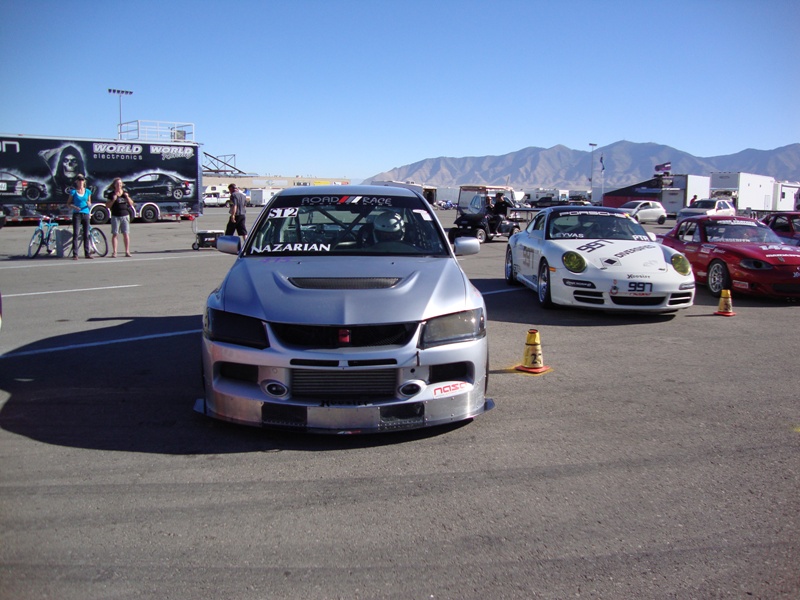
Already been there. Here's a reply directly from NASA:
So it needs to be connected directly to the bumper/fasica (whatever you call it) w/o a gap to be just the 3pts. It's possible.
Originally Posted by NASA
There is nothing that prevents the splitter from being in front of the OEM fascia.
It must be attached directly to the OEM fascia. If you drop it down from the OEM fascia/bumper at all, it will incur points for Air Dam/Fascia modification.
(note: No material or part may extend the vertical reach of the OEM front fascia without taking fascia modification points above.)
Vertical means "up and down". If you drop the splitter down below the OEM fascia, you are creating a non-OEM air dam.
There is nothing that prevents the splitter from being in front of the OEM fascia.
It must be attached directly to the OEM fascia. If you drop it down from the OEM fascia/bumper at all, it will incur points for Air Dam/Fascia modification.
(note: No material or part may extend the vertical reach of the OEM front fascia without taking fascia modification points above.)
Vertical means "up and down". If you drop the splitter down below the OEM fascia, you are creating a non-OEM air dam.
To be sure on the rule you need to get it clarified further I think. Do they mean it can be attached directly to the bottom/underside of the fascia? Or do they mean that if it sits below the fascia at all that you have to take the points?
Last edited by EVOlutionary; Jan 24, 2011 at 12:09 AM.
Here's a pic of a NASA 3pt splitter in it's simplest form. It's an APR splitter that's completely flat, connects directly to the oem bumper, extends < 5" and does not go back past the axle. (confirmed by NASA as 3pts)
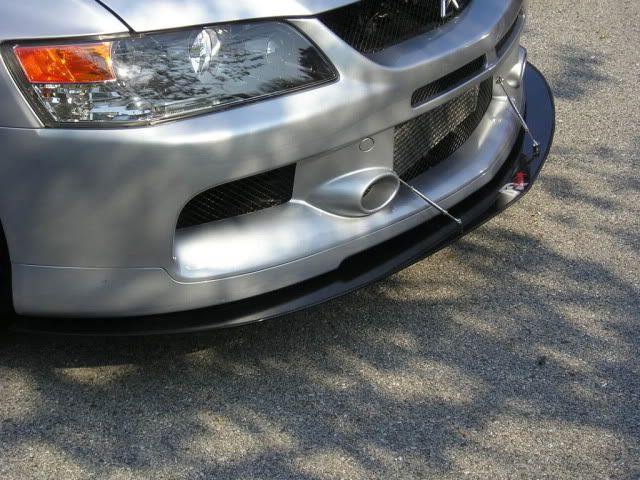
You sent them that picture and they said it was only +3 for splitter even though it mounts under the front fascia? If so, then disregard everything I've been talking about over the past few posts. By reading the rules I thought that would not be legal. . .


Newbie
Joined: Sep 2010
Posts: 25
Likes: 0
From: South Florida

race TT-S or TT-U and don't worry about the points anymore  then you can run unlimited aero mods
i'm very confident that nothing aero-wise can provide any benefit compared to other components available for equal points. since our cars usually are going to fall into the TT-A catagory, use your points for more beneficial mods. Our TT-A evo X doesn't have anything aero on it. his points were maxed out off suspension, tires and power alone. we brought the weight down to the absolute minimum allowed for the car, maximized tire size, running coilovers and sway bars, and the rest power mods (intake + pipes, intercooler, exhaust, fuel system).
then you can run unlimited aero mods i'm very confident that nothing aero-wise can provide any benefit compared to other components available for equal points. since our cars usually are going to fall into the TT-A catagory, use your points for more beneficial mods. Our TT-A evo X doesn't have anything aero on it. his points were maxed out off suspension, tires and power alone. we brought the weight down to the absolute minimum allowed for the car, maximized tire size, running coilovers and sway bars, and the rest power mods (intake + pipes, intercooler, exhaust, fuel system).
Ya know it looks like a gap, but I examined my oem bumper the other night and you can mount the APR directly to the bumper/fascia. Their would be no air gap.