


Evolution Dynamics Pikes Peak Build


Despite the incident, this looks great.
Amongst all the data etc. I see a few things here:
A Safety system was built by a group of individuals who hay not have done the exact job before, but at least have enough proper knowledge, the drive, and ***** to get the job done. various engineering educations and time/skill/handson.
I see 2 men who are still alive... and the people who I saw with my own eyes take the time to make sure they were doing to their best knowledge, the best they could.
I see a design that will receive the proper attention and has been put through one hell of a rigorous test.
I see trial and error, and know these guys have the capability (that all humans have but many for some odd reason choose not to use) to LEARN. I also see a possible future customer for such a job to my own evo if I am ready to race but not knowledgeable in time to do the work. Which is a likely scenario I'd like to believe.
Amongst all the data etc. I see a few things here:
A Safety system was built by a group of individuals who hay not have done the exact job before, but at least have enough proper knowledge, the drive, and ***** to get the job done. various engineering educations and time/skill/handson.
I see 2 men who are still alive... and the people who I saw with my own eyes take the time to make sure they were doing to their best knowledge, the best they could.
I see a design that will receive the proper attention and has been put through one hell of a rigorous test.
I see trial and error, and know these guys have the capability (that all humans have but many for some odd reason choose not to use) to LEARN. I also see a possible future customer for such a job to my own evo if I am ready to race but not knowledgeable in time to do the work. Which is a likely scenario I'd like to believe.

Newbie
Joined: Sep 2010
Posts: 37
Likes: 0
From: US, Colorado
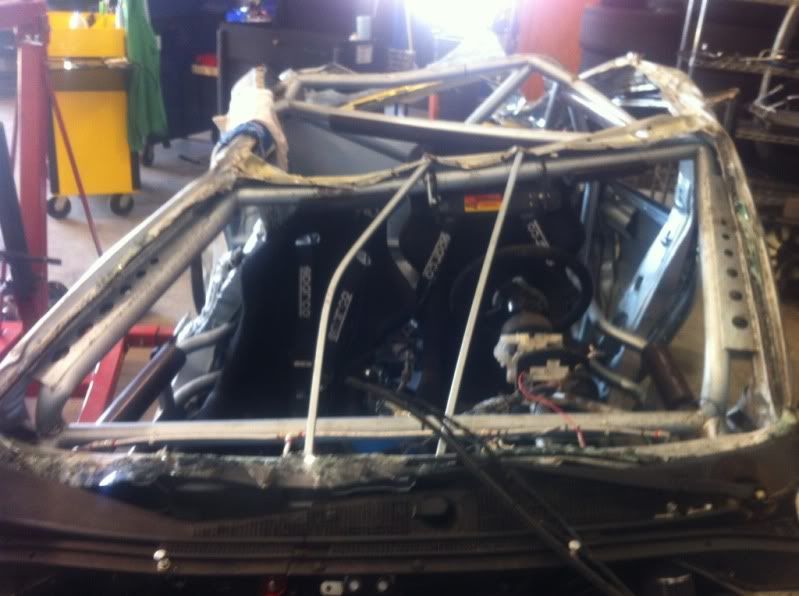
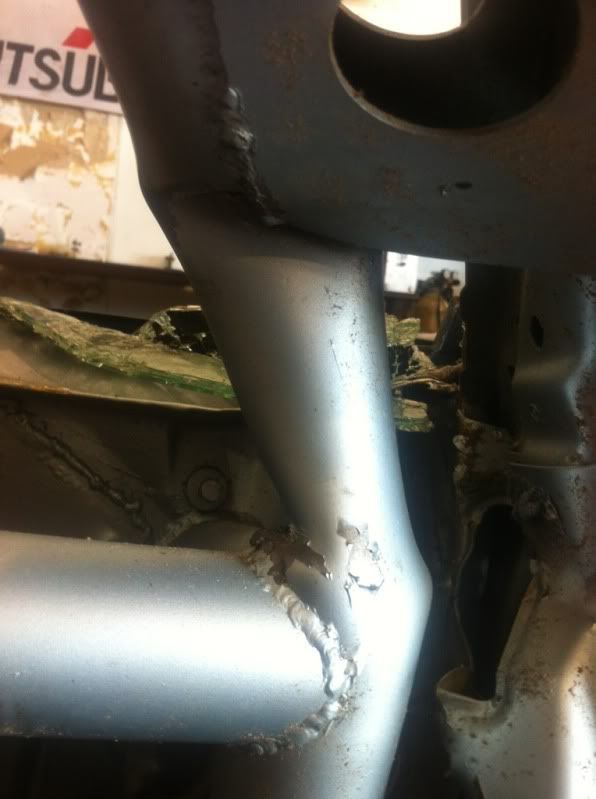

I would like to further discuss and specifically address gusseting and tie plate methods. Gussets should tie a node. If using plate material in lew of pins as panel ties and additional reinforcement (like illustrated), the plate should remain continuious the entire span. It should originate and end at a node. My thinking, once any piece of the cage is abutted it must continue to be supported by same method the entire distributed length between nodes. This ensures concentrated loads can't be established at a mid-span.
In this illustration it would appear the tie plate spanning the forward downs from main hoop to A-pilliar is re-distributed at the gusset tie plate. When energy from impact entered the tie-plate region it spread out. When it had to come back out to stay balanced the load was once again redistibuted and funneled down. The bottleneck allowed the load to become more concentrated. It appears excessive load concentration from an unevenly distributed tie being short of the node also aided in the flattening and deformation of the bar.
My future course of action from this illustration,
1)Initiate and end ALL tie plating at a triangulated intersecting points
2)Mantain continuity the entire span
3)Use body pins in lew of plates to secure non integral panels to the cage
Last edited by J. Fast; Sep 23, 2012 at 09:00 AM.

I would like to further discuss and specifically address gusseting and tie plate methods. Gussets should tie a node. If using plate material in lew of pins as panel ties and additional reinforcement (like illustrated), the plate should remain continuious the entire span. It should originate and end at a node. My thinking, once any piece of the cage is abutted it must continue to be supported by same method the entire distributed length between nodes. This ensures concentrated loads can't be established at a mid-span.
In this illustration it would appear the tie plate spanning the forward downs from main hoop to A-pilliar is re-distributed at the gusset tie plate. When energy from impact entered the tie-plate region it spread out. When it had to come back out to stay balanced the load was once again redistibuted and funneled down. The bottleneck allowed the load to become more concentrated. It appears excessive load concentration from an unevenly distributed tie being short of the node also aided in the flattening and deformation of the bar.
My future course of action from this illustration,
1)Initiate and end ALL tie plating at a triangulated intersecting points
2)Mantain continuity the entire span
3)Use body pins in lew of plates to secure non integral panels to the cage
In this illustration it would appear the tie plate spanning the forward downs from main hoop to A-pilliar is re-distributed at the gusset tie plate. When energy from impact entered the tie-plate region it spread out. When it had to come back out to stay balanced the load was once again redistibuted and funneled down. The bottleneck allowed the load to become more concentrated. It appears excessive load concentration from an unevenly distributed tie being short of the node also aided in the flattening and deformation of the bar.
My future course of action from this illustration,
1)Initiate and end ALL tie plating at a triangulated intersecting points
2)Mantain continuity the entire span
3)Use body pins in lew of plates to secure non integral panels to the cage
 ) All the gussets will span down to a node to avoid overloading a free area of the cage.
One question for you: What are "body pins" that you refer to? That is a term that I am not familiar with.

Totally agree with u.
Last edited by olo; Oct 12, 2012 at 07:25 PM.
Newbie
Joined: Sep 2010
Posts: 37
Likes: 0
From: US, Colorado
Well said analysis and suggestions. That is the same conclusion that KevinD, myself, and several other structural engineers have come to after reviewing the damage. We are using this vehicle as a useful guide for our next cage build (details to come in the following months ) All the gussets will span down to a node to avoid overloading a free area of the cage.
One question for you: What are "body pins" that you refer to? That is a term that I am not familiar with.
) All the gussets will span down to a node to avoid overloading a free area of the cage.One question for you: What are "body pins" that you refer to? That is a term that I am not familiar with.
You utilize this type of tool for installation.
http://dragonplate.com/sections/fastener.asp
The pins are these... They come in either male or female and they support 350+ lbs each, in shear.
http://dragonplate.com/ecart/product...ID=4801&cID=21
http://dragonplate.com/ecart/product...ID=4807&cID=21
And you affix with this type of epoxy...
http://dragonplate.com/ecart/product...ID=4749&cID=21
The epoxy has a shear strength yield of 3100+ psi within two hours and will adhere to:
Carbon Steel
PVC
Rubber
Stainless Steel
Polystyrene
Stone
Aluminum
Nylon
Wood
Copper/Brass
Glass
Tin
Carbon Fiber
Zinc
Fiberglass
PVC
Rubber
Stainless Steel
Polystyrene
Stone
Aluminum
Nylon
Wood
Copper/Brass
Glass
Tin
Carbon Fiber
Zinc
Fiberglass
Newbie
Joined: Sep 2010
Posts: 37
Likes: 0
From: US, Colorado
Forgot to mention the same company also manufactures structural carbon fiber. And will fill custom dimension and design orders. Some stuff is also available as drop ship.
Good resource for DIY racing parts like wings, splitters, undertrays, and structural carbon fiber.
http://dragonplate.com/default.asp
Good resource for DIY racing parts like wings, splitters, undertrays, and structural carbon fiber.
http://dragonplate.com/default.asp


Thread
Thread Starter
Forum
Replies
Last Post
doncarbone
Evo Engine / Turbo / Drivetrain
10
May 29, 2017 05:20 AM
