


Datalog Lab Dyno


Datalog Lab Dyno
For the past couple of days I have been fiddling with the dyno function on data log lab. I think I figured out what you need to do to get it as close to optimal as possible.
First, you need to get your curb weight correctly. According to the maunual of the program the curb weight listed is for the weight of the car with 1/2 a tank of gas. But the curb weight listed for the Evo is 3263 for the GSR. This includes a full tank of gas according to what I read. If 1 gallon of gas equals 6.1 lbs, then the Evo weight w/o gas is 3177.6 lbs. So you will need to know approx how much gas weight you have in the car when you did your runs and add that weight to 3177.6 lbs.
Second, you will also need to figure out how much additional weight you have in the car and add that to the car definition. Your weight beign the most important.
Third, you need to input the correct Cd and correct frontal area for the Evo. DLL uses the "known characteristics" radio button for the EVO. This is not an accurate method. According to my research, the CD on the Evo is 0.36 and the frontal area is 24.92 ft2.
One thing I have not figured out yet is the atmospheric pressure. Can we use the atmospheric pressure that is calculated by Evoscan? Or do we have to use the atmospheric pressure that is commonly listed in my area?
After making all the corrections, my latest run was close to where the car should be hp wise @ 304 hp. This makes more sense than the 320 hp I got before. Torque was still a bit down from where it should be.

First, you need to get your curb weight correctly. According to the maunual of the program the curb weight listed is for the weight of the car with 1/2 a tank of gas. But the curb weight listed for the Evo is 3263 for the GSR. This includes a full tank of gas according to what I read. If 1 gallon of gas equals 6.1 lbs, then the Evo weight w/o gas is 3177.6 lbs. So you will need to know approx how much gas weight you have in the car when you did your runs and add that weight to 3177.6 lbs.
Second, you will also need to figure out how much additional weight you have in the car and add that to the car definition. Your weight beign the most important.
Third, you need to input the correct Cd and correct frontal area for the Evo. DLL uses the "known characteristics" radio button for the EVO. This is not an accurate method. According to my research, the CD on the Evo is 0.36 and the frontal area is 24.92 ft2.
One thing I have not figured out yet is the atmospheric pressure. Can we use the atmospheric pressure that is calculated by Evoscan? Or do we have to use the atmospheric pressure that is commonly listed in my area?
After making all the corrections, my latest run was close to where the car should be hp wise @ 304 hp. This makes more sense than the 320 hp I got before. Torque was still a bit down from where it should be.

Originally Posted by chrisw
I just left all the parameters alone. I am not looking for 100% accuracy, just a measure of "have I improved the tune or not"

Originally Posted by chrisw
I just left all the parameters alone. I am not looking for 100% accuracy, just a measure of "have I improved the tune or not"
yeah the parameters will vary some but not by much. try changing the temp and humidity and see for yourself... it doesn't make all that much of a difference.
Originally Posted by nj1266
But the parameters will vary. Temp, humidity, baro pressure will all vary depending on the date you log. You need to use the correct numbers and use the ASE correction factor to get accurate numbers. The weight of your car will also vary unless you log with a full tank of gas all the time.
I don't care about how accurate the dyno plot is. I only care if the dyno plots taken during that session show improvement or not. The error correction evens itself out between the dyno plots taken in the same tuning session.
By changing these parameters, you are changing the definition for that model car. So the parameters that you have setup for your car are completely different for mine.
I played around with the car parameters, but other than changing the tire size, I have left them alone. I get more consistant and reproducable results that way.
Originally Posted by AlwaysinBoost
x2
yeah the parameters will vary some but not by much. try changing the temp and humidity and see for yourself... it doesn't make all that much of a difference.
yeah the parameters will vary some but not by much. try changing the temp and humidity and see for yourself... it doesn't make all that much of a difference.
The default numbers are:
weight=3263
personal weight=200
temp=0
humidity=50%
Atmo press=100
Known Characteristics radio button used
kept the smoothing @ 4 like the chart above for consistency (default is 5)
And I used the SAE correction factor check box like I did before.
The hp fell from 304 to 299 and torque fell from 277 to 267. It is not a huge difference, but it is different. Personally, I prefer no data to inaccurate data.
Originally Posted by chrisw
you are falling into that same old argument Mustang dyno V.S. dynojet....
I don't care about how accurate the dyno plot is. I only care if the dyno plots taken during that session show improvement or not. The error correction evens itself out between the dyno plots taken in the same tuning session.
By changing these parameters, you are changing the definition for that model car. So the parameters that you have setup for your car are completely different for mine.
I played around with the car parameters, but other than changing the tire size, I have left them alone. I get more consistant and reproducable results that way.
I don't care about how accurate the dyno plot is. I only care if the dyno plots taken during that session show improvement or not. The error correction evens itself out between the dyno plots taken in the same tuning session.
By changing these parameters, you are changing the definition for that model car. So the parameters that you have setup for your car are completely different for mine.
I played around with the car parameters, but other than changing the tire size, I have left them alone. I get more consistant and reproducable results that way.
Last edited by nj1266; Sep 22, 2006 at 06:02 PM.
Trending Topics
Originally Posted by nj1266
That is correct if you are tuning during the same session. But what if you did a couple of runs in the AM hours, then went home did changes to your tune and came back at night and did a couple of more runs. When I did my runs the humidity changed from 63% @ 11 AM to 86% @ 11 PM. The temp changed dropped from 70* to 62* While these are not big changes, they are changes nonetheless. Changing the temps/humidity numbers and using the SAE correction factor will allow you to compare your AM hp to you PM hp numbers while keeping the temp/humidity/baro variables constant.
be nice if you could. In the end it's just a tool, just like the dyno, each reads different, but overall the consistancy of the results is more important given the weather on a given day.

I look at it this way: I could go up to Gruppe-S and use their dyno and calibrate a set of car definitions that could match their dyno to with a resonable percentage. I could do the same for Vishnu and the other shops in the area that have dynos. Then I could say with resonable confidence that I can make x hp on such and such's dyno...
In the end it's still an educated guess, even if you are on the dyno.
Last edited by chrisw; Sep 22, 2006 at 11:06 PM.


Changing those numbers from day to night and using correction factors is like using a weather station on a dyno. Those are INCORRECT numbers. NOT the numbers your car is doing RIGHT THEN AND THERE.
Who cares about corrected numbers?
Who cares about corrected numbers?

Weather correction really is only supposed to compensate for differences to equalize variations when making comparisons..
Generally I don't use it unless there's a severe change in weather between my test runs.. but when I tune my runs are over several evenings where conditions are similar and the location I test is the same.. So I can gage changes pretty convincingly. The actual power numbers aren't really important to me just the gains/losses between mods and tunes..
I wish people would stop swinging their sticks about dyno numbers.. Its like comparing ***** size when the ruler is made of rubber and its a different size every place you go...
Generally I don't use it unless there's a severe change in weather between my test runs.. but when I tune my runs are over several evenings where conditions are similar and the location I test is the same.. So I can gage changes pretty convincingly. The actual power numbers aren't really important to me just the gains/losses between mods and tunes..
I wish people would stop swinging their sticks about dyno numbers.. Its like comparing ***** size when the ruler is made of rubber and its a different size every place you go...
Originally Posted by razorlab
Changing those numbers from day to night and using correction factors is like using a weather station on a dyno. Those are INCORRECT numbers. NOT the numbers your car is doing RIGHT THEN AND THERE.
Who cares about corrected numbers?
Who cares about corrected numbers?
Originally Posted by chrisw
what difference does it make? you yourself say it's not that big a deal. you can attempt to calibrate your reading to be as close to 100% on each pull. But do you really want to be breaking out the scales and weighing the car before each run?
Datalog lab uses the "known characteristics" as default for measurement. If you use that instead of the more accurate Cd. and frontal area, then the hp will be 312 hp in the above dyno plot. That is inaccurate.
In the end it is up to you. I prefer to be as accurate as possible with the numbers that I get.
Since June of 06 I have run 93 octane gas here in CA by mixing some 100 octane with 91 octane. I did that because the 91 octane gas was causing spikes in the AFR log. The car ran fine, but I got these spikes. When I switched to 93 the spikes disappeared. So I was very happy with that. But I had to optimize my 91 octane custom tune. About a month ago I did a number of base runs on my 91 octane map with 93 octane gas. Then I leaned out the AFR and advanced the timing in certain areas of the power band. I finally did three runs to compare the before and after results. I am pleased with the results. The increase in power in the powerband reflect where the AFR changes and timing advance was done.
I still need to go to a real dyno and see the after results. It is amazing what good octane gas does.
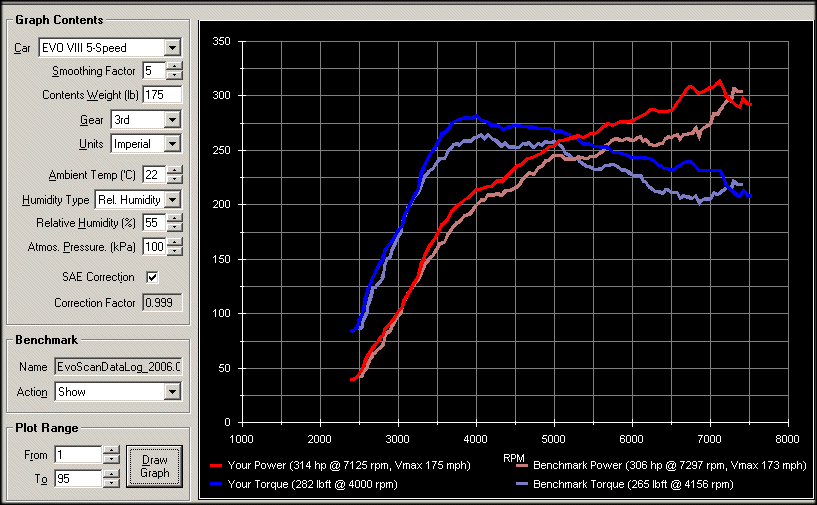
I still need to go to a real dyno and see the after results. It is amazing what good octane gas does.

Originally Posted by Max-Q
Where did you get this program and how much does it cost?