


DYNOJET VS DYNODYNAMICS... Round XX



love that drag race feature....gives you that "perfect world" results.


have you guys had any problems in getting large injectors to idle/run properly? I heard that 1450cc and larger FI's aren't able to be scaled properly with the stock ecu? I just bought FIC BlueMax 1450cc inj. as my 1000cc's were at 100% Duty Cycle by 7k rpms..

For many years drag racers used calculations to guess what their hp levels were. The unfortunate problem with this method is that it only calculated an average of applied hp for the pass. Tires spinning, missing gears, slow shifting, and peaky hp cars with a lack of a flat torque curve never got clean results. These dyno machines allowed us to see exactly where the hp/tq were in the rpm range and more importantly where there was room for improvement. Everyone is very quick to suggest going to the track to see the results, unfortunately heavy cars with poor drivers can skew the outcome very drastically.
For those of you who have been on a dyno AND have run at the track, please give this a shot and post your results.......
Enter your vehicle's race weight and mph here....
http://www.4lo.com/calc/dynocalc.htm
I rely more on the mph/weight for calculation, because it doesn't give the advantage to the better 60 ft/driven cars.
Please post your dyno'd power (include dyno type) vs 'calculated avg hp' results.
Please post your et/mph.
The results here will help some people to really understand their cars at the track!
For those of you who have been on a dyno AND have run at the track, please give this a shot and post your results.......
Enter your vehicle's race weight and mph here....
http://www.4lo.com/calc/dynocalc.htm
I rely more on the mph/weight for calculation, because it doesn't give the advantage to the better 60 ft/driven cars.
Please post your dyno'd power (include dyno type) vs 'calculated avg hp' results.
Please post your et/mph.
The results here will help some people to really understand their cars at the track!
Anyone care to give it a shot?!?

Thread Starter
Evolved Member
iTrader: (10)
Joined: May 2005
Posts: 1,055
Likes: 0
From: long island,ny
Here's what I put together on my sold evo 8...
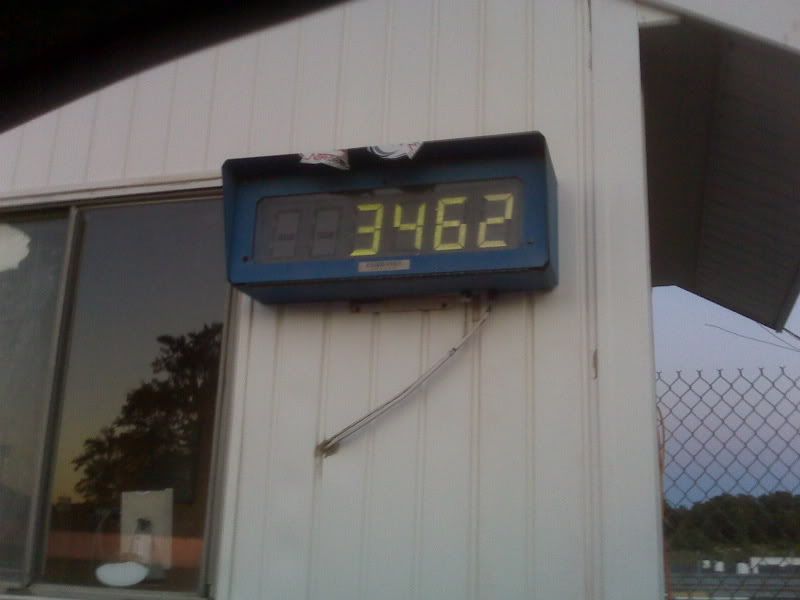
Car weighed 3462lbs.
--With a gt30 I put down 433hp on a dynojet..
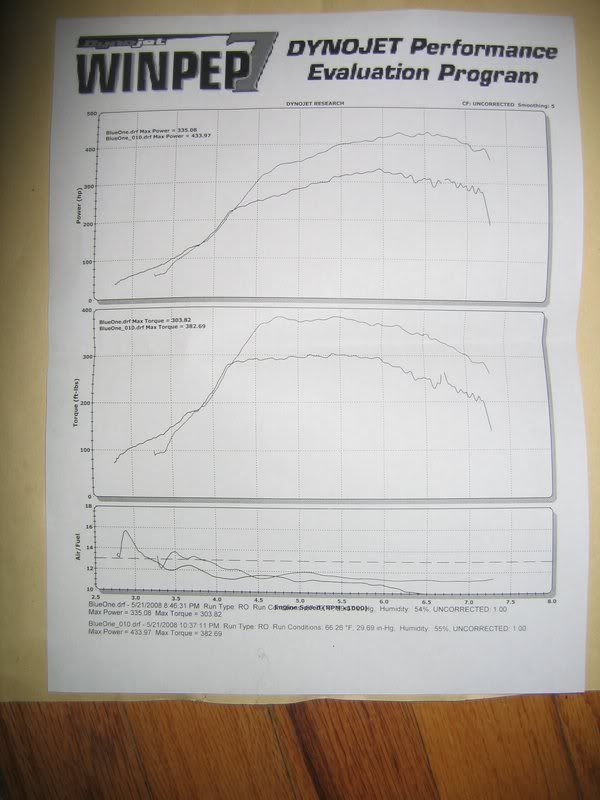

Car would trap 117-118mph,,,,,calculator (according to this mph and weight) resulted in 433-444hp
--With a 35r I put down 534hp on a dynojet
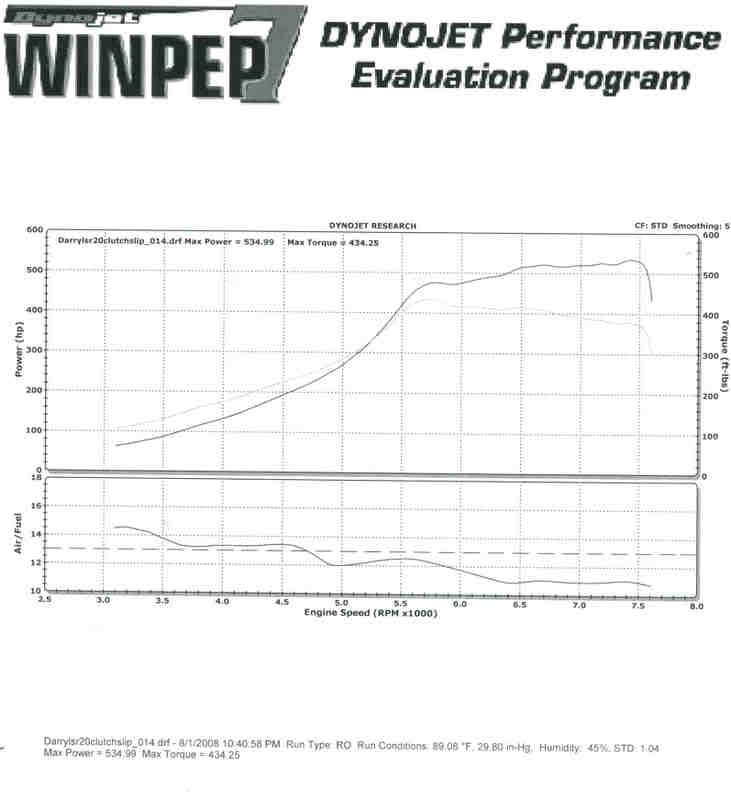
Shifting at 7500 the car would trap 124-125,,, calculator resulted in 515-528hp
Any hypothesis need a 'control'...
Stock evo8's run 100-101mph in the 1/4 correct?
Calculator results---270-278hp>>> right around the same number rated from the dealer?
Car weighed 3462lbs.
--With a gt30 I put down 433hp on a dynojet..
Car would trap 117-118mph,,,,,calculator (according to this mph and weight) resulted in 433-444hp
--With a 35r I put down 534hp on a dynojet
Shifting at 7500 the car would trap 124-125,,, calculator resulted in 515-528hp
Any hypothesis need a 'control'...
Stock evo8's run 100-101mph in the 1/4 correct?
Calculator results---270-278hp>>> right around the same number rated from the dealer?


My car weight with me in it said 3480 @ e-town, not sure how correct that is. (05 MR,LEATHER,Stereo,tire,jack,ect. and alot of gas)
My car trapped 120mph
My dyno plot shows 357hp corrected
The innernet online calculation shows 470hp lol
But putting my 470 with trap speed against your 515 with your trap speed actually makes this 470hp make sense.. Who would have guessed it !
My car trapped 120mph
My dyno plot shows 357hp corrected
The innernet online calculation shows 470hp lol
But putting my 470 with trap speed against your 515 with your trap speed actually makes this 470hp make sense.. Who would have guessed it !

My car weight with me in it said 3480 @ e-town, not sure how correct that is. (05 MR,LEATHER,Stereo,tire,jack,ect. and alot of gas)
My car trapped 120mph
My dyno plot shows 357hp corrected
The innernet online calculation shows 470hp lol
But putting my 470 with trap speed against your 515 with your trap speed actually makes this 470hp make sense.. Who would have guessed it !
My car trapped 120mph
My dyno plot shows 357hp corrected
The innernet online calculation shows 470hp lol
But putting my 470 with trap speed against your 515 with your trap speed actually makes this 470hp make sense.. Who would have guessed it !
Corrected? What kind of dyno did you run on?
I'm Sorry to say.. but in my mind Corrected is a MASSIVE JOKE!
A naturally aspirated car can maybe use the correction factor. But that is about it..
Well basically everyone on this board has at least a turbocharger on there car with an intercooler. Right there the size/efficiency of the intercooler, boost levels are going to alter the correction factor/ Atmosphere(temp, humidity, barometer, oxygen).
Plus if you throw Methanol or Nitrous in the mix again you alter the correction factor/ atmosphere.
Of course your are going to make more power in cooler weather and less in warmer weather cause less oxygen density in the air.
If you go to a Dyno in the summer and head to the track you are racing in similar conditions that you made the Horsepower on the dyno. No need to correct it.Only reason you cause TRY to use correction factor to establish a standard.. but as we all know, Most dynos read different, and that is a fact.
just my .02

Former Sponsor
Joined: Sep 2005
Posts: 984
Likes: 0
From: Chicagoland
A loading dynamometer applies resistance that is measured (using some type of strain gauge.)
A Loading Dynamometer applies resistance to the dyne's roller(s) , typically using either a water brake or a current eddy brake. In either case, the amount of force is measure using a strain gauge. The measured force is torque which is a real, indisputable measurement of the actual output at the wheel. Horsepower than can be calculated: Hp = Trq * 5252 / RPM.
"
A Loading Dynamometer applies resistance to the dyne's roller(s) , typically using either a water brake or a current eddy brake. In either case, the amount of force is measure using a strain gauge. The measured force is torque which is a real, indisputable measurement of the actual output at the wheel. Horsepower than can be calculated: Hp = Trq * 5252 / RPM.
"