


2.4 block and Evo head?


Newbie
Joined: May 2006
Posts: 89
Likes: 0
From: ATL
Originally Posted by sonicnofadz
I do not have any hardcore data or evidence, but the engineers who developed these engines most likely do. Yes you said you have done some road racing, and the failures your engine has experienced were bearing related not piston related. Oil squirters are there not only help prevent piston failure, but premature piston wear.
The only way a piston wears if if the clearances are too tight to begin with. Squirters are not going to stop this. The only item that should ever wear on a piston is the rings under the right conditions.
If you apply some basic principles of thermodynamics, it is easy to see that oil squirters do indeed help prevent engine wear/failure.
No one here can deny that oil squirters indeed drop the operating temperatures of the pistons. The oil splashes the bottom of the pistons and the heat is transferred from the pistons to the engine oil. Because the pistons get this nice constant flow of oil cooling them down at all times, the piston, wrist pin, and even the top of the connecting rod operate at cooler temperatures than they would be if no oil squirter were in place. OK, so what? You say to yourself "big deal". They run at cooler temperature. I cannot prove how much this temperature differential is, but believe me, it is there. Since it is there, remember from your high school physics class the concepts of thermal expansion? The hotter something gets, the more it expands. If no oil squirters were in place, the piston, wrist pin, piston rings, and connecting rod are all going to operate at a higher temperature, and therefore, expand to a larger physical size. This expansion causes excessive wear on the rings, piston skirts, cylinder walls, and on the connecting rod. While a total engine failure may not result, other nasty things (such as bad compression or excessive oil consumption) may show their face. So you see, the oil squirters help "regulate" the temperature of the pistons (and related components) and by doing so they also regulate the size of all related components. There are many, many variables involved in this process, because of every metal alloy has a different thermal coefficient of expansion (i.e. your cast iron block will expand at a different rate than your forged crank, pistons and rods, and aluminum head). It is almost undeniable that oil squirters increase engine longevity (if they don't clog up and fail) however by how much they help is very debatable.
No one here can deny that oil squirters indeed drop the operating temperatures of the pistons. The oil splashes the bottom of the pistons and the heat is transferred from the pistons to the engine oil. Because the pistons get this nice constant flow of oil cooling them down at all times, the piston, wrist pin, and even the top of the connecting rod operate at cooler temperatures than they would be if no oil squirter were in place. OK, so what? You say to yourself "big deal". They run at cooler temperature. I cannot prove how much this temperature differential is, but believe me, it is there. Since it is there, remember from your high school physics class the concepts of thermal expansion? The hotter something gets, the more it expands. If no oil squirters were in place, the piston, wrist pin, piston rings, and connecting rod are all going to operate at a higher temperature, and therefore, expand to a larger physical size. This expansion causes excessive wear on the rings, piston skirts, cylinder walls, and on the connecting rod. While a total engine failure may not result, other nasty things (such as bad compression or excessive oil consumption) may show their face. So you see, the oil squirters help "regulate" the temperature of the pistons (and related components) and by doing so they also regulate the size of all related components. There are many, many variables involved in this process, because of every metal alloy has a different thermal coefficient of expansion (i.e. your cast iron block will expand at a different rate than your forged crank, pistons and rods, and aluminum head). It is almost undeniable that oil squirters increase engine longevity (if they don't clog up and fail) however by how much they help is very debatable.

Originally Posted by TEC
I could go into a long drawn out explanation of the expansion properties of 4340 and other metals used in pistons but I'm not. If someone wants to put squirters in go for it, ignore the data that has been accumulated by engine builders and racers that have been doing this on 4g63 specifically for the last 10 years. As I said before there are a lot better ways to cool the piston and one of them inparticular will even help you make more power as a bonus.
Last edited by sonicnofadz; Aug 10, 2006 at 12:53 PM.

As a track guy here I track my car every chance I get. I say that the concept of having the oil squirts is the way to go. They were designed by Mitsu for a reason and for sure they help cool down the pistons to a certain level.
Also, there is no chance that they might get clogged with the high end oil brands we use today like Synthetic oil.
Also, under strong G force turns I would be comfortable knowing that there is a squirt right under the piston that is being almost pressurized with oil. That means the oil will reach this area almost under any circumstances.
My knowledge about building engines is limited as I have just built 2 BMW engines but I am looking at it from an engineer point of view.
Also, there is no chance that they might get clogged with the high end oil brands we use today like Synthetic oil.
Also, under strong G force turns I would be comfortable knowing that there is a squirt right under the piston that is being almost pressurized with oil. That means the oil will reach this area almost under any circumstances.
My knowledge about building engines is limited as I have just built 2 BMW engines but I am looking at it from an engineer point of view.

Originally Posted by TEC
Interesting. Do you have any information to back this up?
I've been roadracing my latest stroker creation for nearly 2 years at a dyno'ed ~450hp level and daily driving it just as long. I have NEVER once had a piston heat related problem.
Every stroker motor that I have ever built or help built (upwards of 25 since), with the exception of the first one, never had oil squirters either. In fact, most builders I know including myself opt for the NA blocks over the Turbo blocks for this reason.
Every failure I've ever seen related to the stroker has been at the bearings due to the pounding they take nothing at the pistons. If you've found just one that has died due to piston heat please post info.
-------------------------------------------------------------------------------------------------------
Mike H, if you would, please weigh some of the rods you have in stock. I'm pretty sure that the Scat or Eagles are going to end up being the lightest. But I am most curious about the A beam and I beam rods. I think the Carillo rod is going to end up being the lightest but I would like to have that verified...Thanks!
I've been roadracing my latest stroker creation for nearly 2 years at a dyno'ed ~450hp level and daily driving it just as long. I have NEVER once had a piston heat related problem.
Every stroker motor that I have ever built or help built (upwards of 25 since), with the exception of the first one, never had oil squirters either. In fact, most builders I know including myself opt for the NA blocks over the Turbo blocks for this reason.
Every failure I've ever seen related to the stroker has been at the bearings due to the pounding they take nothing at the pistons. If you've found just one that has died due to piston heat please post info.
-------------------------------------------------------------------------------------------------------
Mike H, if you would, please weigh some of the rods you have in stock. I'm pretty sure that the Scat or Eagles are going to end up being the lightest. But I am most curious about the A beam and I beam rods. I think the Carillo rod is going to end up being the lightest but I would like to have that verified...Thanks!
Mike Huml

Originally Posted by sonicnofadz
I would LOVE to hear your long drawn out explanation of the expansion properties of 4340. The thermal expansion properties of any alloy on the planet of earth are EXACTLY the same. The metal gets hot. It expands linearly as a function of temperature. Most engine builders are NOT engineers, and actually know very little about math, physics or any type of engineering.
Golly, I hope I never have to cross a bridge you engineered.
Any rudimentary 30 second search will provide you with the refutation of your claim that "the thermal expansion properties of any alloy on the planet are EXACTLY the same." In plain English, different metals expand at different rates when heated.
Just look for a table showing the thermal coefficients of expansion for a wide variety of metals, which will demonstrate that, for example, iron coefficient is 12.1, while aluminium is more than twice as high at 25.0, which provides the scientific explanation of why head gaskets go south when iron blocks and aluminium heads are heated. Alloys of the various metals show similar patterns within their own grouping, although the ranges are more limited, for the most part, because they are variations of the same base metal.
Aluminium alloys have different coefficients of expansion depending on what is added to the pure base metal. "Thermal expansion is reduced substantially by silicon and much less pronouncedly by all other additions except magnesium, which tends to increase it slightly. Expansion coefficients at subzero temperatures also are some 10-20% lower than those for pure aluminum. A reduction of expansion coefficient by titanium and zirconium additions is reported, but it is very doubtful that it can be appreciable. Alloys produced by powder metallurgy containing up to 50% Si have even lower expansion coefficients. Permanent expansion accompanies precipitation out of solution of silicon, magnesium and copper; the amount varies but maybe as high as 0.15%."
That is why various piston manufacturers are always touting the superiority of the alloy they use, and why people consider the kind of piston that is to be used when setting cylinder wall to piston clearances, just as an example of the importance of being aware of thermal expansion and its effects.
Do pistons need oil squirters? Many very successful racing engines have not had them. Others have. The issue of heat expansion in the piston context is not related to engine wear, IF the clearances have been set properly for the intended operating temperature. If the clearances have NOT been set properly, you can seize the piston in the bore when it gets hot. That is a result of variations in thermal expansion between the cooler block and the hotter piston, BUT it should not happen not while in the range of intended use, unless you lose coolant or similar. In the parameters of intended use, excess heat can eventually cause metal fatigue, which could result in piston failure. On the other hand, squirter failure has been noted in the past on factory equipped 4g63s, so it's really a balancing of personal preferences on which side is "safer". Piston heat can also be reduced with thermal coatings. Forged pistons are less succeptable than cast pistons to heat absorbtion and to metal fatigue, so there are a number of ways to approach the same problem.
Last edited by CO_VR4; Aug 10, 2006 at 01:25 PM.
Golly, that is exactly what I stated: "It expands linearly as a function of temperature." All metals and alloys expand linearly as a function of temperature. Do you know what "linearly" means? Lets go back to some basic 2nd grade algebra:
Y=mx+b
Y is called the dependent variable (this is because it's value DEPENDS on the value of X, and in our case Y stands for how much the metal expanded), x is called the independent variable (because it could be anything, and in our case will stand for the temperature) M is called the LINEAR co-efficient (i.e. the thermal coefficient, which states the rate of expansion which is dependent on what alloy is used) and b is a constant. So you see, Y is a function of X (which is another way of saying that expansion is a linear function of temperature).
I'm sorry you do not understand these concepts, perhaps you should google a little harder before you accuse someone of not understanding something.
Yes, some alloys will expand less than others (especially if Silicon is mixed in) it they will always expand in exactly the same way (remember the linear equation from above) just as all materials do. A good engine builder will set the piston to cylinder wall clearance appropiately, but what is unknown is how hot the pistons will get (depends on the what kind of driving will take place, and for how long) and how large they will expand because of this. That is why oil squirters are used. They are used to control thermal expansion and reduce wear.
Y=mx+b
Y is called the dependent variable (this is because it's value DEPENDS on the value of X, and in our case Y stands for how much the metal expanded), x is called the independent variable (because it could be anything, and in our case will stand for the temperature) M is called the LINEAR co-efficient (i.e. the thermal coefficient, which states the rate of expansion which is dependent on what alloy is used) and b is a constant. So you see, Y is a function of X (which is another way of saying that expansion is a linear function of temperature).
I'm sorry you do not understand these concepts, perhaps you should google a little harder before you accuse someone of not understanding something.
Yes, some alloys will expand less than others (especially if Silicon is mixed in) it they will always expand in exactly the same way (remember the linear equation from above) just as all materials do. A good engine builder will set the piston to cylinder wall clearance appropiately, but what is unknown is how hot the pistons will get (depends on the what kind of driving will take place, and for how long) and how large they will expand because of this. That is why oil squirters are used. They are used to control thermal expansion and reduce wear.
Originally Posted by CO_VR4
Golly, I hope I never have to cross a bridge you engineered.
Any rudimentary 30 second search will provide you with the refutation of your claim that "the thermal expansion properties of any alloy on the planet are EXACTLY the same." In plain English, different metals expand at different rates when heated.
Just look for a table showing the thermal coefficients of expansion for a wide variety of metals, which will demonstrate that, for example, iron coefficient is 12.1, while aluminium is more than twice as high at 25.0, which provides the scientific explanation of why head gaskets go south when iron blocks and aluminium heads are heated. Alloys of the various metals show similar patterns within their own grouping, although the ranges are more limited, for the most part, because they are variations of the same base metal.
Aluminium alloys have different coefficients of expansion depending on what is added to the pure base metal. "Thermal expansion is reduced substantially by silicon and much less pronouncedly by all other additions except magnesium, which tends to increase it slightly. Expansion coefficients at subzero temperatures also are some 10-20% lower than those for pure aluminum. A reduction of expansion coefficient by titanium and zirconium additions is reported, but it is very doubtful that it can be appreciable. Alloys produced by powder metallurgy containing up to 50% Si have even lower expansion coefficients. Permanent expansion accompanies precipitation out of solution of silicon, magnesium and copper; the amount varies but maybe as high as 0.15%."
That is why various piston manufacturers are always touting the superiority of the allooy they use, and why people consider the kind of piston that is to be used when setting cylinder wall to piston clearances, just as an example of the importance of being aware of thermal expansion and its effects.
Any rudimentary 30 second search will provide you with the refutation of your claim that "the thermal expansion properties of any alloy on the planet are EXACTLY the same." In plain English, different metals expand at different rates when heated.
Just look for a table showing the thermal coefficients of expansion for a wide variety of metals, which will demonstrate that, for example, iron coefficient is 12.1, while aluminium is more than twice as high at 25.0, which provides the scientific explanation of why head gaskets go south when iron blocks and aluminium heads are heated. Alloys of the various metals show similar patterns within their own grouping, although the ranges are more limited, for the most part, because they are variations of the same base metal.
Aluminium alloys have different coefficients of expansion depending on what is added to the pure base metal. "Thermal expansion is reduced substantially by silicon and much less pronouncedly by all other additions except magnesium, which tends to increase it slightly. Expansion coefficients at subzero temperatures also are some 10-20% lower than those for pure aluminum. A reduction of expansion coefficient by titanium and zirconium additions is reported, but it is very doubtful that it can be appreciable. Alloys produced by powder metallurgy containing up to 50% Si have even lower expansion coefficients. Permanent expansion accompanies precipitation out of solution of silicon, magnesium and copper; the amount varies but maybe as high as 0.15%."
That is why various piston manufacturers are always touting the superiority of the allooy they use, and why people consider the kind of piston that is to be used when setting cylinder wall to piston clearances, just as an example of the importance of being aware of thermal expansion and its effects.
Last edited by sonicnofadz; Aug 10, 2006 at 01:54 PM.
Originally Posted by sonicnofadz
Golly, that is exactly what I stated: "It expands linearly as a function of temperature." All metals and alloys expand linearly as a function of temperature.
In short, each metal has its OWN thermal expansion coefficient. When you plug different thermal expansion coefficients into the equation, you get different results. Of course, when you took "algebra in 2nd grade", you missed this part, because you couldn't read the book yet.

I am not going to try to explain this to you any further. I said that all alloys have that same expansion PROPERTIES. Meaning they all expand linearly when heat is applied. This is not "utter bull****", that is a scientific fact. YES different metals expand at different rates! Of course they do! That is precisely what "expanding linearly" means. This might be easier for you to understand:
Linear expansion of metals = different metals get bigger at different rates
Understand now?
Refer to the Y=mX + B equation from above. M stands for the linear thermal expansion coefficient, and IT IS DIFFERENT FOR EACH DIFFERENT TYPE OF METAL. I thought you would understand this implicitly, but obviously you don't. I completely agree with what your saying, but you just don't seem to understand math. By the way you are speaking to someone who has been studying mechanical engineering for 3 years, and 5 years of electrical engineering. To see that kids these days don't even know the equation for a straight line is just pitiful.
Linear expansion of metals = different metals get bigger at different rates
Understand now?
Refer to the Y=mX + B equation from above. M stands for the linear thermal expansion coefficient, and IT IS DIFFERENT FOR EACH DIFFERENT TYPE OF METAL. I thought you would understand this implicitly, but obviously you don't. I completely agree with what your saying, but you just don't seem to understand math. By the way you are speaking to someone who has been studying mechanical engineering for 3 years, and 5 years of electrical engineering. To see that kids these days don't even know the equation for a straight line is just pitiful.
Originally Posted by CO_VR4
What you specifically said is "The thermal expansion properties of any alloy on the planet of earth are EXACTLY the same." That's utter bull****. The fact that any alloy will expand linearly when heated does not mean that each alloy will expand the same as all other materials. But that's what you said, and you are wrong.
In short, each metal has its OWN thermal expansion coefficient. When you plug different thermal expansion coefficients into the equation, you get different results. Of course, when you took "algebra in 2nd grade", you missed this part, because you couldn't read the book yet.
In short, each metal has its OWN thermal expansion coefficient. When you plug different thermal expansion coefficients into the equation, you get different results. Of course, when you took "algebra in 2nd grade", you missed this part, because you couldn't read the book yet.
Last edited by sonicnofadz; Aug 10, 2006 at 02:25 PM.
Originally Posted by sonicnofadz
The thermal expansion properties of any alloy on the planet of earth are EXACTLY the same
Originally Posted by sonicnofadz
I'm not going to try to explain this to you any further. YES different metals expand at different rates! Of course they do! That is precisely what "expanding linearly" means.
Originally Posted by sonicnofadz
Linear expansion of metals = different metals get bigger at different rates M stands for the linear thermal expansion coefficient, and IT IS DIFFERENT FOR EACH DIFFERENT TYPE OF METAL. I thought you would understand this implicitly.
OK so I won't "mislead" anyone (lol) here is a "accurate" statement that almost anyone can understand:
All metals on the planet earth expand linearly as a function of temperature (*at different rates).
If you read on post #45, I already covered the concept of different rates of expansion so I'm not even sure why you brought it up in the first place.
Anyways, yeah I think the squirters are a good idea, and if you are buidling up an expensive block it would be wise to put them in even if you are going with forged internals.
All metals on the planet earth expand linearly as a function of temperature (*at different rates).
If you read on post #45, I already covered the concept of different rates of expansion so I'm not even sure why you brought it up in the first place.
Anyways, yeah I think the squirters are a good idea, and if you are buidling up an expensive block it would be wise to put them in even if you are going with forged internals.
Last edited by sonicnofadz; Aug 10, 2006 at 03:16 PM.


Originally Posted by TEC
I *think* the 2000-up Hyundai Sonata 2.4 belt may also work.
Adjustable 4g63 cam gears advanaced 1/2 a tooth on both sides should put all your timing back into spec by my best calculation.
Adjustable 4g63 cam gears advanaced 1/2 a tooth on both sides should put all your timing back into spec by my best calculation.
and come to think of it, the timing belt from a Kia Optima will also work. Get this, the Kia Optima cylinder head minus the design of the thermostat housing, cam specs and lack of a hole to feed oil to a turbo is the identical copy of the EVO head. I cannot take credit for the discovery, this came to light reading the club3g.com boards, one of the guys over there did that headswap, but ended up going to an EVO head later for some reason.. Maybe he was just embarrased that a part of his car was from a Kia, or maybe he had problems, this I do not know.
Newbie
Joined: May 2006
Posts: 89
Likes: 0
From: ATL
Originally Posted by VTEC Killer
I thought the timing needed to be retarded for the 2.4 setup? I recall somone saying -4/-4. SBR can you confirm this?
and come to think of it, the timing belt from a Kia Optima will also work. Get this, the Kia Optima cylinder head minus the design of the thermostat housing, cam specs and lack of a hole to feed oil to a turbo is the identical copy of the EVO head. I cannot take credit for the discovery, this came to light reading the club3g.com boards, one of the guys over there did that headswap, but ended up going to an EVO head later for some reason.. Maybe he was just embarrased that a part of his car was from a Kia, or maybe he had problems, this I do not know.
and come to think of it, the timing belt from a Kia Optima will also work. Get this, the Kia Optima cylinder head minus the design of the thermostat housing, cam specs and lack of a hole to feed oil to a turbo is the identical copy of the EVO head. I cannot take credit for the discovery, this came to light reading the club3g.com boards, one of the guys over there did that headswap, but ended up going to an EVO head later for some reason.. Maybe he was just embarrased that a part of his car was from a Kia, or maybe he had problems, this I do not know.
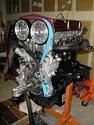
This is a part that I am a little unclear on. I have the Fidanza gears on order (backordered actually) I think they are for the DSM's though. I let SBR know that I am going to run the JUN 264 on my motor and they told me I need the cam gears. I never asked about the settings....yet. I just knew that I needed them.
Newbie
Joined: May 2006
Posts: 89
Likes: 0
From: ATL
You will need to degree (http://www.webcamshafts.com/degreeing.html) any set of cams that you recieve regardless. No one can give you the right settings to do this. In order to do this correctly you really need a set of solid lifters to remove all the lash but I've seen people get away with doing it on hydraulic lifters.
Also, 264 cams are too small for any 4g63 over the stock 2L size. In order to make the most of the engine it will need to be allowed to breath. It can't do it on cams that small. To give you an example, I had HKS 272's in the car then switched over to cam that is 280+ and gained 40 whp peak and extra HP and torque throughout the entire rpm band. In fact, still believe the 280+ cam may still be too small.
Also, 264 cams are too small for any 4g63 over the stock 2L size. In order to make the most of the engine it will need to be allowed to breath. It can't do it on cams that small. To give you an example, I had HKS 272's in the car then switched over to cam that is 280+ and gained 40 whp peak and extra HP and torque throughout the entire rpm band. In fact, still believe the 280+ cam may still be too small.

