


Dual Walbro Flow Tested


Dual Walbro Flow Tested
OK, so I was just sitting at home relaxing, since Sunday is my day off. Somehow i always get suckered into going back to the shop on my days off. I was so curious with how the pumps flowed with different lines and if the 2 pumps actually fight eachother when they are switched on,that i couldnt take it anymore and went to work. This is not a high tech/precision measuring system or anything but it gets close results. You will see what i am talking about when you see the pics.

First, I am going to list all the conversion and measurements along with flow ratings of the walbro 255lph pumps.
Walbro GSS-342 High Pressure 255LPH Tested at 12.5 volts
Tested at 12.5 volts
PSI.........Amps..........Liters/hr
43..........7.5..............233.4
58...........9................210.10
73...........11..............189.3
Tested at 14 volts
PSI.........Amps..........Liters/hr
43..........7.5..............264.4
58...........9................242.9
73...........11..............220.3
** these numbers were taken off another site. I did not do this test.
Good things to know
-There are 3.79 liters in a Gallon
- (1) Gallon of gasoline weighs approximently 6lbs
- There are 16 ounces in a lbs
Ok lets go...!
The test that I ran I used 0 psi ( i had no time to make a system to test against pressure), as you can see from the flow chart above, as pressure increases the volume decreases. Here is the test that i did.
Here is the test equipment I used..
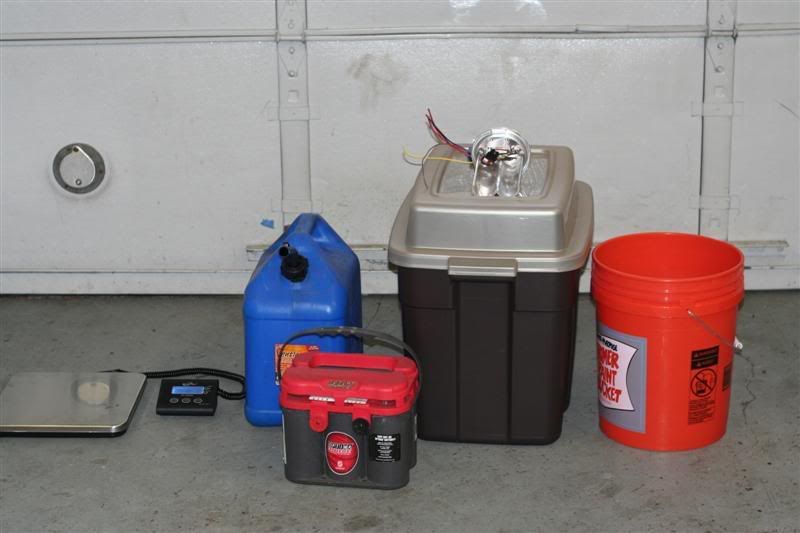
I weighed all my containers before they were filled up with gasoline and then weighted them after with 4 gallons in each.
Container................Empty weight............. With 4 gallons of gasoline inside
Blue fuel container........2lbs 8oz...................26lbs 8 oz.
Brown tubaware...........3lbs 8oz....................27lbs 10oz.
Pretty darn close to that 6lbs of weight per gallon of fuel configurations eh? By the way i didnt make that up. I researched and it seems alot of people agreed that 1 gallon of gasoline at 60 degree room temp weighs 6lbs.
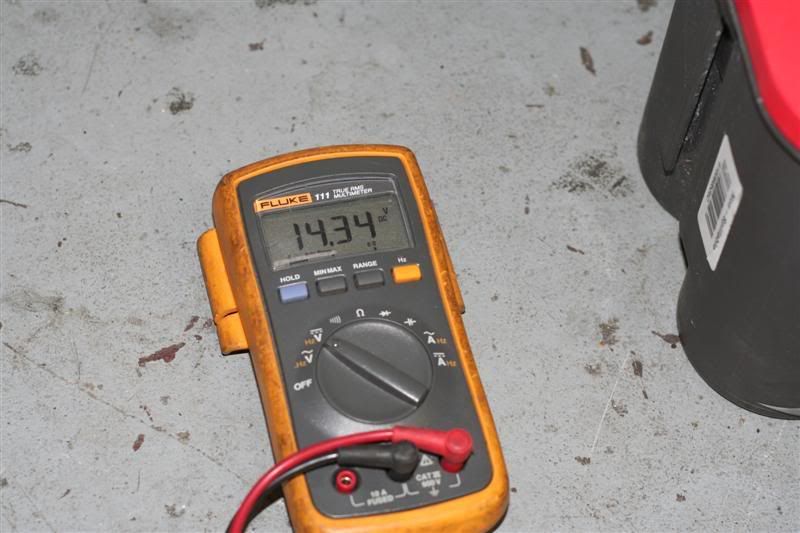
Next, I hooked the battery up to my truck with a jumper cable and kept the truck running so that we have consistant voltage at all times. The voltage were consistant between 14.3-14.2 volts at all times
Heres the little bad boy ready for testing, I am going to be testing with our stock fuel line kit and then with the -10 AN stainless kit
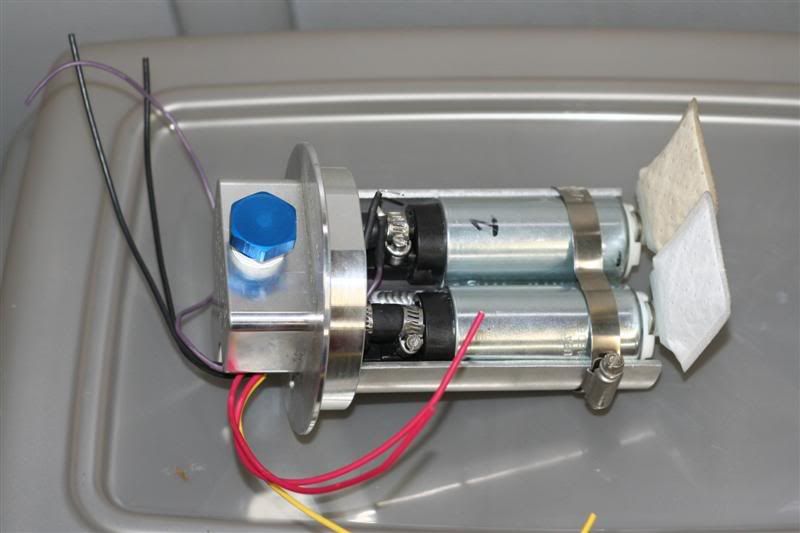
Here he is inside the tank

First test I am going to run a 5/16 fuel line from the Full Blown Twin Pump to the bucket that i will be measuring with my scale, and timed with a stop watch. I started timing as soon as I see the first sign of fuel coming out the line.
Here is the results of the FBM Twin Pump with just a single pump on for 1 min
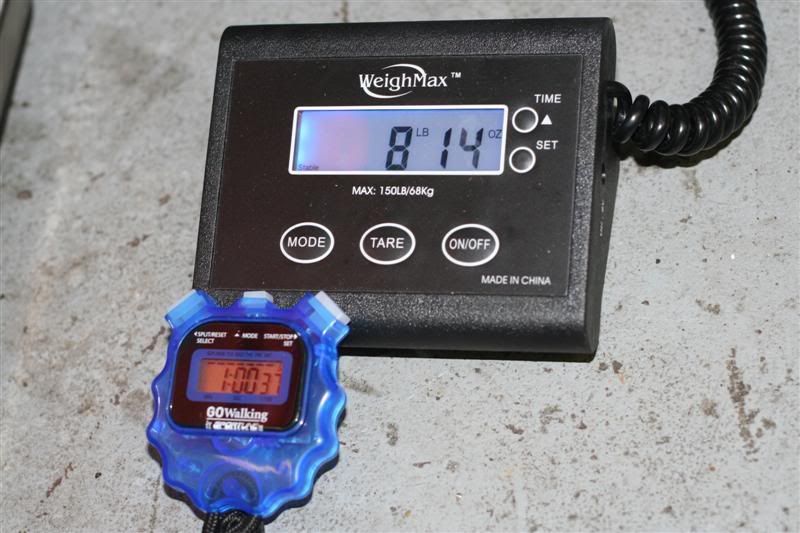
Now here is the results with both pump kicked on for 1 min
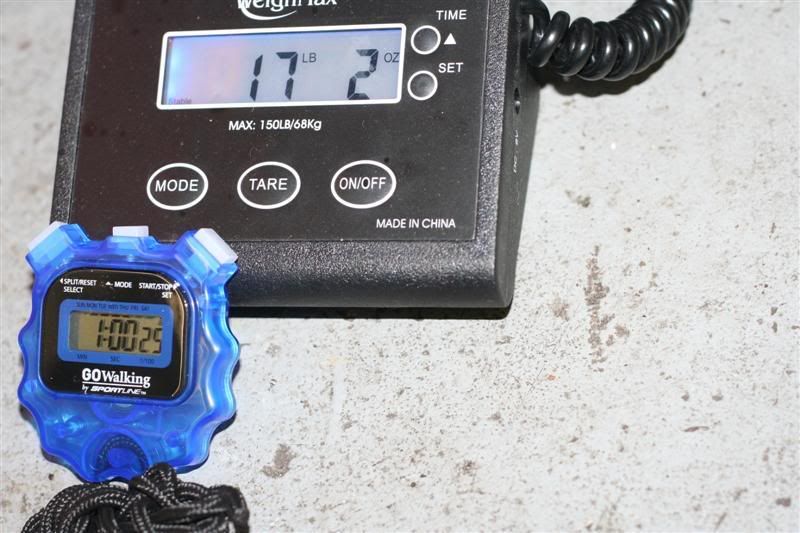
Well, you guys are probally like DUH!! two pumps mean double the volume. This just proved that no they are not fighting eachother. Atleast not at 0psi of pressure. Please pay attention it could change later
Ok, now off to the -10 stainless kit. Oh by the way, both of the lines were cut to 3 feet long to keep it fair, plus i made sure that non of the lines were resting on the bucket that was being weighed.
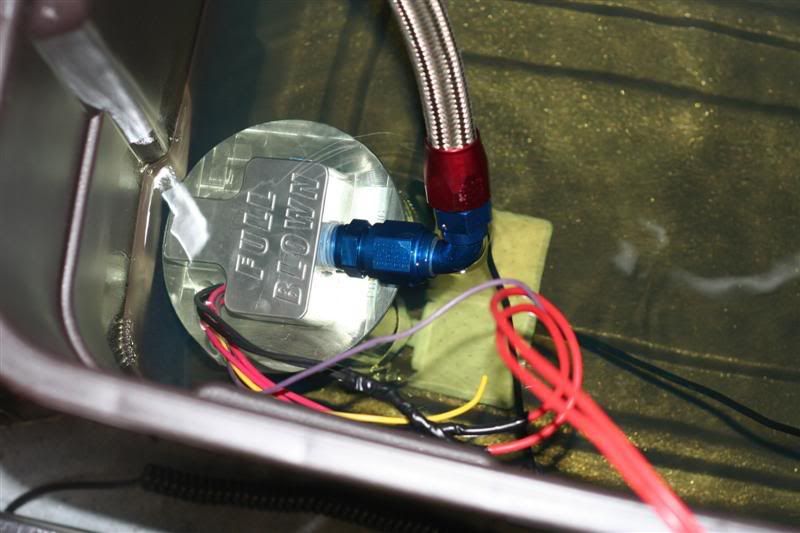
Here is the FBM Pump with the -10 Stainless kit
Ok Now on to the results for the -10 stainless with a single pump turned on, same as the test with the single pump
Finally we have the test with both pumps on with the -10 kit
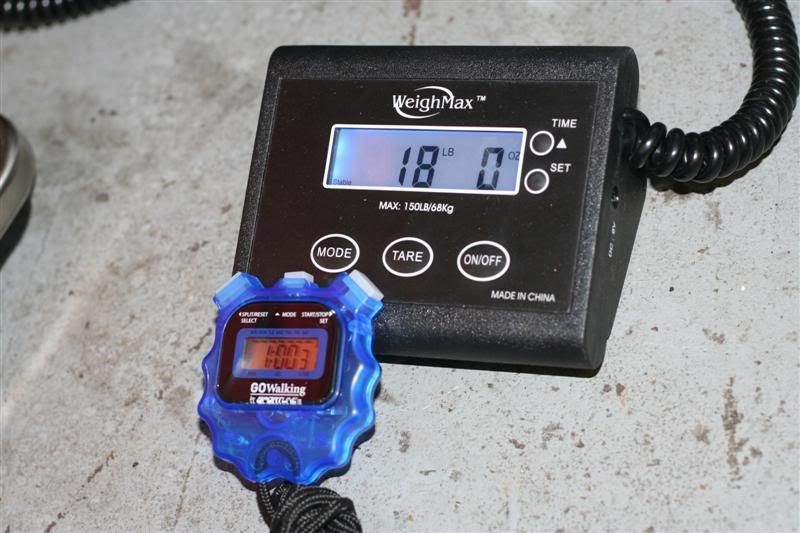
So with the both pumps on, the -10 kit flows about 1 extra lb of fuel then the setup that has the stock lines configured. Lets break it down
1 gallon of fuel = 6 lbs
The Duo pump with the -10 flowed 18lbs per minute.
18 lbs x 60mins = 1080lbs per hour
There are 3.79 liters in a gallon
1080lbs / 6 = 180 gallons
180 gallons x 3.79 literes = 682.2 LPH
If we plug 17 into the equation instead of 18 for the stock line. We get 644.3 LPH
**** you guys may say man these numbers are outragous, but remember the test was done without pressure applied. I will test it againest pressure one of these days, but this took me all day to do. haha
So the results are...
-With a single pump on with the stock line or the -10 the results are the same.
- With both pumps on the the -10 flowed 37.9LPH more then the stock line kit.
And remeber this test is not super accurate but its good enough. Plus all the test were done with 0 pressure. Some of you are probally saying, Hell 37.9LPH is not that much of a difference but look below
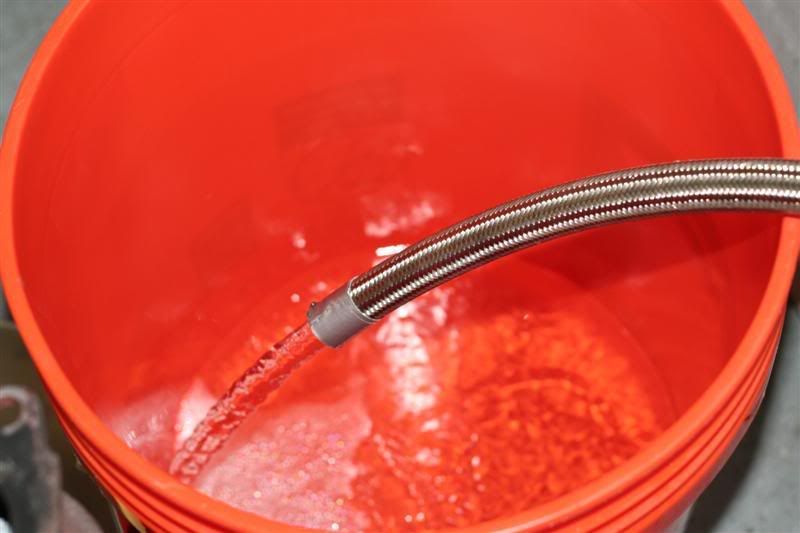
Here is a pic of the -10 with both pumps on, ahhhh.... its almost like someone is pouring you a nice cup of tea
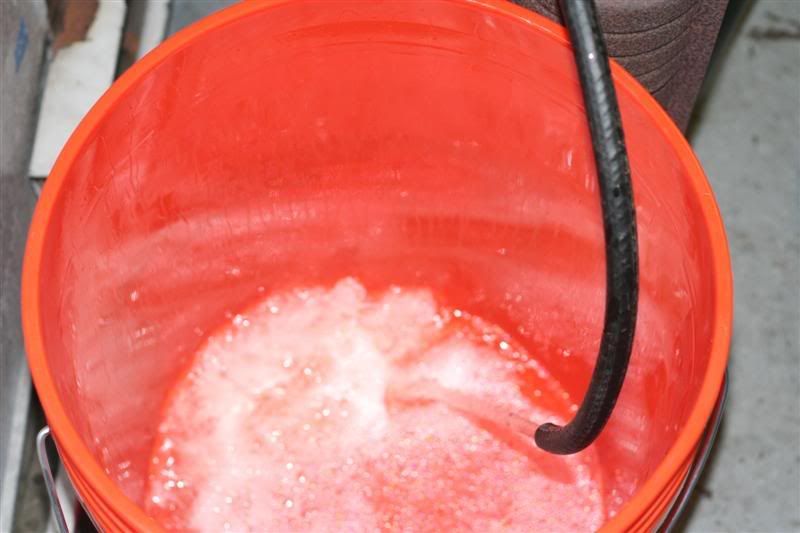
Now the stock line unit, Holy cow its like a fricken horse pissing in your cup of tea!!! I actually got some fuel that bounce off the surface and hit my face cause i wasnt aware of the pressure
Conclusion, both pumps are not fighting eachother in the test. Also I think the stock line will work just as well as the -10 setup. But i dont know if it can compare to the -10 as pressure increases. Im sure you can make tons of power off the stock lines but e85 requires about 30% more volume then gasoline does and those stock lines might not cut it. This setup will work in any way you want it. We offer them in both configurations. Stock lines or -10. You can use it with any type of fuel you like, c16, e85, pump gas, anything you like. If I am wrong with any of the info, please correct me. I just did the test and computed some numbers. I am not claiming that i am right but this is just my opinion based on a test
First, I am going to list all the conversion and measurements along with flow ratings of the walbro 255lph pumps.
Walbro GSS-342 High Pressure 255LPH Tested at 12.5 volts
Tested at 12.5 volts
PSI.........Amps..........Liters/hr
43..........7.5..............233.4
58...........9................210.10
73...........11..............189.3
Tested at 14 volts
PSI.........Amps..........Liters/hr
43..........7.5..............264.4
58...........9................242.9
73...........11..............220.3
** these numbers were taken off another site. I did not do this test.
Good things to know
-There are 3.79 liters in a Gallon
- (1) Gallon of gasoline weighs approximently 6lbs
- There are 16 ounces in a lbs
Ok lets go...!
The test that I ran I used 0 psi ( i had no time to make a system to test against pressure), as you can see from the flow chart above, as pressure increases the volume decreases. Here is the test that i did.
Here is the test equipment I used..
I weighed all my containers before they were filled up with gasoline and then weighted them after with 4 gallons in each.
Container................Empty weight............. With 4 gallons of gasoline inside
Blue fuel container........2lbs 8oz...................26lbs 8 oz.
Brown tubaware...........3lbs 8oz....................27lbs 10oz.
Pretty darn close to that 6lbs of weight per gallon of fuel configurations eh? By the way i didnt make that up. I researched and it seems alot of people agreed that 1 gallon of gasoline at 60 degree room temp weighs 6lbs.
Next, I hooked the battery up to my truck with a jumper cable and kept the truck running so that we have consistant voltage at all times. The voltage were consistant between 14.3-14.2 volts at all times
Heres the little bad boy ready for testing, I am going to be testing with our stock fuel line kit and then with the -10 AN stainless kit
Here he is inside the tank
First test I am going to run a 5/16 fuel line from the Full Blown Twin Pump to the bucket that i will be measuring with my scale, and timed with a stop watch. I started timing as soon as I see the first sign of fuel coming out the line.
Here is the results of the FBM Twin Pump with just a single pump on for 1 min
Now here is the results with both pump kicked on for 1 min
Well, you guys are probally like DUH!! two pumps mean double the volume. This just proved that no they are not fighting eachother. Atleast not at 0psi of pressure. Please pay attention it could change later
Ok, now off to the -10 stainless kit. Oh by the way, both of the lines were cut to 3 feet long to keep it fair, plus i made sure that non of the lines were resting on the bucket that was being weighed.
Here is the FBM Pump with the -10 Stainless kit
Ok Now on to the results for the -10 stainless with a single pump turned on, same as the test with the single pump
Finally we have the test with both pumps on with the -10 kit
So with the both pumps on, the -10 kit flows about 1 extra lb of fuel then the setup that has the stock lines configured. Lets break it down
1 gallon of fuel = 6 lbs
The Duo pump with the -10 flowed 18lbs per minute.
18 lbs x 60mins = 1080lbs per hour
There are 3.79 liters in a gallon
1080lbs / 6 = 180 gallons
180 gallons x 3.79 literes = 682.2 LPH
If we plug 17 into the equation instead of 18 for the stock line. We get 644.3 LPH
**** you guys may say man these numbers are outragous, but remember the test was done without pressure applied. I will test it againest pressure one of these days, but this took me all day to do. haha
So the results are...
-With a single pump on with the stock line or the -10 the results are the same.
- With both pumps on the the -10 flowed 37.9LPH more then the stock line kit.
And remeber this test is not super accurate but its good enough. Plus all the test were done with 0 pressure. Some of you are probally saying, Hell 37.9LPH is not that much of a difference but look below
Here is a pic of the -10 with both pumps on, ahhhh.... its almost like someone is pouring you a nice cup of tea
Now the stock line unit, Holy cow its like a fricken horse pissing in your cup of tea!!! I actually got some fuel that bounce off the surface and hit my face cause i wasnt aware of the pressure
Conclusion, both pumps are not fighting eachother in the test. Also I think the stock line will work just as well as the -10 setup. But i dont know if it can compare to the -10 as pressure increases. Im sure you can make tons of power off the stock lines but e85 requires about 30% more volume then gasoline does and those stock lines might not cut it. This setup will work in any way you want it. We offer them in both configurations. Stock lines or -10. You can use it with any type of fuel you like, c16, e85, pump gas, anything you like. If I am wrong with any of the info, please correct me. I just did the test and computed some numbers. I am not claiming that i am right but this is just my opinion based on a test
Last edited by FullBlown; Jan 14, 2007 at 05:25 PM.


Two open containers of highly flammable liquid, pumped under pressure...
If you are interested, there are liquids available that have a similar specific gravity and viscosity to gasoline but that are not flammable.
The test under pressure would be of much higher importance. Any 4G63 needing twin 255s is going to be seeing close to 75-80 PSI (or higher) fuel pressure which will greatly impact the performance of the system.
I give you praise for actually testing your products though and include various details of the test.
If you are interested, there are liquids available that have a similar specific gravity and viscosity to gasoline but that are not flammable.
The test under pressure would be of much higher importance. Any 4G63 needing twin 255s is going to be seeing close to 75-80 PSI (or higher) fuel pressure which will greatly impact the performance of the system.
I give you praise for actually testing your products though and include various details of the test.
Two open containers of highly flammable liquid, pumped under pressure...
If you are interested, there are liquids available that have a similar specific gravity and viscosity to gasoline but that are not flammable.
The test under pressure would be of much higher importance. Any 4G63 needing twin 255s is going to be seeing close to 75-80 PSI (or higher) fuel pressure which will greatly impact the performance of the system.
I give you praise for actually testing your products though and include various details of the test.
If you are interested, there are liquids available that have a similar specific gravity and viscosity to gasoline but that are not flammable.
The test under pressure would be of much higher importance. Any 4G63 needing twin 255s is going to be seeing close to 75-80 PSI (or higher) fuel pressure which will greatly impact the performance of the system.
I give you praise for actually testing your products though and include various details of the test.
Thanks for your concern, i am aware that there are other liquids available but on a sunday you wont find it. Plus the gas station was less then a block away. I think you have to be extremely careless to hurt yourself in the test that i did.


I am very impressed.
Does this change the idea of the pumps now? can you just have them running on all the time? or do you still want to wire it where the 2nd pump comes on at a certain psi/rpm/speed?
Does this change the idea of the pumps now? can you just have them running on all the time? or do you still want to wire it where the 2nd pump comes on at a certain psi/rpm/speed?
Trending Topics
I personally would have it so the other pump comes on at a certain psi. I dont see why they should be on all the time. The noise might bother ya too.

Buschur had the Walbro pumps professionally flow tested. You can find his data at https://www.evolutionm.net/forums/sh...d.php?t=245064. That test data showed the Walbro in single configuration flows 515 lbs/hr at -0- PSI, about 100 lbs/hr lower than your garage test.
However, no pump operates without restriction, and our base fuel pressure is 43, rising on a 1:1 basis for each pound of boost. So the operating pressure we're interested in is the range of 43-83 PSI or 0=40 PSI boost.
Flow testing without any resistance is not an effective method of determining whether the dual pump setup will give a substantial increase in flow volume over a single pump setup. That information can only be determined with an actual test of the dual pump system in the configuration that duplicates the fuel system on the car.
However, no pump operates without restriction, and our base fuel pressure is 43, rising on a 1:1 basis for each pound of boost. So the operating pressure we're interested in is the range of 43-83 PSI or 0=40 PSI boost.
Flow testing without any resistance is not an effective method of determining whether the dual pump setup will give a substantial increase in flow volume over a single pump setup. That information can only be determined with an actual test of the dual pump system in the configuration that duplicates the fuel system on the car.

Fullblown,
Your test is simply mind blowing fantastic. I must ask you a question though.
I noticed you hooked a secondary battery but have you tried powering the fuel pumps straight from the power source of your car itself.
I currently use 2 voltmeters(one is the stock MR, the other is the Turbo timer digital one) simultaneusly connected to my Evo 8 and the reason why I am bringing this up is because the voltage display might change up to 1.5volts once you run stuff like headlights, high beams,windshield wipers and A/C.
If you only tested the fuel pumps by itself and you used an external battery you might found that in the real test (not the mock up) the car might drop that 1.5volt that I mentioned causing a direct drop on flow.
As far is the comment that you made about the "pumps fighting each other on flow", well, the moment you connect them in parallel the voltage stabilizes so the performance should be very very close, but that is the theory, the practice is different, you definately have the last word on that, I just bring the facts..
Please feel free to add your comment. Again, great post.
Carlos
Your test is simply mind blowing fantastic. I must ask you a question though.
I noticed you hooked a secondary battery but have you tried powering the fuel pumps straight from the power source of your car itself.
I currently use 2 voltmeters(one is the stock MR, the other is the Turbo timer digital one) simultaneusly connected to my Evo 8 and the reason why I am bringing this up is because the voltage display might change up to 1.5volts once you run stuff like headlights, high beams,windshield wipers and A/C.
If you only tested the fuel pumps by itself and you used an external battery you might found that in the real test (not the mock up) the car might drop that 1.5volt that I mentioned causing a direct drop on flow.
As far is the comment that you made about the "pumps fighting each other on flow", well, the moment you connect them in parallel the voltage stabilizes so the performance should be very very close, but that is the theory, the practice is different, you definately have the last word on that, I just bring the facts..
Please feel free to add your comment. Again, great post.
Carlos
Last edited by fromWRXtoEVO; Jan 14, 2007 at 08:09 PM.
Buschur had the Walbro pumps professionally flow tested. You can find his data at https://www.evolutionm.net/forums/sh...d.php?t=245064. That test data showed the Walbro in single configuration flows 515 lbs/hr at -0- PSI, about 100 lbs/hr lower than your garage test.
However, no pump operates without restriction, and our base fuel pressure is 43, rising on a 1:1 basis for each pound of boost. So the operating pressure we're interested in is the range of 43-83 PSI or 0=40 PSI boost.
Flow testing without any resistance is not an effective method of determining whether the dual pump setup will give a substantial increase in flow volume over a single pump setup. That information can only be determined with an actual test of the dual pump system in the configuration that duplicates the fuel system on the car.
However, no pump operates without restriction, and our base fuel pressure is 43, rising on a 1:1 basis for each pound of boost. So the operating pressure we're interested in is the range of 43-83 PSI or 0=40 PSI boost.
Flow testing without any resistance is not an effective method of determining whether the dual pump setup will give a substantial increase in flow volume over a single pump setup. That information can only be determined with an actual test of the dual pump system in the configuration that duplicates the fuel system on the car.
Last edited by FullBlown; Jan 14, 2007 at 08:31 PM.
Fullblown,
Your test is simply mind blowing fantastic. I must ask you a question though.
I noticed you hooked a secondary battery but have you tried powering the fuel pumps straight from the power source of your car itself.
I currently use 2 voltmeters simultaneusly connected to my Evo 8 and the reason why I am bringing this up is because the voltage display might change up to 1.5volts once you run stuff like headlights, high beams,windshield wipers and A/C.
If you only tested the fuel pumps by itself and you used an external battery you might found that in the real test (not the mock up) the car might drop that 1.5volt that I mentioned causing a direct drop on flow.
As far is the comment that you made about the "pumps fighting each other on flow", well, the moment you connect them in parallel the voltage stabilizes so the performance should be very very close, but that is the theory, the practice is different, you definately have the last word on that, I just bring the facts..
Please feel free to add your comment. Again, great post.
Carlos
Your test is simply mind blowing fantastic. I must ask you a question though.
I noticed you hooked a secondary battery but have you tried powering the fuel pumps straight from the power source of your car itself.
I currently use 2 voltmeters simultaneusly connected to my Evo 8 and the reason why I am bringing this up is because the voltage display might change up to 1.5volts once you run stuff like headlights, high beams,windshield wipers and A/C.
If you only tested the fuel pumps by itself and you used an external battery you might found that in the real test (not the mock up) the car might drop that 1.5volt that I mentioned causing a direct drop on flow.
As far is the comment that you made about the "pumps fighting each other on flow", well, the moment you connect them in parallel the voltage stabilizes so the performance should be very very close, but that is the theory, the practice is different, you definately have the last word on that, I just bring the facts..
Please feel free to add your comment. Again, great post.
Carlos
Last edited by FullBlown; Jan 14, 2007 at 08:20 PM.
Additionally guys, always remember that you might have all the pumping force in the world but you are limited by the size of the lines and components, flow and psi are two different beast.
You might have a line that is 1/8 of a inche in diameter that has 500psi but flows 1 galon per hour and have a a line that is 1" diameter that runs 100psi and flows 30galons per hour.. you see what I mean?
Carlos
You might have a line that is 1/8 of a inche in diameter that has 500psi but flows 1 galon per hour and have a a line that is 1" diameter that runs 100psi and flows 30galons per hour.. you see what I mean?
Carlos
Last edited by fromWRXtoEVO; Jan 14, 2007 at 08:24 PM.
Carlos, I have not tryed that. The reason i didnt want any voltage drop is because I wanted the test to be done identical through out, that way we can eliminate as many variables as possible. I even cut the lines the same lengths ect ect. Voltage drop will definately affect the flow rate.But this test was to see the different flow between the single pump and the dual pump and the lines used. You are absolutely correct about the voltage stabilizes and the pumps wont fight eachother, someone had mention that there were cases where they fight eachoter and i just couldnt see that happen, only way that can happen is if the restriction was too great (small line). Thanks bro
The comment that I was refereing to was a full "real load" conditions where your voltage actually fluctuates as you drive. Additionally your test is performed using a custom line, the real final test would be meassuring the flow at the end of the line where it mets the injectors on the fuel rail.
When I went to the automotive vocational school we learned that even the legnth of the cable drops voltage based on the material in which the conductor is made of and the lentgh of the wire itself with the exception of material made with oxigen free.
Another aspect is the gravity of the liquids, the moment you have to feed a line above the resting liquid you now are making the pumps work harder.
Again, I am not critizing your fantastic well meditated test, I think you went far and beyond I was just saying that your test best represents a mock- up fuel flow situation.
Good job anyways.

Carlos
Last edited by fromWRXtoEVO; Jan 14, 2007 at 08:29 PM.
Thnaks for your quick response. That is what I thought so. You basicly created a mock- up lab for identical and untoucahe/unvariable conditions.
The comment that I was refereing to was a full "real load" conditions where your voltage actually fluctuates as you drive. Additionally your test is performed using a custom line, the real final test would be meassuring the flow at the end of the line where it mets the injectors on the fuel rail.
Again, I am not critizing your fantastic well meditated test, I think you went far and beyond I was just saying that your test best represents a mock- up fuel flow situation.
Good job anyways.
Carlos
The comment that I was refereing to was a full "real load" conditions where your voltage actually fluctuates as you drive. Additionally your test is performed using a custom line, the real final test would be meassuring the flow at the end of the line where it mets the injectors on the fuel rail.
Again, I am not critizing your fantastic well meditated test, I think you went far and beyond I was just saying that your test best represents a mock- up fuel flow situation.
Good job anyways.
Carlos
Oh no, i knew you werent criticizing it, if you were thats ok too. Yeh the way you were thinking is maybe a little too far for me haha. We would probally need some kind of voltage restrictor on a knob or something haha. Thanks bro
Last edited by FullBlown; Jan 14, 2007 at 08:33 PM.