


Detailed write-up of walboro vs stock pump


Detailed write-up of walboro vs stock pump
hello everyone,
for a while now i have been wanting to see hard data of how important the walboro 255 fuel pump actually is. i know many vendors have been trying to sell them to everyone, and i wanted to see if this was justified. i know i was strongly against getting a tune after swapping out the fuel pump, but after seeing the data myself, i now stand corrected. here is the data i have collected to compare a stock pump and a walboro 255. the car is a 2003 evo 8 RS. the mods include a ebay TBE with test pipe, manual boost controller, greddy type-S BOV and a dynoflash tune.
to begin with, the car was to be tuned for the exhaust to replace the dynoflash. the first pull i did, we saw the air fuel ratio was 13:1 at WOT at 6000 rpm and up. that was just crazy. i immediately richened the tune up as much as i thought it could handle. and from there i saw it was hitting 100% duty cycle. in the first plot, you can see the duty cycle of the stock injectors with the stock fuel pump touching 100%.

even at 90+ % duty cycle we were a long ways from being a "safe" tune as shown in the following air fuel ratio plot:

the air fuel ratio for the stock pump was still around 12:1, which is much leaner then we wanted. we then immediately went back to the garage and installed the walboro 255 pump in. without touching anything, we ran another pull and saved the data. In the first plot above you can see the injector duty cycles remained the same because we didn't change the open loop fuel tables at all. the only change was the pump. the difference was very visible in the air/fuel ratio though, as seen in the second plot above. the ratio jumped from 12:1 to 10.3:1. this was a huge difference just by swapping the fuel pump. now because the car was running much richer then our target of 11.5:1, we tuned it back to 11.5:1 A/F. the brought the injector duty cycles down to a more managable level as seen by the "after tune" line in the first plot above. the duty cycles went from a peak of 100% to a peak of 85%. the air fuel ratios in the tune left the car running at a perfect 11.5:1 A/F ratio.
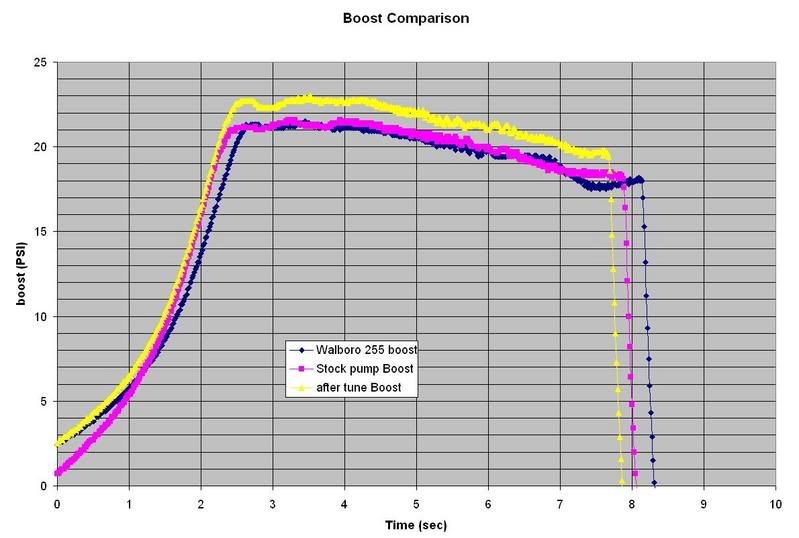
in addition to the final tune, we even turned the boost up. in the plot below, you can see the boost we used in the stock pump run, and the run immediately after it were identical all the way to 7000 rpm (sorry the X axis is in Time, not RPM so it was a little difficult to line up the plots the same as far as when they made full boost). the final tuned run had significantly more boost, and as seen above, still had less duty cycle by about 10-15%.
In conclusion, if you are going to mod your evo 8, one of the first modifications should be the walboro 255. that conclusion isn't anything new, but hopefully the data above shows just how important it is to get the tune after you do your first round of modification which should include the walboro. the stock fuel pump really is a weak link in the system.
for a while now i have been wanting to see hard data of how important the walboro 255 fuel pump actually is. i know many vendors have been trying to sell them to everyone, and i wanted to see if this was justified. i know i was strongly against getting a tune after swapping out the fuel pump, but after seeing the data myself, i now stand corrected. here is the data i have collected to compare a stock pump and a walboro 255. the car is a 2003 evo 8 RS. the mods include a ebay TBE with test pipe, manual boost controller, greddy type-S BOV and a dynoflash tune.
to begin with, the car was to be tuned for the exhaust to replace the dynoflash. the first pull i did, we saw the air fuel ratio was 13:1 at WOT at 6000 rpm and up. that was just crazy. i immediately richened the tune up as much as i thought it could handle. and from there i saw it was hitting 100% duty cycle. in the first plot, you can see the duty cycle of the stock injectors with the stock fuel pump touching 100%.
even at 90+ % duty cycle we were a long ways from being a "safe" tune as shown in the following air fuel ratio plot:
the air fuel ratio for the stock pump was still around 12:1, which is much leaner then we wanted. we then immediately went back to the garage and installed the walboro 255 pump in. without touching anything, we ran another pull and saved the data. In the first plot above you can see the injector duty cycles remained the same because we didn't change the open loop fuel tables at all. the only change was the pump. the difference was very visible in the air/fuel ratio though, as seen in the second plot above. the ratio jumped from 12:1 to 10.3:1. this was a huge difference just by swapping the fuel pump. now because the car was running much richer then our target of 11.5:1, we tuned it back to 11.5:1 A/F. the brought the injector duty cycles down to a more managable level as seen by the "after tune" line in the first plot above. the duty cycles went from a peak of 100% to a peak of 85%. the air fuel ratios in the tune left the car running at a perfect 11.5:1 A/F ratio.
in addition to the final tune, we even turned the boost up. in the plot below, you can see the boost we used in the stock pump run, and the run immediately after it were identical all the way to 7000 rpm (sorry the X axis is in Time, not RPM so it was a little difficult to line up the plots the same as far as when they made full boost). the final tuned run had significantly more boost, and as seen above, still had less duty cycle by about 10-15%.
In conclusion, if you are going to mod your evo 8, one of the first modifications should be the walboro 255. that conclusion isn't anything new, but hopefully the data above shows just how important it is to get the tune after you do your first round of modification which should include the walboro. the stock fuel pump really is a weak link in the system.
Last edited by KevinD; Mar 10, 2007 at 06:55 AM.


How are you measuring the duty cycle of the pump is such a thing exists? You can expect the addition of a pump that flows more to increase the baseline fuel pressure, thus making the injectors flow more. However, the addition of an aftermarket fuel regulator jacking up the pressure on the stock pump may achieve the same thing.
How are you measuring the duty cycle of the pump is such a thing exists? You can expect the addition of a pump that flows more to increase the baseline fuel pressure, thus making the injectors flow more. However, the addition of an aftermarket fuel regulator jacking up the pressure on the stock pump may achieve the same thing.
there is no such thing as duty cycle for a on/off pump. in the plots above it is the duty cycle of the injectors (i edited it to make that clear, sorry for the confusion), with a given pump supplying the fuel. interestingly though, if the stock pump were able to give enough fuel to not drop fuel pressure when the boost demands more pressure, then adding the walboro wouldn't change anything. however, as seen above the stock pump is maxed out with even very minimal mods, and thus cannot keep up to the pressure/flow rate demands. also, you are wrong to assume that simply adding a fuel pump increases baseline fuel pressure. the fuel regulator regulates the baseline pressure, however the stock pump cannot even supply what the stock regulator demands, and thus when adding the walboro we are only achieving what the stock regulator is regulating.
adding an aftermarket fuel pressure regulator on the stock pump wont achieve anything at all because the stock pump cannot even supply the pressure the stock regulator requires, so it would never be able to supply even more pressure from increasing the pressure via aftermarket FPR.
Last edited by KevinD; Mar 10, 2007 at 06:55 AM.

Nice post! I like to see these kinds of threads.
I'll quickly relay what I saw with the pump in these cars. I was getting some lean AFRs on the stock pump. DSMlink was targeting 11:1, and I was seeing ~12.5:1. Ran some quick math and found that the stock pump on stock wiring can only support about 34 lbs/min airflow at 11:1 AFR on pump fuel with a specific gravity of .~75. I turned the boost down to get just below that level, and sure as ****, it held 11:1. As soon as I went over 35 lbs/min AFR started to climb. The same math said that a rewired stock pump (8 or 10 gage right to the pump, full ~14 volts) would support 44 lbs/min, or about 1-2 more than the stock turbo can supply. Sure enough, after rewiring, at 42-43 lbs/min AFRs dropped from the mid 12s right to exactly 11:1.
Not liking to run the pump this close to maxed out, I upgraded to a 255 some time later. WOT AFRs did not budge at all, 11:1. At idle cruise, trims went out about 6%. Not too bad... In the end I put an adjustable FPR on it to get idle cruise pressure back down to normal.
The moral of the story is that if the stock pump is rewired, you won't see this change going to an upgraded pump. If you are a bit creative you can use the stock dual voltage control still I'm sure (and avoid needing the FPR). But for unrewired setups you will have to take out all the extra IDC that was put in to make up for low fuel pressure...
I'll quickly relay what I saw with the pump in these cars. I was getting some lean AFRs on the stock pump. DSMlink was targeting 11:1, and I was seeing ~12.5:1. Ran some quick math and found that the stock pump on stock wiring can only support about 34 lbs/min airflow at 11:1 AFR on pump fuel with a specific gravity of .~75. I turned the boost down to get just below that level, and sure as ****, it held 11:1. As soon as I went over 35 lbs/min AFR started to climb. The same math said that a rewired stock pump (8 or 10 gage right to the pump, full ~14 volts) would support 44 lbs/min, or about 1-2 more than the stock turbo can supply. Sure enough, after rewiring, at 42-43 lbs/min AFRs dropped from the mid 12s right to exactly 11:1.
Not liking to run the pump this close to maxed out, I upgraded to a 255 some time later. WOT AFRs did not budge at all, 11:1. At idle cruise, trims went out about 6%. Not too bad... In the end I put an adjustable FPR on it to get idle cruise pressure back down to normal.
The moral of the story is that if the stock pump is rewired, you won't see this change going to an upgraded pump. If you are a bit creative you can use the stock dual voltage control still I'm sure (and avoid needing the FPR). But for unrewired setups you will have to take out all the extra IDC that was put in to make up for low fuel pressure...


Trending Topics


adding an aftermarket fuel pressure regulator on the stock pump wont achieve anything at all because the stock pump cannot even supply the pressure the stock regulator requires, so it would never be able to supply even more pressure from increasing the pressure via aftermarket FPR.


I only "assume" because you added an aftermarket pump that I "assume" flows more. I have experimented with pumps in the past and I can tell you without a doubt that changing the pump or adding an additional pump can change the baseline fuel pressure. The regulator is essentially a restrictor that is boost referenced and that is how it creates pressure in the rail. If you keep the restriction the same and then increase the flow at the pump the fuel pressure will be greater. For example, adding an additional walbro pump on my TT240Z increased the baseline fuel pressure by 3psi. This caused AFR's to go from 11.6:1 down to 10.8:1. The car did not run rich because my single pump was inadequate, but because I increased the baseline fuel pressure. What did I do? I decreased the baseline fuel pressure back to 41psi using my Aeromotive unit and all was good.
The pump does not supply pressure, it just has a given flow rate. The pressure regulator is what creates the increased fuel pressure by creating a restriction in the line. The only way the you know the pump is inadequate is if the fuel pressure drops during full boost, which indicates that for the given fuel pressure the injectors are flowing more than the pump. Basically, if your fuel pressure drops under boost then the pump is inadequate.
The pump does not supply pressure, it just has a given flow rate. The pressure regulator is what creates the increased fuel pressure by creating a restriction in the line. The only way the you know the pump is inadequate is if the fuel pressure drops during full boost, which indicates that for the given fuel pressure the injectors are flowing more than the pump. Basically, if your fuel pressure drops under boost then the pump is inadequate.
you are sort of right...
a fuel pressure regulator is a restriction in the system, but it is a regulator, and thus regardless of flow rate, it will still maintain the pressure the spring/diaphram system is holding. because they are boost referenced, when boost pressure is added to the diaphram pressure it increases the pressure the fuel is at (regardless of flow rate). in your case, if you added a second pump and the pressure increased without changing the regulator, you have essentially made the regulator a restriction (more like an plug in the system, only so much can flow through it and your trying to push more then it can flow through it).
you are right, the pump does not supply pressure (it supplys flow rate)... the regulator regulates the pressure. think of it this way, if you have 20 argon bottles connected to a pressure regulator set at 80psi, are you saying 160psi will come out of a pressure regulator set at 80psi if we add 20 more argon bottles? the correct answer is no... adding more bottles does not increase pressure. only changing the pressure regulator will change pressure. (not exactly a perfect reference... but you should get the picture)
now in our case the stock pump is only capable of supplying flow rate for 50psi when the regulator is trying to hold 80 psi (which means the return line will be empty). this would be the case where the injectors are demanding more flow rate then the pump is capable of supplying. now if we change the pump out for a larger pump, we will see that 80psi at the regulator, the return line will ahve some fuel in it, the injectors flow rate is less then the flow rate of the larger pump, and everything is happy.
I only "assume" because you added an aftermarket pump that I "assume" flows more. I have experimented with pumps in the past and I can tell you without a doubt that changing the pump or adding an additional pump can change the baseline fuel pressure. For example, adding an additional walbro pump on my TT240Z increased the baseline fuel pressure by 3psi. This caused AFR's to go from 11.6:1 down to 10.8:1.
It's also worth mentioning that the return line is the next major restriction after upgrading the regulator. On the EVO the stock line was a problem with a single 255. I did the same thing I did on the 2g, upgrading the return line to a length of 3/8th inch brake line. Many poeple with larger pumps overlook this aspect of the fuel system...

Thanks for the info, guys.
I'd love to see some data on the IX pump. After speaking with AMS last week (who said that the IX has a stronger pump than the VIII and was supporting a 360whp road race car of theirs), I'm curious to know when the 255HP becomes a rational/required upgrade.
I'd love to see some data on the IX pump. After speaking with AMS last week (who said that the IX has a stronger pump than the VIII and was supporting a 360whp road race car of theirs), I'm curious to know when the 255HP becomes a rational/required upgrade.
FYI, a 3/8" supply line will support 800hp worth of fuel so I would think the stock return will not be an issue. The only way the regulator will maintain the stock pressure regardless of the change in flow of an aftermarket pump is to have a closed loop system. Unless the EVO fuel pressure regulator uses such a system there is a strong probability a higher flowing pump will cause an increase in baseline fuel pressure.
Ask yourself a simple question, if you change the pump how does a normal regulator know what pressure it is creating in the rail? Answer....it doesn't as its only reference is manifold pressure.
Ask yourself a simple question, if you change the pump how does a normal regulator know what pressure it is creating in the rail? Answer....it doesn't as its only reference is manifold pressure.
Last edited by 240Z TwinTurbo; Mar 12, 2007 at 05:56 AM.

