


Mustang dyno load = street load?


Thread Starter


Joined: Aug 2003
Posts: 14,094
Likes: 1,092
From: Mid-Hudson, NY
Here is another overlay. This time a customers car. On and off the dyno same day.
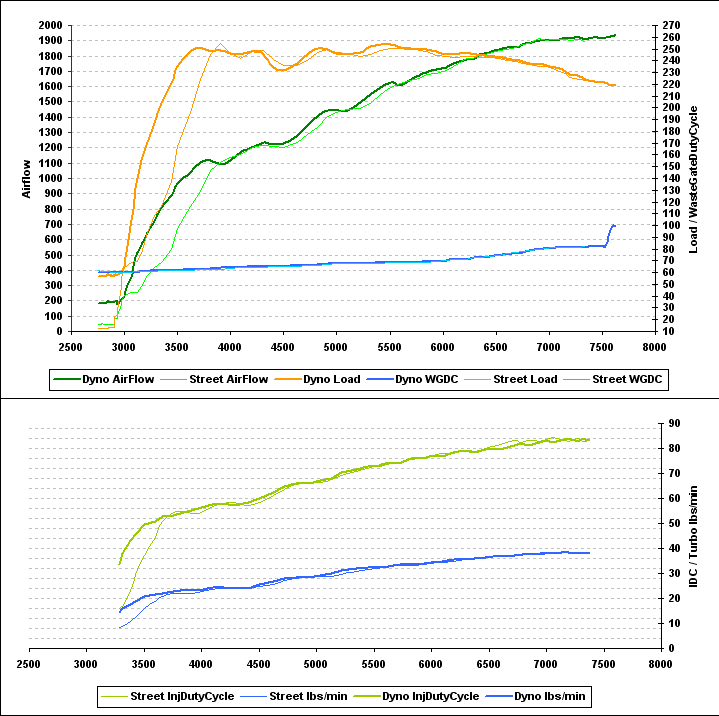
I put the hammer down on the street a little later than the dyno but after that it pretty much lines up everywhere to the dyno.
Notice that the WGDC curve is identical between the two, meaning ecu-boost error correction did not have to kick in to hit the target load on either the dyno, or the street.
I put the hammer down on the street a little later than the dyno but after that it pretty much lines up everywhere to the dyno.
Notice that the WGDC curve is identical between the two, meaning ecu-boost error correction did not have to kick in to hit the target load on either the dyno, or the street.


Thread Starter
Joined: Aug 2003
Posts: 14,094
Likes: 1,092
From: Mid-Hudson, NY


Dynojets are driven on. Tuners tune cars.
Dynojets front and rear rollers roll independently, are not loaded to simulate real street load and your tune could vary from street to dyno.

Dynojets front and rear rollers roll independently, are not loaded to simulate real street load and your tune could vary from street to dyno.

Razorlab,
Would you be willing to do a time based comparision instead of RPM based?
I think it would be more reviling of how close the two load situations are as it would clearly show if the RPM curves overlay or diverge from each other.
Would you be willing to do a time based comparision instead of RPM based?
I think it would be more reviling of how close the two load situations are as it would clearly show if the RPM curves overlay or diverge from each other.


Aby has logs from his car on a DynoJet424x. The rollers together are approximate in weight to the Evo. He has an rpm vs. time trace when he was tweaking his AEM. The trace correlated really closely to his street logs...so close in fact he didn't need to adjust his tune IIRC.
If he wants, he can jump in here with specifics.
Also, I have personally had my car tuned by Bryan (Razorlab) with the Mustang Dyno in this thread. The tunes are spot on, and the MD is reflective of the load the car sees on the street.
I have no idea how they all compare to be honest and I can see each side of this arguement compeltely. I would like to add though so I will just add a few things I have noticed.
On a dynojet, boost came on ~700 RPM later then it did on the street while tuning a 3000 pound GT42 powered subaru. This was the 424 dynojet with the single eddy current load (not used).
The lack of the rollers being tied together on the dynojet really pissed of the Subaru center diff on decel. I would imagine the ACD would respond similarly?
That same car ran like complete crap first time down the track. WAY too rich. A/Fs went from low 11s ont he dyno to high 9s. However, I changed the acceleration correction in the Hydra, retuned on the same dynojet and the next time at the track, the A/Fs were spot on in every gear. I beleive that if you are tuning on a dynojet and you hit the track only to find the A/F has changed, it is because the tune was wrong and not because of the difference in load. If the tune is correct, the load should not matter because the tune should be able to account for varying load.
On the mustang dyno, I was able to run 2-3 more PSI of boost on 91 octane then what I could get away with on the street. This was in 2WD mode on a 2G GS-T with the knock sensor disabled. Running the dyno tune that was safe on the dyno resulted in detonation on the street.
Either the DSM AWD system really sucks out power, or the Mustang dyno reads very different in 2WD vs. AWD. Two friends with similar cars/setups. '95 TSI AWD went 123mph at 3400 pounds, made 380 WHP. '97 GS-T went 122mph at 3000 pounds, made 450 WHP on the same dyno with the same dyno operator running it.
On a dynojet, boost came on ~700 RPM later then it did on the street while tuning a 3000 pound GT42 powered subaru. This was the 424 dynojet with the single eddy current load (not used).
The lack of the rollers being tied together on the dynojet really pissed of the Subaru center diff on decel. I would imagine the ACD would respond similarly?
That same car ran like complete crap first time down the track. WAY too rich. A/Fs went from low 11s ont he dyno to high 9s. However, I changed the acceleration correction in the Hydra, retuned on the same dynojet and the next time at the track, the A/Fs were spot on in every gear. I beleive that if you are tuning on a dynojet and you hit the track only to find the A/F has changed, it is because the tune was wrong and not because of the difference in load. If the tune is correct, the load should not matter because the tune should be able to account for varying load.
On the mustang dyno, I was able to run 2-3 more PSI of boost on 91 octane then what I could get away with on the street. This was in 2WD mode on a 2G GS-T with the knock sensor disabled. Running the dyno tune that was safe on the dyno resulted in detonation on the street.
Either the DSM AWD system really sucks out power, or the Mustang dyno reads very different in 2WD vs. AWD. Two friends with similar cars/setups. '95 TSI AWD went 123mph at 3400 pounds, made 380 WHP. '97 GS-T went 122mph at 3000 pounds, made 450 WHP on the same dyno with the same dyno operator running it.

Thread
Thread Starter
Forum
Replies
Last Post
David Buschur
Evo General
74
Aug 26, 2005 08:24 AM
adjust, boost, calculation, california, colton, dyno, load, loads, mbt, mustang, oklahoma, tuner, tuners, utah, zwingerryry
