


To Stroke or Not to Stroke






True True
A long rod 2.2 becomes a bit tricky in the 4g63. The only kit I like is Greg's at GSC. If you get a shop to build you one, you should get specs like his kit. Also 10.5:1 is a bit high for pump. However I am 10:1 on 92 and E85. What fuel will you be running?
Mikey
Mikey

The problem with revving a 2.3l high is main bearings. This situation hardly changes at all between a 2.3l and long-rod 2.4l. For that matter, the piston acceleration advantage with the extra 6mm rod length is also very, very small. I didn't see anybody put any real numbers to this, but I believe it is less than 200rpm for the piston acceleration difference. Add the 6mm worth of extra rod length/weight and it is pretty much a wash. I see the only advantage of the 2.4l as the slightly lower rod angles for less cylinder wall wear, but with where the Wiseco stuff is going for skirt shapes the wall wear really isn't an issue.
I've been spinning the 2.3l to 9200rpm for a little over a season now. The center main bearing doesn't love this, but lives if slotted and seems to also like more clearance. The real fix is either more counterweight on the crank or less piston weight. I'm working with Wiseco on some parts to go higher than I'm going right now reliably. Then there is the issue of keeping it breathing up there...
Kevin
I've been spinning the 2.3l to 9200rpm for a little over a season now. The center main bearing doesn't love this, but lives if slotted and seems to also like more clearance. The real fix is either more counterweight on the crank or less piston weight. I'm working with Wiseco on some parts to go higher than I'm going right now reliably. Then there is the issue of keeping it breathing up there...
Kevin

The problem with revving a 2.3l high is main bearings. This situation hardly changes at all between a 2.3l and long-rod 2.4l. For that matter, the piston acceleration advantage with the extra 6mm rod length is also very, very small. I didn't see anybody put any real numbers to this, but I believe it is less than 200rpm for the piston acceleration difference. Add the 6mm worth of extra rod length/weight and it is pretty much a wash. I see the only advantage of the 2.4l as the slightly lower rod angles for less cylinder wall wear, but with where the Wiseco stuff is going for skirt shapes the wall wear really isn't an issue.
I've been spinning the 2.3l to 9200rpm for a little over a season now. The center main bearing doesn't love this, but lives if slotted and seems to also like more clearance. The real fix is either more counterweight on the crank or less piston weight. I'm working with Wiseco on some parts to go higher than I'm going right now reliably. Then there is the issue of keeping it breathing up there...
Kevin
I've been spinning the 2.3l to 9200rpm for a little over a season now. The center main bearing doesn't love this, but lives if slotted and seems to also like more clearance. The real fix is either more counterweight on the crank or less piston weight. I'm working with Wiseco on some parts to go higher than I'm going right now reliably. Then there is the issue of keeping it breathing up there...
Kevin
Josh
The added displacement doesn't hurt, but in the grand scheme of things 0.08L at the same overbore (1.5mm different) really isn't much. It is maybe 3% more torque, but I doubt there is any peak power advantage. The 2.3l's really don't tend to make any more power than the 2.0's just because of cylinder head breathing limits.
Kevin
Kevin
The problem with revving a 2.3l high is main bearings. This situation hardly changes at all between a 2.3l and long-rod 2.4l. For that matter, the piston acceleration advantage with the extra 6mm rod length is also very, very small. I didn't see anybody put any real numbers to this, but I believe it is less than 200rpm for the piston acceleration difference. Add the 6mm worth of extra rod length/weight and it is pretty much a wash. I see the only advantage of the 2.4l as the slightly lower rod angles for less cylinder wall wear, but with where the Wiseco stuff is going for skirt shapes the wall wear really isn't an issue.
Also I believe that Aaron and R/TErnie ran the math and the extra 6mm is work about 250rpms based off the pistons peak speeds. You are correct about the piston/rod weight being higher in the LR2.4 vs a 2.3 but I don't believe that is an issue being that we are not revving the motors out to 9.5k or above. Sure the lighter the materials the "easier" the motor will rev and safer but at a turning speed of 8.5k max, I don't think the difference between the two motors is as relevant as a motor reving to 9.5k. Where the weight comes into a problem is giving the bearings a beating but I think that is minimal if the motors are kept below 8.5k and the torque remains below the 550 mark. To make the perfect LR2.4 an aluminum 156mm rod would need to be used, however I don't believe that is possible with the 100mm crank. If you did a Long Rod 2.3 w/ 96mm crank then you may be able to pull it off.
The Wiseco pistons are the **** and skirt design is better than any other comp. That is why I picked these pistons along with the 156mm rod to make side load on the walls as minimal as possible.
I've been spinning the 2.3l to 9200rpm for a little over a season now. The center main bearing doesn't love this, but lives if slotted and seems to also like more clearance. The real fix is either more counterweight on the crank or less piston weight. I'm working with Wiseco on some parts to go higher than I'm going right now reliably. Then there is the issue of keeping it breathing up there...
 What crank are you using? Also can you go into more detail about adding more counterweight on to the crank for me? You should look into a LR2.3 w/4G64 block with a 96mm lightweight crank, aluminum 156mm rods, and a lighter weight Wiseco pistons.
The added displacement doesn't hurt, but in the grand scheme of things 0.08L at the same overbore (1.5mm different) really isn't much. It is maybe 3% more torque, but I doubt there is any peak power advantage. The 2.3l's really don't tend to make any more power than the 2.0's just because of cylinder head breathing limits.
Kevin
Kevin
Also if you have time, can you look through my LR2.4 thread and please add your inputs? Thanks https://www.evolutionm.net/forums/ev...tor-build.html post number 28 goes into what you were talking about...
Also thanks for what you do for the evo community.
Mikey
Last edited by BLKCarbonEVO; Jun 6, 2010 at 03:29 PM.
~
With your 2.3 requiring alittle more than 11% more airflow than a 2.0 you are at the limit of the evo head right now with turning it 9200. I would be interested to know how you plan to rev higher... Also from what I have heard, the head doesn't really respond to anything over 10.5mm lift. Do you agree with this?
Kevin
Those are nowhere near where my targest lie. For what its worth, my setup at the end of last season made peak power at ~8400rpm, which obviously should be revved higher than 8500rpm based on power curve.
Last year I was running an OEM crank, this year it is an Eagle. I had no problems with the OEM crank. Also remember this is a DSM, I would likely be running an Manley crank if it were a 7-bolt.
Where are you getting the 11% number since the engine is ~15% larger? I'm running a 2g dsm head, which is almost identical to an EVO head port-wise aside from the injector placement. My head is about level for flow from 0.400-0.600" lift. I think it is possible to make power past this rpm and I intend to find out. As far as responding on a running engine above 10.5mm lift, more duration at lower lift certainly helps so if there has to be more lift to accomodate the accelerations that is how it goes. I'm running 14.0mm lift on my intake cam.

Mikey

FWIW, I nor anyone I've ever talked to whos opinion I respect has seen a long rod make any sort of difference, if you say otherwise you'll be the first.
What specifically is Wiseco doing with the skirt shape?
The center main bearing doesn't love this, but lives if slotted and seems to also like more clearance.
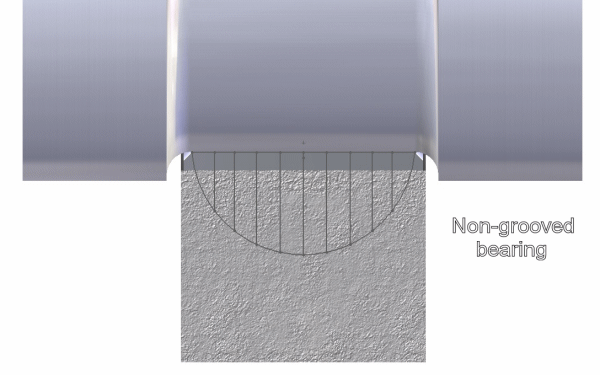
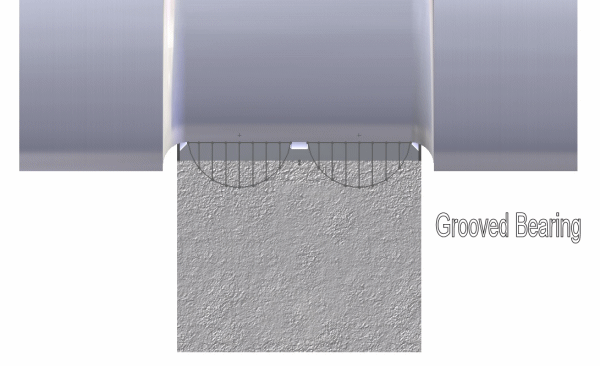
All that said, I'd still like you to describe a little more in depth about your bearing issues. It must be the exhaust stroke taking out the top shell? As the journals are the same size, surface speed is less on a stroker motor, thats the only way I can imagine you having more issues than a higher revving 2.0l. If it is the top shell that is your issue, a non grooved bearing has considerably more load bearing capability than a grooved type.
This is a sketch of the pressure distribution across a bearing. It's less at the edges where oil is leaking out.
This sketch shows how a groove in the bearing significantly degrades the load capacity of a bearing.
Have you tried a full, non grooved bearing in the center?
A non-grooved center main bearing (like our OEM ones) would gall or wipe out in about 10 passes with my old setup. After grooving the main bearings they would go for a season. I think it is a bearing overheat issue, not a film strength issue. The slotted bearing flows more oil and cools itself better.
The main bearing issue is the lower center main bearing. If you run through all the combined inertia and cylinder pressure loading calculations you'll find this is the highest loaded bearing. The bearing loading is also tightly tied to counterweight mass. One reason I would be keen on checking out some of the aftermarket cranks is they could have a higher counterweight percentage to counteract the inertia forces at high rpm. I don't think the OEM 7-bolt has any strength issues, but I think it has the same inertia and bearing loading issues as all the 6-bolts.
Kevin
The main bearing issue is the lower center main bearing. If you run through all the combined inertia and cylinder pressure loading calculations you'll find this is the highest loaded bearing. The bearing loading is also tightly tied to counterweight mass. One reason I would be keen on checking out some of the aftermarket cranks is they could have a higher counterweight percentage to counteract the inertia forces at high rpm. I don't think the OEM 7-bolt has any strength issues, but I think it has the same inertia and bearing loading issues as all the 6-bolts.
Kevin

Aaron at ER did a LR2.2 with a 162mm rod and said it was a pos compared to his LR2.4. He loves the 2.4 much better. That coming from someone with over 10 years of 4G63 experience tuning and racing! I would have never thought Aaron to go to motor like the 2.4, much less love it and say he will never have anything different. Aaron has personally ran almost every motor combination known to man for the evo.
Mikey
A non-grooved center main bearing (like our OEM ones) would gall or wipe out in about 10 passes with my old setup. After grooving the main bearings they would go for a season. I think it is a bearing overheat issue, not a film strength issue. The slotted bearing flows more oil and cools itself better.
The main bearing issue is the lower center main bearing. If you run through all the combined inertia and cylinder pressure loading calculations you'll find this is the highest loaded bearing. The bearing loading is also tightly tied to counterweight mass. One reason I would be keen on checking out some of the aftermarket cranks is they could have a higher counterweight percentage to counteract the inertia forces at high rpm. I don't think the OEM 7-bolt has any strength issues, but I think it has the same inertia and bearing loading issues as all the 6-bolts.
Kevin
The main bearing issue is the lower center main bearing. If you run through all the combined inertia and cylinder pressure loading calculations you'll find this is the highest loaded bearing. The bearing loading is also tightly tied to counterweight mass. One reason I would be keen on checking out some of the aftermarket cranks is they could have a higher counterweight percentage to counteract the inertia forces at high rpm. I don't think the OEM 7-bolt has any strength issues, but I think it has the same inertia and bearing loading issues as all the 6-bolts.
Kevin
Mikey