


PULL type clutch? Someone Please Explain


Thread Starter
Evolving Member
iTrader: (1)
Joined: Jun 2009
Posts: 119
Likes: 0
From: on the interwebs all fricken day.
PULL type clutch? Someone Please Explain
I have done multiple searches and can't find ANYTHING that can help a visual guy like me.
So i understand how a normal clutch works, But what i cant seem to wrap my head around is our "pull" type clutch works.
So, when i press the pedal in, it pulls the clutch disk away from the flywheel?
at what point is there NO load on the TOB? when the clutch pedal is IN? or while the clutch is disengaged (in neutral at a stop light) and there is no foot on the clutch pedal?
any visual aids would help, Im a noob to these vehicles, so thanks for the input.
Mark
So i understand how a normal clutch works, But what i cant seem to wrap my head around is our "pull" type clutch works.
So, when i press the pedal in, it pulls the clutch disk away from the flywheel?
at what point is there NO load on the TOB? when the clutch pedal is IN? or while the clutch is disengaged (in neutral at a stop light) and there is no foot on the clutch pedal?
any visual aids would help, Im a noob to these vehicles, so thanks for the input.
Mark

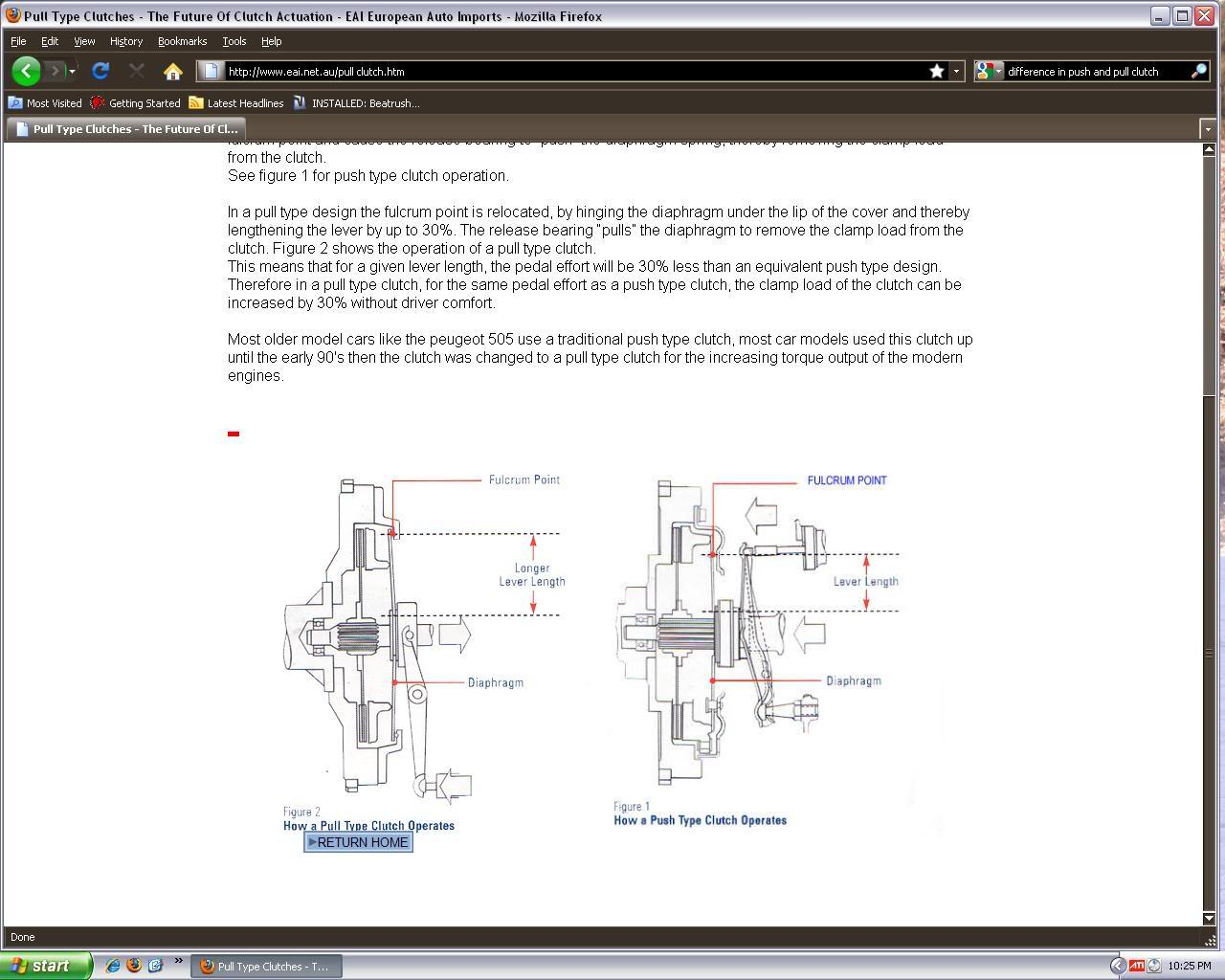

The illustration is great, but unfortunately the logic in the text is flawed. When it comes to a simple change in leverage, you cannot get something for nothing. Whenever you lighten up the pedal effort by a change in geometry, you reduce the lift of the pressure plate from the disc and suffer from inadequate disengagement or less torque capacity in order to make up for the lighter pedal effort.
The real advantage to the pull type system is that the pressure plate is a lot more efficient. Because the pressure plate is loaded in one direction only (toward the transmission) and the diaphragm is supported closer to the clutch bolt flange, there is significantly less deflection (flex) which is basically wasted travel. Any time you reduce travel to accomplish the same clamp load and lift, you can take advantage of the better efficiency by reducing pedal effort or pedal stroke.
The real advantage to the pull type system is that the pressure plate is a lot more efficient. Because the pressure plate is loaded in one direction only (toward the transmission) and the diaphragm is supported closer to the clutch bolt flange, there is significantly less deflection (flex) which is basically wasted travel. Any time you reduce travel to accomplish the same clamp load and lift, you can take advantage of the better efficiency by reducing pedal effort or pedal stroke.


Thread
Thread Starter
Forum
Replies
Last Post
red_evox_87
Mitsubishi TC-SST Discussion
2
Jun 13, 2016 09:00 AM
fireroasted
Evo Engine / Turbo / Drivetrain
13
Jan 13, 2016 04:35 PM
silverevo05
Evo Engine / Turbo / Drivetrain
13
Nov 5, 2007 07:07 PM
ku7484
Evo Engine / Turbo / Drivetrain
7
Sep 9, 2004 03:18 PM


