


3 tanks of E85 and look at my ID2000's! unreal!


Evolving Member
Joined: Feb 2010
Posts: 100
Likes: 1
From: Wisconsin
Well. The testing continues! I heated the lab grade ethanol up to evaporation temperatures and 0 gunk left behind. If anything a clear hardened patina on the bottom of the flask. Not sticky or colored. The additive free 87 octane left some discoloration on the bottom of the vial, but also not sticky. I used an oil bath as opposed to open flame heating source to prevent fire, and also to get constant heat throughout the entire sample. Performed tests on lab grade E-85 and 0 gunk also. I am going to obtain a sample of pump grade E-85 tomorrow and try and finish up all of the previously stated tests and post up charts, results, and my conclusions by mid next week.
1outlaw, I am in the hunt for the major additives that are found in common 87 octane. What would you think would be most relevant to test and how would I obtain some? I think you were right on par with your suggestion of additives as the culprit. Now to narrow down which one, and how to avoid that type at the pump....
1outlaw, I am in the hunt for the major additives that are found in common 87 octane. What would you think would be most relevant to test and how would I obtain some? I think you were right on par with your suggestion of additives as the culprit. Now to narrow down which one, and how to avoid that type at the pump....
 ? Federal law requires all grades of gasoline at retail pumps to contain at least minimum detergents.
I really doubt that Ethyl Corp, Lubrizol, GE/Betz, or Schaeffer's will let any pure additives out for testing. I think the only way to extend this test is to collect a variety of pump grade E0 or E10 85-87 octane (major oil brands/unbranded) from cities where problem existed. This would give us an idea of the gasoline being used for dilution of the E98. I could get you a small sample of the Lubrizol additives I have but they were reportedly made specific for ethanol- thus SHOULD NOT be at issue.
Walking thru the local Wally World last night I looked at the "Octane Boosters" they had on the shelf. They contained MMT
 --this has been reported in various tech docs to be a no-no for ethanol. While no one having trouble has "owned up" to putting OTC's in their E85- it might be interesting to see if this is a deposit issue.
I wish this was simpler to ship samples of fuels and additives but everything today is "hazmat"- costly, limited in who can package (must be certified), and so time consuming. This stops the person who is having an issue from being able to participate freely in the sample process.
Let's see what you find from pump grade E85- that will give us a better clue where to look next.
BTW- gasoline specifications allow for ash to be left over- thus the discoloration left in your 87 octane flask. Can you try rewetting it with a small amount of ethanol to see if it gets sticky?
Last edited by 1outlaw; Apr 29, 2010 at 10:21 AM.

Yes, I obtained an unadulterated sample from a batch of fuel my mother's lab had in stock for testing (she works for an oil company here in the U.S.). So I am 100% certain it was detergent free. I was made aware of the Federal Regulations by her when I told her of my little lab trial. I did ask as to what major detergents were used and her senior lab tech is going to ask for some samples for me, but this is out of their realm of focus so I am not getting my hopes up. They are more on the oil and resorcinol manufacturing side of the business, but we will see what he can dig up.
I understand that some ash could be left over, and this was also what I was thinking for the discoloration. I did put it back in some minimal solvent and it had no adhesive properties. It merely turned the liquid (unadulterated heptane) a darker color, I then did another heating process and the same soot came out of solution, no more, and not sticky at all.
Yes, it stinks that people can't just ship things via Fedex , but we don't want to be breaking any laws. I just need to take a road trip after the motor is built and obtain samples from all of the little stops on the way. I had heard there were some aftermarket fuel cleaners (injector and fuel line cleaners) that were a problem with E-85, but I was never sure of which ones. I never run any of that stuff as I usually clean and disassemble most of the components on my car regularly so I can visually see and clean them myself.
What would be a good thing for people having this issue on their car to do is to take a sample of the fuel that is in your gas tank at the time. Just seal it in a vial or jar and maybe I can figure out a way of inexpensively shipping things to me. I agree, it is only when we get a sample of fuel that is a KNOWN problem before we can really get to the bottom of the issue. A sample from a car with this problem seems like the only reasonable solution to me... Your thoughts?
I understand that some ash could be left over, and this was also what I was thinking for the discoloration. I did put it back in some minimal solvent and it had no adhesive properties. It merely turned the liquid (unadulterated heptane) a darker color, I then did another heating process and the same soot came out of solution, no more, and not sticky at all.
Yes, it stinks that people can't just ship things via Fedex
, but we don't want to be breaking any laws. I just need to take a road trip after the motor is built and obtain samples from all of the little stops on the way. I had heard there were some aftermarket fuel cleaners (injector and fuel line cleaners) that were a problem with E-85, but I was never sure of which ones. I never run any of that stuff as I usually clean and disassemble most of the components on my car regularly so I can visually see and clean them myself. What would be a good thing for people having this issue on their car to do is to take a sample of the fuel that is in your gas tank at the time. Just seal it in a vial or jar and maybe I can figure out a way of inexpensively shipping things to me. I agree, it is only when we get a sample of fuel that is a KNOWN problem before we can really get to the bottom of the issue. A sample from a car with this problem seems like the only reasonable solution to me... Your thoughts?

Evolving Member
Joined: Feb 2010
Posts: 100
Likes: 1
From: Wisconsin
buchnerj-- I would say that a sample from the tank of a problem car would not close the info gap- we also need a sample from the pump at which they bought from. both then could be compared to determine if the problem came from the car or from the retail pump. This would take care of OTC (over the counter) additives which might have been added AND answer if it is a fuel tank/deposit issue. Should it be a station tank or fuel issue at the station the same load may still exist or remnants from cross mix will still be present in the next load.
Even if the samples could not be shipped- there is another resource in many states. There is the state "fuel inspection" boys who commonly distill samples to see if the distillation curve meets specification. They commonly take it to endpoint. While outside of our control as comparison, they should know the local fuels very well and be able to write a report as to findings that the complaintant could share.
I was wondering how you got your hands on unadditized NL--now I know LOL.
Even if the samples could not be shipped- there is another resource in many states. There is the state "fuel inspection" boys who commonly distill samples to see if the distillation curve meets specification. They commonly take it to endpoint. While outside of our control as comparison, they should know the local fuels very well and be able to write a report as to findings that the complaintant could share.
I was wondering how you got your hands on unadditized NL--now I know LOL.
Last edited by 1outlaw; Apr 29, 2010 at 02:49 PM.

This problem has nothing to do with cleaning out the fuel system, I can tell you that much. There is no way dirt from the fuel system is making it past the fuel filter, past the built-in 7 micron filter in the ID injector and for some damn reason sticks to the end of the injector. IT'S HEAT RELATED. And yes it has a LOT to do with where you're getting your e-85 from.
This problem is for the advanced chemists. Get your beakers ready!
IT'S HEAT RELATED. And yes it has a LOT to do with where you're getting your e-85 from. This problem is for the advanced chemists. Get your beakers ready!


HMMM, Recall that I posted I have a DSM and and EVO9, both running on e85 from the same station! The DSM seems to be much more prone to the sludge buildup than the EVO is!
On a DSM, the injector boss is machined directly into the head.
On an EVO, the injector boss is machined into the intake manifold.
In my case I'm running a Magnus intake on both cars WITH the heat barrier gasket on both cars.
The heat at the injector tip "should" be cooler on my EVO than on the DSM. (just speculation at this point as I have no way to measure the differance)
John-
Evolving Member
Joined: Feb 2010
Posts: 100
Likes: 1
From: Wisconsin
This problem has nothing to do with cleaning out the fuel system, I can tell you that much. There is no way dirt from the fuel system is making it past the fuel filter, past the built-in 7 micron filter in the ID injector and for some damn reason sticks to the end of the injector. IT'S HEAT RELATED. And yes it has a LOT to do with where you're getting your e-85 from.
This problem is for the advanced chemists. Get your beakers ready!
IT'S HEAT RELATED. And yes it has a LOT to do with where you're getting your e-85 from. This problem is for the advanced chemists. Get your beakers ready!

HMMM, Recall that I posted I have a DSM and and EVO9, both running on e85 from the same station! The DSM seems to be much more prone to the sludge buildup than the EVO is!
On a DSM, the injector boss is machined directly into the head.
On an EVO, the injector boss is machined into the intake manifold.
In my case I'm running a Magnus intake on both cars WITH the heat barrier gasket on both cars.
The heat at the injector tip "should" be cooler on my EVO than on the DSM. (just speculation at this point as I have no way to measure the differance)
John-
On a DSM, the injector boss is machined directly into the head.
On an EVO, the injector boss is machined into the intake manifold.
In my case I'm running a Magnus intake on both cars WITH the heat barrier gasket on both cars.
The heat at the injector tip "should" be cooler on my EVO than on the DSM. (just speculation at this point as I have no way to measure the differance)
John-

I've seen at least one DSM converted to phenolic fuel rail mounts to eliminate the problem of transferring heat from the head to the aluminum rail either directly (through the plastic spacers), or through the mounting bolts. I've never heard of fuel heat issues on an Evo (which sports a significantly different rail and injector mounting design, different material, etc), but it can definitely be a problem on DSMs.
DSMs also seem to be affected more by this, by a large margin, So, I'd buy the argument that the issue is exacerbated by (but not necessarily caused by) heat.
DSMs also seem to be affected more by this, by a large margin, So, I'd buy the argument that the issue is exacerbated by (but not necessarily caused by) heat.
I've seen at least one DSM converted to phenolic fuel rail mounts to eliminate the problem of transferring heat from the head to the aluminum rail either directly (through the plastic spacers), or through the mounting bolts. I've never heard of fuel heat issues on an Evo (which sports a significantly different rail and injector mounting design, different material, etc), but it can definitely be a problem on DSMs.
DSMs also seem to be affected more by this, by a large margin, So, I'd buy the argument that the issue is exacerbated by (but not necessarily caused by) heat.
DSMs also seem to be affected more by this, by a large margin, So, I'd buy the argument that the issue is exacerbated by (but not necessarily caused by) heat.
No, I can't get my hands on a sample that is known to cause problems. I have been on E-85 for over a year and never had this build up on my car. That is what we really need, a sample of fuel that has known issues. It will be difficult to simulate all those conditions in the lab setting, but I will try my best.

Update... so i ran two tanks of pump gas through the injectors, and now switched back to E85. This is after 2 tanks of E85 now.
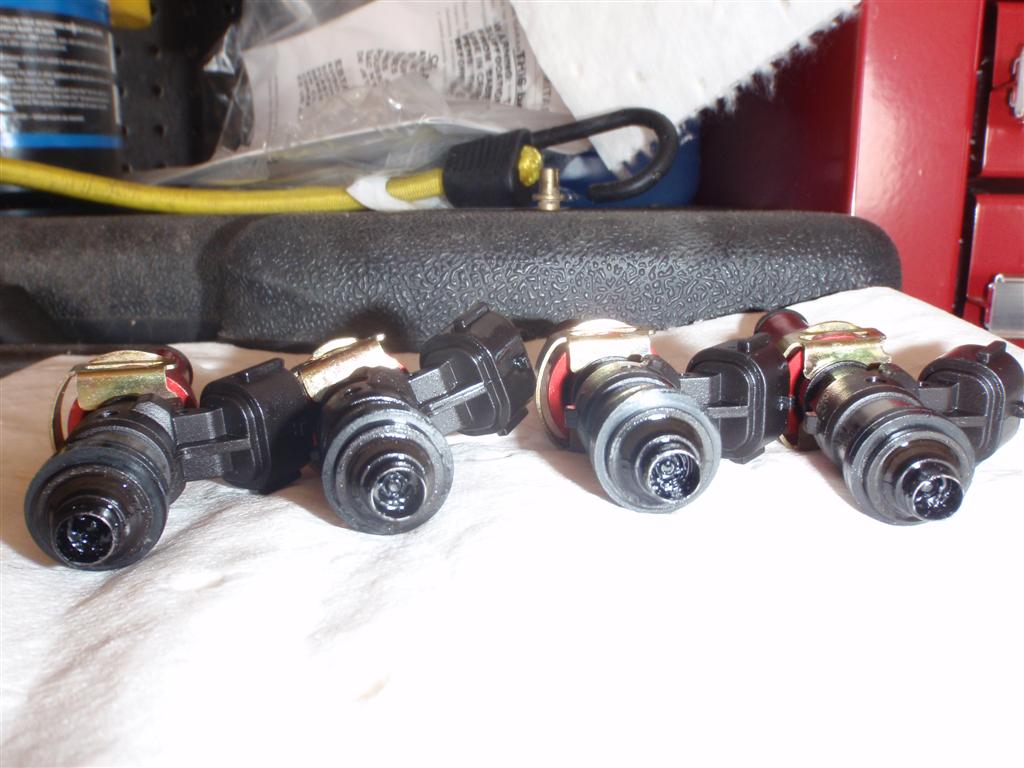
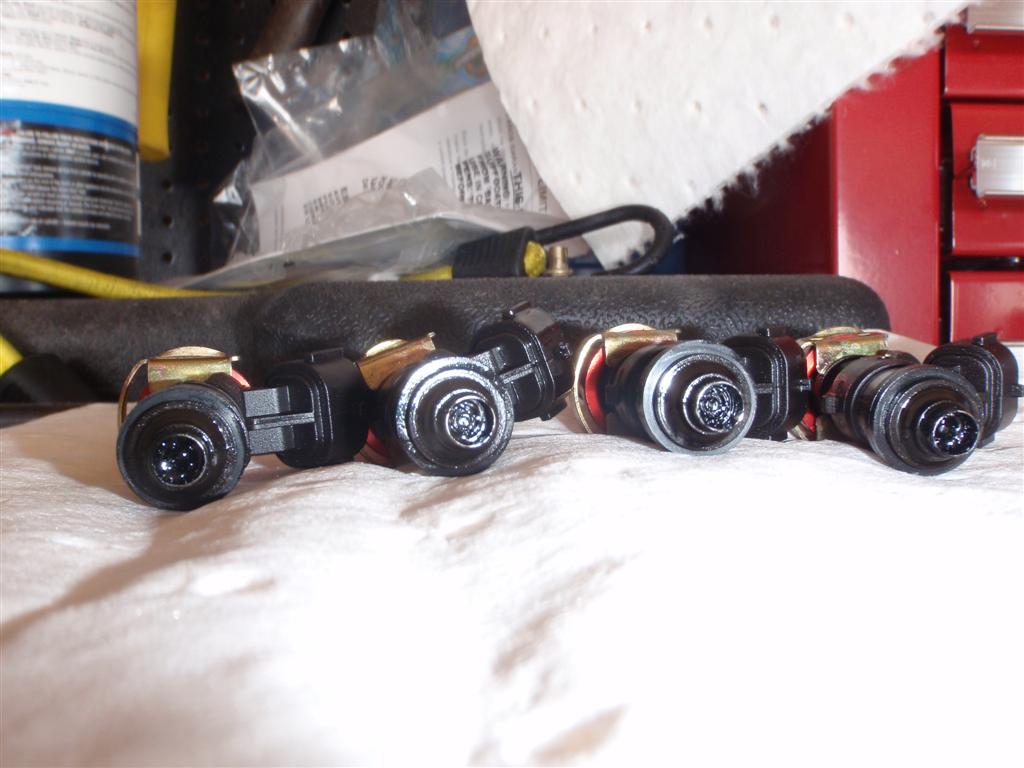
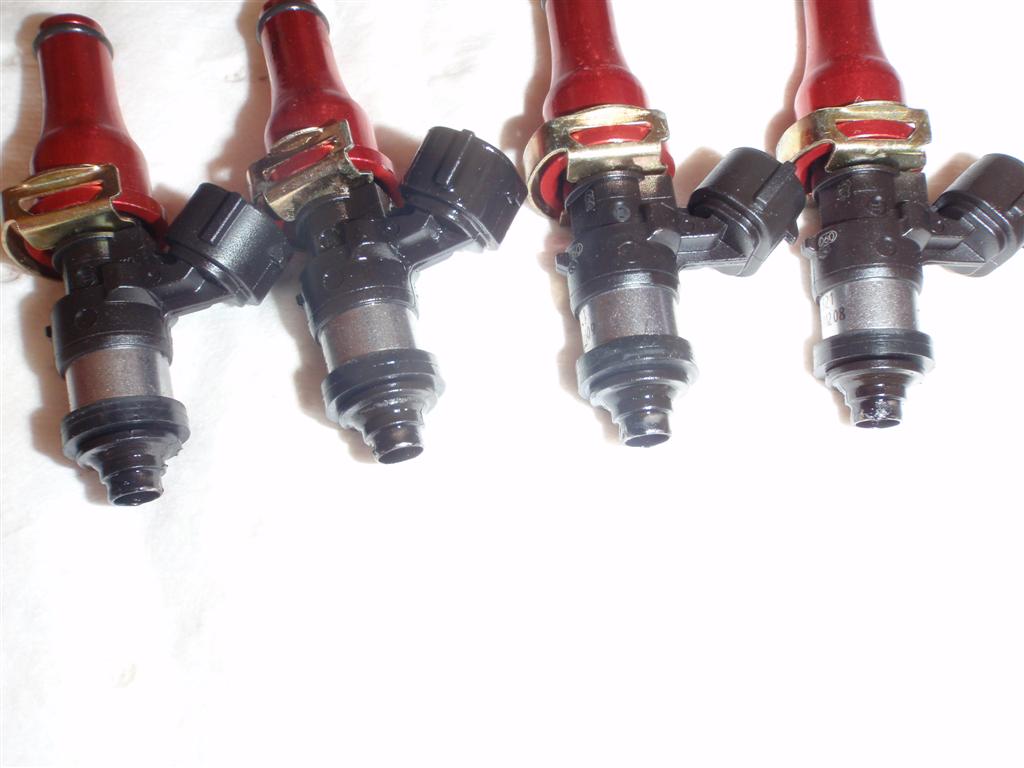
So. not as bad as the first time but this is really discouraging... i built this car around E85.
I dropped the injectors in some 87 octane and i could see the stuff evaporating off immediately.
This is where i buy my E85:
Minit Mart, 106 N. Atherton St., State College, PA 16801
So. not as bad as the first time but this is really discouraging... i built this car around E85.
I dropped the injectors in some 87 octane and i could see the stuff evaporating off immediately.
This is where i buy my E85:
Minit Mart, 106 N. Atherton St., State College, PA 16801