


Ets intercooler vs garrret intercooler


Thread Starter
Evolving Member
iTrader: (1)
Joined: Jan 2011
Posts: 241
Likes: 0
From: aka 1slowassevo
Great find jay!!Ill talk to mike about it as for now I'm talkig to him threw pms hes trying to help my situation and keep me as a happy ets customer! mike is a good guy.

Well, decided to put my money where my theory is and ordered up a smaller Garrett core today.
Part number 753447-6004
22x10.3x2.3
11.8 pounds
Rated to 530 HP
I went with this for a couple reason beyond the weight savings.
First off, with my radiator setup, 22" is about perfect to sneak the IC piping around the radiator as both IC pipes will pass through the core support to eliminate a bunch of piping and bends.
Second, the stock IC opening including the smaller cut outs in the bumper is about 10" tall. Every bit of the core will be able to get fresh air, the idea being to eliminate any of the core that can't get direct access to clean cool air. A 12" tall core has 2 inches of core that sits behind the fascia not getting direct airflow from the front.
Third, the thin 2.3" thickness means I can mount the radiator IN the core support are to get it a few more inches away from the turbo and yet I can still fit a SPAL fan between the intercooler and radiator in pusher configuration. This will clean up the engine bay, something I always try to do.
Lastly, it was fairly cheap. If it doesn’t work, I’m not out too much. Also, the cheaper core means some high end tube connectors are within the budget now which will eliminate any IC pipe blow offs and eliminate coupler swell.
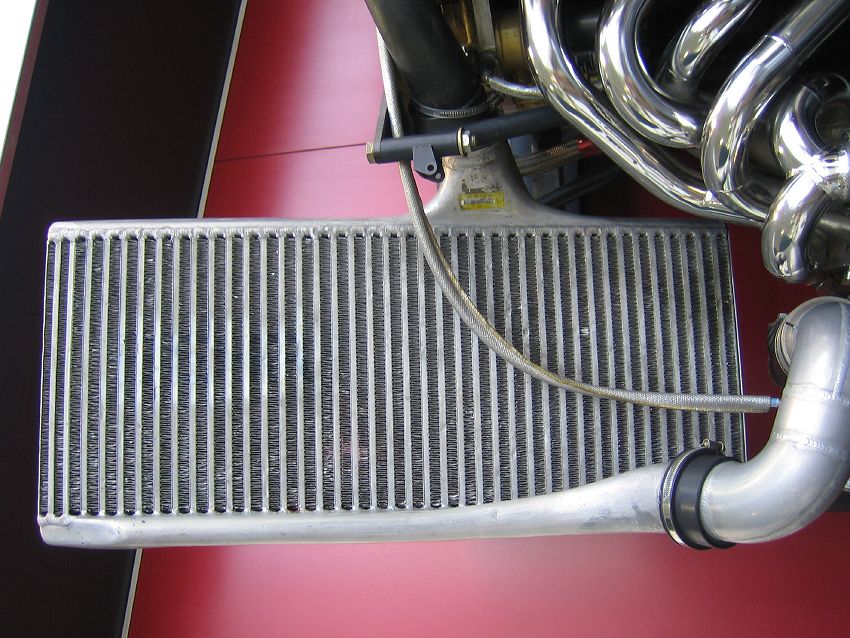
My car is a stock turbo autocross car that will be on E85 so I figure I can give up a little on intercooler capacity and peak power if it means pulling weight off the car and reducing turbo "lag." That’s the theory anyway, I hope it works as I'd still like to trap over 120mph on this setup. I'll be building some hand formed endtanks that will be minimal in volume taking cues from intercoolers like this...
Part number 753447-6004
22x10.3x2.3
11.8 pounds
Rated to 530 HP
I went with this for a couple reason beyond the weight savings.
First off, with my radiator setup, 22" is about perfect to sneak the IC piping around the radiator as both IC pipes will pass through the core support to eliminate a bunch of piping and bends.
Second, the stock IC opening including the smaller cut outs in the bumper is about 10" tall. Every bit of the core will be able to get fresh air, the idea being to eliminate any of the core that can't get direct access to clean cool air. A 12" tall core has 2 inches of core that sits behind the fascia not getting direct airflow from the front.
Third, the thin 2.3" thickness means I can mount the radiator IN the core support are to get it a few more inches away from the turbo and yet I can still fit a SPAL fan between the intercooler and radiator in pusher configuration. This will clean up the engine bay, something I always try to do.
Lastly, it was fairly cheap. If it doesn’t work, I’m not out too much. Also, the cheaper core means some high end tube connectors are within the budget now which will eliminate any IC pipe blow offs and eliminate coupler swell.
My car is a stock turbo autocross car that will be on E85 so I figure I can give up a little on intercooler capacity and peak power if it means pulling weight off the car and reducing turbo "lag." That’s the theory anyway, I hope it works as I'd still like to trap over 120mph on this setup. I'll be building some hand formed endtanks that will be minimal in volume taking cues from intercoolers like this...
We had a similar setup on the LOLA MG EX257 I drove (engine build by AER and was purposebuilt)... the car had a TR30R ceramic setup on it back in 2002.... This picture is from the actual car I won the Sebring 12 Hours in.
Here is a pic..

When I spoke with the engineers during development of the program about the use of the low volume flow molded style tanks, they said the key element was maximizing intercooler core size and still fitting it within the constraints of the bodywork.
That being said, I've always been tempted myself to experiment with the small tank layouts, as Im very passionate about core flow/distribution... Many of the current turbocharged race applications also utilize tube/fin (not bar and plate) to maximize ambient airflow through the bodywork to enhance aerodynamic efficiency.
cb
Thread Starter
Evolving Member
iTrader: (1)
Joined: Jan 2011
Posts: 241
Likes: 0
From: aka 1slowassevo
from being in the turbocharged racing community (professional ALMS road racing) and doing development on a purposebuilt 2.0 liter powerplant, I can tell you that the small volume tank design is done that way for packaging in the side pods and in relation to overall air management.
We had a similar setup on the LOLA MG EX257 I drove (engine build by AER and was purposebuilt)... the car had a TR30R ceramic setup on it back in 2002.... This picture is from the actual car I won the Sebring 12 Hours in.
Here is a pic..
When I spoke with the engineers during development of the program about the use of the low volume flow molded style tanks, they said the key element was maximizing intercooler core size and still fitting it within the constraints of the bodywork.
That being said, I've always been tempted myself to experiment with the small tank layouts, as Im very passionate about core flow/distribution... Many of the current turbocharged race applications also utilize tube/fin (not bar and plate) to maximize ambient airflow through the bodywork to enhance aerodynamic efficiency.
cb
We had a similar setup on the LOLA MG EX257 I drove (engine build by AER and was purposebuilt)... the car had a TR30R ceramic setup on it back in 2002.... This picture is from the actual car I won the Sebring 12 Hours in.
Here is a pic..
When I spoke with the engineers during development of the program about the use of the low volume flow molded style tanks, they said the key element was maximizing intercooler core size and still fitting it within the constraints of the bodywork.
That being said, I've always been tempted myself to experiment with the small tank layouts, as Im very passionate about core flow/distribution... Many of the current turbocharged race applications also utilize tube/fin (not bar and plate) to maximize ambient airflow through the bodywork to enhance aerodynamic efficiency.
cb

I kind of figured maximizing core size had something to do with it too. The fact that they were able to make like 1200+HP on those little endtanks though is what shows that huge endtanks aren't needed. Although, I suppose when you are running like 5bar boost in qualifying, it probably can cover up some short comings of endtank size.
Now I just have to figure out how I'm going to make the endtanks.
Now I just have to figure out how I'm going to make the endtanks.


 try and find an alloy higher in magnatese and copper, its much more pliable and does not crack. if you want some self adhesive rubber pads to put on the face of your dead blow to eliminate marring, pm me your address.
Last edited by n2oiroc; Feb 6, 2011 at 04:53 PM.

I planned on using 0.1" 5052 aluminum, as I've had good results with bending and welding on other projects. I've got a sand filled rubber coated hammer too. I guess I'll give it a shot and see how it goes. I'll do any follow up to this in my build thread in the fabrication section as to not distract further from this topic.
Thread Starter
Evolving Member
iTrader: (1)
Joined: Jan 2011
Posts: 241
Likes: 0
From: aka 1slowassevo
You have that link to that video??
I saw my friends log with a garret cbrd core and the aits went up only 4 degrees and the funny part is in the middle of the pull aits went back to the original temps from the beginning of the pull..
The garret core seems to be real deal makes me think even more about this ets core I have imagining if I had a garret the difference it would make.



If you are referring to the Guam video, that video is a joke. He blames everything on the lack of Buschur parts at first then details how realistically everything was wrong with the installs not the parts, it was hot and humid, and the gas sucked.
Thread Starter
Evolving Member
iTrader: (1)
Joined: Jan 2011
Posts: 241
Likes: 0
From: aka 1slowassevo
'Arron he's talking about the test conducted at ics!
Garrett with straight through channels...

Kind of surprising. Oh well, I'll see how it works out. Honestly I was a little affraid of excessive pressure drop due to the core only being 2.3" thick. I don't think that will be much of an issue, heat transfer could be though...
15fpi internally, 12 fpi louvered externally

achilles3000: Don't get too hung up on intake temps. It's all about efficiency as a whole.
+1* over ambient isn't all that efficient if your deltaP is 15psi (exaggerated obviously).
03whitegsr: buy .063" or .090", .090" being max to make your tanks. 3003 is perfect, it's cheap and forms well.
This radiator and intercooler set are made from .063" 3003 aluminum, hand formed over mandrel. The only time we get them back is for clean/flush and fin straightening. You can use 6061 if you want since the bend radius will be rather large.

The most restrictive part of an intercooler is the core.
Chad, would you happen to know why Garrett's parting sheets protrude from the core like they do?
+1* over ambient isn't all that efficient if your deltaP is 15psi (exaggerated obviously).
03whitegsr: buy .063" or .090", .090" being max to make your tanks. 3003 is perfect, it's cheap and forms well.
This radiator and intercooler set are made from .063" 3003 aluminum, hand formed over mandrel. The only time we get them back is for clean/flush and fin straightening. You can use 6061 if you want since the bend radius will be rather large.
The most restrictive part of an intercooler is the core.
Chad, would you happen to know why Garrett's parting sheets protrude from the core like they do?
Last edited by EVO8emUp; Feb 9, 2011 at 06:57 PM.
