


Ets intercooler vs garrret intercooler


Thread Starter
Evolving Member
iTrader: (1)
Joined: Jan 2011
Posts: 241
Likes: 0
From: aka 1slowassevo
They say the nesi was a good core..I'm confused on what to do the way it looks ets maybe can't help me should I keep it or go to a bigger better core like the garret or buy the new ets but I wasn't to happy with this one don;t want to be dissapointed again but then again I was always a fan of ets almost all my power parts are from them.


They say the nesi was a good core..I'm confused on what to do the way it looks ets maybe can't help me should I keep it or go to a bigger better core like the garret or buy the new ets but I wasn't to happy with this one don;t want to be dissapointed again but then again I was always a fan of ets almost all my power parts are from them.
The 3.8" Garrett core is widely considered to be the unit of choice. Either ETS, Buschur, or CBRD can do you up an excellent IC using this core.
I have kinda been leaning toward an ETS 5", or 6" IC. Personally, I don't mind grinding the bumper and my JDM Evo doesn't have a front bumper brace anyway. I just wanna know if ETS can configure their 5" and 6" cores to mate up with stock IC piping, and if the new ETS core design is available in the 5" and 6" core thickness.
Last edited by sparky; Feb 1, 2011 at 10:25 PM.

I'm with sparky... any more I'm not sure that they're such a thing (in the engine's perspective) as too much intercooler.
In the realm of racing around a course, the weight on the front tires of an Evo is paramount... so you'll want to limit what weight you don't absolutely need. I suppose I'd rather have a heavy FMIC than a heavy turbo manifold. But that comes down to personal preference at some point and is pure conjecture.
Yeah Mikey I really did
In the realm of racing around a course, the weight on the front tires of an Evo is paramount... so you'll want to limit what weight you don't absolutely need. I suppose I'd rather have a heavy FMIC than a heavy turbo manifold. But that comes down to personal preference at some point and is pure conjecture.
Yeah Mikey I really did

There were two Nissei cores. the original core and the later competition core design. I have the earlier design and not the competition.
The 3.8" Garrett core is widely considered to be the unit of choice. Either ETS, Buschur, or CBRD can do you up an excellent IC using this core.
I have kinda been leaning toward an ETS 5", or 6" IC. Personally, I don't mind grinding the bumper and my JDM Evo doesn't have a front bumper brace anyway. I just wanna know if ETS can configure their 5" and 6" cores to mate up with stock IC piping, and if the new ETS core design is available in the 5" and 6" core thickness.
The 3.8" Garrett core is widely considered to be the unit of choice. Either ETS, Buschur, or CBRD can do you up an excellent IC using this core.
I have kinda been leaning toward an ETS 5", or 6" IC. Personally, I don't mind grinding the bumper and my JDM Evo doesn't have a front bumper brace anyway. I just wanna know if ETS can configure their 5" and 6" cores to mate up with stock IC piping, and if the new ETS core design is available in the 5" and 6" core thickness.


So ETS has a new design of their core. The same good old Garrett core everyone else is using.
so now its a matter of end tank design. whats the pressure drop between your 4 inch vs the 3.8 seems the only issue if you can cover more surface with no difference than thumbs up that.
im in the market for a new FMIC so i want to get some info on this. whoever i decide will get a back to back comparison with GayMS's 3.5 core.
so now its a matter of end tank design. whats the pressure drop between your 4 inch vs the 3.8 seems the only issue if you can cover more surface with no difference than thumbs up that.
im in the market for a new FMIC so i want to get some info on this. whoever i decide will get a back to back comparison with GayMS's 3.5 core.
Thread Starter
Evolving Member
iTrader: (1)
Joined: Jan 2011
Posts: 241
Likes: 0
From: aka 1slowassevo
So ETS has a new design of their core. The same good old Garrett core everyone else is using.
so now its a matter of end tank design. whats the pressure drop between your 4 inch vs the 3.8 seems the only issue if you can cover more surface with no difference than thumbs up that.
im in the market for a new FMIC so i want to get some info on this. whoever i decide will get a back to back comparison with GayMS's 3.5 core.
so now its a matter of end tank design. whats the pressure drop between your 4 inch vs the 3.8 seems the only issue if you can cover more surface with no difference than thumbs up that.
im in the market for a new FMIC so i want to get some info on this. whoever i decide will get a back to back comparison with GayMS's 3.5 core.
Curious to see this new core.

Well, decided to put my money where my theory is and ordered up a smaller Garrett core today.
Part number 753447-6004
22x10.3x2.3
11.8 pounds
Rated to 530 HP
I went with this for a couple reason beyond the weight savings.
First off, with my radiator setup, 22" is about perfect to sneak the IC piping around the radiator as both IC pipes will pass through the core support to eliminate a bunch of piping and bends.
Second, the stock IC opening including the smaller cut outs in the bumper is about 10" tall. Every bit of the core will be able to get fresh air, the idea being to eliminate any of the core that can't get direct access to clean cool air. A 12" tall core has 2 inches of core that sits behind the fascia not getting direct airflow from the front.
Third, the thin 2.3" thickness means I can mount the radiator IN the core support are to get it a few more inches away from the turbo and yet I can still fit a SPAL fan between the intercooler and radiator in pusher configuration. This will clean up the engine bay, something I always try to do.
Lastly, it was fairly cheap. If it doesn’t work, I’m not out too much. Also, the cheaper core means some high end tube connectors are within the budget now which will eliminate any IC pipe blow offs and eliminate coupler swell.
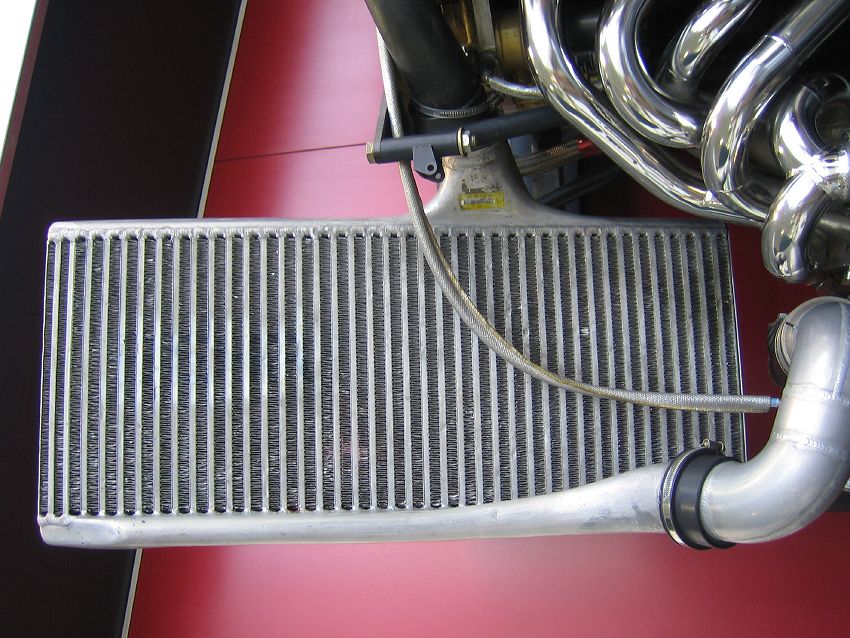
My car is a stock turbo autocross car that will be on E85 so I figure I can give up a little on intercooler capacity and peak power if it means pulling weight off the car and reducing turbo "lag." That’s the theory anyway, I hope it works as I'd still like to trap over 120mph on this setup. I'll be building some hand formed endtanks that will be minimal in volume taking cues from intercoolers like this...
Part number 753447-6004
22x10.3x2.3
11.8 pounds
Rated to 530 HP
I went with this for a couple reason beyond the weight savings.
First off, with my radiator setup, 22" is about perfect to sneak the IC piping around the radiator as both IC pipes will pass through the core support to eliminate a bunch of piping and bends.
Second, the stock IC opening including the smaller cut outs in the bumper is about 10" tall. Every bit of the core will be able to get fresh air, the idea being to eliminate any of the core that can't get direct access to clean cool air. A 12" tall core has 2 inches of core that sits behind the fascia not getting direct airflow from the front.
Third, the thin 2.3" thickness means I can mount the radiator IN the core support are to get it a few more inches away from the turbo and yet I can still fit a SPAL fan between the intercooler and radiator in pusher configuration. This will clean up the engine bay, something I always try to do.
Lastly, it was fairly cheap. If it doesn’t work, I’m not out too much. Also, the cheaper core means some high end tube connectors are within the budget now which will eliminate any IC pipe blow offs and eliminate coupler swell.
My car is a stock turbo autocross car that will be on E85 so I figure I can give up a little on intercooler capacity and peak power if it means pulling weight off the car and reducing turbo "lag." That’s the theory anyway, I hope it works as I'd still like to trap over 120mph on this setup. I'll be building some hand formed endtanks that will be minimal in volume taking cues from intercoolers like this...



I think that's just for display. I don't think that's actually how it ran in the car. If you look at some of the other BMW engine pics, you'll see some clamps that look like a hybrid wiggins clamp/V-band. I'm just pointing out the size and shape of the endtanks more then anything.
And yes, that picture is a *****.
And yes, that picture is a *****.
Well, decided to put my money where my theory is and ordered up a smaller Garrett core today.
Part number 753447-6004
22x10.3x2.3
11.8 pounds
Rated to 530 HP
I went with this for a couple reason beyond the weight savings.
First off, with my radiator setup, 22" is about perfect to sneak the IC piping around the radiator as both IC pipes will pass through the core support to eliminate a bunch of piping and bends.
Second, the stock IC opening including the smaller cut outs in the bumper is about 10" tall. Every bit of the core will be able to get fresh air, the idea being to eliminate any of the core that can't get direct access to clean cool air. A 12" tall core has 2 inches of core that sits behind the fascia not getting direct airflow from the front.
Third, the thin 2.3" thickness means I can mount the radiator IN the core support are to get it a few more inches away from the turbo and yet I can still fit a SPAL fan between the intercooler and radiator in pusher configuration. This will clean up the engine bay, something I always try to do.
Lastly, it was fairly cheap. If it doesn’t work, I’m not out too much. Also, the cheaper core means some high end tube connectors are within the budget now which will eliminate any IC pipe blow offs and eliminate coupler swell.
My car is a stock turbo autocross car that will be on E85 so I figure I can give up a little on intercooler capacity and peak power if it means pulling weight off the car and reducing turbo "lag." That’s the theory anyway, I hope it works as I'd still like to trap over 120mph on this setup. I'll be building some hand formed endtanks that will be minimal in volume taking cues from intercoolers like this...
Part number 753447-6004
22x10.3x2.3
11.8 pounds
Rated to 530 HP
I went with this for a couple reason beyond the weight savings.
First off, with my radiator setup, 22" is about perfect to sneak the IC piping around the radiator as both IC pipes will pass through the core support to eliminate a bunch of piping and bends.
Second, the stock IC opening including the smaller cut outs in the bumper is about 10" tall. Every bit of the core will be able to get fresh air, the idea being to eliminate any of the core that can't get direct access to clean cool air. A 12" tall core has 2 inches of core that sits behind the fascia not getting direct airflow from the front.
Third, the thin 2.3" thickness means I can mount the radiator IN the core support are to get it a few more inches away from the turbo and yet I can still fit a SPAL fan between the intercooler and radiator in pusher configuration. This will clean up the engine bay, something I always try to do.
Lastly, it was fairly cheap. If it doesn’t work, I’m not out too much. Also, the cheaper core means some high end tube connectors are within the budget now which will eliminate any IC pipe blow offs and eliminate coupler swell.
My car is a stock turbo autocross car that will be on E85 so I figure I can give up a little on intercooler capacity and peak power if it means pulling weight off the car and reducing turbo "lag." That’s the theory anyway, I hope it works as I'd still like to trap over 120mph on this setup. I'll be building some hand formed endtanks that will be minimal in volume taking cues from intercoolers like this...
We have actually built a replacement intercooler a customer with a bmw intercooler similar to this. I'm trying to find a picture.
Michael
Intercoolers with short flow lengths and tons of tubes have always interested me, but their performance has always been a little questionable. The idea being that the majority of the heat transfer takes place over the first 6"-8" since that is where the largest temperature gradient is. The large number of tubes and shorter flow length means lower overall pressure drop too.
The down fall though, while the majority of the cooling takes place in that short distance, I think it's that last "little bit" that makes all the difference on lower octane fuels. Sure that first 8" drops IATs from like 350F to 150F, but 150F is still to hot to allow stable combustion on crap fuel. You need that other 16" of flow length to drop that last 60-70 degrees down to ambient since the temperature gradient is getting so small. If that makes sense?
I imagine this works well on a gelled toluene burning monsters like the BMW above that can probably handle high IATs without much trouble though.
The down fall though, while the majority of the cooling takes place in that short distance, I think it's that last "little bit" that makes all the difference on lower octane fuels. Sure that first 8" drops IATs from like 350F to 150F, but 150F is still to hot to allow stable combustion on crap fuel. You need that other 16" of flow length to drop that last 60-70 degrees down to ambient since the temperature gradient is getting so small. If that makes sense?
I imagine this works well on a gelled toluene burning monsters like the BMW above that can probably handle high IATs without much trouble though.
Last edited by 03whitegsr; Feb 4, 2011 at 03:24 PM.
Thread Starter
Evolving Member
iTrader: (1)
Joined: Jan 2011
Posts: 241
Likes: 0
From: aka 1slowassevo
I have been doing my homework with this garret intercooler theory and haven't seen any car keep the same ait's or only raise temps by 2 or less..Any tests on this anyone and date sheet??

http://highboostforum.com/forum/show...-info-mixed-in
Here is some of the info...
2 liter
Turbo Trix T3, GT35r kit
ETS 3.5" FMIC
Starting AIT 105.8 degrees
Ending AIT 129.2 degrees
Peak boost 36.31 psi
20 psi at 5086 rpm
+24 dgree from start to finish
GT40, custom header
2.3 liter
BR Race FMIC
Starting AIT 44.60 degrees
Ending AIT 53.60 degrees
Peak boost 35.53 psi
20 psi at 5063 rpm
+9 degrees from start to finsh
2 liter, GREEN, BR race FMIC
Starting AIT 95 degrees
Ending AIT 100.4 degrees
Peak boost 33 psi (NOTE 6 more psi and still cooler temps)
20 psi at 3723 rpm
+5 degrees from start to finish
2 liter, AMS GT35r, AMS Race FMIC
Starting AIT 87.80 degrees
Ending AIT 93.20 degrees
Peak boost 41.12 psi
20 psi 4676
+6 degrees from start to finish
Last edited by Boosted Tuning; Feb 4, 2011 at 10:19 PM.
Thread Starter
Evolving Member
iTrader: (1)
Joined: Jan 2011
Posts: 241
Likes: 0
From: aka 1slowassevo
Here is the thread.
http://highboostforum.com/forum/show...-info-mixed-in
Here is some of the info...
2 liter
Turbo Trix T3, GT35r kit
ETS 3.5" FMIC
Starting AIT 105.8 degrees
Ending AIT 129.2 degrees
Peak boost 36.31 psi
20 psi at 5086 rpm
+24 dgree from start to finish
GT40, custom header
2.3 liter
BR Race FMIC
Starting AIT 44.60 degrees
Ending AIT 53.60 degrees
Peak boost 35.53 psi
20 psi at 5063 rpm
+9 degrees from start to finsh
2 liter, GREEN, BR race FMIC
Starting AIT 95 degrees
Ending AIT 100.4 degrees
Peak boost 33 psi (NOTE 6 more psi and still cooler temps)
20 psi at 3723 rpm
+5 degrees from start to finish
2 liter, AMS GT35r, AMS Race FMIC
Starting AIT 87.80 degrees
Ending AIT 93.20 degrees
Peak boost 41.12 psi
20 psi 4676
+6 degrees from start to finish
http://highboostforum.com/forum/show...-info-mixed-in
Here is some of the info...
2 liter
Turbo Trix T3, GT35r kit
ETS 3.5" FMIC
Starting AIT 105.8 degrees
Ending AIT 129.2 degrees
Peak boost 36.31 psi
20 psi at 5086 rpm
+24 dgree from start to finish
GT40, custom header
2.3 liter
BR Race FMIC
Starting AIT 44.60 degrees
Ending AIT 53.60 degrees
Peak boost 35.53 psi
20 psi at 5063 rpm
+9 degrees from start to finsh
2 liter, GREEN, BR race FMIC
Starting AIT 95 degrees
Ending AIT 100.4 degrees
Peak boost 33 psi (NOTE 6 more psi and still cooler temps)
20 psi at 3723 rpm
+5 degrees from start to finish
2 liter, AMS GT35r, AMS Race FMIC
Starting AIT 87.80 degrees
Ending AIT 93.20 degrees
Peak boost 41.12 psi
20 psi 4676
+6 degrees from start to finish
Thanks let me look at it!!