


STM Ricer 2011 Rebuild Picture Thread


sounds great Em. We measure blowby with a flow meter... which can be moved to different areas to attempt to measure contribution from particular components. This is done over the course of a 2000hr test between rated power and torque... its very indicative of problem areas related to blowby. I suppose you've never had any turbo on your car for more than 20 minutes at rated torque or power, so the durability validation of your particular setups only makes it through the infant mortality stage at best. Not trying to be antagonistic, just responding to the irony of your comment about if the turbo's hold together.
You have to look at the facilities that Borg Warner has compared to Precision... not to mention their test practices and manufacturing capabilities. Garrett technology is at least 15 years old and their new advent of the GTX wheel has been underwhelming at best... even by their own measure (compressor maps) Precisions billet wheels still lack significant aero development evident by their lack of a modern R&D facility necessary to produce such parts. Precision did very well selling large (70+mm) turbos with the garrett CHRA (big shaft) against the best wishes of Honeywell. Thus the falling out. I worked very closely with Precision during my time at HPF and they were the more affordable option for large frame BB turbochargers, which had been previously a niche market for garrett. GT42,45, 47, 50, and 55 IIRC. Being such a large retailer of PTE turbo's I was also privy to seeing a glimse into their failure rates.
That being said, I hope to test the new EFR turbo's very soon here and some other improved stock appearing options. From an engineer's perspective... the EFR series will outperform your Precision turbo in every effect... especially if you're still shifting gears. Not to mention monitoring turbo speed is a great indicator of having a boost leak! A simple check of the logs after a run will put your fears to rest. I'm sure you can meet or exceed your goals using the PTE turbos, as it has been done before and can most likely be repeated. However the new EFR turbocharger WILL outperform your precision turbocharger mm for mm in every aspect. I find it very difficult to understand that there could be ANY reason why you would use PTE turbo's over the BW units, unless of course its due to a relationship you've developed with PTE, which does not exist with BorgWarner. In that case it would look bad for you to be testing BW turbo's while representing Precision turbochargers.
I can only assume that is your perogative. I understand it from a business sense, but not from an engineering standpoint. If that is the case it will be interesting to see when or IF PTE is capable of producing lightweight titanium aluminide turbine wheels.... better bearing packages in their CHRAs... and furthermore the ability to make turbine housings that customers want *cough* twin scroll... not to mention using relatively advanced materials to do so. And the most overlooked aspect of the new BW turbochargers (IMO) is the efficiency of their turbochargers and flow per mm of compressor wheel. The turbocharger industry is changing and IMO changing faster than companies who simply re-lable and mix and match wheels, can keep up with. Especially companies who do not have the facilities to develope, not simply copy, NEW technology.
I'd like to think that I'm wrong when it comes to PTE's abilities to compete with the new BW units, but Newton's laws still applie to turbochargers leaving PTE, Garrett, etc far behind. I wish you the best of luck in 2011. Your #1 goal for weight reduction is spot on... and if that means leaving what is on the car AND works alone, then that's great. I can understand that and mark it up to good project management, rather than putting the blinders on to new technology. Either way I hope that you recognize the benefits and utilize them to your benefit.
-Eric
You have to look at the facilities that Borg Warner has compared to Precision... not to mention their test practices and manufacturing capabilities. Garrett technology is at least 15 years old and their new advent of the GTX wheel has been underwhelming at best... even by their own measure (compressor maps) Precisions billet wheels still lack significant aero development evident by their lack of a modern R&D facility necessary to produce such parts. Precision did very well selling large (70+mm) turbos with the garrett CHRA (big shaft) against the best wishes of Honeywell. Thus the falling out. I worked very closely with Precision during my time at HPF and they were the more affordable option for large frame BB turbochargers, which had been previously a niche market for garrett. GT42,45, 47, 50, and 55 IIRC. Being such a large retailer of PTE turbo's I was also privy to seeing a glimse into their failure rates.
That being said, I hope to test the new EFR turbo's very soon here and some other improved stock appearing options. From an engineer's perspective... the EFR series will outperform your Precision turbo in every effect... especially if you're still shifting gears. Not to mention monitoring turbo speed is a great indicator of having a boost leak! A simple check of the logs after a run will put your fears to rest. I'm sure you can meet or exceed your goals using the PTE turbos, as it has been done before and can most likely be repeated. However the new EFR turbocharger WILL outperform your precision turbocharger mm for mm in every aspect. I find it very difficult to understand that there could be ANY reason why you would use PTE turbo's over the BW units, unless of course its due to a relationship you've developed with PTE, which does not exist with BorgWarner. In that case it would look bad for you to be testing BW turbo's while representing Precision turbochargers.
I can only assume that is your perogative. I understand it from a business sense, but not from an engineering standpoint. If that is the case it will be interesting to see when or IF PTE is capable of producing lightweight titanium aluminide turbine wheels.... better bearing packages in their CHRAs... and furthermore the ability to make turbine housings that customers want *cough* twin scroll... not to mention using relatively advanced materials to do so. And the most overlooked aspect of the new BW turbochargers (IMO) is the efficiency of their turbochargers and flow per mm of compressor wheel. The turbocharger industry is changing and IMO changing faster than companies who simply re-lable and mix and match wheels, can keep up with. Especially companies who do not have the facilities to develope, not simply copy, NEW technology.
I'd like to think that I'm wrong when it comes to PTE's abilities to compete with the new BW units, but Newton's laws still applie to turbochargers leaving PTE, Garrett, etc far behind. I wish you the best of luck in 2011. Your #1 goal for weight reduction is spot on... and if that means leaving what is on the car AND works alone, then that's great. I can understand that and mark it up to good project management, rather than putting the blinders on to new technology. Either way I hope that you recognize the benefits and utilize them to your benefit.
-Eric
Last edited by R/TErnie; Dec 29, 2010 at 01:58 PM.


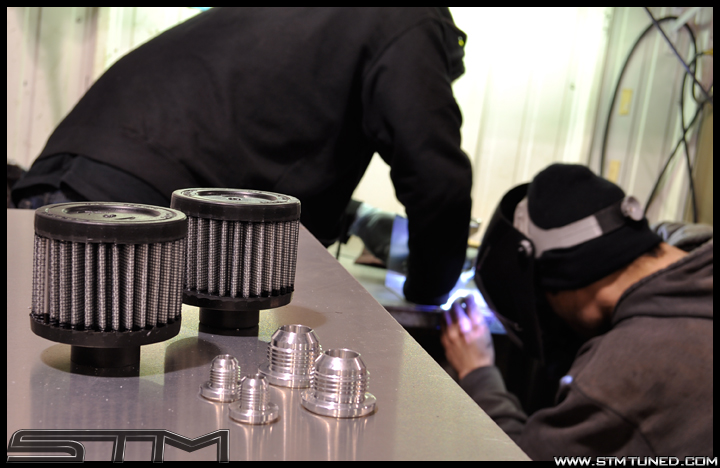


sweet cant wait to see more pics every 4g63 ive seen has always has small catch can/lines vs most of the hondas tony from t1 has done alot of testing on this they do seem to have more room in the bay then us tho.
Last edited by mrboost05; Dec 29, 2010 at 06:09 PM.



sounds great Em. We measure blowby with a flow meter... which can be moved to different areas to attempt to measure contribution from particular components. This is done over the course of a 2000hr test between rated power and torque... its very indicative of problem areas related to blowby. I suppose you've never had any turbo on your car for more than 20 minutes at rated torque or power, so the durability validation of your particular setups only makes it through the infant mortality stage at best. Not trying to be antagonistic, just responding to the irony of your comment about if the turbo's hold together.
You have to look at the facilities that Borg Warner has compared to Precision... not to mention their test practices and manufacturing capabilities. Garrett technology is at least 15 years old and their new advent of the GTX wheel has been underwhelming at best... even by their own measure (compressor maps) Precisions billet wheels still lack significant aero development evident by their lack of a modern R&D facility necessary to produce such parts. Precision did very well selling large (70+mm) turbos with the garrett CHRA (big shaft) against the best wishes of Honeywell. Thus the falling out. I worked very closely with Precision during my time at HPF and they were the more affordable option for large frame BB turbochargers, which had been previously a niche market for garrett. GT42,45, 47, 50, and 55 IIRC. Being such a large retailer of PTE turbo's I was also privy to seeing a glimse into their failure rates.
That being said, I hope to test the new EFR turbo's very soon here and some other improved stock appearing options. From an engineer's perspective... the EFR series will outperform your Precision turbo in every effect... especially if you're still shifting gears. Not to mention monitoring turbo speed is a great indicator of having a boost leak! A simple check of the logs after a run will put your fears to rest. I'm sure you can meet or exceed your goals using the PTE turbos, as it has been done before and can most likely be repeated. However the new EFR turbocharger WILL outperform your precision turbocharger mm for mm in every aspect. I find it very difficult to understand that there could be ANY reason why you would use PTE turbo's over the BW units, unless of course its due to a relationship you've developed with PTE, which does not exist with BorgWarner. In that case it would look bad for you to be testing BW turbo's while representing Precision turbochargers.
I can only assume that is your perogative. I understand it from a business sense, but not from an engineering standpoint. If that is the case it will be interesting to see when or IF PTE is capable of producing lightweight titanium aluminide turbine wheels.... better bearing packages in their CHRAs... and furthermore the ability to make turbine housings that customers want *cough* twin scroll... not to mention using relatively advanced materials to do so. And the most overlooked aspect of the new BW turbochargers (IMO) is the efficiency of their turbochargers and flow per mm of compressor wheel. The turbocharger industry is changing and IMO changing faster than companies who simply re-lable and mix and match wheels, can keep up with. Especially companies who do not have the facilities to develope, not simply copy, NEW technology.
I'd like to think that I'm wrong when it comes to PTE's abilities to compete with the new BW units, but Newton's laws still applie to turbochargers leaving PTE, Garrett, etc far behind. I wish you the best of luck in 2011. Your #1 goal for weight reduction is spot on... and if that means leaving what is on the car AND works alone, then that's great. I can understand that and mark it up to good project management, rather than putting the blinders on to new technology. Either way I hope that you recognize the benefits and utilize them to your benefit.
-Eric
You have to look at the facilities that Borg Warner has compared to Precision... not to mention their test practices and manufacturing capabilities. Garrett technology is at least 15 years old and their new advent of the GTX wheel has been underwhelming at best... even by their own measure (compressor maps) Precisions billet wheels still lack significant aero development evident by their lack of a modern R&D facility necessary to produce such parts. Precision did very well selling large (70+mm) turbos with the garrett CHRA (big shaft) against the best wishes of Honeywell. Thus the falling out. I worked very closely with Precision during my time at HPF and they were the more affordable option for large frame BB turbochargers, which had been previously a niche market for garrett. GT42,45, 47, 50, and 55 IIRC. Being such a large retailer of PTE turbo's I was also privy to seeing a glimse into their failure rates.
That being said, I hope to test the new EFR turbo's very soon here and some other improved stock appearing options. From an engineer's perspective... the EFR series will outperform your Precision turbo in every effect... especially if you're still shifting gears. Not to mention monitoring turbo speed is a great indicator of having a boost leak! A simple check of the logs after a run will put your fears to rest. I'm sure you can meet or exceed your goals using the PTE turbos, as it has been done before and can most likely be repeated. However the new EFR turbocharger WILL outperform your precision turbocharger mm for mm in every aspect. I find it very difficult to understand that there could be ANY reason why you would use PTE turbo's over the BW units, unless of course its due to a relationship you've developed with PTE, which does not exist with BorgWarner. In that case it would look bad for you to be testing BW turbo's while representing Precision turbochargers.
I can only assume that is your perogative. I understand it from a business sense, but not from an engineering standpoint. If that is the case it will be interesting to see when or IF PTE is capable of producing lightweight titanium aluminide turbine wheels.... better bearing packages in their CHRAs... and furthermore the ability to make turbine housings that customers want *cough* twin scroll... not to mention using relatively advanced materials to do so. And the most overlooked aspect of the new BW turbochargers (IMO) is the efficiency of their turbochargers and flow per mm of compressor wheel. The turbocharger industry is changing and IMO changing faster than companies who simply re-lable and mix and match wheels, can keep up with. Especially companies who do not have the facilities to develope, not simply copy, NEW technology.
I'd like to think that I'm wrong when it comes to PTE's abilities to compete with the new BW units, but Newton's laws still applie to turbochargers leaving PTE, Garrett, etc far behind. I wish you the best of luck in 2011. Your #1 goal for weight reduction is spot on... and if that means leaving what is on the car AND works alone, then that's great. I can understand that and mark it up to good project management, rather than putting the blinders on to new technology. Either way I hope that you recognize the benefits and utilize them to your benefit.
-Eric
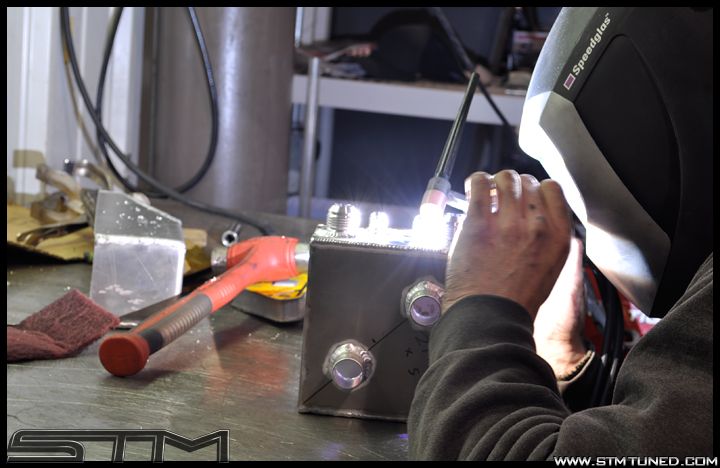
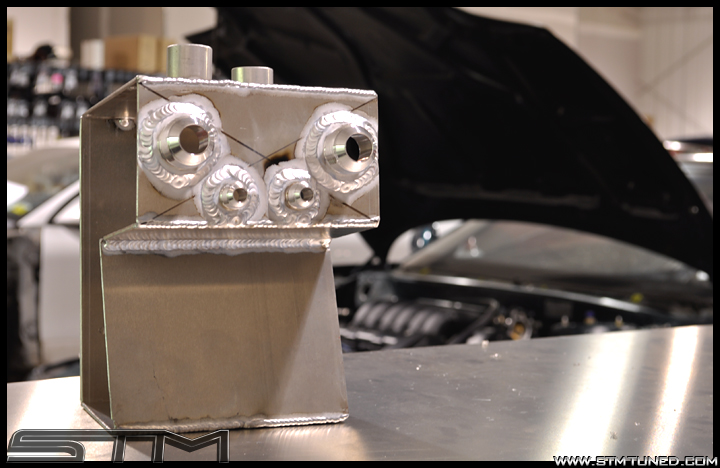
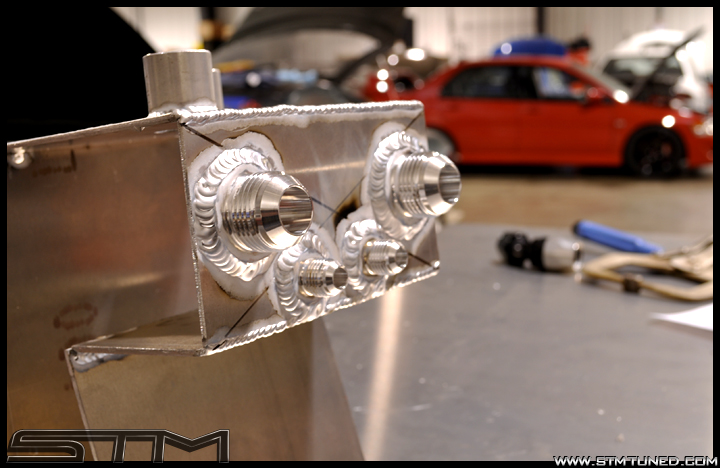
Did y'all have to drill a hole in the block to get that fitting there, or was there already provisions for it like hondas? I've always wanted to vent my block as well to relieve more crank case pressure. Will y'all be producing that specific oil catch can as a kit? I've already had a can custom made with 3 -8an fittings to the valve cover, but this catch can just looks badass! My custom can has yet to be installed, so if you guys were to make some, I would deffinately consider this!


We can certainly re create this can with no issues. The only problem most people will have is it will not work with power steering. We have two more builds we are working on now that will need something as well. Once we get to those two cars we will make something that everyone can use as they have power steering.
-Em
-Em
