


Mivec advantage?


I'm quite sure it's coolant temp, your car will start adjusting LTFM as needed a few seconds after it hits 170F and that's considered full operating temp as far as the ECU is concerned. For the Mivec settings on my car I ended up making the #1 warmup maps just a less aggressive version of #2 full operating temp maps. Granted I avoid hammering on the car when it's warming up but it's good to know that in case I forget it should be tuned to accomodate it safely.
It likely won't make a ton of difference but lets say you disabled the timing retard during warmup or reduced it like I did to avoid hesitation, then run 25+ psi boost via an MBC, and then run full aggressive Mivec settings. If you make a habbit of going WOT right after the car is started up you will have a higher risk of breaking something or at least adding in some pre-mature wear to various parts.
It likely won't make a ton of difference but lets say you disabled the timing retard during warmup or reduced it like I did to avoid hesitation, then run 25+ psi boost via an MBC, and then run full aggressive Mivec settings. If you make a habbit of going WOT right after the car is started up you will have a higher risk of breaking something or at least adding in some pre-mature wear to various parts.
before you start...




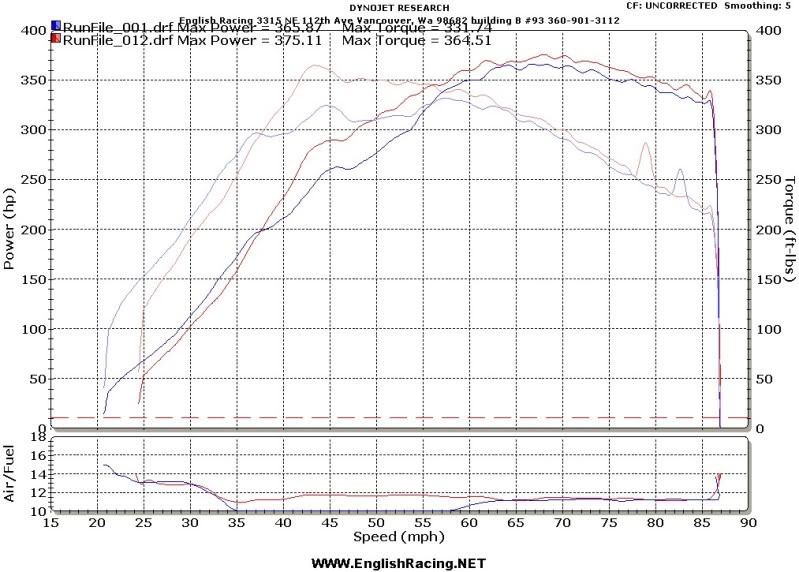
I have been trying to find a back to back test that had both the RPM and this dip, but if you look at around 60mph you'll see a dramatic step up:

Now in the next image, while it did make more power, the "step" is gone. This is from careful tuning of the exhaust cam in that range:
Minor rant- I only saw this about 2 months late, but I have been tuning engines in one form or another since I was 10. Course back then it was change a jet, change the needle setting, look at the plug. Then it was a timing light on V6s and V8s and play with the carb. I got into tuning EFI around 10 years ago with Hondas. I have always had good instructors along the way when I make platform changes. NJ and HBSpeed came to terms with their arguement I thought I'd like to throw out some stuff about me. Bryan has been playing with DSMs (and therefore Evos) for a long time as well.
Now in the next image, while it did make more power, the "step" is gone. This is from careful tuning of the exhaust cam in that range:
Minor rant- I only saw this about 2 months late, but I have been tuning engines in one form or another since I was 10. Course back then it was change a jet, change the needle setting, look at the plug. Then it was a timing light on V6s and V8s and play with the carb. I got into tuning EFI around 10 years ago with Hondas. I have always had good instructors along the way when I make platform changes. NJ and HBSpeed came to terms with their arguement I thought I'd like to throw out some stuff about me. Bryan has been playing with DSMs (and therefore Evos) for a long time as well.


I'm trying to get up to speed on the ins and outs of MIVEC. I read through the 44 page thread for the Evo IX. The basic theories I heard in that thread were:
IX MIVEC
The limits of cell values is 0-28.8 and 28.8 being fully advanced.
During spoolup you want to advance the intake cam because this creates more overlap, which in situations where back pressure is low (spoolup), overlap promotes cylinder filling ergo more efficiency ergo more exhaust gasses ergo spooling the turbo.
At the top end, you don't want to advance the intake cam much because of the high back pressure the stock turbine housing creates. This very significant back pressure will actually hurt the benefits of overlap / scavenging and you might get some reversion.
The JDM RS MIVEC maps are damn good. Changing this MIVEC map so it is more aggressive with advance during spool will get you a very good MIVEC map.
It's thought that the 0-28.8 is in crank degrees, therefore the range of motion of the cam is 0-14.4 cam degrees. And it is thought that a value of 20 in the MIVEC map equals the approximate lobe centerlines of an Evo VIII intake cam.
What was not discussed much was ideas about why you want to start the intake valve opening earlier or later in general disregarding overlap.
Also of course, it's never one size fits all and each car is different to what it wants.
Am I missing any other nuggets of wisdom from the IX MIVEC thread?
X MIVEC
Can someone summarize the understanding of the X MIVEC as I did above for the IX?
IX MIVEC
The limits of cell values is 0-28.8 and 28.8 being fully advanced.
During spoolup you want to advance the intake cam because this creates more overlap, which in situations where back pressure is low (spoolup), overlap promotes cylinder filling ergo more efficiency ergo more exhaust gasses ergo spooling the turbo.
At the top end, you don't want to advance the intake cam much because of the high back pressure the stock turbine housing creates. This very significant back pressure will actually hurt the benefits of overlap / scavenging and you might get some reversion.
The JDM RS MIVEC maps are damn good. Changing this MIVEC map so it is more aggressive with advance during spool will get you a very good MIVEC map.
It's thought that the 0-28.8 is in crank degrees, therefore the range of motion of the cam is 0-14.4 cam degrees. And it is thought that a value of 20 in the MIVEC map equals the approximate lobe centerlines of an Evo VIII intake cam.
What was not discussed much was ideas about why you want to start the intake valve opening earlier or later in general disregarding overlap.
Also of course, it's never one size fits all and each car is different to what it wants.
Am I missing any other nuggets of wisdom from the IX MIVEC thread?
X MIVEC
Can someone summarize the understanding of the X MIVEC as I did above for the IX?

Evolved Member
Joined: Oct 2002
Posts: 2,788
Likes: 1
Doesn't seem like people are that talkative 
I'll take an amateur stab at it ... wait, that didn't sound right
Ok so I've only tuned one X and didn't touch the Mivec. So this is all theory. The Mivec intake map #1 on my buddies JDM GSR romid 52360018 is the following:

If we assume higher number is advance, and lower number is retard. It seems to me the goal is pretty simple in this map, feed in as much advance as possible during spoolup, which is similar to the IX RS intake mivec map, however, this X map keeps the intake advance to redline with only a small taper of 5-10 degrees from peak advance.
Now let's look at the exhaust cam:

If we assume that the larger the number, the more advanced it is, like we did above, it seems like the map above suggest Mitsu wanted the exhaust cam at 0 (all the way advanced?) at idle. And then on tipping into throttle, it feeds in exhaust retard and then approaching peak torque it advances the cam forward. Then approaching redline it retards the cam again.
So if we pick a few datapoints:
2000rpm / 070 load = intake: 25 / exhaust: -20
3000rpm / 160 load = intake: 25 / exhaust: -10
4000rpm / 220 load = intake: 25 / exhaust: 0
7000rpm / 200 load = intake: 20 / exhaust: -10
So at this point I'd love to make a guess at what's going on, but I'm not even sure which way the numbers are moving the cams. Has that info not been posted up yet? If we assume the larger number means advance, and smaller number is retard...
At 2k rpm, you have a situation where the intake cam is advanced, meaning starting to open the valves earlier, and the exhaust cam is retarded, meaning starting later, so at 2k rpm you have a situation with very little overlap if any. And so if you just think in terms of amount of possible overlap for the above datapoints you get:
2000rpm / 070 load = intake: 25 / exhaust: -20 (25 + 20 = 45)
3000rpm / 160 load = intake: 25 / exhaust: -10 (25 + 10 = 35)
4000rpm / 220 load = intake: 25 / exhaust: 0 (25 + 0 = 25)
7000rpm / 200 load = intake: 20 / exhaust: -10 (20 + 10 = 30)
So the larger the number, the further the timing of the intake is from the exhaust cam. The smaller the number, the closer the timing of the two cams is, eg more overlap.
I'm sure I am totally off the mark here but thought I'd fire away regardless
I'll take an amateur stab at it ... wait, that didn't sound right
Ok so I've only tuned one X and didn't touch the Mivec. So this is all theory. The Mivec intake map #1 on my buddies JDM GSR romid 52360018 is the following:
If we assume higher number is advance, and lower number is retard. It seems to me the goal is pretty simple in this map, feed in as much advance as possible during spoolup, which is similar to the IX RS intake mivec map, however, this X map keeps the intake advance to redline with only a small taper of 5-10 degrees from peak advance.
Now let's look at the exhaust cam:
If we assume that the larger the number, the more advanced it is, like we did above, it seems like the map above suggest Mitsu wanted the exhaust cam at 0 (all the way advanced?) at idle. And then on tipping into throttle, it feeds in exhaust retard and then approaching peak torque it advances the cam forward. Then approaching redline it retards the cam again.
So if we pick a few datapoints:
2000rpm / 070 load = intake: 25 / exhaust: -20
3000rpm / 160 load = intake: 25 / exhaust: -10
4000rpm / 220 load = intake: 25 / exhaust: 0
7000rpm / 200 load = intake: 20 / exhaust: -10
So at this point I'd love to make a guess at what's going on, but I'm not even sure which way the numbers are moving the cams. Has that info not been posted up yet? If we assume the larger number means advance, and smaller number is retard...
At 2k rpm, you have a situation where the intake cam is advanced, meaning starting to open the valves earlier, and the exhaust cam is retarded, meaning starting later, so at 2k rpm you have a situation with very little overlap if any. And so if you just think in terms of amount of possible overlap for the above datapoints you get:
2000rpm / 070 load = intake: 25 / exhaust: -20 (25 + 20 = 45)
3000rpm / 160 load = intake: 25 / exhaust: -10 (25 + 10 = 35)
4000rpm / 220 load = intake: 25 / exhaust: 0 (25 + 0 = 25)
7000rpm / 200 load = intake: 20 / exhaust: -10 (20 + 10 = 30)
So the larger the number, the further the timing of the intake is from the exhaust cam. The smaller the number, the closer the timing of the two cams is, eg more overlap.
I'm sure I am totally off the mark here but thought I'd fire away regardless

GST did not know you guys were vendors, never noticed the name. I am near your shop every week, I wrestle for APW. I may have to stop in some time, and get my ralliarts MiVec tuned.
Cams and valve timing are actually affecting your effective compression and expansion ratios (which are quite different from the static compression ratio of your pistons). In a "theoretical engine" your cam would have a tiny 180 degree duration and instantaneous ramp rates (the valve opens to its full height immediately), and the intake and exhaust valves would open and close at the top and bottom of the stroke.
But because the air has inertia, and you can't open the valve immediately with a cam, you need to open the valves earlier so that the air starts moving before the piston starts down, and close them later so that you have the valve open while the air is still moving. You can also overlap the valves so that the air moving out of the exhaust "sucks" air in from the intake to get it started moving faster (aka scavenging)
All of those events mean that the actual compression ratio is never as high as the "static CR" of the pistons. This is why longer duration cams allow you to run more timing advance (because you've actually dropped your compression ratio even more). Alternately, you can bump the static CR ratio up higher to get back some of the actual CR that you lost. The longer duration the cam, the higher the static CR you need to get the same "actual" compression. (This is why people get away with running CR's of 9.0-10.0 while using large cams, but the same CR with shorter/stock cams are more likely to have detonation problems).
The general effects (broken down) are as follows:
Advance centerline (both cams): powerband moves to lower RPM
Retard centerline (both cams): powerband moves to higher RPM
Increase overlap (retard exhaust, advance intake): Sharper (higher) power/torque peaks, narrower powerband
Decrease overlap: (advance exhaust, retard intake intake): Flatter power/torque peaks, broader powerband
You are basically balancing valve opening and closing events to trade between stroke efficiency, effective compression (and expansion) ratios and cylinder filling efficiency.
Since the intake valve closes after the bottom of the intake stroke, closing the intake valve earlier gives you a longer compression stroke, and higher peak cylinder pressure.
But at higher RPMs the valves are open for a much shorter period - with the later intake opening there is not enough time for the cylinder to fill so the peak pressure actually drops off.
Likewise, the exhaust valve opens before the bottom of the exhaust stroke, so opening the exhaust valve later gives you a longer more efficient expansion stroke.
But at low RPM the exhaust valve closing later (while the intake valve is open) causes some of your intake charge to pass through the engine, and get vented into the exhaust manifold.
When you just move one gear, you're making two different adjustments, which can be good for specific situations. Advancing or retarding the intake gear only is an effective way to adjust engine behavior, without really messing everything up.
Advancing the intake gear simultaneously moves your powerband lower by moving the advancing the centerline (towards the RPM range of your turbo spoolup) and increases overlap, increasing the airflow at that point - you allow more air to pass out of the exhaust valve, helping the turbo spool and giving you a stronger, but peakier midrange. Obviously this ends giving you a up costing you on the top end because the earlier intake close reduces cylinder filling.
Retarding the intake gear simultaneously both moves your powerband higher (keeps the intake valve open longer) but also increases your compression and peak pressure, making the powerband broader and more drivable. You lose a little potential power due to lost overlap, but give the engine better manners in the mid to top end.
As you might guess, there's a lot of stuff going on, and a lot of compromises being made. The only way to really find the best setting is to decide what you're trying to do, and try adjusting a couple degrees at a time until you find what you want. There's no ideal setting for every part of the powerband (This is why variable valve timing is such a brilliant idea - you can, with certain limitations, find a more ideal setting for every part of the powerband)
Smaller turbos like advanced, shorter duration cams because they run out of breath up high, while big turbos are better with retarded, long duration cams because they spool up much later, and produce more power at the top end.
To make it even more complex, the cam settings on a turbo engine will vary based on where your turbo hits its sweet spot, and what kind of characteristics you're trying to get out of it. OEMs tend to put shorter cams with a peakier low end with small turbos, because you can make up for the loss at the top end by simply adding boost and throwing in taller gears. They do the same thing for auto transmissions. N/A MT cars tend to run higher RPMs, longer duration cams for more power, and shorter gearing. Ironically, cars with bigger turbos get tuned more like N/A engines.
Another sidenote is that a in a stroker engine, displacement is increased, but the valve events are happening at the same RPM as a normal stroke, you're just trying to pull more air in. As a result, the stroker will like a bit more cam duration and earlier valve opening due to the piston speed, but less overlap is required. This in turn gives you the characteristic of a broader torque band at lower RPMs (in addition to the increased torque from crank length). Likewise, it has a harder time breathing up top.
I guess I didn't really answer the question, because there's no "perfect" setting, but if you understand a bit about what's going on, you can experiment and find one you like with any type of cam.
But because the air has inertia, and you can't open the valve immediately with a cam, you need to open the valves earlier so that the air starts moving before the piston starts down, and close them later so that you have the valve open while the air is still moving. You can also overlap the valves so that the air moving out of the exhaust "sucks" air in from the intake to get it started moving faster (aka scavenging)
All of those events mean that the actual compression ratio is never as high as the "static CR" of the pistons. This is why longer duration cams allow you to run more timing advance (because you've actually dropped your compression ratio even more). Alternately, you can bump the static CR ratio up higher to get back some of the actual CR that you lost. The longer duration the cam, the higher the static CR you need to get the same "actual" compression. (This is why people get away with running CR's of 9.0-10.0 while using large cams, but the same CR with shorter/stock cams are more likely to have detonation problems).
The general effects (broken down) are as follows:
Advance centerline (both cams): powerband moves to lower RPM
Retard centerline (both cams): powerband moves to higher RPM
Increase overlap (retard exhaust, advance intake): Sharper (higher) power/torque peaks, narrower powerband
Decrease overlap: (advance exhaust, retard intake intake): Flatter power/torque peaks, broader powerband
You are basically balancing valve opening and closing events to trade between stroke efficiency, effective compression (and expansion) ratios and cylinder filling efficiency.
Since the intake valve closes after the bottom of the intake stroke, closing the intake valve earlier gives you a longer compression stroke, and higher peak cylinder pressure.
But at higher RPMs the valves are open for a much shorter period - with the later intake opening there is not enough time for the cylinder to fill so the peak pressure actually drops off.
Likewise, the exhaust valve opens before the bottom of the exhaust stroke, so opening the exhaust valve later gives you a longer more efficient expansion stroke.
But at low RPM the exhaust valve closing later (while the intake valve is open) causes some of your intake charge to pass through the engine, and get vented into the exhaust manifold.
When you just move one gear, you're making two different adjustments, which can be good for specific situations. Advancing or retarding the intake gear only is an effective way to adjust engine behavior, without really messing everything up.
Advancing the intake gear simultaneously moves your powerband lower by moving the advancing the centerline (towards the RPM range of your turbo spoolup) and increases overlap, increasing the airflow at that point - you allow more air to pass out of the exhaust valve, helping the turbo spool and giving you a stronger, but peakier midrange. Obviously this ends giving you a up costing you on the top end because the earlier intake close reduces cylinder filling.
Retarding the intake gear simultaneously both moves your powerband higher (keeps the intake valve open longer) but also increases your compression and peak pressure, making the powerband broader and more drivable. You lose a little potential power due to lost overlap, but give the engine better manners in the mid to top end.
As you might guess, there's a lot of stuff going on, and a lot of compromises being made. The only way to really find the best setting is to decide what you're trying to do, and try adjusting a couple degrees at a time until you find what you want. There's no ideal setting for every part of the powerband (This is why variable valve timing is such a brilliant idea - you can, with certain limitations, find a more ideal setting for every part of the powerband)
Smaller turbos like advanced, shorter duration cams because they run out of breath up high, while big turbos are better with retarded, long duration cams because they spool up much later, and produce more power at the top end.
To make it even more complex, the cam settings on a turbo engine will vary based on where your turbo hits its sweet spot, and what kind of characteristics you're trying to get out of it. OEMs tend to put shorter cams with a peakier low end with small turbos, because you can make up for the loss at the top end by simply adding boost and throwing in taller gears. They do the same thing for auto transmissions. N/A MT cars tend to run higher RPMs, longer duration cams for more power, and shorter gearing. Ironically, cars with bigger turbos get tuned more like N/A engines.
Another sidenote is that a in a stroker engine, displacement is increased, but the valve events are happening at the same RPM as a normal stroke, you're just trying to pull more air in. As a result, the stroker will like a bit more cam duration and earlier valve opening due to the piston speed, but less overlap is required. This in turn gives you the characteristic of a broader torque band at lower RPMs (in addition to the increased torque from crank length). Likewise, it has a harder time breathing up top.
I guess I didn't really answer the question, because there's no "perfect" setting, but if you understand a bit about what's going on, you can experiment and find one you like with any type of cam.
The 3D maps are great for details but sometimes simplifying things can make them more readable by just plotting the load path your car takes through the map. The low end RPM range will be different depending on how laggy your turbo is but the mid and upper RPM range tends to be very similar at 200%-320% load no matter what turbo you have. Here are the maps in a simple table format for a 2000-8000 rpm WOT pull. I grouped the RPM's into 3 phases: Low, Mid, and High RPM's.
Hiboost Stock Turbo Mivec
---------Intake----Exhaust----Overlap
2000 --- 30 -------- -20 --------- 50
2500 --- 30 -------- -20 --------- 50
3000 --- 30 -------- -15 --------- 45
3500 --- 30 -------- -10 --------- 40
4000 --- 25 --------- -5 ---------- 30
4500 --- 25 ---------- 0 ---------- 25
5000 --- 25 ---------- 0 ---------- 25
5500 --- 25 ---------- 0 ---------- 25
6000 --- 20 ---------- 0 ---------- 20
6500 --- 15 ---------- 0 ---------- 15
7000 --- 10 ---------- 0 ---------- 10
7500 --- 10 ---------- 0 ---------- 10
8000 --- 10 ---------- 0 ---------- 10
Overlap is just a way to check in Mivec degrees how much relative overlap there is. The JDM maps had 45 tapering to 30 in the low RPM's and 25-30 in the mid and upper RPM's as reference.
Here are the general RPM ranges these effects would apply:
2000 Increase overlap (retard exhaust, advance intake): Sharper (higher) power/torque peaks, narrower powerband, Higher EGT, Great for spoolup
2500
3000
3500 Advance centerline (both cams): powerband moves to lower RPM
4000
4500
5000 Decrease overlap: (advance exhaust, retard intake intake): Flatter power/torque peaks, broader powerband, Lower EGT
5500
6000
6500 Retard centerline (both cams): powerband moves to higher RPM
7000
7500
8000
Here is the map that gained me some power on a Larger than stock turbo:
Hiboost GT30 Turbo Mivec
---------Intake----Exhaust----Overlap
2000 --- 30 -------- -20 --------- 50
2500 --- 30 -------- -20 --------- 50
3000 --- 30 -------- -15 --------- 45
3500 --- 30 -------- -10 --------- 40
4000 --- 25 --------- -5 ---------- 30
4500 --- 25 ---------- 0 ---------- 25
5000 --- 25 ---------- 0 ---------- 25
5500 --- 25 ---------- 0 ---------- 25
6000 --- 20 --------- -5 ---------- 25
6500 --- 15 -------- -10 --------- 25
7000 --- 10 -------- -10 --------- 20
7500 --- 10 -------- -10 --------- 20
8000 --- 10 -------- -10 --------- 20
This map gained me some power from 6000-8000 over my other map. Adding an extra -5 exhaust retard from 5500-8000 lost power again so it seems to be about in the sweet spot +- a few degrees. I also tested reducing intake advance by 5 degrees starting at 4500 and it also lost power.
My next test will be adding 5 degrees of intake advance from 3000-7000 to see if any RPM points have any gains. This map will be closer to what "BigT" was testing so we'll see if the larger turbo gains any HP from it.
Hiboost GT30 Turbo Mivec - Testing Advanced Intake
---------Intake----Exhaust----Overlap
2000 --- 30 -------- -20 --------- 50
2500 --- 30 -------- -20 --------- 50
3000 --- 35 -------- -15 --------- 50
3500 --- 35 -------- -10 --------- 45
4000 --- 30 --------- -5 ---------- 35
4500 --- 30 ---------- 0 ---------- 30
5000 --- 30 ---------- 0 ---------- 30
5500 --- 30 ---------- 0 ---------- 30
6000 --- 25 --------- -5 ---------- 30
6500 --- 20 -------- -10 --------- 30
7000 --- 15 -------- -10 --------- 25
7500 --- 10 -------- -10 --------- 20
8000 --- 10 -------- -10 --------- 20
If anyone wants to test this last map out on a FP Red/Dom2/GT30 turbo I would be interested in your results as well.
Hiboost Stock Turbo Mivec
---------Intake----Exhaust----Overlap
2000 --- 30 -------- -20 --------- 50
2500 --- 30 -------- -20 --------- 50
3000 --- 30 -------- -15 --------- 45
3500 --- 30 -------- -10 --------- 40
4000 --- 25 --------- -5 ---------- 30
4500 --- 25 ---------- 0 ---------- 25
5000 --- 25 ---------- 0 ---------- 25
5500 --- 25 ---------- 0 ---------- 25
6000 --- 20 ---------- 0 ---------- 20
6500 --- 15 ---------- 0 ---------- 15
7000 --- 10 ---------- 0 ---------- 10
7500 --- 10 ---------- 0 ---------- 10
8000 --- 10 ---------- 0 ---------- 10
Overlap is just a way to check in Mivec degrees how much relative overlap there is. The JDM maps had 45 tapering to 30 in the low RPM's and 25-30 in the mid and upper RPM's as reference.
Here are the general RPM ranges these effects would apply:
2000 Increase overlap (retard exhaust, advance intake): Sharper (higher) power/torque peaks, narrower powerband, Higher EGT, Great for spoolup
2500
3000
3500 Advance centerline (both cams): powerband moves to lower RPM
4000
4500
5000 Decrease overlap: (advance exhaust, retard intake intake): Flatter power/torque peaks, broader powerband, Lower EGT
5500
6000
6500 Retard centerline (both cams): powerband moves to higher RPM
7000
7500
8000
Here is the map that gained me some power on a Larger than stock turbo:
Hiboost GT30 Turbo Mivec
---------Intake----Exhaust----Overlap
2000 --- 30 -------- -20 --------- 50
2500 --- 30 -------- -20 --------- 50
3000 --- 30 -------- -15 --------- 45
3500 --- 30 -------- -10 --------- 40
4000 --- 25 --------- -5 ---------- 30
4500 --- 25 ---------- 0 ---------- 25
5000 --- 25 ---------- 0 ---------- 25
5500 --- 25 ---------- 0 ---------- 25
6000 --- 20 --------- -5 ---------- 25
6500 --- 15 -------- -10 --------- 25
7000 --- 10 -------- -10 --------- 20
7500 --- 10 -------- -10 --------- 20
8000 --- 10 -------- -10 --------- 20
This map gained me some power from 6000-8000 over my other map. Adding an extra -5 exhaust retard from 5500-8000 lost power again so it seems to be about in the sweet spot +- a few degrees. I also tested reducing intake advance by 5 degrees starting at 4500 and it also lost power.
My next test will be adding 5 degrees of intake advance from 3000-7000 to see if any RPM points have any gains. This map will be closer to what "BigT" was testing so we'll see if the larger turbo gains any HP from it.
Hiboost GT30 Turbo Mivec - Testing Advanced Intake
---------Intake----Exhaust----Overlap
2000 --- 30 -------- -20 --------- 50
2500 --- 30 -------- -20 --------- 50
3000 --- 35 -------- -15 --------- 50
3500 --- 35 -------- -10 --------- 45
4000 --- 30 --------- -5 ---------- 35
4500 --- 30 ---------- 0 ---------- 30
5000 --- 30 ---------- 0 ---------- 30
5500 --- 30 ---------- 0 ---------- 30
6000 --- 25 --------- -5 ---------- 30
6500 --- 20 -------- -10 --------- 30
7000 --- 15 -------- -10 --------- 25
7500 --- 10 -------- -10 --------- 20
8000 --- 10 -------- -10 --------- 20
If anyone wants to test this last map out on a FP Red/Dom2/GT30 turbo I would be interested in your results as well.
Doesn't seem like people are that talkative
I'll take an amateur stab at it ... wait, that didn't sound right
Ok so I've only tuned one X and didn't touch the Mivec. So this is all theory. The Mivec intake map #1 on my buddies JDM GSR romid 52360018 is the following:
If we assume higher number is advance, and lower number is retard. It seems to me the goal is pretty simple in this map, feed in as much advance as possible during spoolup, which is similar to the IX RS intake mivec map, however, this X map keeps the intake advance to redline with only a small taper of 5-10 degrees from peak advance.
Now let's look at the exhaust cam:
If we assume that the larger the number, the more advanced it is, like we did above, it seems like the map above suggest Mitsu wanted the exhaust cam at 0 (all the way advanced?) at idle. And then on tipping into throttle, it feeds in exhaust retard and then approaching peak torque it advances the cam forward. Then approaching redline it retards the cam again.
So if we pick a few datapoints:
2000rpm / 070 load = intake: 25 / exhaust: -20
3000rpm / 160 load = intake: 25 / exhaust: -10
4000rpm / 220 load = intake: 25 / exhaust: 0
7000rpm / 200 load = intake: 20 / exhaust: -10
So at this point I'd love to make a guess at what's going on, but I'm not even sure which way the numbers are moving the cams. Has that info not been posted up yet? If we assume the larger number means advance, and smaller number is retard...
At 2k rpm, you have a situation where the intake cam is advanced, meaning starting to open the valves earlier, and the exhaust cam is retarded, meaning starting later, so at 2k rpm you have a situation with very little overlap if any. And so if you just think in terms of amount of possible overlap for the above datapoints you get:
2000rpm / 070 load = intake: 25 / exhaust: -20 (25 + 20 = 45)
3000rpm / 160 load = intake: 25 / exhaust: -10 (25 + 10 = 35)
4000rpm / 220 load = intake: 25 / exhaust: 0 (25 + 0 = 25)
7000rpm / 200 load = intake: 20 / exhaust: -10 (20 + 10 = 30)
So the larger the number, the further the timing of the intake is from the exhaust cam. The smaller the number, the closer the timing of the two cams is, eg more overlap.
I'm sure I am totally off the mark here but thought I'd fire away regardless
I'll take an amateur stab at it ... wait, that didn't sound right
Ok so I've only tuned one X and didn't touch the Mivec. So this is all theory. The Mivec intake map #1 on my buddies JDM GSR romid 52360018 is the following:
If we assume higher number is advance, and lower number is retard. It seems to me the goal is pretty simple in this map, feed in as much advance as possible during spoolup, which is similar to the IX RS intake mivec map, however, this X map keeps the intake advance to redline with only a small taper of 5-10 degrees from peak advance.
Now let's look at the exhaust cam:
If we assume that the larger the number, the more advanced it is, like we did above, it seems like the map above suggest Mitsu wanted the exhaust cam at 0 (all the way advanced?) at idle. And then on tipping into throttle, it feeds in exhaust retard and then approaching peak torque it advances the cam forward. Then approaching redline it retards the cam again.
So if we pick a few datapoints:
2000rpm / 070 load = intake: 25 / exhaust: -20
3000rpm / 160 load = intake: 25 / exhaust: -10
4000rpm / 220 load = intake: 25 / exhaust: 0
7000rpm / 200 load = intake: 20 / exhaust: -10
So at this point I'd love to make a guess at what's going on, but I'm not even sure which way the numbers are moving the cams. Has that info not been posted up yet? If we assume the larger number means advance, and smaller number is retard...
At 2k rpm, you have a situation where the intake cam is advanced, meaning starting to open the valves earlier, and the exhaust cam is retarded, meaning starting later, so at 2k rpm you have a situation with very little overlap if any. And so if you just think in terms of amount of possible overlap for the above datapoints you get:
2000rpm / 070 load = intake: 25 / exhaust: -20 (25 + 20 = 45)
3000rpm / 160 load = intake: 25 / exhaust: -10 (25 + 10 = 35)
4000rpm / 220 load = intake: 25 / exhaust: 0 (25 + 0 = 25)
7000rpm / 200 load = intake: 20 / exhaust: -10 (20 + 10 = 30)
So the larger the number, the further the timing of the intake is from the exhaust cam. The smaller the number, the closer the timing of the two cams is, eg more overlap.
I'm sure I am totally off the mark here but thought I'd fire away regardless
Evolved Member
Joined: Oct 2002
Posts: 2,788
Likes: 1
I have to say those maps make no sense. I am not sure why he is even advancing that intake cams so much up top and exhaust cam does not look right by looking at the load points. Basically no exhaust retard at spooling and it looks like he took away exhaust advance up top but added intake, which did nothing for the stocker.
Evolved Member
Joined: Oct 2002
Posts: 2,788
Likes: 1
I have to say those maps make no sense. I am not sure why he is even advancing that intake cams so much up top and exhaust cam does not look right by looking at the load points. Basically no exhaust retard at spooling and it looks like he took away exhaust advance up top but added intake, which did nothing for the stocker.
2000rpm / 070 load = intake: 25 / exhaust: -20 (25 + 20 = 45)
3000rpm / 160 load = intake: 25 / exhaust: -10 (25 + 10 = 35)
4000rpm / 220 load = intake: 25 / exhaust: 0 (25 + 0 = 25)
7000rpm / 200 load = intake: 20 / exhaust: -10 (20 + 10 = 30)
Hiboost Stock Turbo Mivec
---------Intake----Exhaust----Overlap
2000 --- 30 -------- -20 --------- 50
2500 --- 30 -------- -20 --------- 50
3000 --- 30 -------- -15 --------- 45
3500 --- 30 -------- -10 --------- 40
4000 --- 25 --------- -5 ---------- 30
4500 --- 25 ---------- 0 ---------- 25
5000 --- 25 ---------- 0 ---------- 25
5500 --- 25 ---------- 0 ---------- 25
6000 --- 20 ---------- 0 ---------- 20
6500 --- 15 ---------- 0 ---------- 15
7000 --- 10 ---------- 0 ---------- 10
7500 --- 10 ---------- 0 ---------- 10
8000 --- 10 ---------- 0 ---------- 10