


Questions re: Setting AFR map with WB02, lean spool off


On the flip side, I've been re-working my MAP table to better match my FP Red and my Fuel Table is looking much better. I'm not looking to make the AFR match the Actual WB readings; I'm trying to get rid of peaks and valleys in my Fuel Table. So far it has smoothed out the feel of my car a ton.
I leave the table alone for Stock Turbos, because I don't have the same issues.
I leave the table alone for Stock Turbos, because I don't have the same issues.

Thread Starter
Evolved Member
Joined: Oct 2010
Posts: 2,447
Likes: 14
From: Australia
I'm back into the fuel map tuning again, after a few weeks of furious inactivity.
Here's an update, some funny (!) images... and a question or two...
Peaks and valleys, eh? Surely not as "artistic" as the following!...

This... thing... is where I'm at right now. I started from a base tune that used lean-spool ON, and was nice and flat. Switched lean-spool OFF, and set to work adjusting the map with this in mind:
So the above map, which is still in progress, is evolving out of that rich base map by some progressive logging/revising through WOT in 3rd and 4th at:
To give an example log, here's WOT at 3600 rpm...

And the map cells responsible...

As you can imagine, I have quite a few "what ifs" and questions from all this!
Like, I can understand the spool-up area AFR being a little challenging to interpret, as a little wideband delay makes a big difference. A 0.2 second wideband lag can mean I'm seeing 12.5:1 when it's really 12.2:1.
But perhaps I should just take the readings at face value. There's something to be said for keeping it simple, and relying on the data without stuffing around! Dunno...
Next, is this Innovate wideband even capable of keeping up with very quick AFR changes like this? If it simply can't hope to accurately sample the very quick spool-up area, how will I know? Do I look out for overly rich part-throttle driving through those "scooped out" cells?
And can I simply keep it like this, and look to re-enable Lean Spool once I'm done? Can that be a neat compensation for the super-conservative, "most rich" tune underneath? This is Merlin's suggested tuning approach, of a 0.3 AFR enleanment via Lean Spool... which quickly gets dialled back when thrashing the car for any length of time.
So much I still haven't got my head around yet!
Still, it's all valuable experience. The most important things I've learned so far have been: start rich, make incremental changes, log always, and review all logs! Oh, and "install an AFR gauge" - that's been invaluable!
Rich
Here's an update, some funny (!) images... and a question or two...
This... thing... is where I'm at right now. I started from a base tune that used lean-spool ON, and was nice and flat. Switched lean-spool OFF, and set to work adjusting the map with this in mind:
- For spool-up, cross through 12.5:1 at around 10 psi, on the way to...
- Low- to mid-11s before peak torque.
So the above map, which is still in progress, is evolving out of that rich base map by some progressive logging/revising through WOT in 3rd and 4th at:
- 2000 rpm
- 2250 rpm
- 2500 rpm
- 2750 rpm
- ...
To give an example log, here's WOT at 3600 rpm...
And the map cells responsible...
As you can imagine, I have quite a few "what ifs" and questions from all this!
Like, I can understand the spool-up area AFR being a little challenging to interpret, as a little wideband delay makes a big difference. A 0.2 second wideband lag can mean I'm seeing 12.5:1 when it's really 12.2:1.
But perhaps I should just take the readings at face value. There's something to be said for keeping it simple, and relying on the data without stuffing around! Dunno...
Next, is this Innovate wideband even capable of keeping up with very quick AFR changes like this? If it simply can't hope to accurately sample the very quick spool-up area, how will I know? Do I look out for overly rich part-throttle driving through those "scooped out" cells?
And can I simply keep it like this, and look to re-enable Lean Spool once I'm done? Can that be a neat compensation for the super-conservative, "most rich" tune underneath? This is Merlin's suggested tuning approach, of a 0.3 AFR enleanment via Lean Spool... which quickly gets dialled back when thrashing the car for any length of time.
So much I still haven't got my head around yet!
Still, it's all valuable experience. The most important things I've learned so far have been: start rich, make incremental changes, log always, and review all logs! Oh, and "install an AFR gauge" - that's been invaluable!
Rich
Thread Starter
Evolved Member
Joined: Oct 2010
Posts: 2,447
Likes: 14
From: Australia
Nope, STRIKE TWO! Setting up the "spool-up" AFRs first didn't work either.
As noted above, I performed WOT spool-up style data collection (using Innovate LC-1) every 250rpm, then carefully revised my fuel map to give me a good looking AFR curve.
I then went and drove part throttle through those map areas. The LC-1 data logged in that drive showed steeking rich mixtures. For example, while accelerating part-throttle, steady load the wbo2 reported 10.2:1 mixture at Load=160, RPM=4000.
Totally not surprising given the richness of that map cell.
However, it's odd that the wbo2 reading while spooling up through 4000rpm was in between 12.5:1 and 12.0:1, depending on how you view wideband lag.
So the tail-chasing with my LC-1 setup continues. How wonderful. For now, it's back to the original base map with its "lean spool" on.
This seems to be showing me that the LC-1, properly mounted in the downpipe between t/c and cat, with analogue output logged, is completely incapable of reporting rapid AFR changes, like the rapid enrichment during spool-up.
Is this the same finding for others who use this Innovate sensor?
How is this setup actually useful for anything other than "steady-state" tuning?
It seems to me that the only way I can really use this wideband to tune spool-up mixtures is to:
Then all I need to do is have the confidence that the ECU is actually applying something like the revised fuel during spool-up.
Is this a plan? Eliminating all the other ways of doing it (that suck), it's pretty much the only plan available. Essentially, this is the "dyno" style approach. Progressive steady-state checks, cell by cell.
Any words of wisdom would be welcome.
Rich
PS. Take it as read I won't be brake-dragging my way down the road for minutes on end. Just until my AFR gauge tells me a stable reading - a couple of seconds at most, I'd expect. So no need to warn me about causing a brake-related murder-death-kill.
As noted above, I performed WOT spool-up style data collection (using Innovate LC-1) every 250rpm, then carefully revised my fuel map to give me a good looking AFR curve.
I then went and drove part throttle through those map areas. The LC-1 data logged in that drive showed steeking rich mixtures. For example, while accelerating part-throttle, steady load the wbo2 reported 10.2:1 mixture at Load=160, RPM=4000.
Totally not surprising given the richness of that map cell.
However, it's odd that the wbo2 reading while spooling up through 4000rpm was in between 12.5:1 and 12.0:1, depending on how you view wideband lag.
So the tail-chasing with my LC-1 setup continues. How wonderful. For now, it's back to the original base map with its "lean spool" on.
This seems to be showing me that the LC-1, properly mounted in the downpipe between t/c and cat, with analogue output logged, is completely incapable of reporting rapid AFR changes, like the rapid enrichment during spool-up.
Is this the same finding for others who use this Innovate sensor?
How is this setup actually useful for anything other than "steady-state" tuning?
It seems to me that the only way I can really use this wideband to tune spool-up mixtures is to:
- Hit my t/c Base WGDC table and limit boost to, say, 11psi... 160 load. This will give me a nice "ceiling" to bump off.
- Road-test at (say) 4000rpm, part- or full-throttle, to get boost up to 11psi.
- Lightly brake to hold at 4000rpm for a few seconds, and let wideband mixture reading stabilise.
- Pray my SST doesn't scream SLOW DOWN and/or grenade me out of $10k.

Then all I need to do is have the confidence that the ECU is actually applying something like the revised fuel during spool-up.
Is this a plan? Eliminating all the other ways of doing it (that suck), it's pretty much the only plan available. Essentially, this is the "dyno" style approach. Progressive steady-state checks, cell by cell.
Any words of wisdom would be welcome.
Rich
PS. Take it as read I won't be brake-dragging my way down the road for minutes on end. Just until my AFR gauge tells me a stable reading - a couple of seconds at most, I'd expect. So no need to warn me about causing a brake-related murder-death-kill.


a graph paints a thousand words.
i havn't had any problems with mine.
your logging the voltage via OBD right?
did you do the multi volt output setup trick to verify its reading correctly?
i havn't had any problems with mine.
your logging the voltage via OBD right?
did you do the multi volt output setup trick to verify its reading correctly?

I guess that could easily be the case in the tuned spool up areas since say on a stock tune at 3,000 rpm map and maf load may be very close, but once mivec is tuned the maf value may be much higher than map.... but then again boost would be higher on the tuned map and as a result the map load should also be higher yes?
I have looked over the map tables and have started smoothing out the variations that exist where for a given boost pressure the values go from high to low back to high as the rpm's increase to help cut down on load flopping etc..... just would like to know if I'm missing something in the function of these tables.
Is there a way for us mere mortals to log the two load values independently to help pin point the areas of the ve table that could use some work?
I'm on 55590006/7 rom if it matters.
Last edited by Mad_SB; Apr 20, 2011 at 06:31 AM.
Thread Starter
Evolved Member
Joined: Oct 2010
Posts: 2,447
Likes: 14
From: Australia
I have looked over the map tables and have started smoothing out the variations that exist where for a given boost pressure the values go from high to low back to high as the rpm's increase to help cut down on load flopping etc..... just would like to know if I'm missing something in the function of these tables.
With a WGDC set at 21%, boost tracked along between 11.1psi to 10.5psi, from 3250rpm to 5000rpm.
At exactly 4500, load dropped from 162 to 156 in a step, and pretty much stayed there.
Here 'tis...

I'm right with you on trying to tidy up this sort of thing. It's tough enough already trying to get a bead on the AFR side of things without wobbly load calcs.
The Ralliart's MAP table #1 has this in the area in question...
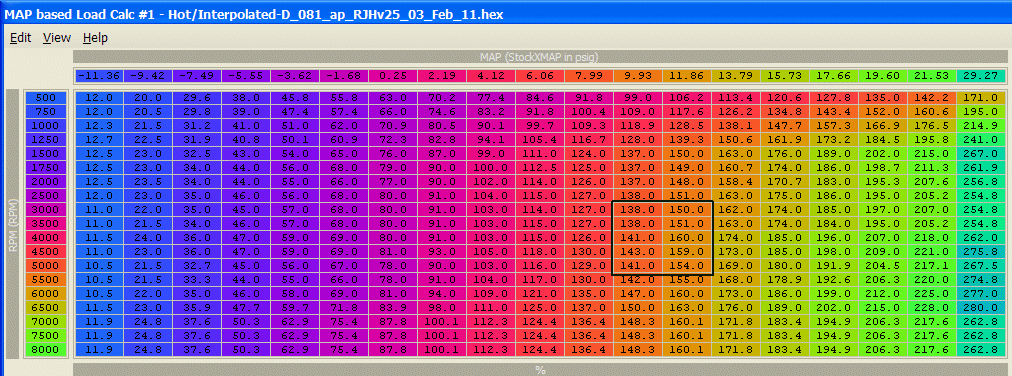
I'm not clear on how all the MAP/MAF load calcs work (despite a whole lotta reading), but even I can see there are some large, rough steps in those cells as RPM increases.
What should it be, I ask myself? How do I go about it empirically? Set a fixed AFR in a range, then tweak the MAP tables to align them with the "real" VE airflow (ie. use AFR to "calibrate")?
Or just smooth out each column, so it's not so skippy - and then tune AFR without the skips and jumps? I won't go for that... chiefly because I know I don't know what I'm doing!

So much to cram into such a tiny brain.
Rich
...
What should it be, I ask myself? How do I go about it empirically? Set a fixed AFR in a range, then tweak the MAP tables to align them with the "real" VE airflow (ie. use AFR to "calibrate")?
Or just smooth out each column, so it's not so skippy - and then tune AFR without the skips and jumps? I won't go for that... chiefly because I know I don't know what I'm doing!
So much to cram into such a tiny brain.
Rich
What should it be, I ask myself? How do I go about it empirically? Set a fixed AFR in a range, then tweak the MAP tables to align them with the "real" VE airflow (ie. use AFR to "calibrate")?
Or just smooth out each column, so it's not so skippy - and then tune AFR without the skips and jumps? I won't go for that... chiefly because I know I don't know what I'm doing!
So much to cram into such a tiny brain.
Rich

Well, I think in an ideal scenario the tables would mirror the VE curve of the engine for a given boost pressure. Such that at peak torque / peak VE the load value is at it's highest and then falls off as rpm increases. You can see that is the general trend, aside from the odd areas where load dips right in the middle of peak torque and goes up as the rpm is increasing.
I would really like to be able to log both the calculated map load and calculated maf load... that should make things much much easier and quicker to dial in the map load tables and make it easier to favor which ever calc you prefer for tuning...
Thread Starter
Evolved Member
Joined: Oct 2010
Posts: 2,447
Likes: 14
From: Australia
It all seems to be logging perfectly. BUT the logged data just doesn't seem to sensibly correspond to the AFR map driving it. And I'm going around it circles because of that.
I'll try to explain it - competently, this time.
This graph I put up earlier...
...seems to show a good, if slightly rich, spool-up. The problem is, to get that AFR curve I had to enrich the relevant spool-up cells quite substantially.
If I go and hang out at those same cells at part-throttle, it looks more like this...

Note the highlighted area - 3600rpm, 168 load... Totally in the same region as the first "spool-up" graph.
The first spool-up graph apparently shows mixtures dropping from stoich to below 12.0:1 before peak boost.
The second part-throttle, steady load graph touches the exact same map area, but that log shows the 4B11 about to start coughing up blood.
These two graphs are definitely of the same map (hooray for OCD map revision numbering systems!).
A bit disappointing.
Hope that explains it!
Rich
......
If I go and hang out at those same cells at part-throttle, it looks more like this...
Note the highlighted area - 3600rpm, 168 load... Totally in the same region as the first "spool-up" graph.
The first spool-up graph apparently shows mixtures dropping from stoich to below 12.0:1 before peak boost.
The second part-throttle, steady load graph touches the exact same map area, but that log shows the 4B11 about to start coughing up blood.
...
If I go and hang out at those same cells at part-throttle, it looks more like this...
Note the highlighted area - 3600rpm, 168 load... Totally in the same region as the first "spool-up" graph.
The first spool-up graph apparently shows mixtures dropping from stoich to below 12.0:1 before peak boost.
The second part-throttle, steady load graph touches the exact same map area, but that log shows the 4B11 about to start coughing up blood.
...
Out of curiosity Rich, have you done any back to back lean spool on vs off runs? Just to verify that the lean spool bit really is the lean spool bit and not something else unrelated? I don't have the xml for the lean spool fuel compensation so the only part i can mess with the is the on / off bit.
Last edited by Mad_SB; Apr 20, 2011 at 09:13 AM.


Got some interesting logs tonight, looks like the ecu does not always use the lower of the two calcs between maf and map....
https://www.evolutionm.net/forums/9257900-post60.html
Don't want to derail Rich's thread so I threw the data in the original map load tables thread.
https://www.evolutionm.net/forums/9257900-post60.html
Don't want to derail Rich's thread so I threw the data in the original map load tables thread.
Thread Starter
Evolved Member
Joined: Oct 2010
Posts: 2,447
Likes: 14
From: Australia
Interstingly, if you go look at your map load tables.... 3,500 rpm 12.9psi... the map load (before compensations) would be about 10 points lower than the logged load or about 160 load
Out of curiosity Rich, have you done any back to back lean spool on vs off runs? Just to verify that the lean spool bit really is the lean spool bit and not something else unrelated? I don't have the xml for the lean spool fuel compensation so the only part i can mess with the is the on / off bit.
Out of curiosity Rich, have you done any back to back lean spool on vs off runs? Just to verify that the lean spool bit really is the lean spool bit and not something else unrelated? I don't have the xml for the lean spool fuel compensation so the only part i can mess with the is the on / off bit.
Yes, I have... and it really is working.
This is GST Base Map (2.5, Boost Pill, 93oct)... Lean Spool ON...

And this is the same map, same day, same stretch of road, Lean Spool OFF...

That first graph is quite a mess, is it not?
Pick the one you'd prefer to use as a starting point for tuning!
Rich

Thread
Thread Starter
Forum
Replies
Last Post
nj1266
Evo X Engine Management / Tuning Forums
125
Jan 12, 2010 07:37 AM
purekoryo
Evo Engine / Turbo / Drivetrain
9
Oct 28, 2009 02:07 PM
