


Evo X motor


Evolved Member
Joined: Mar 2004
Posts: 1,635
Likes: 3
From: Butt**** Nowhere
Bang for the buck! The more power you can make without doing a tear down, the better it will be for guys who want to mod, but don't have the budget for a costly rebuild.
I don't see the sleeves in the X block being a problem. Honda guys are reinforcing their full floating sleeves like how the X has the extra material from the outer part of the block connecting to the sleeves. This is a very well thought out engine.
I don't see the sleeves in the X block being a problem. Honda guys are reinforcing their full floating sleeves like how the X has the extra material from the outer part of the block connecting to the sleeves. This is a very well thought out engine.

Evolved Member
iTrader: (20)
Joined: Mar 2003
Posts: 4,941
Likes: 0
From: Danville/Blackhawk, California
shiv


Evolved Member
Joined: Oct 2007
Posts: 1,849
Likes: 1
From: USA
Yes, I also would like to hear more comments about the strength of the internals as well as the block and sleeve design. My main question is this; I know that the rods and pins are stronger, but what about the pistons? I read that they were gravity cast, ( how that differs from any other kind of casting I'm not exactly sure ). I know that cast pistons, if designed properly, can be about as strong as a basic forged piston, but there are pros and cons to both designs I suppose. Cast pistons can have tighter tolerances in the block than a forged piston because forged pistons expand more with heat supposedly, right? However, forged pistons can handle more boost from my understanding, so why would mitsu go from a forged design to a cast? The car still runs crazy high boost, so they obviously designed them well, but I'm curious about your impressions, keith. Thanks.
Last edited by STi2EvoX; Feb 11, 2008 at 08:19 PM.

Evolved Member
Joined: Oct 2007
Posts: 1,849
Likes: 1
From: USA
Really? Everyone that I've talked to has always said that they were forged. I know one of the interesting things with the sti for example, is that the jdm had forged pistons, and the usdm had hypereutectic cast. This is very interesting. And not to ask a stupid question, but you are 100% positive about this, right? I mean you work for AMS it looks like, so I guess I shouldn't even question you, but this is kinda shocking, and strangely comforting at the same time as it's nice to know that the internals are similar to the old models, if not stronger from what I hear. Either way, that being the case, how do the new pistons compare?

Really? Everyone that I've talked to has always said that they were forged. I know one of the interesting things with the sti for example, is that the jdm had forged pistons, and the usdm had hypereutectic cast. This is very interesting. And not to ask a stupid question, but you are 100% positive about this, right? I mean you work for AMS it looks like, so I guess I shouldn't even question you, but this is kinda shocking, and strangely comforting at the same time as it's nice to know that the internals are similar to the old models, if not stronger from what I hear. Either way, that being the case, how do the new pistons compare?


Evolving Member
Joined: Jul 2007
Posts: 160
Likes: 0
From: Rosamond, CA
ok, i know i got this info from a subaru site but this write-up also applies to the 4G63T & 4B11T (& any car in general) in this situation concerning their closed & semi closed decks.
also this is the reason why i prefer the 4G63T over the 4B11T.
http://spda-online.ca/modules/newbb/...d=3116&forum=9

also this is the reason why i prefer the 4G63T over the 4B11T.
http://spda-online.ca/modules/newbb/...d=3116&forum=9
The deck is the surface where the head is bolted too.
The open deck design is for ease of manufacturing and not good for high cylinder pressures. This cylinder wall design is supported in 2 places. Many people will say that these engines cannot be turboed effectively but that is not the case. There are a couple here in the club that have run low to medium boost without issue. The problem is where the top of the cylinder where it meets the head will distort from high cylinder pressure and damage the head gaskets ability to seal in the combustion gases.
A semi closed deck design is a little harder to manufacture, but supports the cylinder at the top, bottom and sides. (four places). This is stronger then the open deck design and therefore can take higher cylinder pressures.
The fully closed deck design uses a different casting process that takes longer to manufacture and weighs more. These blocks have the most support to the cylinders, which will enable you to run the highest cylinder pressure of the available choices.
Subaru introduced the closed deck block for homologation reasons to be able to run it in their rally cars. This engine was made famous when a very similar version to it was installed in the limited edition 22B. With the casting methods and alloys available at the time Subaru chose this route to ensure a strong motor. With todays “modern” casting methods and alloys even the semi closed deck designed motors are very strong.
As a guide I would say the following;
Open deck blocks will work for all NA or low to medium boost applications.
Semi closed deck blocks are better suited for boost applications that are not extremely high or prolonged.
Closed deck block are best suited for applications where there will be very high boost for extended periods of time.
The open deck design is for ease of manufacturing and not good for high cylinder pressures. This cylinder wall design is supported in 2 places. Many people will say that these engines cannot be turboed effectively but that is not the case. There are a couple here in the club that have run low to medium boost without issue. The problem is where the top of the cylinder where it meets the head will distort from high cylinder pressure and damage the head gaskets ability to seal in the combustion gases.
A semi closed deck design is a little harder to manufacture, but supports the cylinder at the top, bottom and sides. (four places). This is stronger then the open deck design and therefore can take higher cylinder pressures.
The fully closed deck design uses a different casting process that takes longer to manufacture and weighs more. These blocks have the most support to the cylinders, which will enable you to run the highest cylinder pressure of the available choices.
Subaru introduced the closed deck block for homologation reasons to be able to run it in their rally cars. This engine was made famous when a very similar version to it was installed in the limited edition 22B. With the casting methods and alloys available at the time Subaru chose this route to ensure a strong motor. With todays “modern” casting methods and alloys even the semi closed deck designed motors are very strong.
As a guide I would say the following;
Open deck blocks will work for all NA or low to medium boost applications.
Semi closed deck blocks are better suited for boost applications that are not extremely high or prolonged.
Closed deck block are best suited for applications where there will be very high boost for extended periods of time.

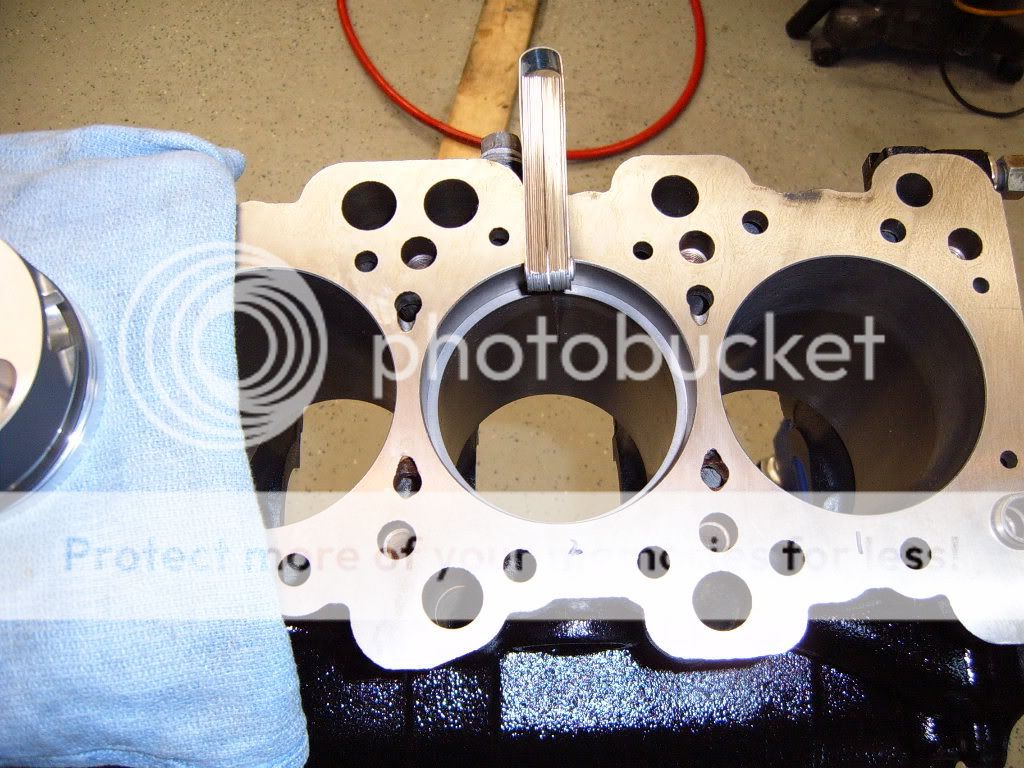
Last edited by pekpekbuster; Feb 12, 2008 at 06:25 AM.


Well, judging from the opinions of ams and looking at the pics, this motor is going to be able to support big power. I mean, with the 4g63 the stock internals cannot hold up reliably to more than about 450whp max, and I'm guessing that the 4b11 is probably the same. One thing I will say is that while you're in there, drop in some more heavy duty sleeves into the 4b11 and I think that this motor will be able to hold close to the same power as the 4g63. If not, I'm sure that some company will make an iron race block for the car. For me, though, ~400whp, depending on the dyno, is probably where I'm going to be content. I don't need any more than that, and so far the motor has shown that it can easily accomplish that.


i think the weight difference between the 4g63t and the 4b11t is not that dramatic. 28 lbs or something like that. But looks like on that picture above it is worth to have 28lbs extra. By the way the new 4b11t have the same exhaust manifold weight then the 4g63t? because in not... than the weight difference will be easely reduce it down around 15 lbs...

Evolving Member
Joined: Jul 2002
Posts: 217
Likes: 0
From: Torrance, California
God looking at these pictures of the torn down motors makes me want to play with them and put them back together and take them apart and keep repeating till I'm to tired to do it. I do a lot of work on big reciprocating compressors, centrifigual compressors, and turbines. This is all just like miniture scale :P I need to go rip a motor apart on my free time now. It's all the same just smaller :P

-Steve
Evolving Member
Joined: Jul 2007
Posts: 160
Likes: 0
From: Rosamond, CA
but if i went that route, after all was said and done, i woulda spent more on a fwd civic than the cost of just getting an awd evo. so after seeing what the 4G63T's block looked like (& driving it), i was sold.

notice how similar the deck on this dart b20 block is to the 4G63T's:

http://www.hondatuningmagazine.com/t...ild/index.html
and eventhough this article was an all motor build, it still clearly points out the benefits of a closed deck block over a sleeved open deck block starting from pg2 on:
First is cylinder roundness. If you look at a sleeved block, you can see where the sleeves butt together; they have flat areas on them where they meet. When you have material of varying thicknesses, it expands at different rates. Consequently, as temps go up, the cylinders don't tend to stay round. Anyone who's ever built engines for serious competition will tell you ring seal is everything when it comes to making power.
The Dart block has sleeves that are the same thickness all the way around, so when the block heats up, even in machining, the cylinders stay round. Straight bores are something that Dart has specialized in for years. The Dart casting also has heavy main bearing webbing, so it supports the bearings and crank instead of the other way around. When you sleeve a Honda block and you mill out the original cylinders, it causes the whole bottom end of the Honda block to relax and the mains go out of alignment. When the sleeves are pressed in, it forces them even further out of alignment. In order to fix this you would have to align-bore, or align-hone the mains, and there aren't many shops doing that correctly, keeping the crank centerline precisely where it needs to be. This is important, because any crank offset will dramatically shorten the life of the oil pump. This process also needs to be done with a torque plate in place.
The Dart block has sleeves that are the same thickness all the way around, so when the block heats up, even in machining, the cylinders stay round. Straight bores are something that Dart has specialized in for years. The Dart casting also has heavy main bearing webbing, so it supports the bearings and crank instead of the other way around. When you sleeve a Honda block and you mill out the original cylinders, it causes the whole bottom end of the Honda block to relax and the mains go out of alignment. When the sleeves are pressed in, it forces them even further out of alignment. In order to fix this you would have to align-bore, or align-hone the mains, and there aren't many shops doing that correctly, keeping the crank centerline precisely where it needs to be. This is important, because any crank offset will dramatically shorten the life of the oil pump. This process also needs to be done with a torque plate in place.
with sleeves though. And hondas are semiclosed, at least the B series engines arent, so they were easier to sleeve. A semi closed block will mean those spots where the sleeves are connected to the block would have to be removed and sleeves would have to be installed. Or maybe we can just pour some concrete in there, lol
-Steve
-Steve
Last edited by pekpekbuster; Feb 27, 2008 at 07:51 AM.