Low-Load High Knock Explained


Thread Starter
Former Sponsor
Joined: Oct 2008
Posts: 539
Likes: 1
From: USA
Low-Load High Knock Explained
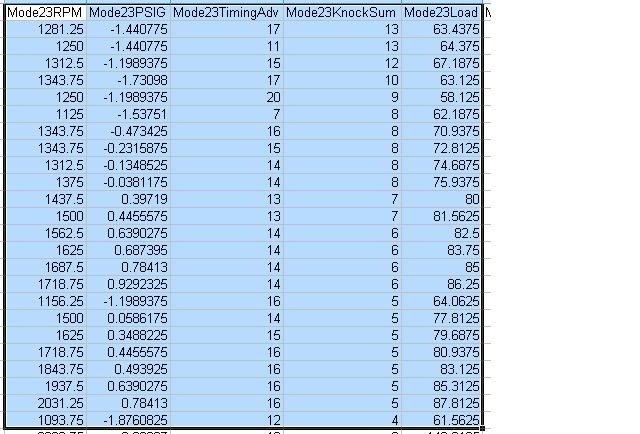
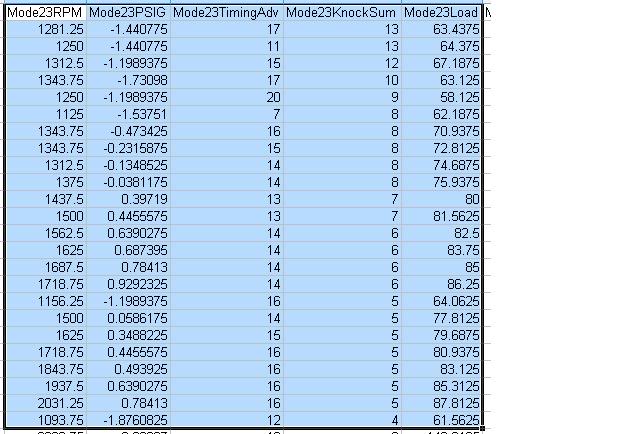
Many of you have noticed while logging your cars, that you see instances of high knock-correction values and low-rpm and low load situations. There has been much speculation about the cause and effects of these occurrences.
To put your apprehension to rest, Tim Bailey, one of our most experienced and knowledgeable tuners has offered the following explanation of this phenomenon:
Modern engine control computers (ECU) monitor and constantly adjust engine parameters including fuel delivery, variable camshaft timing, and ignition timing. Under light load (low boost or vacuum conditions) the objective of this active adjustment is optimized fuel economy and power.
An important component of this active adjustment is changes to ignition timing. Utilizing the highest possible ignition timing is a simple way to enhance the mechanical energy for any given combustion cycle. This enhancement extracts the most torque for a given quantity of spent fuel.
The processes that manage optimal ignition timing at light load are complex and vary by vehicle type. Some ignition timing adjustments are active and based upon sensor feedback. One such sensor is the "knock sensor." This sensor is a simple microphone that listens for engine noise. Complex signal processing inside the ECU helps discriminate detonation from other types of engine noise. The thresholds for noise vs knock vary not only by engine speed but by engine load. The ECU will react to engine noise by actively removing ignition timing. This low-load "knock correction" is a normal and desirable process that promotes optimal ignition timing.
Other timing adjustments are programmed compensations that are predictive in nature. For example, on some vehicles a sharp increase in throttle position predicts a fast change in engine load. In preparation for a predicted change in engine load the ECU will preemptively remove some ignition timing. This compensation is not really knock correction at all but is instead a predictive ignition timing adjustment. Similar compensations exist for a variety of conditions including but not limited to changes in load, air temperature, boost temperature, and acceleration. Tuning strategies for predictive corrections vary by vehicle but are present in some form in every modern ECU.
Unfortunately, the monitors that allow us to monitor the ECU’s activities do not discriminate between predictive timing adjustments and those responding to sensor input. However, regardless of the type of compensatory timing adjustment, at LIGHT load, these corrections are a normal means with which to optimize power and fuel economy. Under light load there is simply not enough cylinder pressure to allow engine damage. As a result, light load "knock correction" is not something to worry about. This is a normal process that is even more apparent when utilizing stock calibrations designed to utilize a range of fuel quality.
Travis Geny
COBB Tuning
To put your apprehension to rest, Tim Bailey, one of our most experienced and knowledgeable tuners has offered the following explanation of this phenomenon:
Modern engine control computers (ECU) monitor and constantly adjust engine parameters including fuel delivery, variable camshaft timing, and ignition timing. Under light load (low boost or vacuum conditions) the objective of this active adjustment is optimized fuel economy and power.
An important component of this active adjustment is changes to ignition timing. Utilizing the highest possible ignition timing is a simple way to enhance the mechanical energy for any given combustion cycle. This enhancement extracts the most torque for a given quantity of spent fuel.
The processes that manage optimal ignition timing at light load are complex and vary by vehicle type. Some ignition timing adjustments are active and based upon sensor feedback. One such sensor is the "knock sensor." This sensor is a simple microphone that listens for engine noise. Complex signal processing inside the ECU helps discriminate detonation from other types of engine noise. The thresholds for noise vs knock vary not only by engine speed but by engine load. The ECU will react to engine noise by actively removing ignition timing. This low-load "knock correction" is a normal and desirable process that promotes optimal ignition timing.
Other timing adjustments are programmed compensations that are predictive in nature. For example, on some vehicles a sharp increase in throttle position predicts a fast change in engine load. In preparation for a predicted change in engine load the ECU will preemptively remove some ignition timing. This compensation is not really knock correction at all but is instead a predictive ignition timing adjustment. Similar compensations exist for a variety of conditions including but not limited to changes in load, air temperature, boost temperature, and acceleration. Tuning strategies for predictive corrections vary by vehicle but are present in some form in every modern ECU.
Unfortunately, the monitors that allow us to monitor the ECU’s activities do not discriminate between predictive timing adjustments and those responding to sensor input. However, regardless of the type of compensatory timing adjustment, at LIGHT load, these corrections are a normal means with which to optimize power and fuel economy. Under light load there is simply not enough cylinder pressure to allow engine damage. As a result, light load "knock correction" is not something to worry about. This is a normal process that is even more apparent when utilizing stock calibrations designed to utilize a range of fuel quality.
Travis Geny
COBB Tuning



Not likely, thats why the ECU is so on top of whats going on. It obviously makes a difference depending on what amount of knock we are talking about, but by and large the part throttle stuff can be mostly ignored. If its a few counts, or if the car is stuttering (i.e. BOV) while at part throttle (not WOT and low load/boost), it can be slid under the carpet. If its 100% throttle and low load and knocking thats the concern. You can just pare the timing out (mostly see this in the 80-120 range) a few degrees but the car does it so fast typically its not worth the effort, especially if its not repeatable.
Last edited by JohnBradley; Jul 21, 2009 at 04:55 PM.


Evolving Member
Joined: Jun 2008
Posts: 146
Likes: 0
From: Romania
it is at WOT
I have pulled the timing a few degrees, but it does not dissapear, only when the ambient temperature drops below 18C/65F then it goes away
at 2600-2800 I have 12,5 AFR, is it too high? and by 3000rpm it drops to 10,5-10,8
I have pulled the timing a few degrees, but it does not dissapear, only when the ambient temperature drops below 18C/65F then it goes away
at 2600-2800 I have 12,5 AFR, is it too high? and by 3000rpm it drops to 10,5-10,8


The ECU reacts to knock after the fact, not before. When it detects a certain amount of knock, it then takes timing out to combat the knock and adds it back once the knock has been taken care of. If there is enough knock, for long enough, this starts to decrement the "octane value" and will start interpolating off the low octane tables. This octane value is quickly reset depending on knock value vs time, etc.
Low load, closed loop cruising "dynamic" efficiency is a result of fuel trims always striving for Stoich fueling and adding and subtracting ignition from the base ignition tables via the EGR ignition tables. There are other tables involved for decel and accel as well.
Low load, closed loop cruising "dynamic" efficiency is a result of fuel trims always striving for Stoich fueling and adding and subtracting ignition from the base ignition tables via the EGR ignition tables. There are other tables involved for decel and accel as well.
Trending Topics


Has anyone datalogged an entirely stock EVO X that they could post the Knock Correction through a 3rd or 4th gear pull? Trying to decipher what is "normal" levels of correction (maybe 0.35 here and there) and what is moderate to severe values or Knock Correction (CA) in my COBB AP.
I tried calling COBB directly but really didn't get a clear answer.
- Louis
BTW, I am talking about full throttle WOT pulls through the gears... not crusing low load knock.
I tried calling COBB directly but really didn't get a clear answer.
- Louis
BTW, I am talking about full throttle WOT pulls through the gears... not crusing low load knock.

Has anyone datalogged an entirely stock EVO X that they could post the Knock Correction through a 3rd or 4th gear pull? Trying to decipher what is "normal" levels of correction (maybe 0.35 here and there) and what is moderate to severe values or Knock Correction (CA) in my COBB AP.
I tried calling COBB directly but really didn't get a clear answer.
- Louis
BTW, I am talking about full throttle WOT pulls through the gears... not crusing low load knock.
I tried calling COBB directly but really didn't get a clear answer.
- Louis
BTW, I am talking about full throttle WOT pulls through the gears... not crusing low load knock.
severe would be consistant 1.0+


EvoM Guru
iTrader: (50)
Joined: Mar 2006
Posts: 9,675
Likes: 132
From: Tri-Cities, WA // Portland, OR
No EGR in the Evo 10. :-) I haven't looked at the timing trim routines in the Evo 10 ROM yet, we both know that there are many sections of code in the Evo 10 ROM that are lifted from the Evo 8/9 code base, so my first reaction is the same as yours... there is likely no closed-loop dynamic timing optimization in the Evo 10 code.