


What a difference....


Notice how the base run power curve drops off suddenly up top and the test run (after tune) does not.
This one is even a bit more extreme:

These are both bone stock EVO 9's with a custom dyno tune and using ECU boost control.
Last edited by razorlab; Jun 4, 2007 at 11:23 PM.

 .
. 
Here is a good example of taking the lean spool or 'IPW' step at 7,000 rpm off:
Notice how the base run power curve drops off suddenly up top and the test run (after tune) does not.
This one is even a bit more extreme:
These are both bone stock EVO 9's with a custom dyno tune and using ECU boost control.
Notice how the base run power curve drops off suddenly up top and the test run (after tune) does not.
This one is even a bit more extreme:
These are both bone stock EVO 9's with a custom dyno tune and using ECU boost control.


EvoM Guru
iTrader: (50)
Joined: Mar 2006
Posts: 9,675
Likes: 132
From: Tri-Cities, WA // Portland, OR
I ended up disabling lean spool also. I found that it reduces boost spiking on spool-up and makes for a more gentle spool-up which I prefer. The trade-off in my case is that it takes about 100-200 rpm longer in 3rd gear to reach full boost (but I still hit full boost by 3400 rpm).
Today, I decided to fix the knock that I was getting stock and w/tbe. Since we have **** poor 91 octane gas, I had a hunch that it was the timing causing the knock.
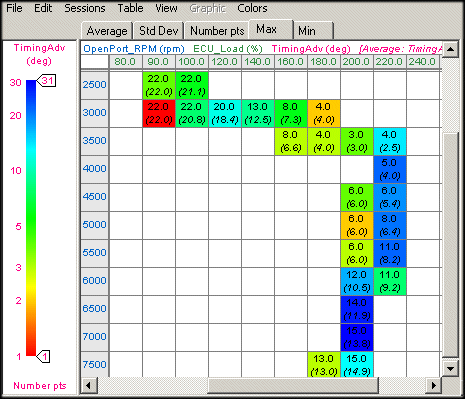
Here is the timing stock timing that I logged with a TBE. All the tables are 3 logs. The numbers in brackets are average numbers and the others are max numbers:
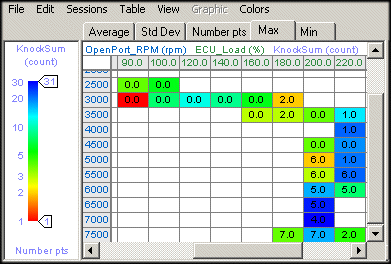
And here is the knock that I was getting. The knock happened in the 5000+ range and was about 6-7 counts.
I changed the #2 high octane ignition map and copied it into #1 and #3. I chose this method because no one is certain about which method to use.
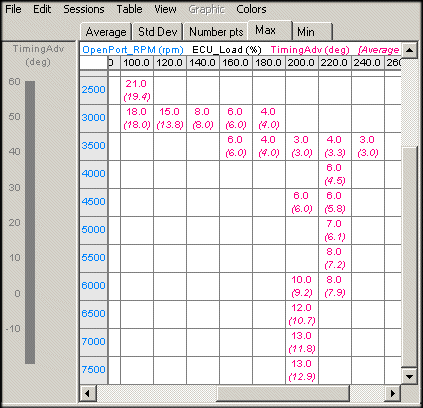
Then I went logging and recorded the following timing numbers:
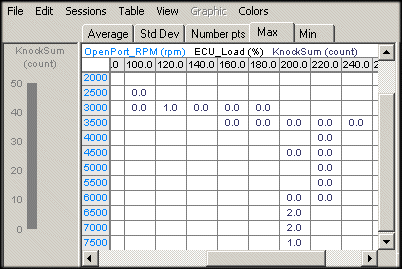
There was virtually no knock in the logs based on the above timing numbers:
Tomorrow I want to add the RS mivec map to the equation.
My question is this:
Are the new timing numbers too aggressive for the RS mivec map? Should I pull some more timing?
Here is the timing stock timing that I logged with a TBE. All the tables are 3 logs. The numbers in brackets are average numbers and the others are max numbers:
And here is the knock that I was getting. The knock happened in the 5000+ range and was about 6-7 counts.
I changed the #2 high octane ignition map and copied it into #1 and #3. I chose this method because no one is certain about which method to use.
Then I went logging and recorded the following timing numbers:
There was virtually no knock in the logs based on the above timing numbers:
Tomorrow I want to add the RS mivec map to the equation.
My question is this:
Are the new timing numbers too aggressive for the RS mivec map? Should I pull some more timing?
Last edited by nj1266; Jun 7, 2007 at 12:26 PM.
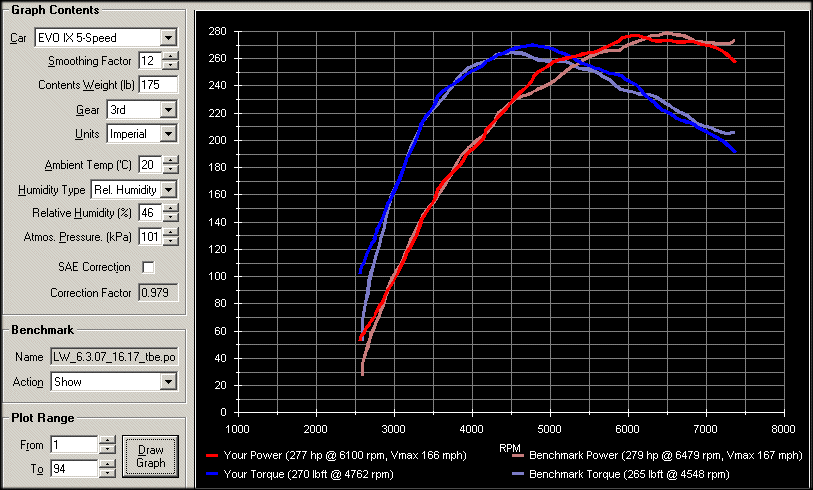
The nice thing is that even though I pulled timing, the car did not lose much power. Infact, in some areas in the mid range it gained power. As I always say, sometimes less is more
Last edited by nj1266; Jun 7, 2007 at 08:09 AM.

Evolved Member


Joined: May 2006
Posts: 2,399
Likes: 6
From: UK
I wouldn't pull more timing. The ECU does excessively retard once you get knock sums over about 3 though, which is why you can gain performance by cooperating with the knock control system, often across the whole range. An early knock to knock sum 6 for example will keep the timing 2 degrees down across quite a wide RPM range as it decays on a counter even though knock has abated.
EvoM Guru
iTrader: (50)
Joined: Mar 2006
Posts: 9,675
Likes: 132
From: Tri-Cities, WA // Portland, OR
Today, I decided to fix the knock that I was getting stock and w/tbe. Since we have **** poor 91 octane gas, I had a hunch that it was the timing causing the knock.
Here is the timing stock timing that I logged with a TBE. All the tables are 3 logs. The numbers in brackets are average numbers and the others are max numbers:

And here is the knock that I was getting. The knock happened in the 5000+ range and was about 6-7 counts.

I changed the #2 high octane ignition map and copied it into #1 and #3. I chose this method because no one is certain about which method to use.
Then I went logging and recorded the following timing numbers:

There was virtually no knock in the logs based on the above timing numbers:

Tomorrow I want to add the RS mivec map to the equation.
My question is this:
Are the new timing numbers too aggressive for the RS mivec map? Should I pull some more timing?
Here is the timing stock timing that I logged with a TBE. All the tables are 3 logs. The numbers in brackets are average numbers and the others are max numbers:
And here is the knock that I was getting. The knock happened in the 5000+ range and was about 6-7 counts.
I changed the #2 high octane ignition map and copied it into #1 and #3. I chose this method because no one is certain about which method to use.
Then I went logging and recorded the following timing numbers:
There was virtually no knock in the logs based on the above timing numbers:
Tomorrow I want to add the RS mivec map to the equation.
My question is this:
Are the new timing numbers too aggressive for the RS mivec map? Should I pull some more timing?
I wouldn't pull more timing. The ECU does excessively retard once you get knock sums over about 3 though, which is why you can gain performance by cooperating with the knock control system, often across the whole range. An early knock to knock sum 6 for example will keep the timing 2 degrees down across quite a wide RPM range as it decays on a counter even though knock has abated.

I have found most of the IX's dont like a large amount of timing up top like VIII's or even older DSM's will. The cammed ones like even less it seems above 6K than stock cams. The funny thing about that is they will take a little more near peak torque but trade it at high rpm. I always thought it would accept more at both but I cant deny the logs I am getting.
I hate to preach the "I dont like lean spool" doctrine, but I turned it off and retuned it all manually a long time ago because of alot of what there are now posted logs showing. The having end user adjustablility is the whole reason we like ECUflash anyway right? Why hinder it because of factory protocols?
JB
p.s. sorry for the minor threadjack Nj...I like what you are doing with you car thus far.
I hate to preach the "I dont like lean spool" doctrine, but I turned it off and retuned it all manually a long time ago because of alot of what there are now posted logs showing. The having end user adjustablility is the whole reason we like ECUflash anyway right? Why hinder it because of factory protocols?
JB
p.s. sorry for the minor threadjack Nj...I like what you are doing with you car thus far.
Today, I tested the impact of the JDM RS mivec map on my tune. I drove the car a lot today since I went to the bank, the pharmacy and then to pick up the pills. After that I went logging. The first and third log were virtually knock free. The 2nd had knock. Since it was the 2nd log that had knock, I am not that concerned about it. If there was knock in the 3rd log then I would be concerned. I think the car was too warm. I noticed that by monitoring the IAT gauge and I was having a hard time keeping the IAT temps below 85* F.
The car felt great during the logs. The butt dyno told me that I gained power. But then I looked @ the DLL power curve and there was almost little to no gain. I was miffed. Then I remembered one variable that I did not account for: weight. Yesterday, I logged with the gas indicator light on. Today I had a FULL tank of gas. After I subtracted the gas weight from yesterday's power curve calculation, I saw a difference in power. From now on, I will begin adjusting the weight of gasoline in the car to get a more accurate dyno plot. Usually, I keep the number @ 3263 lbs. I found out how inaccurate that could be today.
Here is the chart:

The car felt great during the logs. The butt dyno told me that I gained power. But then I looked @ the DLL power curve and there was almost little to no gain. I was miffed. Then I remembered one variable that I did not account for: weight. Yesterday, I logged with the gas indicator light on. Today I had a FULL tank of gas. After I subtracted the gas weight from yesterday's power curve calculation, I saw a difference in power. From now on, I will begin adjusting the weight of gasoline in the car to get a more accurate dyno plot. Usually, I keep the number @ 3263 lbs. I found out how inaccurate that could be today.
Here is the chart: