


Apexi drop-in filter?


Although, as I mentioned above, having an opening at the top somewhat defeats the purpose of a velocity stack. Also, a very important part of a velocity stack is the bend and shape coming into the pipe at the OD, which we can't see with this filter. The inverted cone on top is only half of the equation when designing the velocity stack.
Eric
Inverted cone is a velocity stack. Air comes in a bigger opening and comes out the smaller one, which as the name implies increases its speed. They are commonly used on bike intakes. For our application it seems to help smoothen the airflow.
Example is an oil funnel. If you used it as air intake you would call it a velocity stack.
Edit: But then again this filter sucks air through the sides of the stack, its end is actually plugged, and it's not the way normal stacks work. It definitely looks like one and seems to work for the maf though. So vocabulary aside, for $17 its def worth a try.
Last edited by mplspilot; Jun 18, 2007 at 03:03 PM.

Inverted cone is a velocity stack. Air comes in a bigger opening and comes out the smaller one, which as the name implies increases its speed. They are commonly used on bike intakes. For our application it seems to help smoothen the airflow.
Example is an oil funnel. If you used it as air intake you would call it a velocity stack.
Edit: But then again this filter sucks air through the sides of the stack, its end is actually plugged, and it's not the way normal stacks work. It definitely looks like one and seems to work for the maf though. So vocabulary aside, for $17 its def worth a try.
Example is an oil funnel. If you used it as air intake you would call it a velocity stack.
Edit: But then again this filter sucks air through the sides of the stack, its end is actually plugged, and it's not the way normal stacks work. It definitely looks like one and seems to work for the maf though. So vocabulary aside, for $17 its def worth a try.
The inverted cone itself is part of the velocity stack that helps curve the airflow into the pipe to eliminate the eddies, etc. But air coming through the inverted cone will disrupt the air that is being smoothed because of the inverted cone.
My point is that the inverted cone that allows air through is not a velocity stack. The cone has to be solid.
Let me find a good illustration of the Apexi filter, that somewhat shows what I mean.
Edit: Even though this picture is from Apexi, it shows what I am describing:
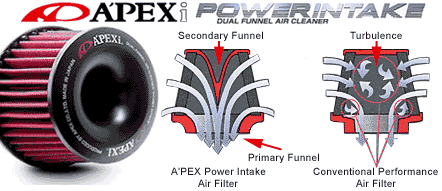
There are two places that need to be properly rounded with a precise radius: the inverted cone itself and the area where the juction occurs at the OD of the pipe (what is called the primary funnel in the picture)...basically both places that the turbulent flow is shown in a 'normal' cone filter.
Allowing air through the inverted cone defeats this purpose. Also, on the EBAY filter, we can't see how the radius is where the filter attaches to the pipe (the primary funnel in the picture).
Eric
Last edited by l2r99gst; Jun 18, 2007 at 04:12 PM.

It definitely gives more surface area, but letting air through the cone is almost as if no cone was there. You're just creating a boundary layer of disturbance with two airflow paths colliding/combining.
It's been years since I have been in any engineering classes or fluid dynamics, but letting air flow through the cone would not be as ideal, in terms of smooth airflow, as having a solid cone.
I would venture to guess, though, that the positive affect of the extra surface area may combat any negative effect of any possible disruption of flow at the boundary layer of the two airflow paths.
But, all this is just speculation and I would also venture a guess that any benefits or gains would be very minimal either way, on the order of 1% or so. Bryan has already stated that the filter performs well, so data speaks louder than any opinions. I just happen to agree with the engineering design of the Apexi. But, in this particular situation, maybe it doesn't really matter and the more surface area is better or maybe the gains/losses are negligible.
Either way, now we have a cheap solution to test and use if we want.
Thanks for all of the input in this thread,
Eric
It's been years since I have been in any engineering classes or fluid dynamics, but letting air flow through the cone would not be as ideal, in terms of smooth airflow, as having a solid cone.
I would venture to guess, though, that the positive affect of the extra surface area may combat any negative effect of any possible disruption of flow at the boundary layer of the two airflow paths.
But, all this is just speculation and I would also venture a guess that any benefits or gains would be very minimal either way, on the order of 1% or so. Bryan has already stated that the filter performs well, so data speaks louder than any opinions. I just happen to agree with the engineering design of the Apexi. But, in this particular situation, maybe it doesn't really matter and the more surface area is better or maybe the gains/losses are negligible.
Either way, now we have a cheap solution to test and use if we want.
Thanks for all of the input in this thread,
Eric
Eric, the Apexi filter would probably work alot better if it where a bit bigger and bolted to the MAF without an adapter, I really think adapters and their designs are one of the big causes of MAF interference. The Apexi adapter is smaller than the MAF input on the filter side so it's actually channeling the air into a smaller area on the filter side then the air is coming out at a larger area on the MAF side. This might make air disturbance.
Again I am not an engineer so take my thoughts and theories with a couple thousand grains of salt.
Again I am not an engineer so take my thoughts and theories with a couple thousand grains of salt.

Bryan introduced me to the buschur filter, and IMHO it works. I ran it with C16 so knock wouldn't be in the equation, and I saw some sick power out of my stock turbo.
The stock airbox is a problem past 340-350 Dyno Dynamics whp, my customers and I have tested it by taking the intake box cover off, which picked up gains on the top end and showed more boost. With no filter at all and just the airbox, there were even more gains to be had.
That is when I decided I would forgo my stock appearing engine bay for more power by going with an open filter, I've tuned many intakes / filters before, and none really stood out except for the Buschur filter.
The stock airbox is a problem past 340-350 Dyno Dynamics whp, my customers and I have tested it by taking the intake box cover off, which picked up gains on the top end and showed more boost. With no filter at all and just the airbox, there were even more gains to be had.
That is when I decided I would forgo my stock appearing engine bay for more power by going with an open filter, I've tuned many intakes / filters before, and none really stood out except for the Buschur filter.

Andy, if you want stealth, this is the filter I run, uses the standard $20 maf adapter, is short (only 4.5" tall), so it fits under the stock box top/snorkel. You left right before my car went on the dyno, but I'm sure you saw the results from the dyno day. Bryan saw them as well since he was, well, in the dyno room 
http://www.amazon.com/K-N-RF-1005-Un...2234974&sr=8-1
http://www.amazon.com/K-N-RF-1005-Un...2234974&sr=8-1

Do you have a picture of this by any chance? It's not that I don't believe you....it just baffles me that someone would design an adapter plate with an opening smaller than the MAF housing that it is being joined to.
I think you are swaying me towards at least giving the EBAY filter a shot. I just hope it filters as well as the Apexi.
Eric
The bolts are pressed into the airbox and are designed for that and cannot be reused for an application like this. I have bolts that work with ebay filter, I just need to go to the hardware store and figure out the length and pitch.
I was definitely not aware of this. If this is true, that makes absolutely no sense at all and would cause a restriction.
Do you have a picture of this by any chance? It's not that I don't believe you....it just baffles me that someone would design an adapter plate with an opening smaller than the MAF housing that it is being joined to.
Eric
Do you have a picture of this by any chance? It's not that I don't believe you....it just baffles me that someone would design an adapter plate with an opening smaller than the MAF housing that it is being joined to.
Eric
Direct link incase embedding gets grumpy: http://us.st11.yimg.com/us.st.yimg.c..._1952_34918854
I can try and take some better photos today.
Bryan,
That's fine. I can see what you are saying.
I would think they did that to help ensure a smooth 'primary funnel' airflow. I can't tell in the pics if the diameter of the circle is bigger than the MAF opening in one direction and smaller than the opening in the other, or just smaller all around?
If it is bigger in one direction, the area may be equal, which wouldn't be a restriction after all.
Thanks for taking the time to post up the pic.
Eric
That's fine. I can see what you are saying.
I would think they did that to help ensure a smooth 'primary funnel' airflow. I can't tell in the pics if the diameter of the circle is bigger than the MAF opening in one direction and smaller than the opening in the other, or just smaller all around?
If it is bigger in one direction, the area may be equal, which wouldn't be a restriction after all.
Thanks for taking the time to post up the pic.
Eric