


Alternative MAF Sensor Implementation


Alternative MAF Sensor Implementation
As an offshoot to THIS THREAD I would like to start a discussion about using alternative MAF sensors with the EVO ECU. Keep in mind, these are just loose thoughts and I’m hoping for some open discussion.
I would actually like to focus on the Subaru hot wire MAF used in the newer turbo Subarus. However, the topic is relevant to many other sensors and all talk is welcome. I personally like the Subaru sensor for a few different reasons.
BENEFITS
1. Easy adaptation: You can weld a plate on to just about any size tube and get a MAF sensor out of it.
2. Low restriction: It is not a large sensor and does not need any special honeycomb structure to straighten airflow before or after the sensor.
3. Boost compliant: The sensor has been successfully run post turbo on the Subarus. Post turbo MAF has shown numerous benefits, however the GM MAF has proven to be a little finicky about post-turbo operation. I think this sensor could provide reliable post-turbo metering.
4. Nearly unlimited power potential: This type of setup I believe has been prove to well over 600WHP on the Subarus. The only limiting factor to tube size seems to be drivability. Anything over a 3" tube tends to cause problems, however the 3" setup post turbo is capable of huge power anyway, so I don't know how much of an issue this really is.
CONS
1. Signal Mismatch: This sensor is a 0-5V sensor so it will require an external voltage to frequency converter (VFC). This can however be a pro as well as you have control over what the frequency range output and the output can be setup to stay within the range the EVO ECU can deal with.
2. Cost: While the sensors aren't incredibly expensive, they will be more expensive then a GM MAF.
IMPLEMENTATION
Signal conditioning
Voltage to frequency converters seem to be pretty common and fairly simple. Last time I looked, it seemed like you could get a pre-packaged chip that could be flash programmed to produce a non-linear voltage to frequency conversion. Adding on a small regulator chip and maybe an output buffer seemed like all it would need, but I’m not an EE, so I could be wrong. I could still see this being a very compact package would have a cable connected directly to the Subaru MAF and another that connected directly to the Mitsubishi MAF connector, a plug and play affair. Also, this box could also have a signal conditioner for an external MAP and IAT sensor…more on that later…
Sensor scaling and trims
First off, MAF scaling would need to be figured out. MAF scaling for the Subaru MAF has been figured out for a few different configurations. The factory maf scaling tables combined with a programmable VFC it seems like some math would get us in the ball-park and then the sensor scaling could be fine tuned on the car with the factory MAF tables. You could probably even get away with a linear VFC (1V = 500Hz or something similar)
From honki24’s thread, it seems like two of the major IAT compensation maps have been discovered. One map that deals strictly with density compensation, then a second map for temperature trims. The map that deals with temperature related density could be set to unity across the board, since a hot wire maf automatically compensates for density changes. By using an IAT post turbo connected through the signal conditioner mentioned previously, we could still maintain IAT trims that are there to deal with different ambient conditions. Further, if the ECU has a table for sensor scaling (which it seems to) signal conditioning may not even be needed for this purpose and the ECU may just need to be rescaled to deal with a different IAT sensor.
Baro compensation I believe would be similar to the IAT stuff above. A simple 1 bar absolute pressure transducer mounted pre-turbo should provide baro trim while the baro density table could be set to unity as well since the hot-wire maf is already a true mass airflow meter.
The main fuel and ignition tables could be setup in different methods. Either the MAF sensor could be setup to mimic the factory sensor output and the load would correspond to the airflow/rev measurement that is currently does. Or the scaling could be setup to extend the range of the factory tables, or combined with a programmable VFC could provide increased resolution in different areas of the maps.
I would actually like to focus on the Subaru hot wire MAF used in the newer turbo Subarus. However, the topic is relevant to many other sensors and all talk is welcome. I personally like the Subaru sensor for a few different reasons.
BENEFITS
1. Easy adaptation: You can weld a plate on to just about any size tube and get a MAF sensor out of it.
2. Low restriction: It is not a large sensor and does not need any special honeycomb structure to straighten airflow before or after the sensor.
3. Boost compliant: The sensor has been successfully run post turbo on the Subarus. Post turbo MAF has shown numerous benefits, however the GM MAF has proven to be a little finicky about post-turbo operation. I think this sensor could provide reliable post-turbo metering.
4. Nearly unlimited power potential: This type of setup I believe has been prove to well over 600WHP on the Subarus. The only limiting factor to tube size seems to be drivability. Anything over a 3" tube tends to cause problems, however the 3" setup post turbo is capable of huge power anyway, so I don't know how much of an issue this really is.
CONS
1. Signal Mismatch: This sensor is a 0-5V sensor so it will require an external voltage to frequency converter (VFC). This can however be a pro as well as you have control over what the frequency range output and the output can be setup to stay within the range the EVO ECU can deal with.
2. Cost: While the sensors aren't incredibly expensive, they will be more expensive then a GM MAF.
IMPLEMENTATION
Signal conditioning
Voltage to frequency converters seem to be pretty common and fairly simple. Last time I looked, it seemed like you could get a pre-packaged chip that could be flash programmed to produce a non-linear voltage to frequency conversion. Adding on a small regulator chip and maybe an output buffer seemed like all it would need, but I’m not an EE, so I could be wrong. I could still see this being a very compact package would have a cable connected directly to the Subaru MAF and another that connected directly to the Mitsubishi MAF connector, a plug and play affair. Also, this box could also have a signal conditioner for an external MAP and IAT sensor…more on that later…
Sensor scaling and trims
First off, MAF scaling would need to be figured out. MAF scaling for the Subaru MAF has been figured out for a few different configurations. The factory maf scaling tables combined with a programmable VFC it seems like some math would get us in the ball-park and then the sensor scaling could be fine tuned on the car with the factory MAF tables. You could probably even get away with a linear VFC (1V = 500Hz or something similar)
From honki24’s thread, it seems like two of the major IAT compensation maps have been discovered. One map that deals strictly with density compensation, then a second map for temperature trims. The map that deals with temperature related density could be set to unity across the board, since a hot wire maf automatically compensates for density changes. By using an IAT post turbo connected through the signal conditioner mentioned previously, we could still maintain IAT trims that are there to deal with different ambient conditions. Further, if the ECU has a table for sensor scaling (which it seems to) signal conditioning may not even be needed for this purpose and the ECU may just need to be rescaled to deal with a different IAT sensor.
Baro compensation I believe would be similar to the IAT stuff above. A simple 1 bar absolute pressure transducer mounted pre-turbo should provide baro trim while the baro density table could be set to unity as well since the hot-wire maf is already a true mass airflow meter.
The main fuel and ignition tables could be setup in different methods. Either the MAF sensor could be setup to mimic the factory sensor output and the load would correspond to the airflow/rev measurement that is currently does. Or the scaling could be setup to extend the range of the factory tables, or combined with a programmable VFC could provide increased resolution in different areas of the maps.

Evolved Member


Joined: May 2006
Posts: 2,399
Likes: 6
From: UK
Good idea.
I would just use an ADC input on the ECU and read the voltage directly. Put this through a transformation table like the Subaru ECU does to linearize it, then divide by RPM, insert that into the load calculations in the ECU. Sounds complex, but once the programming is done it is reliable and cheap with no other electronics to go wrong or to have noise etc.
Better still, why not just convert the stock ECU to speed density using a MAP sensor? The input is already linear, doesn't need division by RPM, just needs VE and temp comp. It has already been done on some Evo ECUs, just needs to be tidied up and converted to the others.
I would just use an ADC input on the ECU and read the voltage directly. Put this through a transformation table like the Subaru ECU does to linearize it, then divide by RPM, insert that into the load calculations in the ECU. Sounds complex, but once the programming is done it is reliable and cheap with no other electronics to go wrong or to have noise etc.
Better still, why not just convert the stock ECU to speed density using a MAP sensor? The input is already linear, doesn't need division by RPM, just needs VE and temp comp. It has already been done on some Evo ECUs, just needs to be tidied up and converted to the others.
I agree, Speed density is the holy grail of the factory ECU. But a lot of guys prefer MAF over speed density as it tends to need less tuning touch ups and is better suited towards daily driving use.
The idea of going over to a blow through MAF that produces reliable sensor outputs would resolve most peoples issues with driveablity due to things like VTA BOVs and MAF sensor over run while still being relatively simple to tune.
I like the idea of direct 0-5V input as well, but I have no idea how "simple" it would be in comparision to adjsuting the factory tables and creating an interface much like the MAFT but for a different sensor then the GM sensor.
I'd use the GM sensor, but from what I have seen in my DSMLink days, the signal is junk if you try to run it post turbo.
The idea of going over to a blow through MAF that produces reliable sensor outputs would resolve most peoples issues with driveablity due to things like VTA BOVs and MAF sensor over run while still being relatively simple to tune.
I like the idea of direct 0-5V input as well, but I have no idea how "simple" it would be in comparision to adjsuting the factory tables and creating an interface much like the MAFT but for a different sensor then the GM sensor.
I'd use the GM sensor, but from what I have seen in my DSMLink days, the signal is junk if you try to run it post turbo.


doesn't the EVO X already have a hot-wire sensor similar to the subaru's? i would think it would be easier to look at the x's code, and maybe port/implement all the scalings/ballparks/etc over and use mitsu parts.
just a thought...might be way off though.
EDIT: i do like this idea though, we need different metering solutions for some of these guys' exotic setups that won't/don't/haven't swapped over to SD
EDIT: lol post #5
just a thought...might be way off though.
EDIT: i do like this idea though, we need different metering solutions for some of these guys' exotic setups that won't/don't/haven't swapped over to SD
EDIT: lol post #5
Last edited by evoredy; Dec 29, 2008 at 10:34 AM.

I agree. I've used the GM sensor for about a year post turbo and it really was nice for a few features... but signal went to crap sometimes and that's really bad when going around turn 9 at Summit Point at 75% throttle and 20psi. I had way too many problems at the track and ditched it for the OE MAS. How about the new X MAS? It looks like one of those little insert types. Perhaps when we know more about the X ecu we could port over some of that programming and use its MAS rather than ours?
Edit: guess we were typing at the same time.
Edit: guess we were typing at the same time.

I have been using a ford meter for about the last 6 years, with my dsm and now with my evo.. I use the Pmas meter. Malibujack used to use the PRO-M version. I had my stock evo meter flow tested and then had PMAS match the new meter in blow through configuration. However they are able to calibrate the meter to a specific injector size, that way the stock ecu won't know the difference.
here are what they look like it is located in the left portion of the picture below
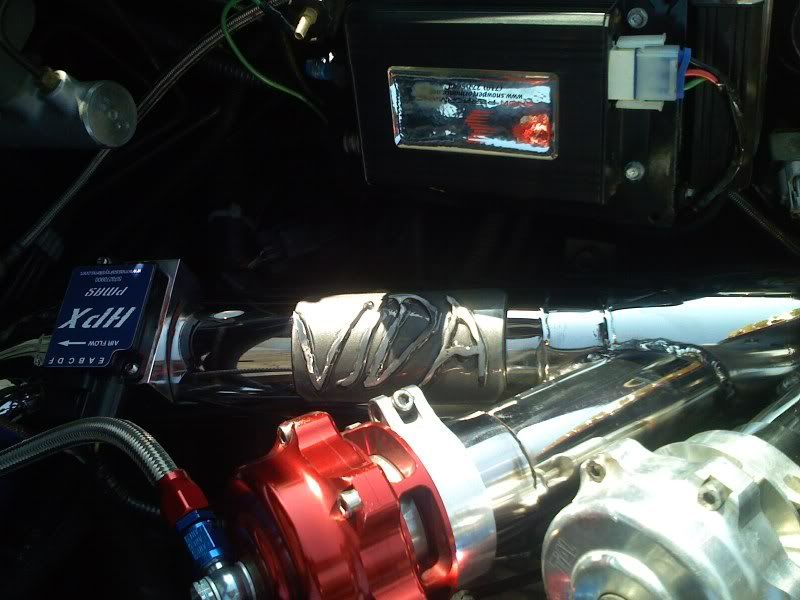
with the evo I am not using a karmen box, as the transfer function is in the software. the system has fixed temp values, but uses a poteniometer for baro calculations
In my dsm below, it is still configured with the karmen convertor box, that offsets the signal globally and then also has load manipulation in another box for fine adjustments
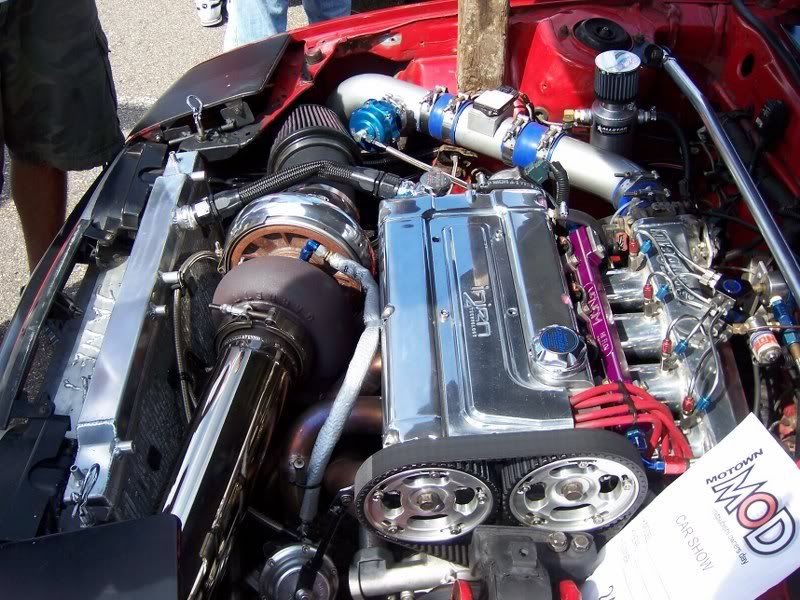
in my dsm above I am still utilizing the stock ecu. The system in my dsm uses a sensor for temp and a sensor for baro calculations unlike my evo.
here are what they look like it is located in the left portion of the picture below
with the evo I am not using a karmen box, as the transfer function is in the software. the system has fixed temp values, but uses a poteniometer for baro calculations
In my dsm below, it is still configured with the karmen convertor box, that offsets the signal globally and then also has load manipulation in another box for fine adjustments
in my dsm above I am still utilizing the stock ecu. The system in my dsm uses a sensor for temp and a sensor for baro calculations unlike my evo.
lol. Your DSM is nuts.
Honestly, I wouldn't be interested in anything that pegs temp or baro any more. I want something that is fully functional so I don't have to think about the weather before hopping in the race car. I'd like to see a successful use of the X MAS in blowthrough on an VIII. Otherwise, SD would be a nice runner up.
Honestly, I wouldn't be interested in anything that pegs temp or baro any more. I want something that is fully functional so I don't have to think about the weather before hopping in the race car. I'd like to see a successful use of the X MAS in blowthrough on an VIII. Otherwise, SD would be a nice runner up.
Trending Topics
I wasn't aware of the X having a hot wire MAF. Could be a very good option over the Subaru MAF.
Anybody have any links to the FSM for an X that might tell a little bit more about the sensor?
EDIT:
The sensor looks very similar to the Subaru MAF. It also looks to have the IAT sensor built into it, just as the Subaru sensor does.
EVO X MAF Tube Plate

Used EVO X MAF

I found a post on another forum stating it's the same part as the '06 Eclipse and the normal Lancers.
I wonder how it deals with boost pressure...
Anybody have any links to the FSM for an X that might tell a little bit more about the sensor?
EDIT:
The sensor looks very similar to the Subaru MAF. It also looks to have the IAT sensor built into it, just as the Subaru sensor does.
EVO X MAF Tube Plate
Used EVO X MAF
I found a post on another forum stating it's the same part as the '06 Eclipse and the normal Lancers.
I wonder how it deals with boost pressure...
Last edited by 03whitegsr; Dec 29, 2008 at 11:49 AM.
I found a copy of the FSM and it had some interesting points about this sensor and how the ECU calculates airflow.
The sensor is a 0-5V output, not frequency unfortunately so what ever needs to be done for a Subaru sensor is the same that needs to be done for this sensor.
When used with the factory airbox
0.2 VDC = 0 g/s
1.8 VDC = 10 g/s
3.5 VDC = 119 g/s
4.9 VDC = 387 g/s
The MAF sensor has a built in thermistor which looks to have roughly the same scaling as the EVO VIII-IX IAT sensor in the stock MAF. This is just from memory though and I'd have to look at my notes to be sure. The X has two seperate air temp sensors though and may deal with fuel enrichment very differently because of the two sensors.
The Baro sensor on the X is in the ECU. I also think it mimics the VIII-IX baro sensor on scaling but would have to look at my notes again. The X also has the 3-bar MAP sensor so there is likely additional mapping to accomodate MAP correction trims.
If an internal diameter measurement of the factory air inlet was taken near the airflow meter, we could probably calibrate it for other tube sizes pretty easily.
The sensor is a 0-5V output, not frequency unfortunately so what ever needs to be done for a Subaru sensor is the same that needs to be done for this sensor.
When used with the factory airbox
0.2 VDC = 0 g/s
1.8 VDC = 10 g/s
3.5 VDC = 119 g/s
4.9 VDC = 387 g/s
The MAF sensor has a built in thermistor which looks to have roughly the same scaling as the EVO VIII-IX IAT sensor in the stock MAF. This is just from memory though and I'd have to look at my notes to be sure. The X has two seperate air temp sensors though and may deal with fuel enrichment very differently because of the two sensors.
The Baro sensor on the X is in the ECU. I also think it mimics the VIII-IX baro sensor on scaling but would have to look at my notes again. The X also has the 3-bar MAP sensor so there is likely additional mapping to accomodate MAP correction trims.
If an internal diameter measurement of the factory air inlet was taken near the airflow meter, we could probably calibrate it for other tube sizes pretty easily.
I found a copy of the FSM and it had some interesting points about this sensor and how the ECU calculates airflow.
The sensor is a 0-5V output, not frequency unfortunately so whatever needs to be done for a Subaru sensor is the same that needs to be done for this sensor. Honestly though, the two sensors look very similar, they may even be the same sensor.
When used with the factory airbox
0.2 VDC = 0 g/s
1.8 VDC = 10 g/s
3.5 VDC = 119 g/s
4.9 VDC = 387 g/s
The MAF sensor has a built in thermistor which looks to have roughly the same scaling as the EVO VIII-IX IAT sensor in the stock MAF. This is just from memory though and I'd have to look at my notes to be sure. The X has two separate air temp sensors though and may deal with fuel enrichment very differently because of the two sensors.
The Baro sensor on the X is in the ECU. I also think it mimics the VIII-IX baro sensor on scaling but would have to look at my notes again. The X also has the 3-bar MAP sensor so there is likely additional mapping to accommodate MAP correction trims.
If an internal diameter measurement of the factory air inlet was taken near the airflow meter, we could probably calibrate it for other tube sizes pretty easily.
The sensor is a 0-5V output, not frequency unfortunately so whatever needs to be done for a Subaru sensor is the same that needs to be done for this sensor. Honestly though, the two sensors look very similar, they may even be the same sensor.
When used with the factory airbox
0.2 VDC = 0 g/s
1.8 VDC = 10 g/s
3.5 VDC = 119 g/s
4.9 VDC = 387 g/s
The MAF sensor has a built in thermistor which looks to have roughly the same scaling as the EVO VIII-IX IAT sensor in the stock MAF. This is just from memory though and I'd have to look at my notes to be sure. The X has two separate air temp sensors though and may deal with fuel enrichment very differently because of the two sensors.
The Baro sensor on the X is in the ECU. I also think it mimics the VIII-IX baro sensor on scaling but would have to look at my notes again. The X also has the 3-bar MAP sensor so there is likely additional mapping to accommodate MAP correction trims.
If an internal diameter measurement of the factory air inlet was taken near the airflow meter, we could probably calibrate it for other tube sizes pretty easily.
it seems this can be done pretty easily...there's plenty of room in the ecu. the only question is will the conversion be fast enough? it should be...don't know exact numbers though.
wherever the ECU takes the raw maf value, it would have to be intercepted...to a new piece of code IAW your linear values (as long as they're pretty accurate on how the sensor actually performs)
in a nutshell/am i missing something?
EDIT: i think this was stated up top too.
wherever the ECU takes the raw maf value, it would have to be intercepted...to a new piece of code IAW your linear values (as long as they're pretty accurate on how the sensor actually performs)
in a nutshell/am i missing something?
EDIT: i think this was stated up top too.


It is mentioned that the GM MAF signal quality suffers with a blow through setup. Are you all certain it is the MAF, or is it the translator box? By default, I would tend to blame the latter. A translator box configured to ignore IAT is like duct tape - a workaround. And as far as a 'two-box' scenario to patch things together, I find that completely unacceptable.
IMO, what first has to be evaluated is if the problem created may in fact be larger than the problem solved. In other words, who really stands to benefit from this? Unless one is well over 500whp and/or running big cams (which doesn't make much sense unless he is well over 500whp), it may prove to be largely unnecessary. I just may flow test a factory MAF to get an indication as to where it presents a significant pressure drop with respect to volumetric airflow.
The most optimum scenario that I envision is the ability to retrofit (both physically and electronically) a high capacity MAF that reports in Hz, without the use of an external box. To even make this possible, the MAF response curve for both (in Hz) must be known, as well as the IAT thermistor response curve. Barring any voltage differences that prove to be irreconcilable or incredibly inconvenient (i.e. can't fix it with a few small parts), the factory ECU should be able to be reprogrammed to accept data from the new MAF and IAT sensor. I don't know where the EVO gets its barometric air pressure (BAP) reported, but if that algorithmic adjustment is made as a function of %, it may not require reprogramming (same for ECT).
I realize this is pie in the sky at this point, but if made possible, one could just run something like this...
http://www.lingenfelter.com/store/l480000000.html
... on the front side, and not need to bother with a blow-through setup (which seems to further complicate matters). But naturally, getting something truly worth the trouble working reliably and efficiently on the front side should be the first step.
IMO, what first has to be evaluated is if the problem created may in fact be larger than the problem solved. In other words, who really stands to benefit from this? Unless one is well over 500whp and/or running big cams (which doesn't make much sense unless he is well over 500whp), it may prove to be largely unnecessary. I just may flow test a factory MAF to get an indication as to where it presents a significant pressure drop with respect to volumetric airflow.
The most optimum scenario that I envision is the ability to retrofit (both physically and electronically) a high capacity MAF that reports in Hz, without the use of an external box. To even make this possible, the MAF response curve for both (in Hz) must be known, as well as the IAT thermistor response curve. Barring any voltage differences that prove to be irreconcilable or incredibly inconvenient (i.e. can't fix it with a few small parts), the factory ECU should be able to be reprogrammed to accept data from the new MAF and IAT sensor. I don't know where the EVO gets its barometric air pressure (BAP) reported, but if that algorithmic adjustment is made as a function of %, it may not require reprogramming (same for ECT).
I realize this is pie in the sky at this point, but if made possible, one could just run something like this...
http://www.lingenfelter.com/store/l480000000.html
... on the front side, and not need to bother with a blow-through setup (which seems to further complicate matters). But naturally, getting something truly worth the trouble working reliably and efficiently on the front side should be the first step.
Your third paragraph is exactly how the pmas meters are done, the stock airmeter was placed on a flow bench and MASS was determined, then the ford meter was calibrated to replicate those stock mass values, the only difference being that you now have higher resolution up top compared to the stock airmeter. the tuner box, is for finer adjustments in the load cycle.
the reason why the gm stuff to my understanding doesn't work well, because the temp and baro values are static ( 80 degrees and 1 atm) . AND I completely agree with you in regards to the karmen box, for years I had problems with my karmen box ( just converting the hot wire signal back to frequency so that my primitive 1990 eclipse could comprehend the signal.
With the evo I have eliminated the karmen box, because the transfer function takes care of that...
Just some thoughts that I am laying out there, if you guys want more information I can contact the manufacturer and have them shed some more light.
the reason why the gm stuff to my understanding doesn't work well, because the temp and baro values are static ( 80 degrees and 1 atm) . AND I completely agree with you in regards to the karmen box, for years I had problems with my karmen box ( just converting the hot wire signal back to frequency so that my primitive 1990 eclipse could comprehend the signal.
With the evo I have eliminated the karmen box, because the transfer function takes care of that...
Just some thoughts that I am laying out there, if you guys want more information I can contact the manufacturer and have them shed some more light.
Your third paragraph is exactly how the pmas meters are done, the stock airmeter was placed on a flow bench and MASS was determined, then the ford meter was calibrated to replicate those stock mass values, the only difference being that you now have higher resolution up top compared to the stock airmeter. the tuner box, is for finer adjustments in the load cycle.
But what you are telling me is that the aftermarket unit you are presently using is a Ford (PMAS) model that was calibrated to match the Hz vs. mass airflow response curve of the EVO MAF, and that allows you to eliminate the translator box, yes? If so, that doesn't shed any light as to if/how/where IAT correction fits in (one apparent pitfall of the GM/translator setup). With the EVO MAF, the IAT is physically internal. The Ford MAFs I used back when had externally mounted IATs, so a bit of clarification as to how that fits would be helpful. Do BAP adjustments continue to get made - (doesn't it come from an external sensor for the EVO as it did for Fords)?
What exactly is 'the tuner box' to which you refer?
hey sorry to cut in here...
but the new generation MAF sensors, on the X at least, have an IAT sensor that can still be used for corrections by the ecu. implementing some extra code to convert the newer hot-wire element V to HZ will just have to be done. actually, all of the stock code/scalings/etc will still be there to tweak or leave alone depending on accuracy of the initial V to HZ code. its like a built in translator. my only worry is the speed of calculation, but if it's linear and tuned with a simple offset or whatever, it should be damn quick/usable.
scaling the new IAT (if even required!) can easily be done/been done/figured out.
i really like the idea of eliminating boxes. the stock MAF is kind of 'in the way' too. the maf translator was a great solution for many at a time when ecu's couldn't handle even the simplest of calcs/or didn't have 'an easy' way of implementing extra built in code. now we(well...not me lol) have them doing airflow calcs for us to ease logging and such .
.
EDIT: and the baro sensor is just some darn surface mounted thing that can be relocated/figured out--its under the sealed maf box cover. to add, someone said the IAT calcs weren't required with a hotwire--i don't think that was right--don't remember where it was said, but anyways it moves like old people **** anyways lol on the logs.
but the new generation MAF sensors, on the X at least, have an IAT sensor that can still be used for corrections by the ecu. implementing some extra code to convert the newer hot-wire element V to HZ will just have to be done. actually, all of the stock code/scalings/etc will still be there to tweak or leave alone depending on accuracy of the initial V to HZ code. its like a built in translator. my only worry is the speed of calculation, but if it's linear and tuned with a simple offset or whatever, it should be damn quick/usable.
scaling the new IAT (if even required!) can easily be done/been done/figured out.
i really like the idea of eliminating boxes. the stock MAF is kind of 'in the way' too. the maf translator was a great solution for many at a time when ecu's couldn't handle even the simplest of calcs/or didn't have 'an easy' way of implementing extra built in code. now we(well...not me lol) have them doing airflow calcs for us to ease logging and such
.EDIT: and the baro sensor is just some darn surface mounted thing that can be relocated/figured out--its under the sealed maf box cover. to add, someone said the IAT calcs weren't required with a hotwire--i don't think that was right--don't remember where it was said, but anyways it moves like old people **** anyways lol on the logs.
Last edited by evoredy; Dec 29, 2008 at 11:19 PM.