


Balance-Shafts Explained


Thread Starter
Evolving Member
Joined: Jul 2005
Posts: 274
Likes: 0
From: Davis, California
Balance-Shafts Explained
First an image showing the nasty second order vibration of a typical inline-4 engine:
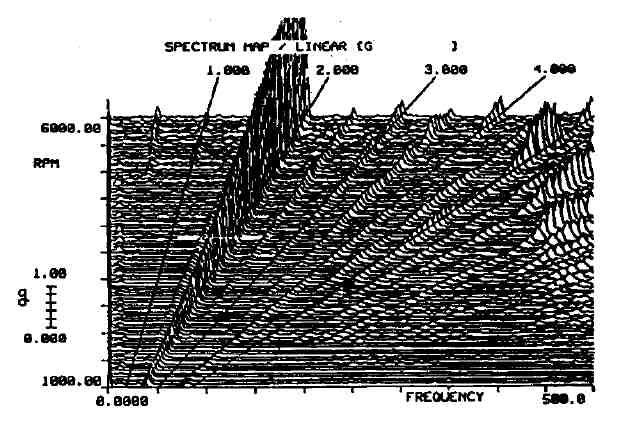
Now, how balance shafts work to smooth that:

-----
IMHO, because second order vibrations could upset the oil-film barrier in certain parts, they should be left alone as long as you are not revving the engine past stock RPM.
Anyway. Hope I'm not beating a dead horse here. I searched but didn't see a specific thread discussing how balance shafts work. Hopefully not to bad of a repost.
-Adrian
Now, how balance shafts work to smooth that:
-----
IMHO, because second order vibrations could upset the oil-film barrier in certain parts, they should be left alone as long as you are not revving the engine past stock RPM.
Anyway. Hope I'm not beating a dead horse here. I searched but didn't see a specific thread discussing how balance shafts work. Hopefully not to bad of a repost.
-Adrian


Originally Posted by SaabTuner
IMHO, because second order vibrations could upset the oil-film barrier in certain parts

I had AMS take my balance shafts out as part of a 2.0 liter build-up (ross pistons, crower rods, new valve-train), because I plan on revving to 9000 rpms. So far I can't tell the difference at all as far as vibration goes. Feels the same as it did when it was stock. Oil pressure also seems to be in line with what a stock block sees, but I'm still in the break-in period, so I haven't pushed it really hard yet.
l8r)
l8r)

Thread Starter
Evolving Member
Joined: Jul 2005
Posts: 274
Likes: 0
From: Davis, California
Originally Posted by Shaun@SG
Thanks for the post, Adrian. When you say upset the oil film, I take it you are referring to the oil film on the major thrust surface? If so, I am quite sure the additional loads seen after balance shaft removal are miniscule compared to the inertial loads especially in the upper RPM. I believe it is just a matter of NVH, not wear.
However, I just thought of what could possibly be a more important issue; the knock sensors are just vibration microphones on the block. Large second-order vibrations would show up as noise with a frequency of twice the RPM of the engine. Knock sensors generally "look" for noise at about 6,300-6,800 Hz. Which means that when the engine is at 3,150-3,400 RPM these second order vibrations will show up as "noise" dampening the detection of knock.
Here's a graph showing the knocking frequencies for the various modes of knock in a pent-roof 4-valve combustion chamber:
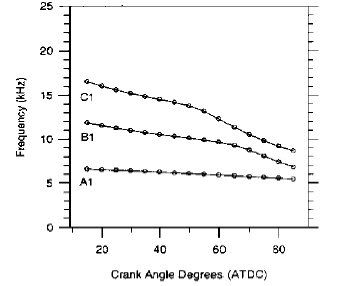
(And for educational value, here's a chart showing four of the major knocking modes for those interested: http://img.photobucket.com/albums/v1...ckingModes.jpg )
Someone should make charts of the log straight from the knock-sensor. I'd wager a significant increase in "noise" when the ballance shafts are removed.

Food for thought ...
-Adrian
Last edited by SaabTuner; Jul 17, 2005 at 10:53 AM.
Good thought and post.
I wonder if amplitude of the two sources is similar though. If they are, and frequency and amplitude are similar, then it is really bad because depending on setup, the 3000-3500 RPM window is right in the high torque zone which is exactly where knock is most likely to occur. If differentiation is no longer possible, then increased safety buffer in tune is necessary.
Look forward to any test result that anyone may have. Maybe some of the Honda guys have run tests too being as they frequently remove theirs, but perhaps in their situation it is a little less critical because of lack of the forced induction variable, plus the fact that high speed NA engines typically reach peak torque at a higher RPM.
BTW, which book are you getting your graphs and knock mode diagrams from? I don't recall seeing them in Blair, Heywood, Taylor, or Lumley. There are four knock modes in the linked picture.. which corresponds to A1, B1 and C1? Where is the fourth mode? In the modes the + and - signs indicate the origin of the second and other subsequent fronts? If so, which sign represents the origin? There has to be an infinite number of modes because of the range of cylinder geometries in all dimensions, mixture motion, charge stratification, and spark location (or at least direction of propogation in the early stages- based on mixture motion).
I wonder if amplitude of the two sources is similar though. If they are, and frequency and amplitude are similar, then it is really bad because depending on setup, the 3000-3500 RPM window is right in the high torque zone which is exactly where knock is most likely to occur. If differentiation is no longer possible, then increased safety buffer in tune is necessary.
Look forward to any test result that anyone may have. Maybe some of the Honda guys have run tests too being as they frequently remove theirs, but perhaps in their situation it is a little less critical because of lack of the forced induction variable, plus the fact that high speed NA engines typically reach peak torque at a higher RPM.
BTW, which book are you getting your graphs and knock mode diagrams from? I don't recall seeing them in Blair, Heywood, Taylor, or Lumley. There are four knock modes in the linked picture.. which corresponds to A1, B1 and C1? Where is the fourth mode? In the modes the + and - signs indicate the origin of the second and other subsequent fronts? If so, which sign represents the origin? There has to be an infinite number of modes because of the range of cylinder geometries in all dimensions, mixture motion, charge stratification, and spark location (or at least direction of propogation in the early stages- based on mixture motion).
Trending Topics
Thread Starter
Evolving Member
Joined: Jul 2005
Posts: 274
Likes: 0
From: Davis, California
Originally Posted by Shaun@SG
Good thought and post.
I wonder if amplitude of the two sources is similar though. If they are, and frequency and amplitude are similar, then it is really bad because depending on setup, the 3000-3500 RPM window is right in the high torque zone which is exactly where knock is most likely to occur. If differentiation is no longer possible, then increased safety buffer in tune is necessary.
Look forward to any test result that anyone may have. Maybe some of the Honda guys have run tests too being as they frequently remove theirs, but perhaps in their situation it is a little less critical because of lack of the forced induction variable, plus the fact that high speed NA engines typically reach peak torque at a higher RPM.
BTW, which book are you getting your graphs and knock mode diagrams from? I don't recall seeing them in Blair, Heywood, Taylor, or Lumley. There are four knock modes in the linked picture.. which corresponds to A1, B1 and C1? Where is the fourth mode? In the modes the + and - signs indicate the origin of the second and other subsequent fronts? If so, which sign represents the origin? There has to be an infinite number of modes because of the range of cylinder geometries in all dimensions, mixture motion, charge stratification, and spark location (or at least direction of propogation in the early stages- based on mixture motion).
I wonder if amplitude of the two sources is similar though. If they are, and frequency and amplitude are similar, then it is really bad because depending on setup, the 3000-3500 RPM window is right in the high torque zone which is exactly where knock is most likely to occur. If differentiation is no longer possible, then increased safety buffer in tune is necessary.
Look forward to any test result that anyone may have. Maybe some of the Honda guys have run tests too being as they frequently remove theirs, but perhaps in their situation it is a little less critical because of lack of the forced induction variable, plus the fact that high speed NA engines typically reach peak torque at a higher RPM.
BTW, which book are you getting your graphs and knock mode diagrams from? I don't recall seeing them in Blair, Heywood, Taylor, or Lumley. There are four knock modes in the linked picture.. which corresponds to A1, B1 and C1? Where is the fourth mode? In the modes the + and - signs indicate the origin of the second and other subsequent fronts? If so, which sign represents the origin? There has to be an infinite number of modes because of the range of cylinder geometries in all dimensions, mixture motion, charge stratification, and spark location (or at least direction of propogation in the early stages- based on mixture motion).
The Saab guys often disable their balance shafts, but that's of no help here as they do not use microphone knock-sensors; instead, newer Saabs use the spark plugs as an ion-sensor to detect knock. (Virtually zero noise which allows much more aggressive tuning and compression ratios.)
The graphs and charts come from a number of doctoral theses which I've read. Because Sweden is a socialist government, the doctoral research is almost always free and public. You can learn a lot of cool stuff there without paying a dime. Very handy.
Also, the plus and minus signs don't indicate the origin of knock. They merely are there to indicate that the two regions resonate with eachother with pressure in each region being the opposite sign of the other. That's how the knocking generates a sound; it resonates. Because of the shape of the combustion chamber, only certain resonant "shapes" occur even when the detonation occurs at different locations. (Though obviously certain locations tend to produce certain resonant forms.)
edit: Small changes in geometry don't affect the resonant form much, nor the frequency. It's like singing a note with your mouth open versus shut; some of the harmonic frequencies are muted/distorted, but they are insignificant compared to the main note which only changes with larger changes in geometry.
Here's another very interesting read. It's a report by NACA (old name for NASA) on the interdependance of various types of auto-ignition and knock. It proved conclusively that pin-point autoignition was not the source of knock and showed pretty conclusively that knock originates in the already burning gasses behind the flame-wave. Interestingly, none of the modern research has caught on to this and that is probably why we still don't have a complete understanding of knock today. Here's the link: http://naca.larc.nasa.gov/reports/1948/naca-report-912/
Anyway ... back to balance shafts, anyone wanna make a few logs with their knock-sensor before and after removing the balance shafts?
-Adrian
Last edited by SaabTuner; Jul 17, 2005 at 01:32 PM.
Originally Posted by SaabTuner
I think there would have to be some extra margin for error in the tune without the balance shafts but it's really hard to know without testing. More than likely a lot of tuners may simply think they are running into knock at ~3400 RPM and tune accordingly without even realizing that the knock may in fact be the factory ECU tripping out with all the extra noise. I look forward to some data on this as well.
The Saab guys often disable their balance shafts, but that's of no help here as they do not use microphone knock-sensors; instead, newer Saabs use the spark plugs as an ion-sensor to detect knock. (Virtually zero noise which allows much more aggressive tuning and compression ratios.)
The Saab guys often disable their balance shafts, but that's of no help here as they do not use microphone knock-sensors; instead, newer Saabs use the spark plugs as an ion-sensor to detect knock. (Virtually zero noise which allows much more aggressive tuning and compression ratios.)
The graphs and charts come from a number of doctoral theses which I've read. Because Sweden is a socialist government, the doctoral research is almost always free and public. You can learn a lot of cool stuff there without paying a dime. Very handy.
Also, the plus and minus signs don't indicate the origin of knock. They merely are there to indicate that the two regions resonate with eachother with pressure in each region being the opposite sign of the other. That's how the knocking generates a sound; it resonates. Because of the shape of the combustion chamber, only certain resonant "shapes" occur even when the detonation occurs at different locations. (Though obviously certain locations tend to produce certain resonant forms.)
Your definition of knock is unique. Certainly different or at least phrased differently compared to the traditional definition. I'm not following
 If there are two regions of opposite pressure, how can there be an overall rise in pressure that is destructive since they effectively or at least somewhat cancel each other out?
edit: Small changes in geometry don't affect the resonant form much, nor the frequency. It's like singing a note with your mouth open versus shut; some of the harmonic frequencies are muted/distorted, but they are insignificant compared to the main note which only changes with larger changes in geometry.
Here's another very interesting read. It's a report by NACA (old name for NASA) on the interdependance of various types of auto-ignition and knock. It proved conclusively that pin-point autoignition was not the source of knock and showed pretty conclusively that knock originates in the already burning gasses behind the flame-wave. Interestingly, none of the modern research has caught on to this and that is probably why we still don't have a complete understanding of knock today.
I find it difficult to believe that these intelligent people hungry for advancement would disregard something as contrary to what they find, if it was right. I will get back to you on this.
Sorry for all the off topic posts and apologies if I am thick. If the moderators could split this thread and move these posts into the new topic possibly titled "Uncontrolled combustion" that would be great. I would love to follow up on all this information and discussion, especially because uncontrolled combustion is a result of a multitude of dynamic factors and is very difficult to properly monitor (without costly equipment). Perhaps it can be considered one of the largest hurdles that privateers have to overcome and the only way is by thorough understanding and finding the best method of detection.
Best regards
Shaun


there isn't any extra engine noise or vibrations with them out. I can confirm this with my datalogs. the engine does seem to vibrate the car a little more at higher rpms, but none at idle. also these shafts both spin at 2-3 times the engine rpm.
They complete two revolutions for every revolution of the crankshaft. Can you share the logs? Absolutely 0 extra noise?
I suppose then the amplitude is too small versus knock, or perhaps the ECU has a means of referencing to engine noise as it rises. All possibilities till they've all been confirmed to not exist.
I suppose then the amplitude is too small versus knock, or perhaps the ECU has a means of referencing to engine noise as it rises. All possibilities till they've all been confirmed to not exist.
See, this is why I came here... to Evom... where did all the good tech go? I was almost ready to give up on this place... until I stumbled across this little tidbit.
Good stuff guys
Good stuff guys
Thread Starter
Evolving Member
Joined: Jul 2005
Posts: 274
Likes: 0
From: Davis, California
I'm just putting my responses in bold because I'm too lazy to make seperate quotes. (I'm singing for a pretty girl; cut me some slack. heh )
If this discussion gets too long, theeeen we might break it up. For now I think it's nice to have all this information in one place! 
-Adrian
heh )
Originally Posted by Shaun@SG
That is wonderful. Can foreigners get access to these papers? I would be interested.
Absolutely! I haven't even delved into most of it. But here's one of my favorite university sites with lots of public information: http://www.fs.isy.liu.se/Publications/phdthesis.html
I'm a bit biased since that university uses a Saab engine in their research, but I find it to be top-notch for the most part. "Spark Advance Modeling and Control" is ESPECIALLY good and deals with everything from interpretation of PPP from ion-signal through the spark plug to the effect of water injection on both of the primary burn angles. It's a great paper!
OK so which mode corresponds to A1, which to B1, and which to C1? Where is the 4th mode?
a,b, and c are the first, second and third circumferennial modes respectively. The third circumferennial mode was not shown in the other graph and I don't have the frequencies for those. I do have the paper which shows the derivation for those frequencies. I'll try to find the paper on the linkoping site.
Your definition of knock is unique. Certainly different or at least phrased differently compared to the traditional definition. I'm not following If there are two regions of opposite pressure, how can there be an overall rise in pressure that is destructive since they effectively or at least somewhat cancel each other out?
Waves travel. The entire pressure in the cyllinder cannot just rise and fall all at once in every location. It must oscillate. When pressure sensors sense the resonant spike, it's going to be out of phase with a pressure sensor located at the opposite end of the node. In fact, if the pressure sensor is located at the node itself, even a severe detonation will yeild almost no measureable effect on pressure at that location. Obviously the engine will still ping audibly, and both microphone and ion-sensing knock-sensors would "hear" it. But a single pressure sensor on the nodal line might not.
Yes the other main factor in frequency is cylinder gas properties and pressure which affect the natural frequency of the sound waves.
Actually temperature determines the speed of sound waves as long as they isentropic. It can be calculated as the sqrt ( Gas-costant x Ratio-of-specific-heats x temperature) = local speed of sound.
However, since the compression/decompression in the cyllinder is roughly adiabatic, any increase or decrease in pressure would create a corresponding decrease in temperature. So, in a sense pressure would affect the speed of sound/waves. It's just worth noting that it isn't directly the pressure.
Thanks for the link. It certainly is very interesting and I will have to read it considering it goes against all conventional definition by a multitude of researchers across a span of around 60 years! The common thread is that the auto ignition occurs in the gasses ahead of the flame front, not behind it. Gordon Blair's stand is a little more specific in that he says that detonation (if you stick to the purest definition) doesn't exist because that would require the entire charge to autoignite, not just a portion of it. He doesn't expound. Taylor has is own images clearly showing second flame origin being ahead of the original front.
There is no second flame. That is auto-ignition and NOT detonation. That NACA paper successfully got auto-ignition without knock and knock without auto-ignition. It is impossible for them to be the same thing. The current argument is whether there is a non-visible exothermic reaction in-front-of or behind the flame front.
NACA had extremely good evidence for it being behind the flame front. Here are two series of schliren film images which show this. First though, to understand them, you need to realize that ANY significant change in the image between two juxtaposed frames indicates motion at speeds only a detonation wave could carry. In normal combustion there are no abrupt changes between two juxtaposed frames because the time interval is only 1/40,000th of a second between them:
In the first I put a red arrow towards a part of the flame-front that was progressing towards the end-gas. A large chunk completely disappears immediately before the entire end-gas is obliterated by the knock reaction. The chunk which disappears is behind the leading edge of the flame front and NOT in the un-burned end-gas. This indicates that the detonation reaction must have begun behind the flame wave.
In the second image, at 200,000 fps, a shock-wave travelling at twice the speed of sound in the cyllinder (non-isentropic) moving away from the already burning gasses towards the un-burnt gasses. That should indicate that the reaction occurs in the already burning gasses.
1: http://img.photobucket.com/albums/v1..._Explained.jpg
2: http://img.photobucket.com/albums/v1...nationWave.jpg
My theory on the matter, especially in light of water's inhibiting effect on detoantion, is that the CO- CO2 reaction that occurs late in combustion does not complete, and if there is too much free hydrogen the hydrogen steals the oxygen from the CO to make H2O and leave free carbon. This hypothesis is supported by two key facts: 1, during detonation there is always copious amounts of free carbon which cannot otherwise be explained and 2, a higher concentration of water in the cyllinder in place of excess fuel allowas the CO- CO2 reaction to occur more quickly which helps to keep the free hydrogen from having time to "steal" the oxygen. Also, if there is sufficient heat to ionize the CO to allow the CO + 2H = H2O + C to completely (it should be exothermic), then the reaction would be spontaneous because the reactants are already mixed.
Of course, it's just a theory. But hydrogen does have one of the fastest reaction-rates and the theory does fit the facts ... for now.
I find it difficult to believe that these intelligent people hungry for advancement would disregard something as contrary to what they find, if it was right. I will get back to you on this.
At the time NACA was the only research body on the planet with both 40,000 FPS and 200,000 FPS high-speed schliren cameras. The work may have been classified until well after NACA changed its name to NASA because it was military aircraft engine research. When the name changed the documents were just buried even though now declassified. NACA now has a site you can search and there are TONS of documents on knock, and more importantly, water injection.
Sorry for all the off topic posts and apologies if I am thick. If the moderators could split this thread and move these posts into the new topic possibly titled "Uncontrolled combustion" that would be great. I would love to follow up on all this information and discussion, especially because uncontrolled combustion is a result of a multitude of dynamic factors and is very difficult to properly monitor (without costly equipment). Perhaps it can be considered one of the largest hurdles that privateers have to overcome and the only way is by thorough understanding and finding the best method of detection.
Uncontrolled combustion can be completely monitored with an ion-gap sensor, which is standard on all Trionic Saabs. It can even detect slight variations in burn-rate, could theoretically extrapolate EGT and be calibrated to give a live indication of average BMEP without a brake-dynamometer. 
Best regards
Shaun
Absolutely! I haven't even delved into most of it. But here's one of my favorite university sites with lots of public information: http://www.fs.isy.liu.se/Publications/phdthesis.html
I'm a bit biased since that university uses a Saab engine in their research, but I find it to be top-notch for the most part. "Spark Advance Modeling and Control" is ESPECIALLY good and deals with everything from interpretation of PPP from ion-signal through the spark plug to the effect of water injection on both of the primary burn angles. It's a great paper!
OK so which mode corresponds to A1, which to B1, and which to C1? Where is the 4th mode?
a,b, and c are the first, second and third circumferennial modes respectively. The third circumferennial mode was not shown in the other graph and I don't have the frequencies for those. I do have the paper which shows the derivation for those frequencies. I'll try to find the paper on the linkoping site.
Your definition of knock is unique. Certainly different or at least phrased differently compared to the traditional definition. I'm not following
If there are two regions of opposite pressure, how can there be an overall rise in pressure that is destructive since they effectively or at least somewhat cancel each other out? Waves travel. The entire pressure in the cyllinder cannot just rise and fall all at once in every location. It must oscillate. When pressure sensors sense the resonant spike, it's going to be out of phase with a pressure sensor located at the opposite end of the node. In fact, if the pressure sensor is located at the node itself, even a severe detonation will yeild almost no measureable effect on pressure at that location. Obviously the engine will still ping audibly, and both microphone and ion-sensing knock-sensors would "hear" it. But a single pressure sensor on the nodal line might not.
Yes the other main factor in frequency is cylinder gas properties and pressure which affect the natural frequency of the sound waves.
Actually temperature determines the speed of sound waves as long as they isentropic. It can be calculated as the sqrt ( Gas-costant x Ratio-of-specific-heats x temperature) = local speed of sound.
However, since the compression/decompression in the cyllinder is roughly adiabatic, any increase or decrease in pressure would create a corresponding decrease in temperature. So, in a sense pressure would affect the speed of sound/waves. It's just worth noting that it isn't directly the pressure.
Thanks for the link. It certainly is very interesting and I will have to read it considering it goes against all conventional definition by a multitude of researchers across a span of around 60 years! The common thread is that the auto ignition occurs in the gasses ahead of the flame front, not behind it. Gordon Blair's stand is a little more specific in that he says that detonation (if you stick to the purest definition) doesn't exist because that would require the entire charge to autoignite, not just a portion of it. He doesn't expound. Taylor has is own images clearly showing second flame origin being ahead of the original front.
There is no second flame. That is auto-ignition and NOT detonation. That NACA paper successfully got auto-ignition without knock and knock without auto-ignition. It is impossible for them to be the same thing. The current argument is whether there is a non-visible exothermic reaction in-front-of or behind the flame front.
NACA had extremely good evidence for it being behind the flame front. Here are two series of schliren film images which show this. First though, to understand them, you need to realize that ANY significant change in the image between two juxtaposed frames indicates motion at speeds only a detonation wave could carry. In normal combustion there are no abrupt changes between two juxtaposed frames because the time interval is only 1/40,000th of a second between them:
In the first I put a red arrow towards a part of the flame-front that was progressing towards the end-gas. A large chunk completely disappears immediately before the entire end-gas is obliterated by the knock reaction. The chunk which disappears is behind the leading edge of the flame front and NOT in the un-burned end-gas. This indicates that the detonation reaction must have begun behind the flame wave.
In the second image, at 200,000 fps, a shock-wave travelling at twice the speed of sound in the cyllinder (non-isentropic) moving away from the already burning gasses towards the un-burnt gasses. That should indicate that the reaction occurs in the already burning gasses.
1: http://img.photobucket.com/albums/v1..._Explained.jpg
2: http://img.photobucket.com/albums/v1...nationWave.jpg
My theory on the matter, especially in light of water's inhibiting effect on detoantion, is that the CO- CO2 reaction that occurs late in combustion does not complete, and if there is too much free hydrogen the hydrogen steals the oxygen from the CO to make H2O and leave free carbon. This hypothesis is supported by two key facts: 1, during detonation there is always copious amounts of free carbon which cannot otherwise be explained and 2, a higher concentration of water in the cyllinder in place of excess fuel allowas the CO- CO2 reaction to occur more quickly which helps to keep the free hydrogen from having time to "steal" the oxygen. Also, if there is sufficient heat to ionize the CO to allow the CO + 2H = H2O + C to completely (it should be exothermic), then the reaction would be spontaneous because the reactants are already mixed.
Of course, it's just a theory. But hydrogen does have one of the fastest reaction-rates and the theory does fit the facts ... for now.
I find it difficult to believe that these intelligent people hungry for advancement would disregard something as contrary to what they find, if it was right. I will get back to you on this.
At the time NACA was the only research body on the planet with both 40,000 FPS and 200,000 FPS high-speed schliren cameras. The work may have been classified until well after NACA changed its name to NASA because it was military aircraft engine research. When the name changed the documents were just buried even though now declassified. NACA now has a site you can search and there are TONS of documents on knock, and more importantly, water injection.
Sorry for all the off topic posts and apologies if I am thick. If the moderators could split this thread and move these posts into the new topic possibly titled "Uncontrolled combustion" that would be great. I would love to follow up on all this information and discussion, especially because uncontrolled combustion is a result of a multitude of dynamic factors and is very difficult to properly monitor (without costly equipment). Perhaps it can be considered one of the largest hurdles that privateers have to overcome and the only way is by thorough understanding and finding the best method of detection.
Uncontrolled combustion can be completely monitored with an ion-gap sensor, which is standard on all Trionic Saabs.
It can even detect slight variations in burn-rate, could theoretically extrapolate EGT and be calibrated to give a live indication of average BMEP without a brake-dynamometer. Best regards
Shaun
-Adrian
Last edited by SaabTuner; Jul 18, 2005 at 01:01 AM.
Thread Starter
Evolving Member
Joined: Jul 2005
Posts: 274
Likes: 0
From: Davis, California
I couldn't find the online-location of the paper which contained the information on detonation that I posted earlier. However, I do have a copy saved to my computer. Anyone who wants it, just PM me an e-mail; it's about 400 kb.
-Adrian
-Adrian