


Full Race Vertical Flow Intercooler Review


Cooling takes place in the first few inches of any intercooler core anyway (I recall it being 4" more or less), this adds alot more tubes for increased flow and all of them are more than 4" tall, I fail to see then how it will be "crappy" in the charge cooling departement.

Cooling takes place in the first few inches of any intercooler core anyway (I recall it being 4" more or less), this adds alot more tubes for increased flow and all of them are more than 4" tall, I fail to see then how it will be "crappy" in the charge cooling departement.
this is simple heat transfer... if the intercooler core is cooler then the air inside it, the air is going to transfer energy into the core, thus reducing air temps.
turning the intercooler sideways does reduce the amount of heat transfer that can be done PER TUBE, simply because it is shorter. however, because there are twice as many tubes, the net effect is the same. there is less pressure in each tube but there are twice as many tubes causing back pressure, there is less air velocity through each tube, but there is still the same mass flow rate. the real difference between the cores is going to be pressure differential between inlet and outlet, and then the surface area of the heat transfer elements, i.e. the fins (oh what its efficiency is at cooling the air)
there are a couple things about the vertical pass IC though... because the end tanks are so long, you will have a tendency to have dead spots, or areas in the core where no air is flowing. this means you are not using all of the core to its full effect. proper routing of the air internally within the end tank can reduce/eliminate this.
the same thing applys to the horizontal pass IC. having such long tubes means the air might reach equal temps with the core halfway through the tube. that means that half the core is not even used (like what johnbradley was saying). the end tanks are going to offer better distribution of the air among the tubes because they are more centralized. a good designed core will take all of this into consideration, and i suspect the full race core has taken the length of the endtank into consideration. simply viewing the core at temperature with an infrared camera might show exactly how well the air is distributed across the core.

Evolved Member
Joined: Dec 2003
Posts: 1,074
Likes: 0
From: UK
this is not at all true. the only case where the cooling only takes place in the first 4 inches, is if the air in the tubes equalizes with the intercooler temperature within 4 inches.
this is simple heat transfer... if the intercooler core is cooler then the air inside it, the air is going to transfer energy into the core, thus reducing air temps.
turning the intercooler sideways does reduce the amount of heat transfer that can be done PER TUBE, simply because it is shorter. however, because there are twice as many tubes, the net effect is the same. there is less pressure in each tube but there are twice as many tubes causing back pressure, there is less air velocity through each tube, but there is still the same mass flow rate. the real difference between the cores is going to be pressure differential between inlet and outlet, and then the surface area of the heat transfer elements, i.e. the fins (oh what its efficiency is at cooling the air)
there are a couple things about the vertical pass IC though... because the end tanks are so long, you will have a tendency to have dead spots, or areas in the core where no air is flowing. this means you are not using all of the core to its full effect. proper routing of the air internally within the end tank can reduce/eliminate this.
the same thing applys to the horizontal pass IC. having such long tubes means the air might reach equal temps with the core halfway through the tube. that means that half the core is not even used (like what johnbradley was saying). the end tanks are going to offer better distribution of the air among the tubes because they are more centralized. a good designed core will take all of this into consideration, and i suspect the full race core has taken the length of the endtank into consideration. simply viewing the core at temperature with an infrared camera might show exactly how well the air is distributed across the core.
this is simple heat transfer... if the intercooler core is cooler then the air inside it, the air is going to transfer energy into the core, thus reducing air temps.
turning the intercooler sideways does reduce the amount of heat transfer that can be done PER TUBE, simply because it is shorter. however, because there are twice as many tubes, the net effect is the same. there is less pressure in each tube but there are twice as many tubes causing back pressure, there is less air velocity through each tube, but there is still the same mass flow rate. the real difference between the cores is going to be pressure differential between inlet and outlet, and then the surface area of the heat transfer elements, i.e. the fins (oh what its efficiency is at cooling the air)
there are a couple things about the vertical pass IC though... because the end tanks are so long, you will have a tendency to have dead spots, or areas in the core where no air is flowing. this means you are not using all of the core to its full effect. proper routing of the air internally within the end tank can reduce/eliminate this.
the same thing applys to the horizontal pass IC. having such long tubes means the air might reach equal temps with the core halfway through the tube. that means that half the core is not even used (like what johnbradley was saying). the end tanks are going to offer better distribution of the air among the tubes because they are more centralized. a good designed core will take all of this into consideration, and i suspect the full race core has taken the length of the endtank into consideration. simply viewing the core at temperature with an infrared camera might show exactly how well the air is distributed across the core.
bassically you want the biggest front area possiable with a core thats thick enough not to cause big presure drop.
thanks Chris.

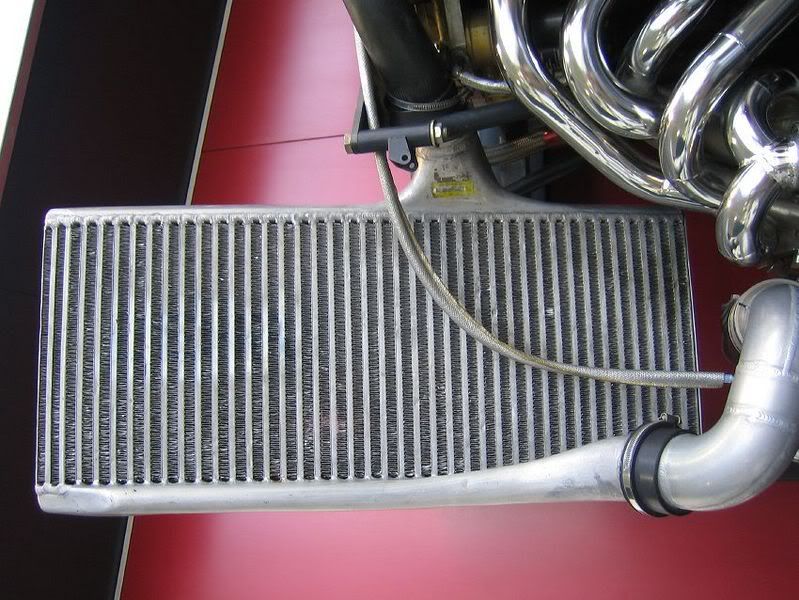
I believe the top to bottom cores are superior if designed correctly. I believe you should use the highest inner fin density that you can find. And you still need to make the core as big as possible. Unfortunately there just isnt the room on the front of cars to get good size core on without some serious modding. this 26x8x3 is pretty small by IC standards. Thats only 624sq/in of core area. The full race side to side core is 24x12x3=864sq/in of core area. My initial thoughts are this top to bottom core is good for stock turbos and 20g upgrades. I would wait on the taller version if you ask me. Tank design is important as well. If you make the core taller you have no choice but to make the tanks smaller. I looked real hard at making a top to bottom core for my cars but I came to the conclusion that a good design endtank needs to be cast for a taller core to work well.
As for the pic above thats an f1 car IC. Most would immediately jump to the conclusion that the tanks are too small for good flow. I would say small endtanks will work well if not better than large ones. Reducing charge pipe volume is the single most important step in increasing boost response . endtanks are part of that volume.
Last edited by 94AWDcoupe; Aug 2, 2007 at 01:27 PM.


How much of the spool-up improvement is due to the core being tube and fin as opposed to bar and plate? Also, would this core cool less efficiently than a good bar and plate core (in a horizontal alignment) like a Garrett? Would you recommend this core for all applications, or is it more of a drag racing app?
This core will not cool less efficiently, the thing to keep in mind is that temp and pressure go hand in hand. you dont get anything for free, if you are to improve pressure drop, the temp transfer will go down. The key to optimization is figuring out what sacrifics can be made in order to get other gains. In this case, a vertical flow will have advantages due in the most part to the reduced pressure drop this style core affords.
Geoff, how does your intercooler compare to Nisei, AMS or Buschur? The core seems a lot smaller, does this matter? The shorter path seems great for spool up, which definately peaks my interest...... but is there enough surface area to actually cool the charge as efficiently as say Buschur's race front mount intercooler? If your intercooler can keep up with the above, combined with the TS manifold and turbo, then this would be the best of all worlds!! Looking forward to the final testing. Your products look awesome.
There is no doubt a horizontal core works well and cools efficiently. For all intents and purposes, a heat exchanger is a heat exchanger. How you configure the pressure drop of the system is what makes the end result. Im confident this design works the best as are most other experienced engineers (in fact every engineer ive ever spoken with about this the subject agrees...)
i def am interested in possibly getting some of your stuff for my IX MR. i think i talked Big A into getting one or he saw how much fun and trouble ive been haveing...hell i think my brother in law is getting tired of bailing me out of speeding stops.. as for the other doubters Have you ever seen a slow car with Full Race parts...i think alot of them are the fastest out there so far
this intercooler will have great flow but craappy cooling. the longer the cooling rails the more time the hot air has to dissapate thus cool. when turned on its side its a very short run for the air meaning less cooling time. go on nisei and watch their video its very knowledgable.
the core shown is not designed for drag racing. It is intended to be used for a gt30R, gt35R and up to a gt4088R. It offers great response, low p[ressure drop and sufficient cooling capacity. For the higher power drag stuff where response isnt the most important thing and you want huge flow rates, huge heat transfer #s and as much air as you can move, a bar and plate vertical flow core that is longer and thicker is the way to go... (we're working on it right now)
Cooling takes place in the first few inches of any intercooler core anyway (I recall it being 4" more or less), this adds alot more tubes for increased flow and all of them are more than 4" tall, I fail to see then how it will be "crappy" in the charge cooling departement.
i do agree it will definately not be crappy at cooling, however
this is not at all true. the only case where the cooling only takes place in the first 4 inches, is if the air in the tubes equalizes with the intercooler temperature within 4 inches. this is simple heat transfer... if the intercooler core is cooler then the air inside it, the air is going to transfer energy into the core, thus reducing air temps.
Turning the intercooler sideways does reduce the amount of heat transfer that can be done PER TUBE, simply because it is shorter. however, because there are twice as many tubes, the net effect is the same. there is less pressure in each tube but there are twice as many tubes causing back pressure, there is less air velocity through each tube, but there is still the same mass flow rate. the real difference between the cores is going to be pressure differential between inlet and outlet, and then the surface area of the heat transfer elements, i.e. the fins (oh what its efficiency is at cooling the air)
the same thing applys to the horizontal pass IC. having such long tubes means the air might reach equal temps with the core halfway through the tube. that means that half the core is not even used (like what johnbradley was saying). the end tanks are going to offer better distribution of the air among the tubes because they are more centralized. a good designed core will take all of this into consideration, and i suspect the full race core has taken the length of the endtank into consideration. simply viewing the core at temperature with an infrared camera might show exactly how well the air is distributed across the core.
Turning the intercooler sideways does reduce the amount of heat transfer that can be done PER TUBE, simply because it is shorter. however, because there are twice as many tubes, the net effect is the same. there is less pressure in each tube but there are twice as many tubes causing back pressure, there is less air velocity through each tube, but there is still the same mass flow rate. the real difference between the cores is going to be pressure differential between inlet and outlet, and then the surface area of the heat transfer elements, i.e. the fins (oh what its efficiency is at cooling the air)
the same thing applys to the horizontal pass IC. having such long tubes means the air might reach equal temps with the core halfway through the tube. that means that half the core is not even used (like what johnbradley was saying). the end tanks are going to offer better distribution of the air among the tubes because they are more centralized. a good designed core will take all of this into consideration, and i suspect the full race core has taken the length of the endtank into consideration. simply viewing the core at temperature with an infrared camera might show exactly how well the air is distributed across the core.

thanks for the compliments, every application we've tested a vertical flow core with we've been very happy with too

nice
geoff finally replies but too bad big A hasnt given another review unless it hasnt been finished yet...
yah that LB event was funny
i think i still have rubber smoke poisoning from the burnout contest
as for the club it was pretty sick
u displaying Big A's car? or u wanna bolt some stuff onto mine for a display car
we still have one whole day to make me decide to go to Etown after a few years of not going
geoff finally replies but too bad big A hasnt given another review unless it hasnt been finished yet...
yah that LB event was funny
i think i still have rubber smoke poisoning from the burnout contest
as for the club it was pretty sick
u displaying Big A's car? or u wanna bolt some stuff onto mine for a display car
we still have one whole day to make me decide to go to Etown after a few years of not going

Just like fashion, old concepts get "discovered" again and again. Without taking anything away from Geoff, a vertical flow intercooler is NOTHING NEW. I ran a vertical flow Spearco 7 years ago on my DSM. Still have it in the garage somewhere. Corky Bell described the concept at length in Maximum Boost. Kudos to Geoff for implementing it for Evo application.
The advantage of a vertical flow intercooler is less pressure drop, because the air flow is being forced through a shorter line of heat transfer fins. Since about 90% of the heat transfer happens in the first shorter distance of exposure to the fins, you don't lose much if any heat reduction, and you gain better flow at lower pressure drop...
The advantage of a vertical flow intercooler is less pressure drop, because the air flow is being forced through a shorter line of heat transfer fins. Since about 90% of the heat transfer happens in the first shorter distance of exposure to the fins, you don't lose much if any heat reduction, and you gain better flow at lower pressure drop...
Corky Bell described the concept at length in Maximum Boost. Kudos to Geoff for implementing it for Evo application. The advantage of a vertical flow intercooler is less pressure drop, because the air flow is being forced through a shorter line of heat transfer fins. Since about 90% of the heat transfer happens in the first shorter distance of exposure to the fins, you don't lose much if any heat reduction, and you gain better flow at lower pressure drop...
giving credit where credit is due, the Grand National guys were really the first to use vertical flow cores on a regular basis. Then the 7MGTE supra guys use them (comes factory on that car) followed by the early DSMers ... corky bell was definately on the money
Last edited by Geoff Raicer; Aug 27, 2007 at 11:43 AM.

Account Disabled
Joined: May 2007
Posts: 123
Likes: 0
When looking on your website I saw the vertical flow intercooler for the evo and the piping with it but under the description for the vertical flow intercooler and piping it says the setup is made to fit to a stock evo turbo. What would I need to do if I wanted the vertical flow intercooler and piping for a gt35r. Would I need larger piping for a gt35r?