


AMS working their magic on my Evo MR ... in NC.



Chris is like some Buddhist monk. His knowledge is unknown until it's put to the test.
In other words that's one smart A&* dude!
Seriously though, in his field he is one of the most intelligent people I have ever met and I get to work with the guy
Eric
In other words that's one smart A&* dude!
Seriously though, in his field he is one of the most intelligent people I have ever met and I get to work with the guy
Eric

Here's an article I wrote on it a while ago:
A dyno is a great tool for tuning. When you make a change on a car, or bolt on a new part, you can easily compare those numbers that you had previously to the new numbers that your dyno is reading. The only real benchmark for horsepower is what your car will end up making in comparison to other cars that have been on that specific dyno! Using the information above, I hope that it is a little bit clearer what the dyno numbers that a listed actually mean. Using this information will help us all find the next best modification for any car that we may be modifying.
A dyno is a great tool for tuning. When you make a change on a car, or bolt on a new part, you can easily compare those numbers that you had previously to the new numbers that your dyno is reading. The only real benchmark for horsepower is what your car will end up making in comparison to other cars that have been on that specific dyno! Using the information above, I hope that it is a little bit clearer what the dyno numbers that a listed actually mean. Using this information will help us all find the next best modification for any car that we may be modifying.
We know that 30hp+ (~10%) difference in dyno readings is very possible. So let's say dyno D reads 330hp and dyno M reads 300hp for the same car, tune, temp, etc. Now a modification is done, and the car picks up 100hp on dyno D. This same mod will most likely pick up only 90hp on dyno M, due to it reading 10% lower.
Some people seem to think that the gain would be 100hp on either dyno, but I don't believe that would be the case. Sorry to the OP for the hyjack.

While there is truth in either statement, I can't explain the mathematics in simple terms to give you a justified answer. I can only speculate on the answer to your question.
Without knowing the actual, complete process by which the dyno calculates the numbers and the specific formula by which it achieves them, this question has no answer. If the formula applies exponential functions in its calculations then yes, the results will be skewed further as the power increases, and a constant correction factor will not be viable.
They are all just numbers anyways. I'd like to think that there is more involved in selecting parts and tuning than just peak numbers. They only tell a very small portion of ANY story.
Without knowing the actual, complete process by which the dyno calculates the numbers and the specific formula by which it achieves them, this question has no answer. If the formula applies exponential functions in its calculations then yes, the results will be skewed further as the power increases, and a constant correction factor will not be viable.
They are all just numbers anyways. I'd like to think that there is more involved in selecting parts and tuning than just peak numbers. They only tell a very small portion of ANY story.

The dyno sheet is a photoshop bwahahahalol!!!! 
Anyway, thanks Chris for making my car a BEAST now, heres my Dyno sheet attached, First run is with all the mods untuned, and the other is the final pull Tuned, mods are below
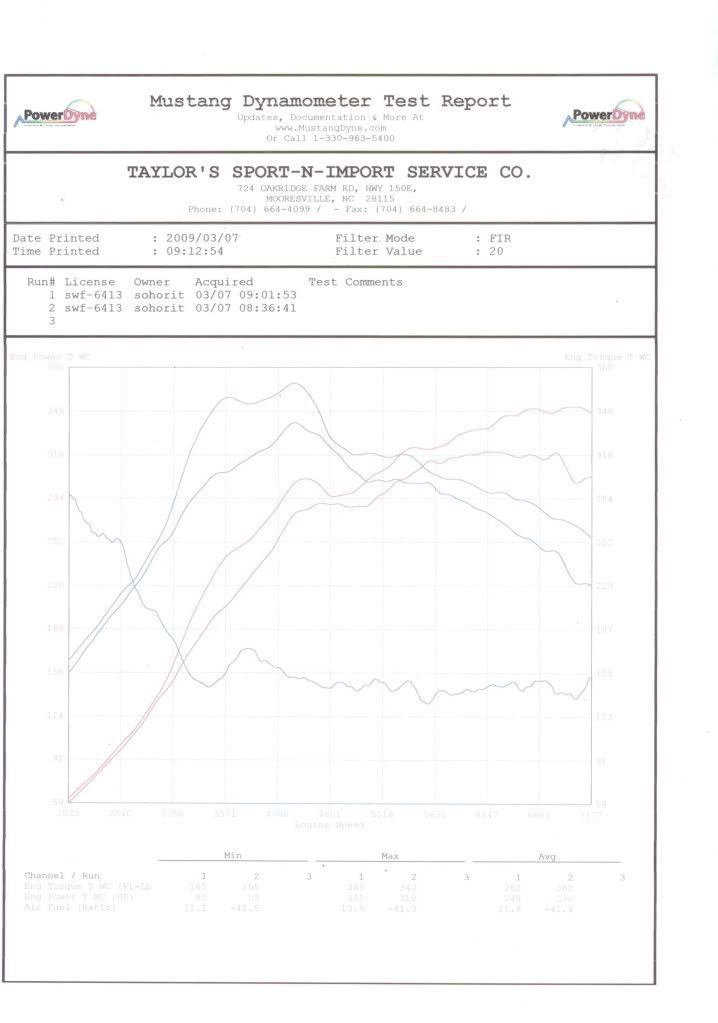
351whp 370wtq
Anyway, thanks Chris for making my car a BEAST now, heres my Dyno sheet attached, First run is with all the mods untuned, and the other is the final pull Tuned, mods are below
351whp 370wtq


Thread
Thread Starter
Forum
Replies
Last Post
HybridKOOP
Northeast Region
28
Jun 11, 2010 04:41 PM
