

Evolved Member
Two things.
1. It's sort of a duel element so I don't think it conforms to known 3d airfoil issues 100%
2. It ripped off the car down the main straight at eastern creek a few years ago. Whether that is attributed to the trunk, the forces on the wing of both is up for debate.
1. It's sort of a duel element so I don't think it conforms to known 3d airfoil issues 100%
2. It ripped off the car down the main straight at eastern creek a few years ago. Whether that is attributed to the trunk, the forces on the wing of both is up for debate.

Evolving Member
Quote:
1. It's sort of a duel element so I don't think it conforms to known 3d airfoil issues 100%
2. It ripped off the car down the main straight at eastern creek a few years ago. Whether that is attributed to the trunk, the forces on the wing of both is up for debate.
After reading about the entire build for the Cyber Evo I would be they just went too light on the wing support structure. That car was a serious exercise in least amount of metal to hold a car togather. Originally Posted by killerpenguin21
Two things.1. It's sort of a duel element so I don't think it conforms to known 3d airfoil issues 100%
2. It ripped off the car down the main straight at eastern creek a few years ago. Whether that is attributed to the trunk, the forces on the wing of both is up for debate.
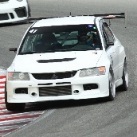
Look at the wing mounting

kaj
EvoM Community Team Leader
close


Yesterday
- Join DateMar 2006
- LocationFresno, CA
- Posts:13,635
-
iTrader Positive Feedback100
-
iTrader Feedback Score(60)
-
Likes:484
-
Liked:824 Times in 685 Posts
Quote:
The driver is so little! LOLOriginally Posted by RJones
That's an interesting point because if you look at the old Cyber Evo, they actually ran the 3D profile at roof height too. I never really thought about it.
Quote:
of course, but every bit of data I've seen shows that 3d foils create too much drag in clean air. They are built to create more downforce down low. I believe APR's website mentions it as well. So, when I see one mounted up high, I can't help but to think "WTF"? Unless Voltex knows something the wind tunnels don't. Originally Posted by nollij
The air doesn't magically flatten out at roof height. It is still being pushed up from the windshield high pressure area and then sucked back down from the rear window/trunk low pressure area creating a downward angle.
I did forget they are kind of dual foil, though. I suppose if the primary foil has less AOA than your typical 3d wing, then that would help....
But if your running in clean air, why not just go 2d?
All these "what ifs" and no data is why I've never considered Voltex nor Varis.


Can you please provide information on that?
Here is what APR has to say:
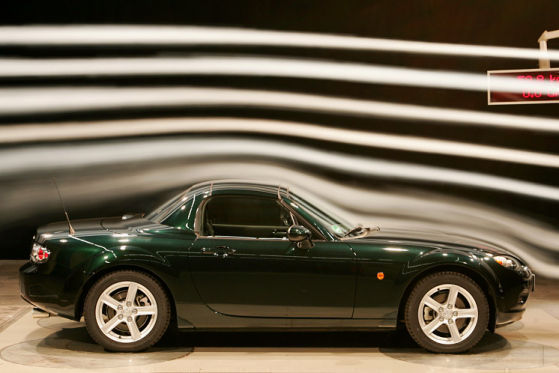
You can see that even above the Miata's roof line at the trunk area, the air is traveling downwards. It doesn't really become "free air" until a couple feet above the Miata. I would think the Evo has an even worse slope as the back of our car has a higher window slope and a larger flat rear panel in the trunk/bumper.
So then, why would a 3D airfoil not work at roof height if the air is still coming in at a downward angle? I would think a 2D would suffer as well from "either the outside or inside" is at a different AOA to the air stream.
Here is what APR has to say:
Quote:
"What we want to do now is to try to apply a bit of the CFD data and analysis to the real-world application of using this airfoil on a vehicle. First, we will first need to change a few things around. The first thing to change is the environment, because the mounted airfoil (both the center and outer sections) will never truly see any free-stream air flow. Even though the outer sections of the airfoil may be positioned beyond the vehicle's roof and body, and even though the air flow may be "cleaner" or be more parallel to the ground plane, the air around the sides of the vehicle is still affected such that it can no longer be considered to be free-stream air..."
And shows this picture:"What we want to do now is to try to apply a bit of the CFD data and analysis to the real-world application of using this airfoil on a vehicle. First, we will first need to change a few things around. The first thing to change is the environment, because the mounted airfoil (both the center and outer sections) will never truly see any free-stream air flow. Even though the outer sections of the airfoil may be positioned beyond the vehicle's roof and body, and even though the air flow may be "cleaner" or be more parallel to the ground plane, the air around the sides of the vehicle is still affected such that it can no longer be considered to be free-stream air..."
You can see that even above the Miata's roof line at the trunk area, the air is traveling downwards. It doesn't really become "free air" until a couple feet above the Miata. I would think the Evo has an even worse slope as the back of our car has a higher window slope and a larger flat rear panel in the trunk/bumper.
So then, why would a 3D airfoil not work at roof height if the air is still coming in at a downward angle? I would think a 2D would suffer as well from "either the outside or inside" is at a different AOA to the air stream.
Evolved Member
here:
Quote:
Decreasing the 2D airfoil's angle-of-attack to accommodate for the downward airflow causes the outer sections to produce relatively less downforce. Increasing the 2D airfoil's angle-of-attack causes the center section to produce relatively more downforce. The 2D airfoil ends up functioning inefficiently in this unbalanced state. This is a situation where the 3D airfoil has an advantage. The 3D airfoil's built-in angle-of-attack variations allow it to function more efficiently when it is mounted below the roofline. When the center section is mounted at 0 degrees angle-of-attack (relative to the ground), it acts as though it has a positive (typically 15 to 20 degrees in a sedan-type car) angle-of-attack relative to the airflow coming from the rear center edge of the roof. The outer sections, with the higher angle-of-attack built-in, are better-suited to take advantage of the cleaner, freer air stream. Therefore, the 3D airfoil, when used in a sedan-type car and mounted below the roofline, is able to function more efficiently (and in a more balanced state) than a 2D airfoil.
RE: cyber evo - yes the trunk ans such was thin which is why i said it probably wasnt wholly the wings fault. that being said it is a KNOWN fact that a 3d wing is more draggy than a 2d, especially the APR stuff. does it work for the majority of us? YES. Is it the fastest top of the line setup? in my opinion, NO.Decreasing the 2D airfoil's angle-of-attack to accommodate for the downward airflow causes the outer sections to produce relatively less downforce. Increasing the 2D airfoil's angle-of-attack causes the center section to produce relatively more downforce. The 2D airfoil ends up functioning inefficiently in this unbalanced state. This is a situation where the 3D airfoil has an advantage. The 3D airfoil's built-in angle-of-attack variations allow it to function more efficiently when it is mounted below the roofline. When the center section is mounted at 0 degrees angle-of-attack (relative to the ground), it acts as though it has a positive (typically 15 to 20 degrees in a sedan-type car) angle-of-attack relative to the airflow coming from the rear center edge of the roof. The outer sections, with the higher angle-of-attack built-in, are better-suited to take advantage of the cleaner, freer air stream. Therefore, the 3D airfoil, when used in a sedan-type car and mounted below the roofline, is able to function more efficiently (and in a more balanced state) than a 2D airfoil.
kaj
EvoM Community Team Leader
close
Yesterday
- Join DateMar 2006
- LocationFresno, CA
- Posts:13,635
-
iTrader Positive Feedback100
-
iTrader Feedback Score(60)
-
Likes:484
-
Liked:824 Times in 685 Posts
killerpenguin21 gee thanks. i spend 20mins trying to find the info on it.. then came back to find you found first LOL.
so yes: the center section of a 3d wing basically does nothing above the roofline; it's a waste of airfoil. if you angle the center section, you will end up with a ton of drag on the outsides. no bueno.
makes sense why our stock wings are "flat"; it's effectively a 15* AOA, from what i read. not bad, but not as good as the 3d wing would work, at the same height, i'd bet. and far less effective than a 2d wing at roof line.
IF i understand all this right.
sadly, every 2d wing i can find it quite a bit more than any of the 3D ones. i guess you get what ya pay for.
so yes: the center section of a 3d wing basically does nothing above the roofline; it's a waste of airfoil. if you angle the center section, you will end up with a ton of drag on the outsides. no bueno.
makes sense why our stock wings are "flat"; it's effectively a 15* AOA, from what i read. not bad, but not as good as the 3d wing would work, at the same height, i'd bet. and far less effective than a 2d wing at roof line.
IF i understand all this right.
sadly, every 2d wing i can find it quite a bit more than any of the 3D ones. i guess you get what ya pay for.
kaj
EvoM Community Team Leader
close
Yesterday
- Join DateMar 2006
- LocationFresno, CA
- Posts:13,635
-
iTrader Positive Feedback100
-
iTrader Feedback Score(60)
-
Likes:484
-
Liked:824 Times in 685 Posts
Quote:
RE: cyber evo - yes the trunk ans such was thin which is why i said it probably wasnt wholly the wings fault. that being said it is a KNOWN fact that a 3d wing is more draggy than a 2d, especially the APR stuff. does it work for the majority of us? YES. Is it the fastest top of the line setup? in my opinion, NO.
Originally Posted by killerpenguin21
here:RE: cyber evo - yes the trunk ans such was thin which is why i said it probably wasnt wholly the wings fault. that being said it is a KNOWN fact that a 3d wing is more draggy than a 2d, especially the APR stuff. does it work for the majority of us? YES. Is it the fastest top of the line setup? in my opinion, NO.
so the drag pulled it off the trunk? how would a company like that not know better?
Quote:
RE: cyber evo - yes the trunk ans such was thin which is why i said it probably wasnt wholly the wings fault. that being said it is a KNOWN fact that a 3d wing is more draggy than a 2d, especially the APR stuff. does it work for the majority of us? YES. Is it the fastest top of the line setup? in my opinion, NO.
That doesn't say anything about at the roof line or above the roof line. It just says what is obvious about the AOA of the air at the wing at the inside and outside below the roof line.Originally Posted by killerpenguin21
here:RE: cyber evo - yes the trunk ans such was thin which is why i said it probably wasnt wholly the wings fault. that being said it is a KNOWN fact that a 3d wing is more draggy than a 2d, especially the APR stuff. does it work for the majority of us? YES. Is it the fastest top of the line setup? in my opinion, NO.
What I stated and what I hope can be agreed is fact:
(1) At the roof line or even above the roof line the AOA of the air is still at a downward angle. This is apparent from the wind tunnel images and CFDs of other cars you can find on the internet. The only cars that have minimal affect from this are coupes with lightly sloped roofs (not an Evo)
(2) At some point there is a crossover where the 2D wing becomes more efficient than the 3D wing because the inside to outside air flow AOA differences minimizes. (With the assumption that the wing cross section is the same from the 2D and 3D wings)
(3) Even at the roof line, the 2D wing experiences a higher AOA at the inside than the outside because as stated in (1), the air stream is still approaching at a downward angle.
The position that is commonly being stated:
The 2D wing becomes more effective than the 3D wing at slightly below the roof line and above.
I am merely questioning:
Based on what information is this "cutoff" point determined and why is this held to be such a certainty? The wind tunnels indicate that there is still a non-insignificant downward air stream angle at the roof line.
kaj
EvoM Community Team Leader
close
Yesterday
- Join DateMar 2006
- LocationFresno, CA
- Posts:13,635
-
iTrader Positive Feedback100
-
iTrader Feedback Score(60)
-
Likes:484
-
Liked:824 Times in 685 Posts
Quote:
The 2D wing becomes more effective than the 3D wing at slightly below the roof line and above.
I am merely questioning:
Based on what information is this "cutoff" point determined and why is this held to be such a certainty? The wind tunnels indicate that there is still a non-insignificant downward air stream angle at the roof line.
test data from Kognition, Aeromotions, etc.Originally Posted by nollij
The position that is commonly being stated:The 2D wing becomes more effective than the 3D wing at slightly below the roof line and above.
I am merely questioning:
Based on what information is this "cutoff" point determined and why is this held to be such a certainty? The wind tunnels indicate that there is still a non-insignificant downward air stream angle at the roof line.
Quote:
Can you please link the test data that compares 2D and 3D wings on particular cars with wing height taken as a variable?Originally Posted by kaj
test data from Kognition, Aeromotions, etc.
Here is a poster of the NASA Eastern states championship. The TT2 and TTU champion both have 3D wings that are at or above the roof line. Someone should probably go tell them that they are doing it wrong.

kaj
EvoM Community Team Leader
close
Yesterday
- Join DateMar 2006
- LocationFresno, CA
- Posts:13,635
-
iTrader Positive Feedback100
-
iTrader Feedback Score(60)
-
Likes:484
-
Liked:824 Times in 685 Posts
Quote:
Here is a poster of the NASA Eastern states championship. The TT2 and TTU champion both have 3D wings that are at or above the roof line. Someone should probably go tell them that they are doing it wrong.
Kognition's site is down, but you can google Aeromotion and find their info. there are other companies that post their data.. i think APR has but i don't have the time to chase it all down at the moment. Originally Posted by nollij
Can you please link the test data that compares 2D and 3D wings on particular cars with wing height taken as a variable?Here is a poster of the NASA Eastern states championship. The TT2 and TTU champion both have 3D wings that are at or above the roof line. Someone should probably go tell them that they are doing it wrong.
feel free to tell them they seem to have it all wrong

but looking at those pictures, i'd imagine the difference has something to do with the quote above, particularly this part:
Quote:
Therefore, the 3D airfoil, when used in a sedan-type car and mounted below the roofline, is able to function more efficiently (and in a more balanced state) than a 2D airfoil.
we drive Evos so i assume most info posted in this thread is directed towards our cars.Therefore, the 3D airfoil, when used in a sedan-type car and mounted below the roofline, is able to function more efficiently (and in a more balanced state) than a 2D airfoil.
Evolved Member
tomorrow ill dig through my collection of crap and try an find you a definitive answer. my short answer for now is, that at our level i dont think you can classify things as "right" and "wrong" instead only as crap, sorta works, and oh sh*t it ACTUALLY works. just because they did it and won doesnt mean that it is the best. keep in mind they are all working with cars that have significantly better aerodynamics than an evo.
Below is a slightly better flow reference.
Below is a slightly better flow reference.

Evolved Member
Quote:
no it was a combo of the extremely thin trunk lid and wing drag. the million dollar question is, would a 2d/lower drag wing have stayed on? we'll never know.Originally Posted by kaj
so the drag pulled it off the trunk? how would a company like that not know better?
kaj
EvoM Community Team Leader
close
Yesterday
- Join DateMar 2006
- LocationFresno, CA
- Posts:13,635
-
iTrader Positive Feedback100
-
iTrader Feedback Score(60)
-
Likes:484
-
Liked:824 Times in 685 Posts
Quote:
true, true. even i know not to mount a wing like that Originally Posted by killerpenguin21
no it was a combo of the extremely thin trunk lid and wing drag. the million dollar question is, would a 2d/lower drag wing have stayed on? we'll never know.


Think this is from an older option DVD in japan. it is the wind tunnel video of the cyber evo. probably a very educational video if u can speak japanese.
The cyber evo wing coming off at WTAC was a boot skin failure rather than a wing failure. i remember reading somewhere that the boot lid skins actually disbonded. but yea mounting direct to a carbon bootlid was never going to work.
http://www.trackhq.com/forums/attach...r-evo-evo1.jpg
The way i understand rear wings is that the higher you place the wing the more downforce you get. but with the height and downforce also comes more drag. so therefore you are attempting to find a median/trade off between the two.
as the picture of the miata shows the clean air is quite high above the vehicle. and if u can poke ur wing into this clean air you will get significantly more downforce. and with that also becomes a significant increase in drag. RE the formula 1 cars of the late 60s with the boeing sized rear wings.
Then theres no point in having all that downforce if you cant transfer it through the wing into the chassis. hence why its a good idea to make sure u have some solid mountings direct from the base of the wing mounts to the chassis. otherwise all ur doing is pushing the bootlid down and not necessary the chassis. (yes the bootlid will eventually push the car down, but there will be alot more slack and flex in the bootlid and it would probably make the car quite boat like)
You also need to balance the rear wing downforce to the front of the vehicle or you will just end up understeering like a pig. so theres no point having formula 1 levels of downforce on the rear and a completely stock front end.
But u guys probably know this already. What im interested in more so is how the 2 step wings like the voltex type 5 work effectively and at what angles. i assume the smaller wing on the back edge is designed to be like a gurney flap on steriods??