


calc HP/TQ from EvoScan using Excel


WG spring mod, crushed BOV-a very heavy spring -LOL. I downloaded the openoffice- it gives me about 8 options in which to open- which do I open?
Edit: I cant wait to get the map sensor to show that taper is preventable on a stock turbo. With the Buschur MBC, I could go higher than that- that thing is unreal. But once again- only due to the WG spring mod.
Edit: I cant wait to get the map sensor to show that taper is preventable on a stock turbo. With the Buschur MBC, I could go higher than that- that thing is unreal. But once again- only due to the WG spring mod.
Last edited by lan_evo_mr9; May 31, 2009 at 08:20 PM.
Open with the "Western"option they ask. Umm, I doubt it. People have WELDED the flapper closed and it still tapered like heck. Its not the WG thats the limit, its the turbo design. What load values are you seeing at peak torque and redline?
Last edited by Jack_of_Trades; May 31, 2009 at 08:23 PM.

WG spring mod, crushed BOV-a very heavy spring -LOL. I downloaded the openoffice- it gives me about 8 options in which to open- which do I open?
Edit: I cant wait to get the map sensor to show that taper is preventable on a stock turbo. With the Buschur MBC, I could go higher than that- that thing is unreal. But once again- only due to the WG spring mod.
Edit: I cant wait to get the map sensor to show that taper is preventable on a stock turbo. With the Buschur MBC, I could go higher than that- that thing is unreal. But once again- only due to the WG spring mod.

Are you currently eye balling this? No MAP log? I think you might be in for a rude awakening.

Yeah, there isn't a magical BOV thats gonna make that happen. I bench tested numerous BOV's used with stock Evo turbos and they all held solid well over 30psi so its not a crushed BOV thats making magic happen.

I'm still not able to post the graphs correctly, I would love to have all the numbers & extra data Jamie has supplied .
.
Was this for my graph? If so, both logged runs were done on the same portion of road. For me it's essential to allow accurate depictions for my tuner, I didn't always do this & it must have driven him mad
.
Thanks Turco, still smoothing out a lot of little bugs in her though. NOw that Bill got some decent data from ESP'd Mustang Dyno we are gonna do a street pull soon to compare the results. I'd add a little more smoothing to that funky ripple you got there.
Until we can get more data, its best used to save a "BASE" pull before tuning or adding mods and then compare the results against your own "BASE" pull, rahter than have people worrying about the numbers for now. If you will be doing the mods/tuning across a long time frame, its best to use the weather corrections feature to see more stable results over different days.
Dave from ESP will be emailing me the data files of a few of Bills pulls so I can compare them in the simulator.
Until we can get more data, its best used to save a "BASE" pull before tuning or adding mods and then compare the results against your own "BASE" pull, rahter than have people worrying about the numbers for now. If you will be doing the mods/tuning across a long time frame, its best to use the weather corrections feature to see more stable results over different days.
Dave from ESP will be emailing me the data files of a few of Bills pulls so I can compare them in the simulator.
Last edited by Steveevo9; May 31, 2009 at 11:22 PM.
So far GST Motorsports and Buschur Racings Mustangs are pretty darn close with only minimal variances but I think Enhanced Street Performances Mustang dyno is reading differently.
Ideally, the best way to dial this program in is to have someone do 3 pulls on a Dyno, then go do 2-3 pulls on flat road in the same gears. The issue I see is that the simulated load that the dyno creates can be different than an actual street pull This all depends on how well the shop dialed in their dyno to simulate the road conditions and drag.
I think I might create a dropdown list with parameters for different dynos located all over the place if we can get enough data from the community. I would also have it set so the user can add their own presets for their local dyno shop if they wanted so they can switch quickly without having to edit multiple values.
ESP uses the default vehicle weight of 3625lbs. which is supposed to be a FULL weight Evo with driver plus a full tank of gas according to the shop. Buschurs uses this value and GST Motorsports uses 3500lbs. The higher the weight, the more the load simulator applies 'the brakes' to create greater resistance. This makes the car go thru the RPM range slower and results in lower readings. I gotta get my hands on a MD owners manual *cough* Bryan!*cough* lol.
Ideally, the best way to dial this program in is to have someone do 3 pulls on a Dyno, then go do 2-3 pulls on flat road in the same gears. The issue I see is that the simulated load that the dyno creates can be different than an actual street pull This all depends on how well the shop dialed in their dyno to simulate the road conditions and drag.
I think I might create a dropdown list with parameters for different dynos located all over the place if we can get enough data from the community. I would also have it set so the user can add their own presets for their local dyno shop if they wanted so they can switch quickly without having to edit multiple values.
ESP uses the default vehicle weight of 3625lbs. which is supposed to be a FULL weight Evo with driver plus a full tank of gas according to the shop. Buschurs uses this value and GST Motorsports uses 3500lbs. The higher the weight, the more the load simulator applies 'the brakes' to create greater resistance. This makes the car go thru the RPM range slower and results in lower readings. I gotta get my hands on a MD owners manual *cough* Bryan!*cough* lol.
Last edited by Jack_of_Trades; Jun 1, 2009 at 07:43 AM.

ESP uses the default vehicle weight of 3625lbs. which is supposed to be a FULL weight Evo with driver plus a full tank of gas according to the shop. Buschurs uses this value and GST Motorsports uses 3500lbs. The higher the weight, the more the load simulator applies 'the brakes' to create greater resistance. This makes the car go thru the RPM range slower and results in lower readings. I gotta get my hands on a MD owners manual *cough* Bryan!*cough* lol.
Yeah I know, Bryan @ GST Motorsports said he's varied the vehicle weight by a considerable amount and saw no real drastic changes but I'd LOVE to see him do a pull at 3300 (my car with me in it), 3400,3500, and 3625 just to see the actual variance. And if possible, a pull with the ACTUAL weight of that particular car to compare against a street pull. He said he would have his personal Evo back on the road soon so hopefully I can send him some donations to collect some data for us when he has the opportunity.
It may only be a 10whp difference from 3300 to 3625 but in my book, thats huge.
Here is a decent Vehicle Weight Scale product thats not too expensive for most shops. A lot of Auto-x and drifting shops have these systems already for corner balancing.
http://intercomp-racing.com/Products..._SCALE_900.cfm
It may only be a 10whp difference from 3300 to 3625 but in my book, thats huge.
Here is a decent Vehicle Weight Scale product thats not too expensive for most shops. A lot of Auto-x and drifting shops have these systems already for corner balancing.
http://intercomp-racing.com/Products..._SCALE_900.cfm
Last edited by Jack_of_Trades; Jun 1, 2009 at 09:06 AM.

I was recently looking around online for scales as well, just out of curiosity. You can find ones like Jamie linked about in about the $800 range. I also found one site that sells individual scales with attached readout somewhere in the 200-300 range or so.
Also, if there are any CAT scales around where you live, you can pay $9 and weigh your car there. I don't think the accuracy at our weight is going to be that great though.
Actually, there are a couple ways to weigh your car with simple tools and/or scales as well. The one method that you see a lot (either on youtube) or fun scient project pages is measuring the area of your tire contact patch and knowing the exact pressure of your tires. Since your tire pressure in is pounds per inch spuare and you measure the area your tire's contact path, the simple multiplication of the two is the weight being held up by that tire. Do all four and you have your car weight. However, this is assuming that the tire is actually flexible enough so that the rigidity of the tire is negligible.
Another interesting, yet scientifically sound method is something I found on a forum where someone posted a way to weigh your car with a normal bathroom scale. You would have to actually do this method four times (averaged for the front end and averaged for the rear end), but it should work. This picture describes the method:
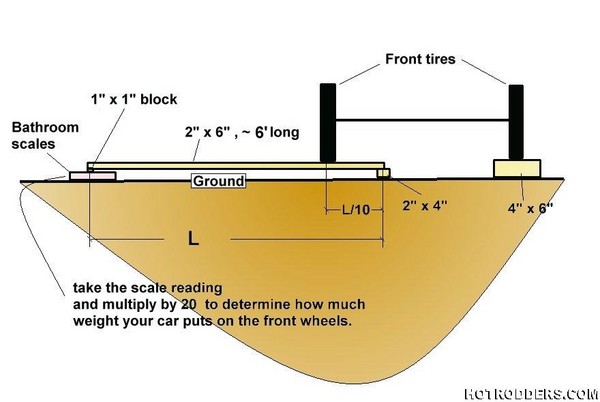
The image actually states that the result will be the amount of weight put on the ground by your front end, but that's assuming that you are balanced 50/50 left/right. So, you would really have to do this for each wheel and average the results to get your front-end weight.
Also, if there are any CAT scales around where you live, you can pay $9 and weigh your car there. I don't think the accuracy at our weight is going to be that great though.
Actually, there are a couple ways to weigh your car with simple tools and/or scales as well. The one method that you see a lot (either on youtube) or fun scient project pages is measuring the area of your tire contact patch and knowing the exact pressure of your tires. Since your tire pressure in is pounds per inch spuare and you measure the area your tire's contact path, the simple multiplication of the two is the weight being held up by that tire. Do all four and you have your car weight. However, this is assuming that the tire is actually flexible enough so that the rigidity of the tire is negligible.
Another interesting, yet scientifically sound method is something I found on a forum where someone posted a way to weigh your car with a normal bathroom scale. You would have to actually do this method four times (averaged for the front end and averaged for the rear end), but it should work. This picture describes the method:
The image actually states that the result will be the amount of weight put on the ground by your front end, but that's assuming that you are balanced 50/50 left/right. So, you would really have to do this for each wheel and average the results to get your front-end weight.
Yeah I know, Bryan @ GST Motorsports said he's varied the vehicle weight by a considerable amount and saw no real drastic changes but I'd LOVE to see him do a pull at 3300 (my car with me in it), 3400,3500, and 3625 just to see the actual variance. And if possible, a pull with the ACTUAL weight of that particular car to compare against a street pull. He said he would have his personal Evo back on the road soon so hopefully I can send him some donations to collect some data for us when he has the opportunity.
It may only be a 10whp difference from 3300 to 3625 but in my book, thats huge.
Here is a decent Vehicle Weight Scale product thats not too expensive for most shops. A lot of Auto-x and drifting shops have these systems already for corner balancing.
http://intercomp-racing.com/Products..._SCALE_900.cfm
It may only be a 10whp difference from 3300 to 3625 but in my book, thats huge.
Here is a decent Vehicle Weight Scale product thats not too expensive for most shops. A lot of Auto-x and drifting shops have these systems already for corner balancing.
http://intercomp-racing.com/Products..._SCALE_900.cfm
Do you know what Buschur and ESP use for the HP@50 setting?
http://www.mustangdyne.com/downloads/dwnLd_manuals.htm

