


calc HP/TQ from EvoScan using Excel


Evolving Member
Joined: Oct 2006
Posts: 204
Likes: 0
From: Trinidad
seriously tho, really good work. I put down 351/363 @ 25psi, 91oct on my local dyno and the excel closely matches. I Think u will put some dyno men out of business with this one. Really great job man.

Pro-tip for all of you: When selecting/deleting data, you can press ctl + shift + arrow key in a direction and it will go to the logical end of that data. Makes it much easier for deleting/copy/etc the data sets.
So I found a nice way to standardize how many lines of data gets inoutted thru the formulas by using the 'lookup' feature I can have the spreadsheet find the closest data at RPM intervals. So it will look in column 'B' for the closest value to 3000 rpm, then 3050 rpm,then 3100 rpm, etc... and also have it lookup the LogEntrySeconds in that same row. I will set it to check from 3000 rpm to 8000 rpm in 50 rpm intervals which will give us a constant 100 lines of data regardless of the file size. This should help make the spreadsheet more consistent between large and small datalogs, and make it easier to have the smoothing factor be consistent as well. I just need to do some more testing to find the best smoothing values to use and such.
Last edited by Jack_of_Trades; Jun 3, 2009 at 11:42 AM.

So I found a nice way to standardize how many lines of data gets inoutted thru the formulas by using the 'lookup' feature I can have the spreadsheet find the closest data at RPM intervals. So it will look in column 'B' for the closest value to 3000 rpm, then 3050 rpm,then 3100 rpm, etc... and also have it lookup the LogEntrySeconds in that same row. I will set it to check from 3000 rpm to 8000 rpm in 50 rpm intervals which will give us a constant 100 lines of data regardless of the file size. This should help make the spreadsheet more consistent between large and small datalogs, and make it easier to have the smoothing factor be consistent as well. I just need to do some more testing to find the best smoothing values to use and such.

Fosty: Thanks for the "pro tip". good to know!

I ran a log from an Evo 9 that I had tuned and compared it to DLL. I took into account weather and baro variations. While the peak numbers were different, the GAINS from each road dyno were almost the same. This proves to me, once again, how pointless it is to focus on dyno numbers and how meaningful it is to focus on the gains.
DLL dyno sheet

Jaime's dyno sheet

One question, though, why does the sheet say not to change the weight unless there is extreme weight reduction?
With DLL I adjust the weight based on Evo model, gas in the tank, and people in the car.
DLL dyno sheet
Jaime's dyno sheet
One question, though, why does the sheet say not to change the weight unless there is extreme weight reduction?
With DLL I adjust the weight based on Evo model, gas in the tank, and people in the car.
Only because most dyno shops use the 'default' evo vehicle weight that is in the dyno software which pre-loads the car as if it was that weight anyhow. The range I've found from e-mailing a bunch of dyno shops was between 3350-3625 lbs so I tried to set it for an average of 3500lbs so the numbers wouldn't be skewed in one direction or another. This isn't as useful with Dynojet figures but it certainly is with any dyno that simulates raod conditions by applying a load on the vehicle as it accelerates. I this is one reason people have been getting higher-than-reality numbers when they choose dynojet simulation.
I'm going to set it up so there is Vehicle weight and a seperate 'Occupants Weight' so its easier to add the weight of the driver+any passengers seperately. I might have it set so when MUSTANG dyno is chosen, it defaults to the standard weight somehow but when the dynojet value is used it will use the ACTAUL vehicle weight entered by the user.
I'm going to set it up so there is Vehicle weight and a seperate 'Occupants Weight' so its easier to add the weight of the driver+any passengers seperately. I might have it set so when MUSTANG dyno is chosen, it defaults to the standard weight somehow but when the dynojet value is used it will use the ACTAUL vehicle weight entered by the user.


I ran a log from an Evo 9 that I had tuned and compared it to DLL. I took into account weather and baro variations. While the peak numbers were different, the GAINS from each road dyno were almost the same. This proves to me, once again, how pointless it is to focus on dyno numbers and how meaningful it is to focus on the gains.
DLL dyno sheet
Jaime's dyno sheet
With DLL I adjust the weight based on Evo model, gas in the tank, and people in the car.
DLL dyno sheet
Jaime's dyno sheet
With DLL I adjust the weight based on Evo model, gas in the tank, and people in the car.
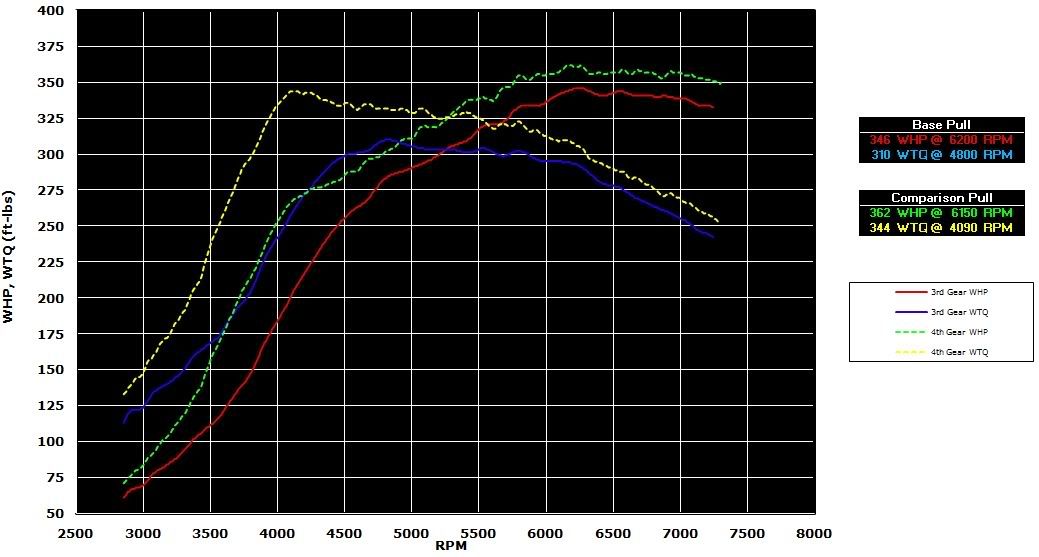
Well guys, I think I really dialed this sucker in now. I am adjusting the 3rd gear/4th accuracies with the syno results I got from our last dyno session but wondered if anyone has any 3rd gear/4th gear logs from the same tune (preferably from the same day)?
Also, if anyone knows the different gear ratios used on the 8's/9's for 3rd and 4th gear(and their final drive gears), that would be helpful too. Evoscan claims that the RS has different gears but I'm not sure. If Evoscan is correct, I'll just use their values. This version is 10 times more consistent than anything you've seen thus far from files as small as 40 lines to as big as 500 lines
Also, if anyone knows the different gear ratios used on the 8's/9's for 3rd and 4th gear(and their final drive gears), that would be helpful too. Evoscan claims that the RS has different gears but I'm not sure. If Evoscan is correct, I'll just use their values. This version is 10 times more consistent than anything you've seen thus far from files as small as 40 lines to as big as 500 lines

Well guys, I think I really dialed this sucker in now. I am adjusting the 3rd gear/4th accuracies with the syno results I got from our last dyno session but wondered if anyone has any 3rd gear/4th gear logs from the same tune (preferably from the same day)?
Also, if anyone knows the different gear ratios used on the 8's/9's for 3rd and 4th gear(and their final drive gears), that would be helpful too. Evoscan claims that the RS has different gears but I'm not sure. If Evoscan is correct, I'll just use their values. This version is 10 times more consistent than anything you've seen thus far from files as small as 40 lines to as big as 500 lines
Also, if anyone knows the different gear ratios used on the 8's/9's for 3rd and 4th gear(and their final drive gears), that would be helpful too. Evoscan claims that the RS has different gears but I'm not sure. If Evoscan is correct, I'll just use their values. This version is 10 times more consistent than anything you've seen thus far from files as small as 40 lines to as big as 500 lines
Here is a gear ratio chart I found...