


Did a few logs tonight...




Like was already mentioned, the biggest factor is MIVEC in a IX then timing and fuel. I have customer cars that have made peak torque at 3150 on a Mustang so a good tune goes along way. I dont think Trav has problems with that, I was just wondering if that was a side effect of DLL not being level or something.
On topic-
The following timing map is a customer VIII (uncammed ran in the 270's, cammed it runs 290ish) that was tuned at 11.8:1 with no knock and this timing. PNW air tends be better than most places in the US, lower humidity and lower temps, but even when it gets hot and crappy here (85* and 40%)the car still didnt knock. The car saw a peak of 24psi tapering to 20ish (not under, but cant be exact without logging it) by redline. This was repeated under 2 different fuel conditions one was 94 octane with 10% ethanol and the other was normal Shell 92 (which seems to work well around here).
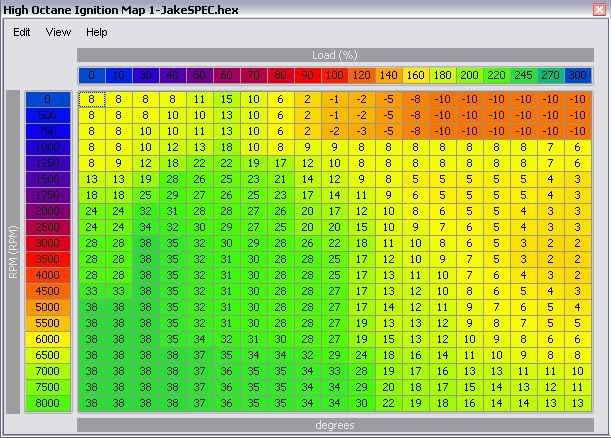
My personal car runs and has run 11.5 AFR minimum, 26psi, and as much as 6* at peak torque all without knock (stock turbo). I usually keep my AFR's in the 11.7 range and fairly aggressive timing for a Green at 25psi and those AFR's.
JB
On topic-
The following timing map is a customer VIII (uncammed ran in the 270's, cammed it runs 290ish) that was tuned at 11.8:1 with no knock and this timing. PNW air tends be better than most places in the US, lower humidity and lower temps, but even when it gets hot and crappy here (85* and 40%)the car still didnt knock. The car saw a peak of 24psi tapering to 20ish (not under, but cant be exact without logging it) by redline. This was repeated under 2 different fuel conditions one was 94 octane with 10% ethanol and the other was normal Shell 92 (which seems to work well around here).
My personal car runs and has run 11.5 AFR minimum, 26psi, and as much as 6* at peak torque all without knock (stock turbo). I usually keep my AFR's in the 11.7 range and fairly aggressive timing for a Green at 25psi and those AFR's.
JB

Yeah .. can we please stop the arguing here and focus on helping the OP? I'll try to just break it down ...
GENERALLY, an AFR greater than 11.5:1 is considered fairly lean for pump gas w/o meth or water injection.
However, with proper tuning, an AFR greater than 11.5:1 can be utilized safely when paired with lower timing advance values.
These are simply 2 different approaches to tuning and NEITHER IS WRONG. In both circumstances knock values should be monitored to ensure engine safety.
GENERALLY, an AFR greater than 11.5:1 is considered fairly lean for pump gas w/o meth or water injection.
However, with proper tuning, an AFR greater than 11.5:1 can be utilized safely when paired with lower timing advance values.
These are simply 2 different approaches to tuning and NEITHER IS WRONG. In both circumstances knock values should be monitored to ensure engine safety.

Yeah .. can we please stop the arguing here and focus on helping the OP? I'll try to just break it down ...
GENERALLY, an AFR greater than 11.5:1 is considered fairly lean for pump gas w/o meth or water injection.
However, with proper tuning, an AFR greater than 11.5:1 can be utilized safely when paired with lower timing advance values.
These are simply 2 different approaches to tuning and NEITHER IS WRONG. In both circumstances knock values should be monitored to ensure engine safety.
GENERALLY, an AFR greater than 11.5:1 is considered fairly lean for pump gas w/o meth or water injection.
However, with proper tuning, an AFR greater than 11.5:1 can be utilized safely when paired with lower timing advance values.
These are simply 2 different approaches to tuning and NEITHER IS WRONG. In both circumstances knock values should be monitored to ensure engine safety.
12.0-12.3 AFR in 3rd is suitable for maximum safe performance.

Last year I tuned my stock motored 154K 90 eclipse by ear and trap speeds. Throwing it on a wideband netted 12.6:1 AFR. Made about 50-60 passes like that, 100 or more tuning pulls on the street getting the timing tables where I wanted them, and many pulls through 150mph (travman can vouch for me). I was shocked to see such a lean AFR and I had to run low timing but the car made power. 11.50's at 130 on a bone stock high tired stock motor on, did I mention stock cams as well? I ran mid 12's on pump or race gas. I had ignition issues or the car would have went faster. Something about stock crusty old coils and ignitor modules on worn NGK wires. I dunno maybe mellon can fill me in on that one.
THen I tuned my stock evo 9 to 12's on pump. 315 hp to the wheels on a dyno. Nice little street car.
THen I brought the eclipse back out with a built to the hilt motor for this year, ran out of funds, and made some just for funnie passes on the stock 14b turbo (about half the size of the stock evo turbo FYI). 12.0 at 122mph were the numbers to that tale on a cracked intercooler. The endtanks kept cracking, car went slower, and haven't raced it since.
So yeah, I'm pretty sure mid 12's ain't gonna hurt ****. Dumbasses with too much time to post on message boards break ****, which is cool, because it makes for a good laugh when my self tuned stock motored budget car runs circles around a broken "tuned by _______" car.
THen I tuned my stock evo 9 to 12's on pump. 315 hp to the wheels on a dyno. Nice little street car.
THen I brought the eclipse back out with a built to the hilt motor for this year, ran out of funds, and made some just for funnie passes on the stock 14b turbo (about half the size of the stock evo turbo FYI). 12.0 at 122mph were the numbers to that tale on a cracked intercooler. The endtanks kept cracking, car went slower, and haven't raced it since.
So yeah, I'm pretty sure mid 12's ain't gonna hurt ****. Dumbasses with too much time to post on message boards break ****, which is cool, because it makes for a good laugh when my self tuned stock motored budget car runs circles around a broken "tuned by _______" car.
Its because the pull isn't very long in third gear so boost hits later in the RPM band. That coupled with the amazing heat the eastcoast is getting causes 1000rpm's or so before boost threshold compared to say a nice winter day.
Unless you have an EGT on each cylinder and are datalogging them to measure a cylinder to cylinder fueling issue your wasting your time. Even at that you can do a WBO2 per cylinder to read it directly. EGT's are for diesel motors not gas motors.

Yeah .. can we please stop the arguing here and focus on helping the OP? I'll try to just break it down ...
GENERALLY, an AFR greater than 11.5:1 is considered fairly lean for pump gas w/o meth or water injection.
However, with proper tuning, an AFR greater than 11.5:1 can be utilized safely when paired with lower timing advance values.
These are simply 2 different approaches to tuning and NEITHER IS WRONG. In both circumstances knock values should be monitored to ensure engine safety.
GENERALLY, an AFR greater than 11.5:1 is considered fairly lean for pump gas w/o meth or water injection.
However, with proper tuning, an AFR greater than 11.5:1 can be utilized safely when paired with lower timing advance values.
These are simply 2 different approaches to tuning and NEITHER IS WRONG. In both circumstances knock values should be monitored to ensure engine safety.
whats wrong is forcing a car to make power by just adding a bunch of timing and then making it work by adding a bunch of fuel........
but what do i know?


Think about what your saying "my car likes more timing and more fuel". Tuning it for optimal timing and about 0.8 O2 is very difficult, and with changing conditions is an ongoing process. By adding the fuel for the amount of time your just weakening the combustion (kinda like lifting the throttle or dropping the boost - same damn thing).
It is very possible to get the same whp without detonation even more simply by trimming the fuel and timing to reasonable amounts, and guess, what your wide band will read more accurately. The problem is it's much more difficult to do which is probably why most revert back to overfueling and then advancing the timing.
It is very possible to get the same whp without detonation even more simply by trimming the fuel and timing to reasonable amounts, and guess, what your wide band will read more accurately. The problem is it's much more difficult to do which is probably why most revert back to overfueling and then advancing the timing.
Please explain why I would hurt my motor on a 12.0 afr on pump gas? 
Plus they way you did it of course it wasnt going to respond well. You took a map that had a lot of fuel and timing and then tried to lean it out with the same amount of timing, then had to take timing away....All you did was cause yourself grief because you were trying to change 2 things at once to make work together.
If you would have started off by getting your afr at 12.0 and then building a timing map around that by adding and not backwards tuning like it seems you did from your explanation you might have found you would have had better luck.
btw what is your timing #'s at redline, just curious to see how much more timing you run dumping a lot of fuel to do it....
Plus they way you did it of course it wasnt going to respond well. You took a map that had a lot of fuel and timing and then tried to lean it out with the same amount of timing, then had to take timing away....All you did was cause yourself grief because you were trying to change 2 things at once to make work together.
If you would have started off by getting your afr at 12.0 and then building a timing map around that by adding and not backwards tuning like it seems you did from your explanation you might have found you would have had better luck.
btw what is your timing #'s at redline, just curious to see how much more timing you run dumping a lot of fuel to do it....
maybe you misunderstood me remeber when tuning your constants are your boost and your afrs and timing is your variable i leaned it out then i started tweaking timing.

Last edited by jrsimon27; Jul 19, 2007 at 06:48 PM.

Travman,
I am surprised by the low torque numbers on your Evo IX. I run 22 psi tapering to 19.6 psi @ redline. AFR is @ 11.70 tapering to 11 by redline and timing is 3* @ peak and 10* by redline. The Gas is crappy CA 91 octane.
The log was taken on a slightly inclined ramp. The benchmark is the stock output. The car only has a TBE with a drop in.

I am surprised by the low torque numbers on your Evo IX. I run 22 psi tapering to 19.6 psi @ redline. AFR is @ 11.70 tapering to 11 by redline and timing is 3* @ peak and 10* by redline. The Gas is crappy CA 91 octane.
The log was taken on a slightly inclined ramp. The benchmark is the stock output. The car only has a TBE with a drop in.
Yeah .. can we please stop the arguing here and focus on helping the OP? I'll try to just break it down ...
GENERALLY, an AFR greater than 11.5:1 is considered fairly lean for pump gas w/o meth or water injection.
However, with proper tuning, an AFR greater than 11.5:1 can be utilized safely when paired with lower timing advance values.
These are simply 2 different approaches to tuning and NEITHER IS WRONG. In both circumstances knock values should be monitored to ensure engine safety.
GENERALLY, an AFR greater than 11.5:1 is considered fairly lean for pump gas w/o meth or water injection.
However, with proper tuning, an AFR greater than 11.5:1 can be utilized safely when paired with lower timing advance values.
These are simply 2 different approaches to tuning and NEITHER IS WRONG. In both circumstances knock values should be monitored to ensure engine safety.

anything under 11.5 is way to rich and your just cutting yourself short.....and i dont have lower timing values, my timing map looks fairly similar to what JB posted. I dont consider that "lower" timing values....and i still have room to add a little more timing, i have to atleast make it knock??
whats wrong is forcing a car to make power by just adding a bunch of timing and then making it work by adding a bunch of fuel........
but what do i know?
whats wrong is forcing a car to make power by just adding a bunch of timing and then making it work by adding a bunch of fuel........
but what do i know?
with 12.0 afrs i still dont undertstand why you are not knocking?
Trav, you have said you are running 23 psi, but it looks more like 20.5 or 21 psi in your log. You have a spike of around 250 load which is likely 23 psi but you don't seem to be holding it very long.
Now, I know that's not a huge difference but considering all of the factors in play here I think we are just simply arguing 2 different points.
Your log was in 3rd, you don't seem to be holding 23 psi (only spiking there) and you are likely in slightly cooler weather than me. I tune in 4th (a difference Scott mentioned), am holding 23.5 psi or so and often run in ambient temps in the 90's (it's currently 83* at 65% humidity here at 10:30 p.m.).
If what I assume is true then I have no doubt you are running the numbers your show in the log safely. Is this in fact the situation?
Now, I know that's not a huge difference but considering all of the factors in play here I think we are just simply arguing 2 different points.
Your log was in 3rd, you don't seem to be holding 23 psi (only spiking there) and you are likely in slightly cooler weather than me. I tune in 4th (a difference Scott mentioned), am holding 23.5 psi or so and often run in ambient temps in the 90's (it's currently 83* at 65% humidity here at 10:30 p.m.).
If what I assume is true then I have no doubt you are running the numbers your show in the log safely. Is this in fact the situation?
It is very possible to get the same AFR in 3rd gear and 4th gear. All you have to do is make the AFR target in the load cell that you hit in 3rd gear the same as the one you hit in 4th gear. That will give you a consistent AFR in both gears.
Many times the load cells overlap and it is not possible.
Even if you perfected this practice, as soon as you ran through the gears in a drag pass the AFR's would get all screwed up as the load changes yet again under this driving condition.
The only way to achieve this is through SPEED DENSITY tuning.
Even if you perfected this practice, as soon as you ran through the gears in a drag pass the AFR's would get all screwed up as the load changes yet again under this driving condition.
The only way to achieve this is through SPEED DENSITY tuning.