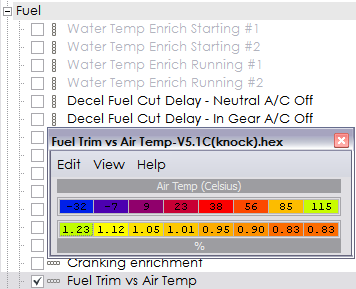
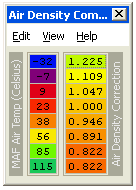
Air Temp Compensation table


This is awfully confusing. Is there anything that would cause the values or algorithims for the Airflow Hz comp table to flip? At the moment I'm using a table similar to what Honki is using(higher values in the two left columns). So far I'm getting a pretty stable AFR's between 70F to 110F (1.03 to.78)MAF temperatures. However the first time I used this table it seemed that lowering the values in the columns on the right caused an extremely lean condition.
Last edited by D-VO; Jan 28, 2009 at 11:23 AM.

Thread Starter

Joined: Apr 2003
Posts: 1,580
Likes: 0
From: Houston, TX
The values in this table are a multiplication factor on IPW. Anything greater than 1 will enrich. Anything less than one will enlean. The left most column of values is for the highest IAT, the rightmost is for the lowest IAT.
BTW, there is no way to accurately convert the horizontal axis to temperature, and its very easy to render the table useless depending on how you did the modification. Did you change the scaling in the xml file?
BTW, there is no way to accurately convert the horizontal axis to temperature, and its very easy to render the table useless depending on how you did the modification. Did you change the scaling in the xml file?
MRFred: I have temperature in the X axis because lr299gst rewrote the x axis scaling for me as you see below. I've done this assuming that air pressure is always 1 bar. I know that is not true but baro change is insignificant compared to temperature change for me. Ideally we would have two separate tables for each but this way made most sense for me and, yes, I agree most people shouldn't just rescale their x axis this way without this understanding.
honki24,
I want it all in pennies in a brown paper bag left on the porch.
Here you go:
You may need to change the endian depending on which version of ECUFlash you're using.
If you use this scaling, maybe rename the X axis in the map to something like 'deg F for air density change at 1atm' or something similar to remind you. Maybe just add the table again with the new changes so you can keep the correct scaling that mrfred gave.
Eric
I want it all in pennies in a brown paper bag left on the porch.
Here you go:
Code:
<scaling name="AirTempBaroFactor1atm" units="F" toexpr="-4.5813*x+335.46" frexpr="(x-335.46)/-4.5813" format="%.0f" min="-40" max="335" inc="1" storagetype="uint16" endian="little"/>
If you use this scaling, maybe rename the X axis in the map to something like 'deg F for air density change at 1atm' or something similar to remind you. Maybe just add the table again with the new changes so you can keep the correct scaling that mrfred gave.
Eric

EvoM Guru
iTrader: (50)
Joined: Mar 2006
Posts: 9,675
Likes: 132
From: Tri-Cities, WA // Portland, OR
I think the thing to keep in mind with the OE values is that there can be several reasons to enrich as the temperature goes up. The stock enrichment based on this table is pretty small anyhow.

honki24, I could be wrong, but this table doesn't compensate for density but it adjusts the fuel delivery based on density to deal with different conditions. Sounds confusing, but I'll explain what I mean and somebody else that knows the ECU can correct my thinking.
The ECU has additional tables to directly compensate for air density. This is seen in jscbanks' thread
When I read that, I read it to mean that there is a table strictly to compensate for changes in density due to air temperature (AIRTEMP, I assume this is the table that was mentioned earlier in this thread by you). There is a second table that compensates for barometric pressure (BARO). Finally, there is a table that adjusts the fuel delivery based on density conditions (TEMPBAROAIRFLOWLKUP).
Now I may be wrong, but it seems like the table you are adjusting is the last table I mentioned. From my understanding, that table is just to adjust the fueling under certain (low load) conditions.
It's not uncommon to lean out the AFR in high density air. This is done because if the ambient air is more dense, it requires less boost to reach the same mass flow rate/LOAD (remember, the factory ECU controls the boost pressure based on LOAD and not actual boost pressure), which means it's cooler and less likely to detonate. Yes, overall, IPW must increase to maintain a given AFR because of the higher air density, but this table seems to be used to change the AFR after the ECU has already compensated for the density.
The ECU has additional tables to directly compensate for air density. This is seen in jscbanks' thread
***snip***
In summary IPW is calculated from:
AFRMAP*AIRTEMP*BARO*MAFSCALING*MAFSMTHG*TEMPBAROAIRFLOWLKUP*INJSCALING*MAFSOURCEMAINxMAFMULTIPWARMUP
(* WARMUP*COOLANT*MAFMULTIPWARMUPxLOADBASEDMULT*O2FEE DBACK)
+ accel1 - accel 2 (still to be fully worked out)
+INJDEADTIMELOOKUP*INJLAGRES
Questions?
In summary IPW is calculated from:
AFRMAP*AIRTEMP*BARO*MAFSCALING*MAFSMTHG*TEMPBAROAIRFLOWLKUP*INJSCALING*MAFSOURCEMAINxMAFMULTIPWARMUP
(* WARMUP*COOLANT*MAFMULTIPWARMUPxLOADBASEDMULT*O2FEE DBACK)
+ accel1 - accel 2 (still to be fully worked out)
+INJDEADTIMELOOKUP*INJLAGRES
Questions?
Now I may be wrong, but it seems like the table you are adjusting is the last table I mentioned. From my understanding, that table is just to adjust the fueling under certain (low load) conditions.
It's not uncommon to lean out the AFR in high density air. This is done because if the ambient air is more dense, it requires less boost to reach the same mass flow rate/LOAD (remember, the factory ECU controls the boost pressure based on LOAD and not actual boost pressure), which means it's cooler and less likely to detonate. Yes, overall, IPW must increase to maintain a given AFR because of the higher air density, but this table seems to be used to change the AFR after the ECU has already compensated for the density.
Last edited by 03whitegsr; Jan 29, 2009 at 03:45 PM.
It's not uncommon to lean out the AFR in high density air. This is done because if the ambient air is more dense, it requires less boost to reach the same mass flow rate/LOAD (remember, the factory ECU controls the boost pressure based on LOAD and not actual boost pressure), which means it's cooler and less likely to detonate. Yes, overall, IPW must increase to maintain a given AFR because of the higher air density, but this table seems to be used to change the AFR after the ECU has already compensated for the density.
Last edited by D-VO; Jan 29, 2009 at 07:23 PM.
I have no idea, I was just putting out a possible idea as to why the factory tuning may potentially lean out the AFR under higher density conditions.
The fact that it's set to unity above 200Hz though to me seems to say that this table is not for WOT tuning and is more likely only meant for driveability tuning.
The fact that it's set to unity above 200Hz though to me seems to say that this table is not for WOT tuning and is more likely only meant for driveability tuning.
EvoM Guru
iTrader: (50)
Joined: Mar 2006
Posts: 9,675
Likes: 132
From: Tri-Cities, WA // Portland, OR
honki24, I could be wrong, but this table doesn't compensate for density but it adjusts the fuel delivery based on density to deal with different conditions. Sounds confusing, but I'll explain what I mean and somebody else that knows the ECU can correct my thinking.
The ECU has additional tables to directly compensate for air density. This is seen in jscbanks' thread
When I read that, I read it to mean that there is a table strictly to compensate for changes in density due to air temperature (AIRTEMP, I assume this is the table that was mentioned earlier in this thread by you). There is a second table that compensates for barometric pressure (BARO). Finally, there is a table that adjusts the fuel delivery based on density conditions (TEMPBAROAIRFLOWLKUP).
...
The ECU has additional tables to directly compensate for air density. This is seen in jscbanks' thread
When I read that, I read it to mean that there is a table strictly to compensate for changes in density due to air temperature (AIRTEMP, I assume this is the table that was mentioned earlier in this thread by you). There is a second table that compensates for barometric pressure (BARO). Finally, there is a table that adjusts the fuel delivery based on density conditions (TEMPBAROAIRFLOWLKUP).
...
https://www.evolutionm.net/forums/ec...ion-table.html
I had previously recommended against adjusting this table as it will also affect the airtemp compensated loads which will complicate the results.
I have no idea, I was just putting out a possible idea as to why the factory tuning may potentially lean out the AFR under higher density conditions.
The fact that it's set to unity above 200Hz though to me seems to say that this table is not for WOT tuning and is more likely only meant for driveability tuning.
The fact that it's set to unity above 200Hz though to me seems to say that this table is not for WOT tuning and is more likely only meant for driveability tuning.
At one point I even tried to change the y axis to account for anything above 200hz, but it was way more difficult to tune than I thought. I've also learned if there are any ranges outside of the x scales (hits .53/180F on the MAF when it not on the table) the ECU does not interpolate the values. It went really lean past that point.
Last edited by D-VO; Jan 29, 2009 at 09:12 PM.

Evolved Member
Joined: May 2006
Posts: 2,399
Likes: 6
From: UK
I'm coming around to the opinion that this airtemp table might be worth changing from its present gas law configuration. Given that the load calc and the IPW calc both use it, if we get the AFR consistent between different temperatures by using it then we are actually making it hit the "correct" load.
The airtemp correction in jcsbanks formula is not the table posted earlier. That is an incorrectly defined table. The airtemp correction in jcsbanks formula is the same one used to calculate airtemp-compensated load and baro+airtemp compensated load. Its in this thread:
https://www.evolutionm.net/forums/ec...ion-table.html
I had previously recommended against adjusting this table as it will also affect the airtemp compensated loads which will complicate the results.
https://www.evolutionm.net/forums/ec...ion-table.html
I had previously recommended against adjusting this table as it will also affect the airtemp compensated loads which will complicate the results.
EvoM Guru
iTrader: (50)
Joined: Mar 2006
Posts: 9,675
Likes: 132
From: Tri-Cities, WA // Portland, OR
I'm coming around to the opinion that this airtemp table might be worth changing from its present gas law configuration. Given that the load calc and the IPW calc both use it, if we get the AFR consistent between different temperatures by using it then we are actually making it hit the "correct" load.
Evolved Member
Joined: May 2006
Posts: 2,399
Likes: 6
From: UK
I think the ideal gas law model it comes with is good in theory, but it is not compensating for reality because of the other factors you mention. The table is being used to correct the load and IPW calculations in a way we understand, I think we should use it to make the AFR behave as we want it to. If we make the AFR less variable with temperature (but still leave in a sensible enrichment), we will also reduce the timing variation with temperature. If we see increasing knock sums in high temperatures we can adjust the timing vs temp table to compensate.
In my equation, the AIRTEMP*BARO compensations are part of the density calculation. The MAFSCALING*MAFSMTHG*TEMPBAROAIRFLOWLKUP are for sorting out the non-linearities of the MAF sensor.
In my equation, the AIRTEMP*BARO compensations are part of the density calculation. The MAFSCALING*MAFSMTHG*TEMPBAROAIRFLOWLKUP are for sorting out the non-linearities of the MAF sensor.
Thread Starter
Joined: Apr 2003
Posts: 1,580
Likes: 0
From: Houston, TX
Okay, I did a bit of logging on the way to work today. I was skeptical that the values in this map are direct IPW multipliers. Here's what I did.:
29F outside this morning
Did several pulls
These 2nd to 3rd pulls show what I've found:
My initial table:

Here is the log:
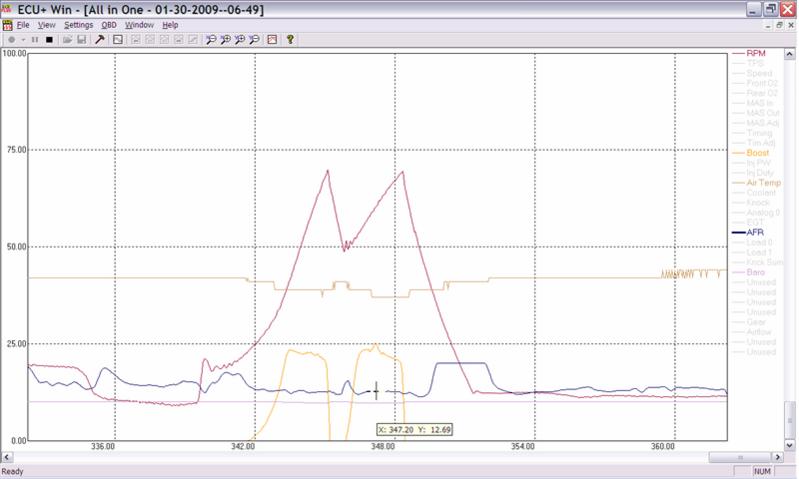
You'll see the AFR here is in the High 12s. (look at the little box by the cursor)
----------------------------------------------------------------------------------------------
Here is the inverted table:
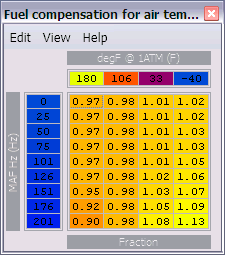
Here is the log:
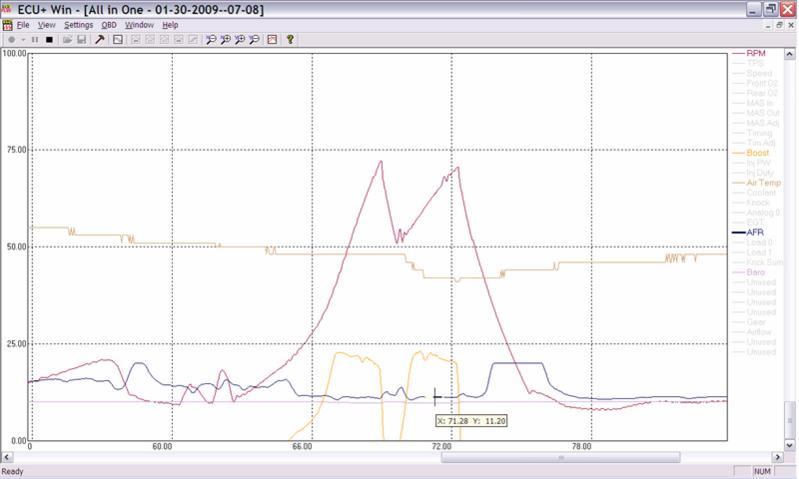
You'll see the AFR here is in the 11s. (look at the little box by the cursor)
In both of these cases temperature and baro are comparable, the only difference is the values in the cells. These values are not IPW multipliers. They do the inverse. Higher numbers decrease fuel and lower numbers increase fuel.
In both of these cases I should have been running "just to the left" of my 33F column. I would estimate that temp and baro would have put me 15% to the left of my 33F column and 85% to the right of my 106F column. So basically you could say that both of these pulls are running pretty much off of the cell at the intersect of 200Hz and 33F. As you see, when this value is higher my AFR is leaner. When it is lower my AFR is richer.
I calculate from these findings roughly:
An increase of .07 on this map made me run 1.4 AFR points leaner.
29F outside this morning
Did several pulls
These 2nd to 3rd pulls show what I've found:
My initial table:
Here is the log:
You'll see the AFR here is in the High 12s. (look at the little box by the cursor)
----------------------------------------------------------------------------------------------
Here is the inverted table:
Here is the log:
You'll see the AFR here is in the 11s. (look at the little box by the cursor)
In both of these cases temperature and baro are comparable, the only difference is the values in the cells. These values are not IPW multipliers. They do the inverse. Higher numbers decrease fuel and lower numbers increase fuel.
In both of these cases I should have been running "just to the left" of my 33F column. I would estimate that temp and baro would have put me 15% to the left of my 33F column and 85% to the right of my 106F column. So basically you could say that both of these pulls are running pretty much off of the cell at the intersect of 200Hz and 33F. As you see, when this value is higher my AFR is leaner. When it is lower my AFR is richer.
I calculate from these findings roughly:
An increase of .07 on this map made me run 1.4 AFR points leaner.
Last edited by honki24; Jan 30, 2009 at 04:56 AM.

The airtemp correction in jcsbanks formula is not the table posted earlier. That is an incorrectly defined table. The airtemp correction in jcsbanks formula is the same one used to calculate airtemp-compensated load and baro+airtemp compensated load. Its in this thread:
https://www.evolutionm.net/forums/ec...ion-table.html
I had previously recommended against adjusting this table as it will also affect the airtemp compensated loads which will complicate the results.
https://www.evolutionm.net/forums/ec...ion-table.html
I had previously recommended against adjusting this table as it will also affect the airtemp compensated loads which will complicate the results.