


Engine Size Comparison


Engine Size Comparison
Getting ready to build a stroker so I started running some numbers on 88mm vs. 94mm vs. 100mm vs 102mm strokes. I wrote a computer program to run through two complete revolutions of the engine cycle calculating piston position, speed, acceleration, load, rod angle, etc. given an rpm, stroke, etc.
All I ever hear around here is how you can't rev stroker motors, which seemed a bit odd coming from a domestic background where 4" (100mm) stroke V8's regularly rev to 8000+ rpms.
Anyway, I picked 8000rpms as the "max" rpm that you'd want to spin the 102mm crank to. On a purely ideal basis, you would need 8680rpms on a 94mm crank and 9272rpms on an 88mm crank to achieve the same airflow.
Here are the results:
102mm @ 8000: max speed: 1777 in/sec, max accel: 4891 g's
94mm @ 8680: max speed: 1763 in/sec, max accel: 5201 g's
88mm @ 9272: max speed: 1753 in/sec, max accel: 5471 g's
I always see postings about max piston speeds but they use the simple calculation that assumes the piston is moving the same speed the whole time. I calculated the speed at thousands of points and picked the absolute max. One thing you don't hear about as much around here, but that I always hear about from engine builders is that the rods and in particular the rods bolts are the most stressed component in the engine. Analyzing the data with that in mind, it seems to suggest that while you do gain a slight reduction in piston speed, you also pick up a huge increase in rod load (as you move to a shorter stroke and higher rpms). Again, this is in order to achieve the same airflow ratings, which would equate to roughly the same power level. To sum it up, the numbers would seem to suggest that the longer stroke actually puts the motor under less stress for a given power level since that power level should be achieved at a lower rpm.
Anyway, just thought I'd throw this out there in case anybody felt like talking about something other than "what cams should I run" Who knew that computers could be used for something cool?
All I ever hear around here is how you can't rev stroker motors, which seemed a bit odd coming from a domestic background where 4" (100mm) stroke V8's regularly rev to 8000+ rpms.
Anyway, I picked 8000rpms as the "max" rpm that you'd want to spin the 102mm crank to. On a purely ideal basis, you would need 8680rpms on a 94mm crank and 9272rpms on an 88mm crank to achieve the same airflow.
Here are the results:
102mm @ 8000: max speed: 1777 in/sec, max accel: 4891 g's
94mm @ 8680: max speed: 1763 in/sec, max accel: 5201 g's
88mm @ 9272: max speed: 1753 in/sec, max accel: 5471 g's
I always see postings about max piston speeds but they use the simple calculation that assumes the piston is moving the same speed the whole time. I calculated the speed at thousands of points and picked the absolute max. One thing you don't hear about as much around here, but that I always hear about from engine builders is that the rods and in particular the rods bolts are the most stressed component in the engine. Analyzing the data with that in mind, it seems to suggest that while you do gain a slight reduction in piston speed, you also pick up a huge increase in rod load (as you move to a shorter stroke and higher rpms). Again, this is in order to achieve the same airflow ratings, which would equate to roughly the same power level. To sum it up, the numbers would seem to suggest that the longer stroke actually puts the motor under less stress for a given power level since that power level should be achieved at a lower rpm.
Anyway, just thought I'd throw this out there in case anybody felt like talking about something other than "what cams should I run"
Who knew that computers could be used for something cool?

Evolving Member
Joined: Mar 2007
Posts: 272
Likes: 0
From: In front of a Catia screen
what sort of rod length dod you use on these calcs?
Getting ready to build a stroker so I started running some numbers on 88mm vs. 94mm vs. 100mm vs 102mm strokes. I wrote a computer program to run through two complete revolutions of the engine cycle calculating piston position, speed, acceleration, load, rod angle, etc. given an rpm, stroke, etc.
All I ever hear around here is how you can't rev stroker motors, which seemed a bit odd coming from a domestic background where 4" (100mm) stroke V8's regularly rev to 8000+ rpms.
Anyway, I picked 8000rpms as the "max" rpm that you'd want to spin the 102mm crank to. On a purely ideal basis, you would need 8680rpms on a 94mm crank and 9272rpms on an 88mm crank to achieve the same airflow.
Here are the results:
102mm @ 8000: max speed: 1777 in/sec, max accel: 4891 g's
94mm @ 8680: max speed: 1763 in/sec, max accel: 5201 g's
88mm @ 9272: max speed: 1753 in/sec, max accel: 5471 g's
I always see postings about max piston speeds but they use the simple calculation that assumes the piston is moving the same speed the whole time. I calculated the speed at thousands of points and picked the absolute max. One thing you don't hear about as much around here, but that I always hear about from engine builders is that the rods and in particular the rods bolts are the most stressed component in the engine. Analyzing the data with that in mind, it seems to suggest that while you do gain a slight reduction in piston speed, you also pick up a huge increase in rod load (as you move to a shorter stroke and higher rpms). Again, this is in order to achieve the same airflow ratings, which would equate to roughly the same power level. To sum it up, the numbers would seem to suggest that the longer stroke actually puts the motor under less stress for a given power level since that power level should be achieved at a lower rpm.
Anyway, just thought I'd throw this out there in case anybody felt like talking about something other than "what cams should I run" Who knew that computers could be used for something cool?
All I ever hear around here is how you can't rev stroker motors, which seemed a bit odd coming from a domestic background where 4" (100mm) stroke V8's regularly rev to 8000+ rpms.
Anyway, I picked 8000rpms as the "max" rpm that you'd want to spin the 102mm crank to. On a purely ideal basis, you would need 8680rpms on a 94mm crank and 9272rpms on an 88mm crank to achieve the same airflow.
Here are the results:
102mm @ 8000: max speed: 1777 in/sec, max accel: 4891 g's
94mm @ 8680: max speed: 1763 in/sec, max accel: 5201 g's
88mm @ 9272: max speed: 1753 in/sec, max accel: 5471 g's
I always see postings about max piston speeds but they use the simple calculation that assumes the piston is moving the same speed the whole time. I calculated the speed at thousands of points and picked the absolute max. One thing you don't hear about as much around here, but that I always hear about from engine builders is that the rods and in particular the rods bolts are the most stressed component in the engine. Analyzing the data with that in mind, it seems to suggest that while you do gain a slight reduction in piston speed, you also pick up a huge increase in rod load (as you move to a shorter stroke and higher rpms). Again, this is in order to achieve the same airflow ratings, which would equate to roughly the same power level. To sum it up, the numbers would seem to suggest that the longer stroke actually puts the motor under less stress for a given power level since that power level should be achieved at a lower rpm.
Anyway, just thought I'd throw this out there in case anybody felt like talking about something other than "what cams should I run"
Who knew that computers could be used for something cool? 
5000 g's seems pretty high to me...
on my back of the envolope calcs, lets say your piston speed is 0 at TDC, and max instantaneous speed 90 deg later. so at 8000rpm thats .0075 sec/rev and .0019 sec for 90 deg or rev. so your going from 0 to about 1800 in/sec in .0019sec which is an acceleration of 947400 in/s^2 converted to ft/s^2 is 78950 ft/s^2, and converted to G's is 2467 G's.... or course the acceleration profile is nonlinear, but rather sinusoidal, that might change things a bit.
at what crank position are you seeing max instantanious piston speed? and where is the max G's seen at?
on my back of the envolope calcs, lets say your piston speed is 0 at TDC, and max instantaneous speed 90 deg later. so at 8000rpm thats .0075 sec/rev and .0019 sec for 90 deg or rev. so your going from 0 to about 1800 in/sec in .0019sec which is an acceleration of 947400 in/s^2 converted to ft/s^2 is 78950 ft/s^2, and converted to G's is 2467 G's.... or course the acceleration profile is nonlinear, but rather sinusoidal, that might change things a bit.
at what crank position are you seeing max instantanious piston speed? and where is the max G's seen at?
max velocity is halfway down in the bore which is also where accel is the minimum (it's at the zero-crossing point where the piston begins to go from accel to decel or vice versa). Max accel is at TDC. BDC is actually less accel (around 2450 g's). The load (in pounds) is calculated with a 1.1kg mass (top of the rod + piston + pin + rings). 3/8" ARP bolts have a clamp load of about 10000lbs per bolt, so the total that I see is 11xxx pounds spread over two bolts which is well within the safety margin of the fastener.
t = time in seconds
pos = piston position in inches (0 = TDC, -4.01 = BDC)
vel = piston speed in inches/sec
accel = piston acceleration in g's
rod_ang = rod angle in degrees
load = load due to accel in lbs
Here are some excerpts from the data log (102mm crank at 8000rpms):
t = time in seconds
pos = piston position in inches (0 = TDC, -4.01 = BDC)
vel = piston speed in inches/sec
accel = piston acceleration in g's
rod_ang = rod angle in degrees
load = load due to accel in lbs
Here are some excerpts from the data log (102mm crank at 8000rpms):
Code:
// max downward velocity on the way from TDC to BDC
t	pos	  vel	     accel      rod_ang	load
0.001396 -1.520305 -1762.904957 -633.256782 18.256047 -1535.640397
0.001417 -1.557123 -1767.243083 -539.332303 18.393236 -1307.874618
0.001438 -1.594015 -1770.830796 -446.038075 18.524726 -1081.637190
0.001458 -1.630967 -1773.673735 -353.444999 18.650465 -857.100049
0.001479 -1.667962 -1775.778101 -261.622834 18.770403 -634.432356
0.001500 -1.704986 -1777.150647 -170.640063 18.884490 -413.800185
0.001521 -1.742024 -1777.798662 -80.563768 18.992681 -195.366208
0.001542 -1.779060 -1777.729967 8.540499 19.094931 20.710612
0.001563 -1.816079 -1776.952892 96.608840 19.191199 234.275324
0.001583 -1.853069 -1775.476271 183.579137 19.281446 445.177292
0.001604 -1.890012 -1773.309420 269.391169 19.365633 653.270479
0.001625 -1.926897 -1770.462124 353.986729 19.443726 858.413737
0.001646 -1.963708 -1766.944618 437.309739 19.515693 1060.471075
0.001667 -2.000433 -1762.767571 519.306355 19.581504 1259.311925
0.001688 -2.037057 -1757.942066 599.925074 19.641131 1454.811389
0.001708 -2.073567 -1752.479581 679.116826 19.694549 1646.850474
0.001729 -2.109950 -1746.391969 756.835069 19.741735 1835.316318

// BDC
t	pos	  vel	     accel      rod_ang	load
0.003458 -3.976136 -281.896776 2436.573947 4.722523 5908.663732
0.003479 -3.981601 -262.326467 2433.055143 4.390563 5900.130673
0.003500 -3.986659 -242.782911 2429.729230 4.057411 5892.065374
0.003521 -3.991310 -223.264468 2426.606992 3.723159 5884.493981
0.003542 -3.995555 -203.769421 2423.698370 3.387899 5877.440607
0.003562 -3.999395 -184.295977 2421.012477 3.051721 5870.927347
0.003583 -4.002829 -164.842280 2418.557601 2.714719 5864.974302
0.003604 -4.005858 -145.406410 2416.341218 2.376983 5859.599597
0.003625 -4.008483 -125.986396 2414.369992 2.038606 5854.819398
0.003646 -4.010703 -106.580218 2412.649791 1.699679 5850.647931
0.003667 -4.012520 -87.185816 2411.185687 1.360293 5847.097494
0.003687 -4.013932 -67.801097 2409.981960 1.020540 5844.178471
0.003708 -4.014941 -48.423938 2409.042109 0.680513 5841.899343
0.003729 -4.015546 -29.052194 2408.368849 0.340302 5840.266695
0.003750 -4.015748 -9.683705 2407.964119 0.000000 5839.285228
0.003771 -4.015546 9.683697 2407.829079 0.340302 5838.957760
0.003792 -4.014941 29.052186 2407.964118 0.680513 5839.285228
0.003812 -4.013932 48.423930 2408.368849 1.020540 5840.266695
0.003833 -4.012520 67.801089 2409.042109 1.360293 5841.899342
0.003854 -4.010703 87.185809 2409.981960 1.699678 5844.178470
0.003875 -4.008483 106.580210 2411.185686 2.038606 5847.097493
0.003896 -4.005858 125.986388 2412.649791 2.376983 5850.647929
0.003917 -4.002829 145.406402 2414.369991 2.714719 5854.819396
0.003937 -3.999395 164.842272 2416.341217 3.051721 5859.599595
0.003958 -3.995555 184.295969 2418.557601 3.387899 5864.974300
0.003979 -3.991310 203.769413 2421.012476 3.723159 5870.927345
0.004000 -3.986659 223.264460 2423.698369 4.057411 5877.440605

// max upward velocity on the way from BDC to TDC
t	pos	  vel	     accel      rod_ang	load
0.005792 -2.073567 1746.391967 833.035904 19.694549 2020.102463
0.005813 -2.037057 1752.479579 756.835101 19.641131 1835.316395
0.005833 -2.000433 1757.942064 679.116858 19.581504 1646.850553
0.005854 -1.963708 1762.767569 599.925107 19.515693 1454.811469
0.005875 -1.926897 1766.944616 519.306389 19.443726 1259.312006
0.005896 -1.890013 1770.462122 437.309773 19.365633 1060.471157
0.005917 -1.853069 1773.309419 353.986763 19.281446 858.413820
0.005938 -1.816079 1775.476271 269.391204 19.191199 653.270564
0.005958 -1.779060 1776.952892 183.579173 19.094931 445.177378
0.005979 -1.742024 1777.729967 96.608876 18.992681 234.275412
0.006000 -1.704986 1777.798663 8.540536 18.884490 20.710700
0.006021 -1.667962 1777.150647 -80.563731 18.770403 -195.366119
0.006042 -1.630967 1775.778102 -170.640025 18.650465 -413.800095
0.006063 -1.594015 1773.673736 -261.622796 18.524726 -634.432265
0.006083 -1.557123 1770.830797 -353.444961 18.393236 -857.099957
0.006104 -1.520305 1767.243085 -446.038037 18.256047 -1081.637097
0.006125 -1.483578 1762.904959 -539.332265 18.113213 -1307.874525
0.006146 -1.446957 1757.811351 -633.256743 17.964792 -1535.640303
0.006167 -1.410458 1751.957769 -727.739555 17.810841 -1764.760031
0.006188 -1.374097 1745.340308 -822.707896 17.651421 -1995.057164
0.006208 -1.337889 1737.955654 -918.088207 17.486593 -2226.353317


// TDC
t	pos	  vel	     accel      rod_ang	load
0.007313 -0.033087 370.954317 -4767.799843 3.051722 -11561.859656
0.007333 -0.026162 332.415581 -4791.282178 2.714719 -11618.804046
0.007354 -0.020043 293.707548 -4812.329833 2.376983 -11669.844369
0.007375 -0.014734 254.849900 -4830.930407 2.038606 -11714.950546
0.007396 -0.010236 215.862410 -4847.072968 1.699679 -11754.096069
0.007417 -0.006554 176.764924 -4860.748050 1.360293 -11787.257987
0.007438 -0.003688 137.577354 -4871.947653 1.020541 -11814.416895
0.007458 -0.001639 98.319664 -4880.665235 0.680513 -11835.556930
0.007479 -0.000410 59.011859 -4886.895709 0.340302 -11850.665759
0.007500 0.000000 19.673973 -4890.635446 0.000000 -11859.734578
0.007521 -0.000410 -19.673941 -4891.882268 0.340302 -11862.758106
0.007542 -0.001639 -59.011827 -4890.635448 0.680513 -11859.734583
0.007563 -0.003688 -98.319632 -4886.895714 1.020540 -11850.665769
0.007583 -0.006554 -137.577322 -4880.665241 1.360293 -11835.556945
0.007604 -0.010236 -176.764892 -4871.947662 1.699678 -11814.416915
0.007625 -0.014734 -215.862378 -4860.748061 2.038606 -11787.258012
0.007646 -0.020043 -254.849868 -4847.072980 2.376983 -11754.096099
0.007667 -0.026162 -293.707516 -4830.930421 2.714719 -11714.950581
0.007688 -0.033087 -332.415549 -4812.329850 3.051721 -11669.844408
0.007708 -0.040815 -370.954286 -4791.282196 3.387899 -11618.804091
Last edited by 2JZfan; Jul 19, 2007 at 08:10 AM.
it makes sense that the accel at the top is quite a bit higher then at the bottom. the angle of the rod as it goes to zero (or whatever the cylinder offset is) where the crank position is at zero, adds to the velocity of the piston, while at the bottom the rod angle change decreases the piston velocity relative to crank.
i would have never guessed it was double the acceleration though. the shorter the rod, the more an effect that will have.
i'm going to throw together a quick sim in matlab and see if i generate similar results.
i would have never guessed it was double the acceleration though. the shorter the rod, the more an effect that will have.
i'm going to throw together a quick sim in matlab and see if i generate similar results.
Trending Topics

 i got identical results.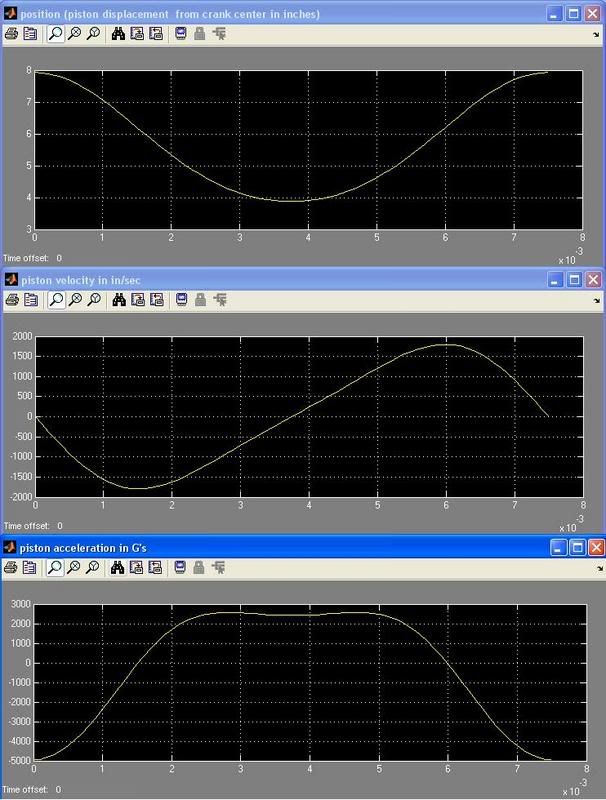

88mm stroke @ 9272rpm = 1753 in/sec, 5467 G's
94mm stroke @ 8680rpm = 1763 in/sec, 5197 G's
102mm stroke @ 8000rpm = 1778 in/sec, 4888 G's
so yeah, i got what you got for all 3 cases.
94mm stroke @ 8680rpm = 1763 in/sec, 5197 G's
102mm stroke @ 8000rpm = 1778 in/sec, 4888 G's
so yeah, i got what you got for all 3 cases.

Thread
Thread Starter
Forum
Replies
Last Post
R/TErnie
Evo Engine / Turbo / Drivetrain
80
Jan 7, 2021 02:46 PM
STi*guy.kiev
Evo Engine / Turbo / Drivetrain
16
Jul 14, 2013 09:13 PM