


SD - first test success


If you're hitting 380 load with only 17 PSI (217kPa) (do you really mean only 17 PSI as whilst the big turbos are efficient it doesn't sound right to me) then you'll need a wildly different VE table to the stock turbo guys, so the MAF based log of mixed driving including full throttle, cruise, idle, will be essential to setup your VE.

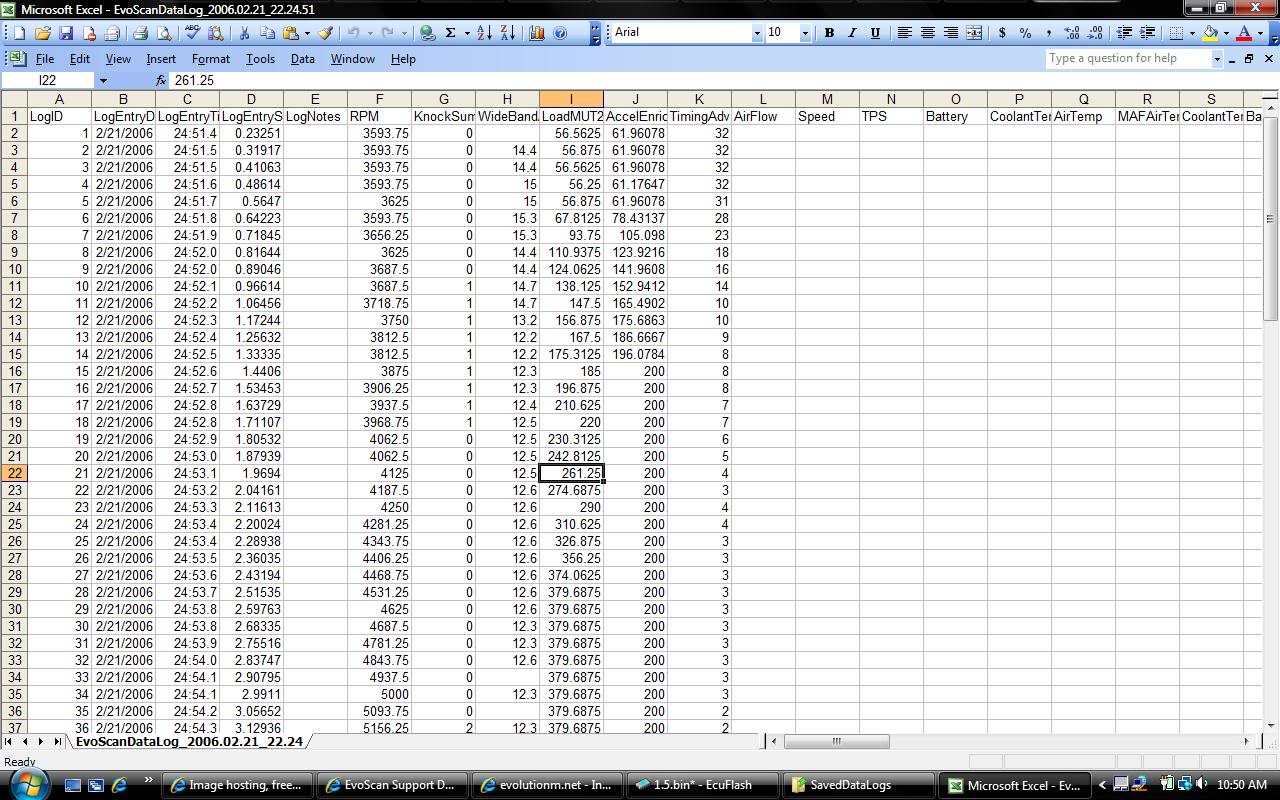
Here is a pic of a MAF log at 17 psi


Thread Starter
Evolved Member
Joined: May 2006
Posts: 2,399
Likes: 6
From: UK
So how do you tune it when you run more than 17 PSI? Doesn't it just go lean as it is? Have you got the airflow meter mounted near a bend or in a small pipe? I thought Mellon was running more like double that boost to hit 380 load with a pretty big turbo. What do your injector size and fuel map look like?
Anyway, it doesn't matter terribly, you just need to emulate what load you have on the MAF using your VE tables. However, if it was mine I would probably still set it to be 1:1 load:MAP on full midrange boost and then map the rest to suit. So then to have 380 load you would have 380kPa or 40.6 PSI. You can choose how you want to do it, but it is clear why you're running lean given the very high loads you hit with low MAP values.
Forgot to mention, if this is not a 2.0 that is another reason why the load and the MAP are so far apart. You're in uncharted territory, it can still be made to work, just needs some planning and thought.
Anyway, it doesn't matter terribly, you just need to emulate what load you have on the MAF using your VE tables. However, if it was mine I would probably still set it to be 1:1 load:MAP on full midrange boost and then map the rest to suit. So then to have 380 load you would have 380kPa or 40.6 PSI. You can choose how you want to do it, but it is clear why you're running lean given the very high loads you hit with low MAP values.
Forgot to mention, if this is not a 2.0 that is another reason why the load and the MAP are so far apart. You're in uncharted territory, it can still be made to work, just needs some planning and thought.
Last edited by jcsbanks; Feb 26, 2009 at 10:46 AM.

In EvoScan, I see a few different loads. JCSBanks, which load do I need to log for Baro correction?
Airflow/Rev = MUT 1D
Load 1 Byte = MUT 41 (Tephra V5.10 Load)
Load Calculated = MUT 29
Load11Bit4 = MUT 1F
ECULoad = 1C
Load MUT 2Byte Mod = MUT 00
Also, is the load we need to be using a 2-Byte load? If so, what do I need to change in logworks to log this?
Also, this makes me wonder how much baro is going to impact this patch. I can be over 9000' in 15 minutes so it's kind of a problem for me if it's going to be an issue.
Airflow/Rev = MUT 1D
Load 1 Byte = MUT 41 (Tephra V5.10 Load)
Load Calculated = MUT 29
Load11Bit4 = MUT 1F
ECULoad = 1C
Load MUT 2Byte Mod = MUT 00
Also, is the load we need to be using a 2-Byte load? If so, what do I need to change in logworks to log this?
Also, this makes me wonder how much baro is going to impact this patch. I can be over 9000' in 15 minutes so it's kind of a problem for me if it's going to be an issue.
Thread Starter
Evolved Member
Joined: May 2006
Posts: 2,399
Likes: 6
From: UK
Use the Load MUT 2 byte but change the address to the baro compensated load in your MUT table (I don't have this address for your ECU, but there have been other threads on it by Tephra and mrfred. On mine, IIRC, it is 4 bytes further on than the old 2 byte load we all used to log.
Baro affects your MAF sensor much more than I think it will affect speed density, but I guess you'll probably be the first to test to see what it is like in real life. If a problem arises, you could mount a baro sensor in the engine bay (out of the inlet tract), wire it into the old input and we could rewrite to account for it. I hope that isn't necessary.
Baro affects your MAF sensor much more than I think it will affect speed density, but I guess you'll probably be the first to test to see what it is like in real life. If a problem arises, you could mount a baro sensor in the engine bay (out of the inlet tract), wire it into the old input and we could rewrite to account for it. I hope that isn't necessary.
Thread Starter
Evolved Member
Joined: May 2006
Posts: 2,399
Likes: 6
From: UK
 )
)
I don't know what tephra is using for his 1 byte load, so probably best to use a 2 byte load on request 00 and 01, but use a baro compensated version if you feel it is necessary. I didn't, but most of the population of Scotland doesn't live/drive at anything like the altitude that some of you guys do, and it simply isn't an isssue here. (I can't believe I'm suggesting Scotland is flat )
)So how do you tune it when you run more than 17 PSI? Doesn't it just go lean as it is? Have you got the airflow meter mounted near a bend or in a small pipe? I thought Mellon was running more like double that boost to hit 380 load with a pretty big turbo. What do your injector size and fuel map look like?
Anyway, it doesn't matter terribly, you just need to emulate what load you have on the MAF using your VE tables. However, if it was mine I would probably still set it to be 1:1 load:MAP on full midrange boost and then map the rest to suit. So then to have 380 load you would have 380kPa or 40.6 PSI. You can choose how you want to do it, but it is clear why you're running lean given the very high loads you hit with low MAP values.
Forgot to mention, if this is not a 2.0 that is another reason why the load and the MAP are so far apart. You're in uncharted territory, it can still be made to work, just needs some planning and thought.
Anyway, it doesn't matter terribly, you just need to emulate what load you have on the MAF using your VE tables. However, if it was mine I would probably still set it to be 1:1 load:MAP on full midrange boost and then map the rest to suit. So then to have 380 load you would have 380kPa or 40.6 PSI. You can choose how you want to do it, but it is clear why you're running lean given the very high loads you hit with low MAP values.
Forgot to mention, if this is not a 2.0 that is another reason why the load and the MAP are so far apart. You're in uncharted territory, it can still be made to work, just needs some planning and thought.
Sorry MR Turco for the steal...

It goes richer at 380 load with the MAF. I have 1000cc injectors. I am running a 18in metal pipe that is s shaped like the stock one.
I have switched it to KPA/MAP. I will go do three logs with the MAF in; Idle, cruise, and wot. Then post a zip to my Rom, and logs for you to view.
I hope I can get a relitive tune done so we can help others with big turbo setups. I belive some of the EMS's will be dropped for the oem once we get this working correctly.
Thank you!
Evan Smith
Thread Starter
Evolved Member
Joined: May 2006
Posts: 2,399
Likes: 6
From: UK
We/you need to decide whether to emulate your MAF arrangement then, which clips/saturates, which obviously isn't ideal, or whether you want to redo your fuel/timing/injector size to suit a new arrangement that is 1:1 for load:MAP at midrange WOT.
I would go for the latter, probably turn lean spool off completely, and fill my fuel map with the actual AFRs I wanted to hit, adjusting the injector size to make it hit that midrange WOT AFR with 100% VE in the tables. Then adjust the RPM VE to get the top end AFR correct. Adjust the MAP & RPM VE to get idle and cruise trims good, and then get your ignition map back on track.
How do you want to play?
I would go for the latter, probably turn lean spool off completely, and fill my fuel map with the actual AFRs I wanted to hit, adjusting the injector size to make it hit that midrange WOT AFR with 100% VE in the tables. Then adjust the RPM VE to get the top end AFR correct. Adjust the MAP & RPM VE to get idle and cruise trims good, and then get your ignition map back on track.
How do you want to play?

Evolved Member
Joined: Aug 2007
Posts: 569
Likes: 1
From: UK
John.
Not sure if you spotted my post or not.
Just wondering if you could comment.
https://www.evolutionm.net/forums/6742541-post435.html
Not sure if you spotted my post or not.
Just wondering if you could comment.
https://www.evolutionm.net/forums/6742541-post435.html
Thread Starter
Evolved Member
Joined: May 2006
Posts: 2,399
Likes: 6
From: UK
Yes, baro is deactivated the way it has been implemented so far. This is because we already know the pressure of the air entering the engine from the MAP sensor, and since we also know the volume of air being ingested (from our RPM and MAP VE tables) and also the temperature, we know the air mass. The only fly in the ointment from your point of view re altitude is that the compressor and turbine efficiency drop for the same MAP when your atmospheric pressure is lower. This results in lower VE which we are not modelling, so you'll get a richening and retarding. Probably no bad thing since you'll be working the turbo much harder. I think the effect is likely to be small at lower engine loads since the efficiency curves are much flatter until you push the turbo to the edge of its efficiency.
The stock MAF measures the volume of air entering the turbo, using the baro and temperature sensors to convert to air mass. Without a baro sensor in the MAF you would have nearly 10% error just from going to WOT and high revs on a stock airbox. The odd thing is that the baro sensor isn't really measuring baro, but the pressure of air at the MAF, and this is a completely different thing at high revs when there is great suction in the turbo inlet pipe.
So I'm hoping we don't need baro compensation with the SD conversion because we have a MAP sensor which knows the pressure of the air already in the inlet manifold. The only thing we don't account for is the drop in VE due to spinning the turbo faster for the same MAP at altitude.
All my comments about altitude are theoretical, nearly all my tuning experience is in the UK. I know the theory and how various systems do it, but there may be snags with the practicalities, that is what I hope you can reveal!
It sounds like the stock altitude mapping may be a bit suspect anyway, do you presently notice changes in AFR between altitudes?
The stock MAF measures the volume of air entering the turbo, using the baro and temperature sensors to convert to air mass. Without a baro sensor in the MAF you would have nearly 10% error just from going to WOT and high revs on a stock airbox. The odd thing is that the baro sensor isn't really measuring baro, but the pressure of air at the MAF, and this is a completely different thing at high revs when there is great suction in the turbo inlet pipe.
So I'm hoping we don't need baro compensation with the SD conversion because we have a MAP sensor which knows the pressure of the air already in the inlet manifold. The only thing we don't account for is the drop in VE due to spinning the turbo faster for the same MAP at altitude.
All my comments about altitude are theoretical, nearly all my tuning experience is in the UK. I know the theory and how various systems do it, but there may be snags with the practicalities, that is what I hope you can reveal!
It sounds like the stock altitude mapping may be a bit suspect anyway, do you presently notice changes in AFR between altitudes?
Thread Starter
Evolved Member
Joined: May 2006
Posts: 2,399
Likes: 6
From: UK
John.
I put my car back onto the maf sensor last week, as I couldn't sort out that "popping issue" and I also had to change my injectors as someone bought the ones I was using lol.
Anyway tomorrow I have a 400 mile round trip to do (swapping clutch finally and getting a new gearbox ).
).
If I do a single log (as in all the way there) which will cover all types of driving (no doubt), should that be good enough for you to beable to sus out the correct settings for my car ?
I messed about with different logs and settings for about 4 days or so, and in the end I made it worse than you did with 3 crap logs I sent lol.
I put my car back onto the maf sensor last week, as I couldn't sort out that "popping issue" and I also had to change my injectors as someone bought the ones I was using lol.
Anyway tomorrow I have a 400 mile round trip to do (swapping clutch finally and getting a new gearbox
).If I do a single log (as in all the way there) which will cover all types of driving (no doubt), should that be good enough for you to beable to sus out the correct settings for my car ?
I messed about with different logs and settings for about 4 days or so, and in the end I made it worse than you did with 3 crap logs I sent lol.
Evolved Member
Joined: Aug 2007
Posts: 569
Likes: 1
From: UK
You need to minimise the STFT at steady state in the idle and various cruise areas. If you have issues it will come down to errors in AFR which are revealed with throttle transients which can't be corrected quickly enough by the closed loop system to avoid a likely lean misfire. If you can isolate a section of log where you are having the issue you should be able to see whether it is too lean and then fix the VE, but at this stage a huge log of mixed driving without the faulty bits pointed out might not be so useful. Might be easier to tune it for you in person, but I think you're across the Irish sea?
You are correct, in saying that it was going lean at the point it was doing it.
But it was split second stuff.
I actually managed to fix it on the 4000-5000rpm area, however in doing this, it started doing it in the 2000-3000rpm area and also messed up the idle.
Thats why I went back to maf, as I prooved to myself that I didn't understand what I was doing


