


Forced Performance Evo Red Turbo data


If the runner diameter is too small, then you should make them larger, but also shorter to keep the volume as low as possible. Runner length is usually determined by matching all other runners to the longest runner. The longest runner is determined by whichever cylinder is farthest from the necessary turbo location.
And what does the larger cold side have to do with anything? Exhaust flow is almost entirely determined by the hot side design. A more efficient compressor wheel can alleviate some back pressure (as we saw when the HTA35r was first released, but it is peanuts compared to designing a more efficient turbine wheel or selecting the proper turbine a/r.

Added runner volume is NEVER good on a turbocharged car. never ever. never.
If the runner diameter is too small, then you should make them larger, but also shorter to keep the volume as low as possible. Runner length is usually determined by matching all other runners to the longest runner. The longest runner is determined by whichever cylinder is farthest from the necessary turbo location.
And what does the larger cold side have to do with anything? Exhaust flow is almost entirely determined by the hot side design. A more efficient compressor wheel can alleviate some back pressure (as we saw when the HTA35r was first released, but it is peanuts compared to designing a more efficient turbine wheel or selecting the proper turbine a/r.
If the runner diameter is too small, then you should make them larger, but also shorter to keep the volume as low as possible. Runner length is usually determined by matching all other runners to the longest runner. The longest runner is determined by whichever cylinder is farthest from the necessary turbo location.
And what does the larger cold side have to do with anything? Exhaust flow is almost entirely determined by the hot side design. A more efficient compressor wheel can alleviate some back pressure (as we saw when the HTA35r was first released, but it is peanuts compared to designing a more efficient turbine wheel or selecting the proper turbine a/r.
Glad to see that you are back to your senses.
I'm not here to go off topic or spread a wealth of information. I merely asked the op what his thoughts were on a tubular manni vs. the ported stocker for this turbo application. i have my own reasoning and DB has been quoted in saying that there are increased hp results from tubular manni designs..
From Full-race;;
http://www.full-race.com/articles/Bs...st_writeup.pdf
Glad to see that you are back to your senses.
I'm not here to go off topic or spread a wealth of information. I merely asked the op what his thoughts were on a tubular manni vs. the ported stocker for this turbo application. i have my own reasoning and DB has been quoted in saying that there are increased hp results from tubular manni designs..
From Full-race;;
http://www.full-race.com/articles/Bs...st_writeup.pdf
I'm not here to go off topic or spread a wealth of information. I merely asked the op what his thoughts were on a tubular manni vs. the ported stocker for this turbo application. i have my own reasoning and DB has been quoted in saying that there are increased hp results from tubular manni designs..
From Full-race;;
http://www.full-race.com/articles/Bs...st_writeup.pdf
If that's the case, why port the stocker? Surely removing material not only directs air more freely in the exhaust flow, but anytime you remove material you INCREASE the capacity ie volume.
It's ok if we agree to disagree. Thank you for being more civil.
As for the cold-side. The increased lbs/minute benefit of the larger wheel may or may not benefit from the change in ve. It all depends on where the restrictions are. I think it was 9sec9 that suggested porting the turbine section first and foremost. I would guess that continuing with this train of thought would be to attack the items before the turbine as well. Since we know that this is a 'no-nonsense' BR car, with intake manni,tb, headwork already modified it may be the exhaust manni could help flatten out the boost curve.
Just my .02.
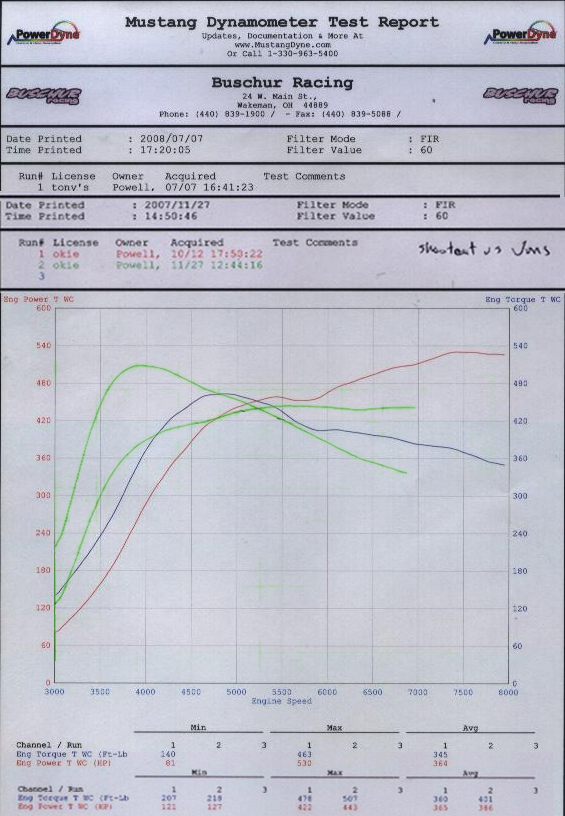
By the way, I took OKIX's old dyno sheet with the Green, and his new dyno sheet with the red and did an overlay. It's not perfect, but it's close.
Please keep in mind that his car has improved since the Red has been installed and this is not their best dyno run on the Green either. It's merely for the sake of a VERY ROUGH comparison.
These are two very different turbos for very different purposes. If you have to ask which is which, you shouldn't be attempting to pick a turbo on your own anyway.
Please keep in mind that his car has improved since the Red has been installed and this is not their best dyno run on the Green either. It's merely for the sake of a VERY ROUGH comparison.
These are two very different turbos for very different purposes. If you have to ask which is which, you shouldn't be attempting to pick a turbo on your own anyway.

Evolving Member
Joined: Jun 2005
Posts: 259
Likes: 0
From: McKinney TX

When you "port" the stocker, you are really "port-matching" the stocker, not hogging it out. The misaligned ports on the inlet and outlet of the stocker cause turbulence which restricts flow. All porting does is create a smooth transition from the head to the mani and from the mani to the turbine so the air can flow more easily. Believe me, this is done by removing as little material as possible.
It is not hot air because he didn't try to hold 38psi all the way to redline.
And as I mentioned before in other threads, turbo rpm has it's limits as well. In OKIX's thread, DB said they were keeping an eye on the turbo's rpm so as not to over-rev it.
And as I mentioned before in other threads, turbo rpm has it's limits as well. In OKIX's thread, DB said they were keeping an eye on the turbo's rpm so as not to over-rev it.

Evolving Member
Joined: Jun 2005
Posts: 259
Likes: 0
From: McKinney TX
Its shows just how good those IC cores are. Turbo don't care what the IAT's are, but it sure cares what the Delta T across the compressor is. Once you start crossing the RPM lines on the right side of the map and Delta T's and exh pressures skyrocket you lose power. By monitoring your turbo shaft RPM you can see when it happens and prevent it from happening. See the White thread for a perfect example of that data.


Last edited by GrocMax; Jul 9, 2008 at 10:44 AM.

Evolving Member
Joined: Jul 2003
Posts: 148
Likes: 0
From: NE Ohio
Its shows just how good those IC cores are. Turbo don't care what the IAT's are, but it sure cares what the Delta T across the compressor is. Once you start crossing the RPM lines on the right side of the map and Delta T's and exh pressures skyrocket you lose power. By monitoring your turbo shaft RPM you can see when it happens and prevent it from happening. See the White thread for a perfect example of that data.

I was under the impression that DB uses manual boost controllers. I must have missed the post that stated this car was tuned with electronic boost control.
I believe that they kept an eye on turbo rpm on spool-up and limited the peak to 38 or so psi. in order to not over-rev. Was the 12psi drop over the next 3k rpm done intentionally?