


The "Official" Evo Modding for Dummies




I guess he could be asking what a "built" transmission means?
Built Tranmission:
Well unfortunately the word is a bit misleading as a built transmission can mean many things. Most commonly it seems to refer to a transmission totally taken apart then fitted with all new synchro, shifting sleeves, seals, roll pins, and possibly bearings. Generally this means the internals have been "built" with better quality parts that ensure better shifting and less breakage.
Other things that can be done to the transmission besides the usual rebuild are options like changing the gear ratios, final drive, REM the gear set and sliders for smoother operation, and double synchro's.
Transfer Case:
The transfer case is the powered link to your rear differential, it also houses an important piece of equipment called a differential as seen in the reference picture below with a stock diff. The differential serves to split torque between the input and output and can be upgraded to better handle more demanding situations. Like the transmission you could upgrade the gearing in it with a simple REM process and beef up the hosing by adding better containment hardware preventing side deflection.

Dog Boxes:
A dog box is can come in two forms helical gears or spur. A dog box simply means it has NO synchro's. The dog box gets it's name from the engagement teeth which are called dog teeth. See reference picture below. To successfully engage a different gear in the dog box you want to slam the gear lever as quickly as possible into the next gear, typically using the clutch isn't even necessary. This makes the gear change very fast which is superior for racing applications but horrible for a commute. Another advantage to the dog box is due to its lack of synchro's you can use that space to make bigger gears which will be stronger.
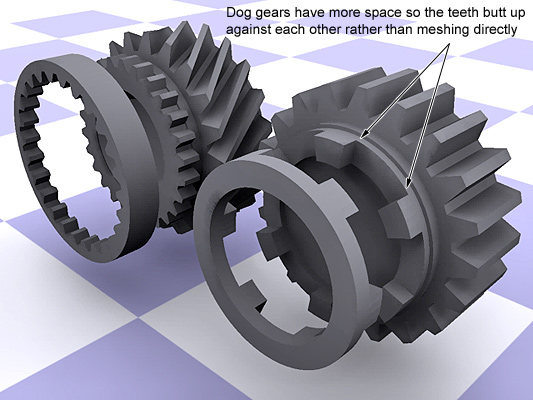
The Gears:
The helical gears (left) are quiet which is one of the main reasons manufactures choose a helical gear over spur (right). The helical set also has a constant patch of gear meshing with another gear making them ironically more resilient to stress. The main down fall is the side loading of the helical gear vs. a spur type. The helical gear is cut at an angle so when force is applied it goes parallel to that angle against the bearing sometimes causing premature wear. A spur gear is already parallel to the bearing so the side load is non existent, so in this sense the spur type is superior.

Built Tranmission:
Well unfortunately the word is a bit misleading as a built transmission can mean many things. Most commonly it seems to refer to a transmission totally taken apart then fitted with all new synchro, shifting sleeves, seals, roll pins, and possibly bearings. Generally this means the internals have been "built" with better quality parts that ensure better shifting and less breakage.
Other things that can be done to the transmission besides the usual rebuild are options like changing the gear ratios, final drive, REM the gear set and sliders for smoother operation, and double synchro's.
Transfer Case:
The transfer case is the powered link to your rear differential, it also houses an important piece of equipment called a differential as seen in the reference picture below with a stock diff. The differential serves to split torque between the input and output and can be upgraded to better handle more demanding situations. Like the transmission you could upgrade the gearing in it with a simple REM process and beef up the hosing by adding better containment hardware preventing side deflection.
Dog Boxes:
A dog box is can come in two forms helical gears or spur. A dog box simply means it has NO synchro's. The dog box gets it's name from the engagement teeth which are called dog teeth. See reference picture below. To successfully engage a different gear in the dog box you want to slam the gear lever as quickly as possible into the next gear, typically using the clutch isn't even necessary. This makes the gear change very fast which is superior for racing applications but horrible for a commute. Another advantage to the dog box is due to its lack of synchro's you can use that space to make bigger gears which will be stronger.
The Gears:
The helical gears (left) are quiet which is one of the main reasons manufactures choose a helical gear over spur (right). The helical set also has a constant patch of gear meshing with another gear making them ironically more resilient to stress. The main down fall is the side loading of the helical gear vs. a spur type. The helical gear is cut at an angle so when force is applied it goes parallel to that angle against the bearing sometimes causing premature wear. A spur gear is already parallel to the bearing so the side load is non existent, so in this sense the spur type is superior.


Or, he might have been inquiring "at what point do I need to worry about breaking/beefing up the transmission"?
I don't have a comprehensive or informed answer to that, although my general understanding is that while any idiot can blow up any transmission at any power level (even OEM), you shouldn't have to worry about damaging your Evo's transmission until around 400 whp/tq.
You can start snapping axles before you exceed 400 whp/tq though, if you're running drag slicks and launching really hard with a clutch that isn't designed to absorb any shock - i.e., a clutch utilizing a pucked disc (less pucks = more "off/on" engagement) and lacking a sprung hub and/or marcel springs.
Here are some links from Jack's Transmission (an import/DSM performance tranny shop here in Colorado).
This page shows how they beef up Evo trannies with their "Super Taper" bearing upgrade, among a bunch of other changes/improvements:
http://www.jackstransmissions.com/pr...1bb3d13e1ae66b
And here are some Mitsubishi TSBs on trannies:
http://www.jackstransmissions.com/ev...ssion_tsbs.php
If you look at the left sidebar of their website, there's a whole section of Evo-specific articles about our transmissions under "Articles - EVO".
Hope that helps somewhat.
I don't have a comprehensive or informed answer to that, although my general understanding is that while any idiot can blow up any transmission at any power level (even OEM), you shouldn't have to worry about damaging your Evo's transmission until around 400 whp/tq.
You can start snapping axles before you exceed 400 whp/tq though, if you're running drag slicks and launching really hard with a clutch that isn't designed to absorb any shock - i.e., a clutch utilizing a pucked disc (less pucks = more "off/on" engagement) and lacking a sprung hub and/or marcel springs.
Here are some links from Jack's Transmission (an import/DSM performance tranny shop here in Colorado).
This page shows how they beef up Evo trannies with their "Super Taper" bearing upgrade, among a bunch of other changes/improvements:
http://www.jackstransmissions.com/pr...1bb3d13e1ae66b
And here are some Mitsubishi TSBs on trannies:
http://www.jackstransmissions.com/ev...ssion_tsbs.php
If you look at the left sidebar of their website, there's a whole section of Evo-specific articles about our transmissions under "Articles - EVO".
Hope that helps somewhat.


For the installl go here:
https://www.evolutionm.net/forums/ev...ual-links.html
or here:
http://evomoto.com/tech_info.php?tPa...5b5edeec4fc906
If you want opinions on what clutch is the "best" you better just search around. Everyone has an opinion why twin disk A is better than 6 puck B..
Clutch Types
Single organic:
Its a disk almost always sprung with an organic/carbon friction material in it usually with some kind of binding fibers pressed into it. Most people call these "street" clutches but it really just means easy to drive and low torque holding.
Racing Clutches (with pucks):
What is a puck? Well it looks like a brake pad stuck to a metal plate mostly made with something like a ceramic composite. It grabs HARD and does not have a real friendly slip pressure like an organic clutch. To compensate for this revving the engine a little more before slipping engagement seems to help with the take off. These kind of clutches hold lots of power and can come in sprung or unsprung.
Multi-disk:
So what do you do when you run out of surface area for friction on a clutch? Well you make more surface area by stacking clutches on top of themselves. Thus the really crude idea behind a multi disk clutch is that simple.
Sprung:
Means simply you have a set of big springs connecting the friction plate to the shaft. Its supposed to prevent the shaft splines from being damaged on hard launches but honestly all its seemed to do for me is create clutch chatter on take off..
Unsprung:
In evo aftermarket clutches it seems to prevent take off chatter having a solid clutch. Of course you run the risk of spline damage instead.
Pressure Plates:
Pedal pressure bothering you? Perhaps your clutch manufacturer thought instead of making the friction material better they'd just slap another 1000lbs of force on the clutch instead. Unless you like light switch like feel try to avoid extreme pressure plates and go for something more sensible.
Flywheels:
Lighter flywheel means you will probably have to gas it on take off or risk a stall. Rev matching is somewhat easier since the engine will spin more freely.
Braided line:
Did I feel the difference? Well... no but it looks cool!
https://www.evolutionm.net/forums/ev...ual-links.html
or here:
http://evomoto.com/tech_info.php?tPa...5b5edeec4fc906
If you want opinions on what clutch is the "best" you better just search around. Everyone has an opinion why twin disk A is better than 6 puck B..
Clutch Types
Single organic:
Its a disk almost always sprung with an organic/carbon friction material in it usually with some kind of binding fibers pressed into it. Most people call these "street" clutches but it really just means easy to drive and low torque holding.
Racing Clutches (with pucks):
What is a puck? Well it looks like a brake pad stuck to a metal plate mostly made with something like a ceramic composite. It grabs HARD and does not have a real friendly slip pressure like an organic clutch. To compensate for this revving the engine a little more before slipping engagement seems to help with the take off. These kind of clutches hold lots of power and can come in sprung or unsprung.
Multi-disk:
So what do you do when you run out of surface area for friction on a clutch? Well you make more surface area by stacking clutches on top of themselves. Thus the really crude idea behind a multi disk clutch is that simple.
Sprung:
Means simply you have a set of big springs connecting the friction plate to the shaft. Its supposed to prevent the shaft splines from being damaged on hard launches but honestly all its seemed to do for me is create clutch chatter on take off..
Unsprung:
In evo aftermarket clutches it seems to prevent take off chatter having a solid clutch. Of course you run the risk of spline damage instead.
Pressure Plates:
Pedal pressure bothering you? Perhaps your clutch manufacturer thought instead of making the friction material better they'd just slap another 1000lbs of force on the clutch instead. Unless you like light switch like feel try to avoid extreme pressure plates and go for something more sensible.
Flywheels:
Lighter flywheel means you will probably have to gas it on take off or risk a stall. Rev matching is somewhat easier since the engine will spin more freely.
Braided line:
Did I feel the difference? Well... no but it looks cool!


noob moment here...
i have an AEM uego wideband and want a boost gauge also.. which boost gauge would you guys recommend and how about a gauge pod? and where to buy?? thanks!
i have an AEM uego wideband and want a boost gauge also.. which boost gauge would you guys recommend and how about a gauge pod? and where to buy?? thanks!


