


Isn't That Lean?


Here is something that some might find interesting. I did two logs today. One on a flat on ramp and the other on a decline on ramp. The afr logged on the decline ramp was a bit leaner than the one done on the flat surface. From now on I will try to do all of my logs on a flat on ramp. These are not easy to find, but they are around. Here are the tables:
Flat on ramp
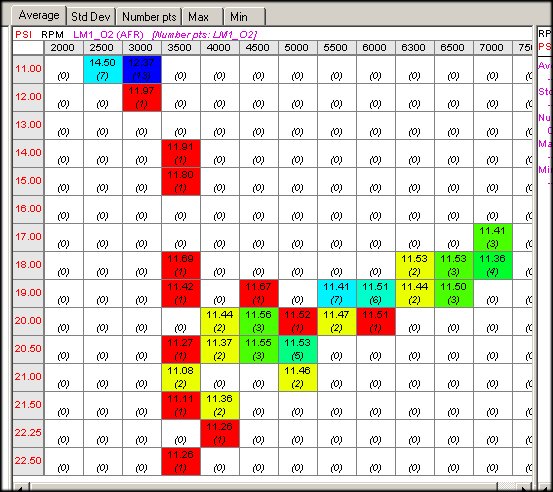
Decline on ramp
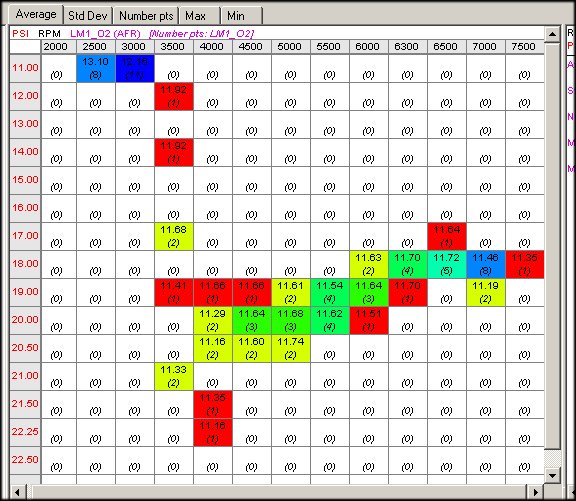
Flat on ramp
Decline on ramp
Originally Posted by Spec'd
I have ALL the tools I need now to do that. 
Originally Posted by Jeff_Jeske
The difference in performance between a race gas map and a pump gas map come from the following:
1. The recovery of 3-4* of timing from 6k-8k. (primary RPM range during drag race)
2. Maxing boost table to 100% increases low rpm boost spike which sometimes helps decrease high end boost drop.
3. Leaner AFR. Pump=11.5:1 Race=12.5:1
4. If you had knock race gas normally eliminates it unless you are running your turbo to hot or do not have enough intercooling.
On race gas I pick up nearly 40WHP.
1. The recovery of 3-4* of timing from 6k-8k. (primary RPM range during drag race)
2. Maxing boost table to 100% increases low rpm boost spike which sometimes helps decrease high end boost drop.
3. Leaner AFR. Pump=11.5:1 Race=12.5:1
4. If you had knock race gas normally eliminates it unless you are running your turbo to hot or do not have enough intercooling.
On race gas I pick up nearly 40WHP.


Originally Posted by nj1266
Here is something that some might find interesting. I did two logs today. One on a flat on ramp and the other on a decline on ramp. The afr logged on the decline ramp was a bit leaner than the one done on the flat surface. From now on I will try to do all of my logs on a flat on ramp. These are not easy to find, but they are around.
Well, unless you have all 8's and 7's in your maps...
That makes total sense. That's more or less the problem I was having a few
days ago. That's why I thought an abandoned airstrip or dyno would
make it easier to get more consistent readings.
days ago. That's why I thought an abandoned airstrip or dyno would
make it easier to get more consistent readings.

Originally Posted by nj1266
Keep in mind that this approach is good for drag racing. But it is not as good for road course driving. On the road course, I do not advise people to run more than 11.5:1 afr even with 100 octane gas. Also keep the boost no more than 22-23 psi. This is for the conservative road course driver who wants to drive his car home in one piece from the track.
In the past I safely run 100 octane @ 22PSI with a 12:1AFR and the tune was nearly knockproof for me. In fact I can't remember a time that I've seen knock on straight 100 octane. Its just too damn expensive.
I think most people just fatten their tunes for road racing events.
Originally Posted by Jeff_Jeske
These days I can't afford to run race gas for road racing. Now I keep my pump gas maps loaded and then dump 3 gallons of 110 in the tank for safe measure.
In the past I safely run 100 octane @ 22PSI with a 12:1AFR and the tune was nearly knockproof for me. In fact I can't remember a time that I've seen knock on straight 100 octane. Its just too damn expensive.
I think most people just fatten their tunes for road racing events.
In the past I safely run 100 octane @ 22PSI with a 12:1AFR and the tune was nearly knockproof for me. In fact I can't remember a time that I've seen knock on straight 100 octane. Its just too damn expensive.
I think most people just fatten their tunes for road racing events.
Well I've traced knock a few different ways. First I was using a 95 GSX ecu with DSMLink. This directly interfaces with the knock sensor.
Then I switched to the Xede with knock buffer.
I have also used pocket logger software on a laptop to log ignition timing retard.
I've logged while on the dyno and can tell you that reading ignition timing was more accurate than the knock buffer. Dips in power on a pull matched perfectly with the retard of timing. You just have to keep in mind there are other reasons outside of knock for timing changes.
Then I switched to the Xede with knock buffer.
I have also used pocket logger software on a laptop to log ignition timing retard.
I've logged while on the dyno and can tell you that reading ignition timing was more accurate than the knock buffer. Dips in power on a pull matched perfectly with the retard of timing. You just have to keep in mind there are other reasons outside of knock for timing changes.
Originally Posted by Jeff_Jeske
Well I've traced knock a few different ways. First I was using a 95 GSX ecu with DSMLink. This directly interfaces with the knock sensor.
Then I switched to the Xede with knock buffer.
I have also used pocket logger software on a laptop to log ignition timing retard.
I've logged while on the dyno and can tell you that reading ignition timing was more accurate than the knock buffer. Dips in power on a pull matched perfectly with the retard of timing. You just have to keep in mind there are other reasons outside of knock for timing changes.
Then I switched to the Xede with knock buffer.
I have also used pocket logger software on a laptop to log ignition timing retard.
I've logged while on the dyno and can tell you that reading ignition timing was more accurate than the knock buffer. Dips in power on a pull matched perfectly with the retard of timing. You just have to keep in mind there are other reasons outside of knock for timing changes.
I have a knock buffer installed and tracked knock with it. In certain loggs there seems to be overlap between timing pull and a spike in the knock buffer voltage. In other logs there is no overlap.
Yesterday I got te Tactrix cable and I am using Evoscan to log knock sum. The one log that I did had a max of 5 knock sum in it. I was told that anything less than 7 is ok.
My problem with the Knock Sum system is that it is getting its info from the OBD2 port. We now know that the reading timing from the obd2 port when you have an Xede is NOT the real timing. Could it be that reading the Knock Sum from the obd2 port is also NOT the real Knock Sum?
What do you think Jeff?
Timing is being altered by the xede.....knock isn't. Knock is knock.
Even though the xede retards timing you shouldn't see it at the OBD2 port. If you do see retard then you know some variable caused it. (variable= intake temp, air flow, coolant temp, knock, ect)
Even though the xede retards timing you shouldn't see it at the OBD2 port. If you do see retard then you know some variable caused it. (variable= intake temp, air flow, coolant temp, knock, ect)
I have been logging my timing and knock with Evoscan for the past few days and I have to admit that it is a much better program than the often used pocketlogger. The logging speed of Evoscan is much better for timing than the pocketlogger.
I have also had a chance to compare the Knock Sum (KS) reading of Evoscan to the Knock Buffer (KB) reading of chiptorque. It is simply amazing how both of them detect knock at the same time. Whenever there is a significant spike in the KB there is an increase in the KS reading.
Apparently, I have been getting a single knock event in the higher RPMs. I confirmed it with both KS and KB. Here is the chart of the log so you can see. Notice the spike in the KS and the KB at the same rpm point. Inorder to draw the KB on the chart (which is in 0-5 volts and usually fluctuates between 0.6-2.3 v), I simply multiplied the results by a factor of 10. So the 16.6 black spike is actually a 1.66 volt spike. Notice also how the timing got pulled by 3 degrees when the spike and KS increased.

Rather than richen the map, I followed the Klaus Almendinger school of tuning and backed off the timing. I simply used the 91 octane timing map that Shiv uses in the 91 octane off-the-shelf map.
That seems to have done the trick since the next two logs at the same place and similar time produced no spike/KS in the log.
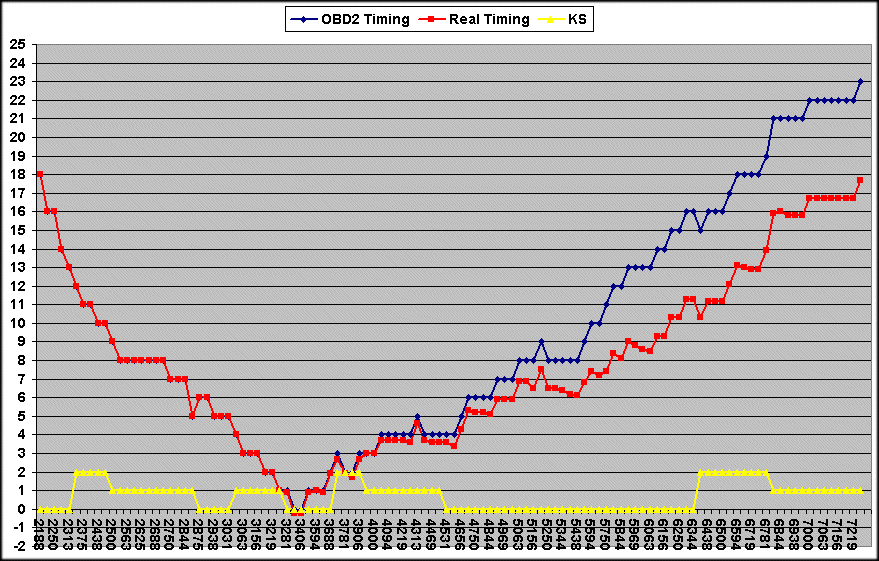
I have also had a chance to compare the Knock Sum (KS) reading of Evoscan to the Knock Buffer (KB) reading of chiptorque. It is simply amazing how both of them detect knock at the same time. Whenever there is a significant spike in the KB there is an increase in the KS reading.
Apparently, I have been getting a single knock event in the higher RPMs. I confirmed it with both KS and KB. Here is the chart of the log so you can see. Notice the spike in the KS and the KB at the same rpm point. Inorder to draw the KB on the chart (which is in 0-5 volts and usually fluctuates between 0.6-2.3 v), I simply multiplied the results by a factor of 10. So the 16.6 black spike is actually a 1.66 volt spike. Notice also how the timing got pulled by 3 degrees when the spike and KS increased.
Rather than richen the map, I followed the Klaus Almendinger school of tuning and backed off the timing. I simply used the 91 octane timing map that Shiv uses in the 91 octane off-the-shelf map.
That seems to have done the trick since the next two logs at the same place and similar time produced no spike/KS in the log.
I like those Excel graphs.
Can one assume that your fuel mixture is approximately 93 octane ?
Are you using only the " timing " part of the 91 off the shelf map ?
How much more advanced was the timing portion of your own custom map ?
Did you completely follow Klaus Almendinger's school of tuning with
higher a/f ratios or just timing retard ? ( that's kind of a redundant question )
Can one assume that your fuel mixture is approximately 93 octane ?
Are you using only the " timing " part of the 91 off the shelf map ?
How much more advanced was the timing portion of your own custom map ?
Did you completely follow Klaus Almendinger's school of tuning with
higher a/f ratios or just timing retard ? ( that's kind of a redundant question )
Originally Posted by Spec'd
I like those Excel graphs.
Can one assume that your fuel mixture is approximately 93 octane ?
Are you using only the " timing " part of the 91 off the shelf map ?
How much more advanced was the timing portion of your own custom map ?
Did you completely follow Klaus Almendinger's school of tuning with
higher a/f ratios or just timing retard ? ( that's kind of a redundant question )
higher a/f ratios or just timing retard ? ( that's kind of a redundant question )
 I hope I can find time this weekend to install it. I hope that my EGTs are below 850* C. That will give me more confidence in this tune.
The real test would be on the dyno. I need to book some dyno time with Alfred @ Tuning Tech and see where the car is power wise.

Originally Posted by nj1266
I have been logging my timing and knock with Evoscan for the past few days and I have to admit that it is a much better program than the often used pocketlogger.
Also your EGT's will be 930-950*C, not 850. We'll see. Hopefully you will have purchased a fast reacting accurate probe such as a kflex thermocouple.