


MIVEC tuning





I didnt mean to sound arguementative Nj, but looking at your DLL plot it would seem at 7500rpm my MIVEC makes 10hp more than the "radical" map. Its a matter of what can be done with the advance since I am able to run more timing and more boost at higher rpm.
Bryan's Mustang doesnt show any gain where a local Mustang and a Dyno Dynamics do. I cant really say if it makes difference one way or the other but the cars I have tuned and my car seem to like it here in the PacNW. I dunno but if it works I do it. I have logged 2 byte both ways and I always see more load (which I assume means more power) with some advance over none.
JB
Bryan's Mustang doesnt show any gain where a local Mustang and a Dyno Dynamics do. I cant really say if it makes difference one way or the other but the cars I have tuned and my car seem to like it here in the PacNW. I dunno but if it works I do it. I have logged 2 byte both ways and I always see more load (which I assume means more power) with some advance over none.
JB

I'm confused about the 0 setting being equal to -10* on the cam gears. I must be reading that wrong.
So for grins help me modify my map to make it better. I'm more concerned with hard hitting low end than eeking 10hp out of the top end.

So for grins help me modify my map to make it better. I'm more concerned with hard hitting low end than eeking 10hp out of the top end.
Last edited by Jeff_Jeske; Aug 13, 2007 at 08:11 PM.
I have been combining 2 different measurements and taking a shortcut. I will explain briefly.
The MIVEC table works in crank degrees, where as a cam gear (excluding the MIVEC measurement) always works in cam degrees. The difference between the 2 is exactly half since the cams move half the speed of the crank. 10 cam degrees is 20 crank degrees.
An Evo VIII (if it had a MIVEC map to look at) would show all points on the map at 19.2* (19 actually is the engineered spec). If I wanted it to read the same as the IX at 0*, I would have to set the cam gear to -10 to achieve the same measurement. There are some other factors that I am leaving out for the time being because they would cloud the issue currently. Other engineering details come into play also in determing optimum cam timing such as the lobecenter and Lobe seperation angle of the cam or cams.
There was a test done (and quoted somewhere in this thread I believe) that Sport Compact car put cam gears on an otherwise stock Evo, retarded the cam gears 5* (cam degrees, 10* by crank reference) and made power everywhere in the powerband. Applying this to the engineering we already covered for the VIII would mean the intake valve opens at 9* BTDC.
This is one of the reasons that some tuners in this thread (TTP, RRev, the other professionals, etc.) have said the same thing that I have that 0* is not optimum. Now maybe there are other things that contribute to the power that arent being utilised at the same time MIVEC maps like mine are being used. 91 octane doesnt allow the timing that even 92 will so there is a chance that the AFR's and timing required to run knock free negate the benefits that we find running on higher octane fuel (because we run leaner and more aggressive on the timing).
To answer your question Jeff, there is a max of 30* of motion in the system. To get spool as fast as possible you need to ramp up timing and MIVEC as fast as possible. This doesnt mean put 30* everywhere but there are alot of good images floating around in this thread and also the one entitled "MIVEC and Boost" that MR Evo IX posted awhile back.
JB
The MIVEC table works in crank degrees, where as a cam gear (excluding the MIVEC measurement) always works in cam degrees. The difference between the 2 is exactly half since the cams move half the speed of the crank. 10 cam degrees is 20 crank degrees.
An Evo VIII (if it had a MIVEC map to look at) would show all points on the map at 19.2* (19 actually is the engineered spec). If I wanted it to read the same as the IX at 0*, I would have to set the cam gear to -10 to achieve the same measurement. There are some other factors that I am leaving out for the time being because they would cloud the issue currently. Other engineering details come into play also in determing optimum cam timing such as the lobecenter and Lobe seperation angle of the cam or cams.
There was a test done (and quoted somewhere in this thread I believe) that Sport Compact car put cam gears on an otherwise stock Evo, retarded the cam gears 5* (cam degrees, 10* by crank reference) and made power everywhere in the powerband. Applying this to the engineering we already covered for the VIII would mean the intake valve opens at 9* BTDC.
This is one of the reasons that some tuners in this thread (TTP, RRev, the other professionals, etc.) have said the same thing that I have that 0* is not optimum. Now maybe there are other things that contribute to the power that arent being utilised at the same time MIVEC maps like mine are being used. 91 octane doesnt allow the timing that even 92 will so there is a chance that the AFR's and timing required to run knock free negate the benefits that we find running on higher octane fuel (because we run leaner and more aggressive on the timing).
To answer your question Jeff, there is a max of 30* of motion in the system. To get spool as fast as possible you need to ramp up timing and MIVEC as fast as possible. This doesnt mean put 30* everywhere but there are alot of good images floating around in this thread and also the one entitled "MIVEC and Boost" that MR Evo IX posted awhile back.
JB


Now maybe there are other things that contribute to the power that arent being utilised at the same time MIVEC maps like mine are being used. 91 octane doesnt allow the timing that even 92 will so there is a chance that the AFR's and timing required to run knock free negate the benefits that we find running on higher octane fuel (because we run leaner and more aggressive on the timing).

Cali 91 is greeeaaatt!

To provide even more data points, I have also seen some small gains from advancing mivec past 0 at 6,000 rpm and above on cars equipped with certain MBC's that cannot hold the same amount of boost up top that ecu-controlled boost can.


MIVEC can advance the intake cam from "0" to whatever, but cannot retard it. Zero advance is the straight up ("0") position. Obviously, there is power to be made at high rpm by retarding the intake cam, so the IX intake cam is ground such that it's about 10* retarded as compared to a regular VIII intake cam. This allows MIVEC to bring the intake to a full retard cam timing setting, simply by bringing it back to "0".
Last edited by Ted B; Aug 13, 2007 at 08:37 PM.

This is what I have personally found, on 91 octane california fuel:
More than 0 in 6000rpm and above shows no gains on the dyno. The curves are exactly the same. Once you go past 10 on mivec from 6000 rpm up the horsepower can decrease but it will hold that decreased horsepower.
More than 0 in 6000rpm and above shows no gains on the dyno. The curves are exactly the same. Once you go past 10 on mivec from 6000 rpm up the horsepower can decrease but it will hold that decreased horsepower.
The areas where mivec changes actually made gains where the 3000 to 5000 area at WOT and also lower loads. Advanced mivec during spool decreases spool time. Advanced mivec at peak boost gains torque. How much increase you can use depends on how sensitive the car is. Advanced mivec from peak torque past 5000 rpm helps hold torque.
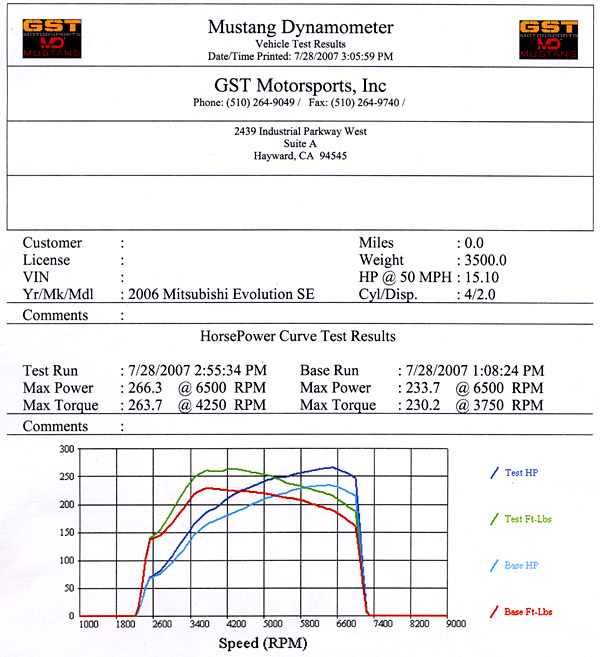
Here is a 99% stock evo 9. The only mods are a custom boost pill and a custom dyno tune, everything else stock down to the paper filter. Base run is 100% stock. Test run is after boost pill and dyno tune. This is a good example of the the large spool gains you can get from custom mivec tuning. Of course the upped boost and other tuning helps too but mivec tuning can make huge changes to spool.
I believe this was set at 28.8 from load 80 or something to load 300, from 2000 to 4000 rpm.

Here's the VVT Map I used with this dyno result on a Dyno Dynamics:


Currently I hold the following amount of boost:
3000 - 4000 >> 24psi
4000 - 5000 >> 23psi
5000 - 5500 >> 22psi
5500 - 6000 >> 20psi
6000 - 6500 >> 19psi
6500 - 7000 >> 17psi
Currently I hold the following amount of boost:
3000 - 4000 >> 24psi
4000 - 5000 >> 23psi
5000 - 5500 >> 22psi
5500 - 6000 >> 20psi
6000 - 6500 >> 19psi
6500 - 7000 >> 17psi
Questions:
Does a more aggressive Mivec map require more conservative engine timing?
Why does the low load mivec map change? Is there a way to tune for better MPG using mivec?
Lastly what # in the mivec map is considered zero * of cam gear adjustment?
Does a more aggressive Mivec map require more conservative engine timing?
Why does the low load mivec map change? Is there a way to tune for better MPG using mivec?
Lastly what # in the mivec map is considered zero * of cam gear adjustment?
1. No
2. To encourage increased transient response (to help spool from rolling start), and No
(for mileage increase look at this: https://www.evolutionm.net/forums/sh...7&postcount=37 )
3. Technically it would be 19.2* on the map if you wanted to measure it relative to an VIII. In reality this isnt exactly accurate or practical as you cant judge this to make best power (or use VIII cam gear settings to make best power). The reason is the intake cam is ground with a totally different lobecenter and will react a little differently compared to a non-MIVEC cam.
2. To encourage increased transient response (to help spool from rolling start), and No
(for mileage increase look at this: https://www.evolutionm.net/forums/sh...7&postcount=37 )
3. Technically it would be 19.2* on the map if you wanted to measure it relative to an VIII. In reality this isnt exactly accurate or practical as you cant judge this to make best power (or use VIII cam gear settings to make best power). The reason is the intake cam is ground with a totally different lobecenter and will react a little differently compared to a non-MIVEC cam.
Last edited by JohnBradley; Aug 14, 2007 at 09:24 AM.