


How To Tune an Evo


Evolved Member
iTrader: (16)
Joined: Jan 2007
Posts: 691
Likes: 0
From: Fayetteville, NC via Puerto Rico
Correct. If its stock and you won’t change it, just log and see what cells you're hitting and adjust that. The thing is that you wont know if you adjusting the 18 psi ones or the once that are lower psi ramping up. SO.....to do it properly, you need to see PSI. If not, you are guessing.
 I still dont know ****

I don't see why a person couldn't tune without psi., lots of people do.
forget the term peak boost and concentrate on load. just remember what you are trying to do, which is getting an afr and timing that works well on your car.
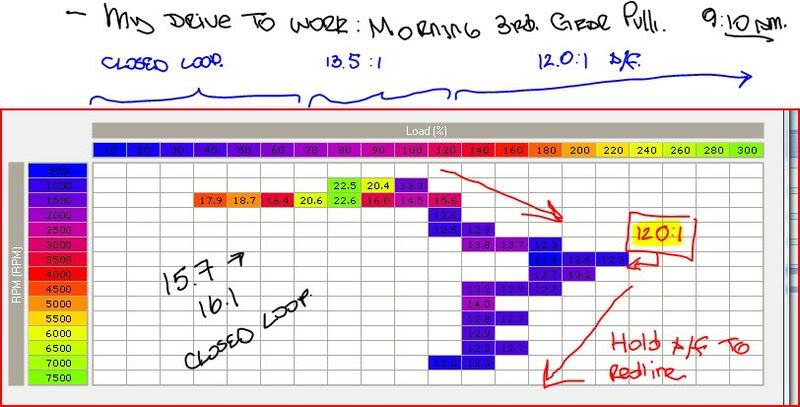
100 load is the transition into positive boost pressure. it is where a turbo makes your car different than a car without a turbo. a non turbo car can not really go beyond 100 load.
highest load is just that, the point where your car is straining the hardest. a foulup there is bad. a foulup at 60 load is typical. so the routine is to work up from a known safe afr or timing and move carefully towards what you feel is the tune you want.
from your first pull it is likely you will hit knock, think about what is causing it. weak afr, to much afr, too much timing... maybe its a rattle within the engine bay.
your first tuning job is to determine how sever the knock is and what to do about it.
At this point you have not changed anything on your maps. So now you decide,,, well my afr is so and so, my timing is ... hmmm, looks like my afr is where I want it, lets try lowering the timing. Or whatever. And so it goes, if you can get the afr where you want it without having to do something with timing, then its time to start working the timing.
Then the process starts over. And the process is hindered by little odd things in the ecu program. There is pretty good sticky area in the forum that will help.
forget the term peak boost and concentrate on load. just remember what you are trying to do, which is getting an afr and timing that works well on your car.
100 load is the transition into positive boost pressure. it is where a turbo makes your car different than a car without a turbo. a non turbo car can not really go beyond 100 load.
highest load is just that, the point where your car is straining the hardest. a foulup there is bad. a foulup at 60 load is typical. so the routine is to work up from a known safe afr or timing and move carefully towards what you feel is the tune you want.
from your first pull it is likely you will hit knock, think about what is causing it. weak afr, to much afr, too much timing... maybe its a rattle within the engine bay.
your first tuning job is to determine how sever the knock is and what to do about it.
At this point you have not changed anything on your maps. So now you decide,,, well my afr is so and so, my timing is ... hmmm, looks like my afr is where I want it, lets try lowering the timing. Or whatever. And so it goes, if you can get the afr where you want it without having to do something with timing, then its time to start working the timing.
Then the process starts over. And the process is hindered by little odd things in the ecu program. There is pretty good sticky area in the forum that will help.


Evolved Member
iTrader: (16)
Joined: Jan 2007
Posts: 691
Likes: 0
From: Fayetteville, NC via Puerto Rico
I don't see why a person couldn't tune without psi., lots of people do.
forget the term peak boost and concentrate on load. just remember what you are trying to do, which is getting an afr and timing that works well on your car.
100 load is the transition into positive boost pressure. it is where a turbo makes your car different than a car without a turbo. a non turbo car can not really go beyond 100 load.
YOU MUST BE REFERING TO 100KPA AND THE NUMBERS ON THE LOAD ARE NOT KPA
highest load is just that, the point where your car is straining the hardest. a foulup there is bad. a foulup at 60 load is typical. so the routine is to work up from a known safe afr or timing and move carefully towards what you feel is the tune you want.
from your first pull it is likely you will hit knock, think about what is causing it. weak afr, to much afr, too much timing... maybe its a rattle within the engine bay.
your first tuning job is to determine how sever the knock is and what to do about it.
BY WEAK AFR DO YOU SAY ITS "LEAN" AND BY TOO MUCH "RICH". TELL US HOW WOULD YOUR ENGINE KNOCK BECAUSE IT HAS TOO MUCH FUEL.
At this point you have not changed anything on your maps. So now you decide,,, well my afr is so and so, my timing is ... hmmm, looks like my afr is where I want it, lets try lowering the timing. Or whatever. And so it goes, if you can get the afr where you want it without having to do something with timing, then its time to start working the timing.
Then the process starts over. And the process is hindered by little odd things in the ecu program. There is pretty good sticky area in the forum that will help.
forget the term peak boost and concentrate on load. just remember what you are trying to do, which is getting an afr and timing that works well on your car.
100 load is the transition into positive boost pressure. it is where a turbo makes your car different than a car without a turbo. a non turbo car can not really go beyond 100 load.
YOU MUST BE REFERING TO 100KPA AND THE NUMBERS ON THE LOAD ARE NOT KPA
highest load is just that, the point where your car is straining the hardest. a foulup there is bad. a foulup at 60 load is typical. so the routine is to work up from a known safe afr or timing and move carefully towards what you feel is the tune you want.
from your first pull it is likely you will hit knock, think about what is causing it. weak afr, to much afr, too much timing... maybe its a rattle within the engine bay.
your first tuning job is to determine how sever the knock is and what to do about it.
BY WEAK AFR DO YOU SAY ITS "LEAN" AND BY TOO MUCH "RICH". TELL US HOW WOULD YOUR ENGINE KNOCK BECAUSE IT HAS TOO MUCH FUEL.
At this point you have not changed anything on your maps. So now you decide,,, well my afr is so and so, my timing is ... hmmm, looks like my afr is where I want it, lets try lowering the timing. Or whatever. And so it goes, if you can get the afr where you want it without having to do something with timing, then its time to start working the timing.
Then the process starts over. And the process is hindered by little odd things in the ecu program. There is pretty good sticky area in the forum that will help.
What afr should I be in at 20psi and what timing on the BUTT dyno?
You can get close if you know what you're doing. I know a couple of my boys in town have ran high 11's in the quarter mile on MOSTLY street tunes.
Ill be back in a bit.
Last edited by crewdawg130; Feb 5, 2008 at 08:46 AM.

Evolved Member
iTrader: (16)
Joined: Jan 2007
Posts: 691
Likes: 0
From: Fayetteville, NC via Puerto Rico


Evolved Member
iTrader: (37)
Joined: Sep 2003
Posts: 3,146
Likes: 2
From: Spec-Ops Motorsports, Fayetteville, NC
what boost are you running ? by your load id guess no more than 20, or at least i hope not, otherwise, its a good thing you are working on the tune... keep at it, you are on the right place, and in the right place for help
soooo...guess, guess,guess and uhmmmm guess some more.
What afr should I be in at 20psi and what timing on the BUTT dyno?
You can get close if you know what you're doing. I know a couple of my boys in town have ran high 11's in the quarter mile on MOSTLY street tunes.
Ill be back in a bit.
What afr should I be in at 20psi and what timing on the BUTT dyno?
You can get close if you know what you're doing. I know a couple of my boys in town have ran high 11's in the quarter mile on MOSTLY street tunes.
Ill be back in a bit.
if you study your logs you will see 100 load is between 1 and 2 psi, so technically you are correct. 100 load is not kpa but is fairly close for our intentions.
although I have not witnessed it myself others have seen rich knock. I believe Klaus of Innovate believes it and mentioned it in his tuning spiels.
be that as it may, you are correct, I am out.


