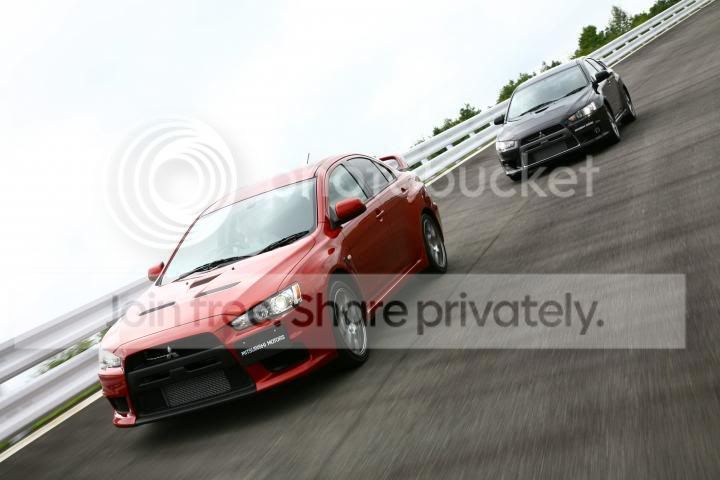
Lancer Evolution X News, Info, Pics, etc... | [ALL THREADS MERGED]


Evolving Member
Joined: Jun 2007
Posts: 393
Likes: 0
From: pa

Newbie
Joined: Oct 2007
Posts: 1
Likes: 0
From: Seattle
I love it! Just not sure yet if I think this should have been the Evo or a luxury version of the Evo...the Evo has always been great because of having the 'not-so-subtle' look that they praise the new Evo for not having.


Evolved Member
Joined: May 2005
Posts: 1,259
Likes: 0
From: ATLANTA
Mistsubishi needs this upgraded look to get rid of the POS perception that the last generatiojn lancer put ono the whole brand.... Just look .. the only reason KIA and hyundia are accepted brands now is cause mitsue left a huge gap in the market whebn it messed up the eclipse redesign and gave it a crappy engine! The last evo looked cool but was over priced and mared by negative asociation with the old ugly regular lancer. Now mitsu has to fight to regain all those "would have been mitsu owners" who baught kia and hyundia in stead over the last 6 years...

UPDATE!!!


More pics of the parts used @ the link below:
http://www.autoblog.com/photos/2008-...-evo-x/424639/
More pics of the parts used @ the link below:
http://www.autoblog.com/photos/2008-...-evo-x/424639/


Evolved Member
Joined: Jun 2007
Posts: 846
Likes: 0
From: tsukuba turn 4
redline is the same as the IX, wtf is with the "only"??? anyways fuel cutoff is 7600. the square bore/stroke and the cam on bucket valvetrain should make it rev faster and have a higher redline. i think they kept the redline the same because they didn't want a mismatched turbo. they want less lag but ample power up top. better to have a smaller, smoother turbo than a large, laggy one in a production car.


https://www.evolutionm.net/forums/sh...worth+pictures
Last edited by Mr. Stock; Oct 5, 2007 at 07:21 AM.


Evolved Member
Joined: Jul 2006
Posts: 1,191
Likes: 0
From: Australia
^ how can u say its let people down?
from what i have read, noone(on these boards) has driven one so they dont know if it drives better or worse, but from the critics and test drives it out performed the IX by 2 seconds
ok its changed the engine, big whoop, thats what evolving is about, change, but its also has a more rigid and stiff chasis which makes for better cornering and it also looks good and much more comfort feastures to appeal to a wider market, so maybe mitsu can get in the black better
im not sayin the X is the greatest, or better than the IX, hell i would love a WW IX, but its just a load of crap when people say "yeah the X is S#!7" when they havent even experianced it
from what i have read, noone(on these boards) has driven one so they dont know if it drives better or worse, but from the critics and test drives it out performed the IX by 2 seconds
ok its changed the engine, big whoop, thats what evolving is about, change, but its also has a more rigid and stiff chasis which makes for better cornering and it also looks good and much more comfort feastures to appeal to a wider market, so maybe mitsu can get in the black better
im not sayin the X is the greatest, or better than the IX, hell i would love a WW IX, but its just a load of crap when people say "yeah the X is S#!7" when they havent even experianced it

Newbie
Joined: May 2007
Posts: 32
Likes: 0
From: Edmonton, AB, Canada
Just a little info I thought pertinent to the X, found in the 08 Lancer Engine forums, as it shares the 4B11 with the reg. Lancer.
Originally Posted by Gts BlackJoker
--------------------------------------------------------------------------------
The first thing you notice is that the power output is not remarkable. Even with MIVEC variable valve lift & timing on both the intake and exhaust camshafts, the 4B11 (developed in conjunction with Hyundai and Daimler Chrysler but with Mitsu-specific camshafts and cylinder head for the Lancer) only develops a pedestrian 152hp.
That's not bad, mind you... considering that the new Honda Civic K20Z, Alfa 156 2.0TS and BMW 320i produce roughly the same 150-160hp. The new Camry 2.0G and Nissan Cefiro 2.0 outputs slightly less at 140+hp. So, it's respectable, but it's not spectacular by any standards.
Then you'd notice the 4B11 engine has a 86mm bore and 86mm stroke. The legendary 4G63 which served 9 generations of Lancer Evos as well as several generations of Galant VR4 rally cars - was under-square with a bore of 85mm and 88mm stroke. Why the perfectly square 4B11 after decades of rally-tested under-square 4G63?
In my opinion, the answer lies in a small tuning workshop in the heart of Kepong, Malaysia - called Forge Racing (formerly KCK Racing). It is the birthplace of the first street legal Mivec turbo engine... ever. In 2000, several years before Mitsubishi rolled out its first Mivec turbo in the Evo VIII - Forge Racing crossbred the block of a 1.8 litre 4G93 turbo and the cylinder head of a 1.6 litre 4G92 Mivec. That resulting 1.8 engine output over 300hp at 8000rpm with a boost of only 1.5bar. But what was the main lesson learnt from that little pocket rocket?
It was that if the overarching limitation on any turbo engine is [small] displacement... then more turbo boost is NOT the answer. It rapidly gets to a stage where there's too much mechanical stress, too much heat and petrol from a regular gas-station produces problems rather than power. The answer was more revs! Don't overdo the boost. Keep it sane, keep it steady and turn up the revs. The power will follow.
Squaring the engine by enlarging the bore and shortening the stroke usually means one thing... more revs. So... if Mitsu wanted more revs, then why the peak power at a lowly 6000rpm still, and low-ish compression of 10.01 from the 4B11?... My speculation... headroom.
My thinking is that Mitsubishi had basically extracted all it could from the 4G63 by playing all the turbo tweaking cards available to it. At roughly 300hp, there wasn't very much more they could do with the 2 litre warhorse without making it too uneconomical to manufacture/ warranty and too unstreetable with turbo lag, fuel consumption and inconvenient emissions. Ralliart UK's FQ320 was possibly the limit of streetability. The FQ400 was best left for the track and Sunday drives. Subaru's STi has traditionally mirrored the Evo's evolution (pun intended), and it is very telling that even they have recently migrated the STi from 2 litres to 2.5 litres.
I reckon Mitsubishi figured they needed a new high rev engine that provides room to increase power, but without the attendant downsides of excessive boost pressures and big turbines. So, in walks a perfectly square engine. The 152hp in the everyday Lancer might be just be the tip of the 4B11's proverbial horsepower iceberg. And 152hp is a very, very comfortable minimum to start from. The 4B11 turbo in the upcoming 2007 Lancer Evolution X is rumoured to have 300+hp straight out of the factory... and we'll soon see if Mitsu agrees that raising the revs is the best way to get there (since they aren't increasing the displacement).
I also strongly believe that Mitsubishi realises that it has been missing out on a lucrative mid-range performance market niche ie. the 180-250hp hot compact segment. Since the last 200hp Lancer GSR rolled off the production lines in the mid 90's, Mitsubishi has not had an answer to the Subaru WRX, VW Golf GTi, Ford Focus RS, Civic and Integra Type R, Mazda 6 MPS etc. A new baby Lancer Evo would be timely... and simple to achieve with the 4B11.
Info from here:
http://sean-the-man.blogspot.com/200...fications.html
I still see big things from these new lancers..
The first thing you notice is that the power output is not remarkable. Even with MIVEC variable valve lift & timing on both the intake and exhaust camshafts, the 4B11 (developed in conjunction with Hyundai and Daimler Chrysler but with Mitsu-specific camshafts and cylinder head for the Lancer) only develops a pedestrian 152hp.
That's not bad, mind you... considering that the new Honda Civic K20Z, Alfa 156 2.0TS and BMW 320i produce roughly the same 150-160hp. The new Camry 2.0G and Nissan Cefiro 2.0 outputs slightly less at 140+hp. So, it's respectable, but it's not spectacular by any standards.
Then you'd notice the 4B11 engine has a 86mm bore and 86mm stroke. The legendary 4G63 which served 9 generations of Lancer Evos as well as several generations of Galant VR4 rally cars - was under-square with a bore of 85mm and 88mm stroke. Why the perfectly square 4B11 after decades of rally-tested under-square 4G63?
In my opinion, the answer lies in a small tuning workshop in the heart of Kepong, Malaysia - called Forge Racing (formerly KCK Racing). It is the birthplace of the first street legal Mivec turbo engine... ever. In 2000, several years before Mitsubishi rolled out its first Mivec turbo in the Evo VIII - Forge Racing crossbred the block of a 1.8 litre 4G93 turbo and the cylinder head of a 1.6 litre 4G92 Mivec. That resulting 1.8 engine output over 300hp at 8000rpm with a boost of only 1.5bar. But what was the main lesson learnt from that little pocket rocket?
It was that if the overarching limitation on any turbo engine is [small] displacement... then more turbo boost is NOT the answer. It rapidly gets to a stage where there's too much mechanical stress, too much heat and petrol from a regular gas-station produces problems rather than power. The answer was more revs! Don't overdo the boost. Keep it sane, keep it steady and turn up the revs. The power will follow.
Squaring the engine by enlarging the bore and shortening the stroke usually means one thing... more revs. So... if Mitsu wanted more revs, then why the peak power at a lowly 6000rpm still, and low-ish compression of 10.01 from the 4B11?... My speculation... headroom.
My thinking is that Mitsubishi had basically extracted all it could from the 4G63 by playing all the turbo tweaking cards available to it. At roughly 300hp, there wasn't very much more they could do with the 2 litre warhorse without making it too uneconomical to manufacture/ warranty and too unstreetable with turbo lag, fuel consumption and inconvenient emissions. Ralliart UK's FQ320 was possibly the limit of streetability. The FQ400 was best left for the track and Sunday drives. Subaru's STi has traditionally mirrored the Evo's evolution (pun intended), and it is very telling that even they have recently migrated the STi from 2 litres to 2.5 litres.
I reckon Mitsubishi figured they needed a new high rev engine that provides room to increase power, but without the attendant downsides of excessive boost pressures and big turbines. So, in walks a perfectly square engine. The 152hp in the everyday Lancer might be just be the tip of the 4B11's proverbial horsepower iceberg. And 152hp is a very, very comfortable minimum to start from. The 4B11 turbo in the upcoming 2007 Lancer Evolution X is rumoured to have 300+hp straight out of the factory... and we'll soon see if Mitsu agrees that raising the revs is the best way to get there (since they aren't increasing the displacement).
I also strongly believe that Mitsubishi realises that it has been missing out on a lucrative mid-range performance market niche ie. the 180-250hp hot compact segment. Since the last 200hp Lancer GSR rolled off the production lines in the mid 90's, Mitsubishi has not had an answer to the Subaru WRX, VW Golf GTi, Ford Focus RS, Civic and Integra Type R, Mazda 6 MPS etc. A new baby Lancer Evo would be timely... and simple to achieve with the 4B11.
Info from here:
http://sean-the-man.blogspot.com/200...fications.html
I still see big things from these new lancers..