


2.3L GT3076Build

Thread Starter
Evolved Member
iTrader: (62)
Joined: Feb 2004
Posts: 3,336
Likes: 6
From: Redmond - Lake Tapps ,WA
PROCEED WITH CAUTION: if you don't know what you're doing.
Here's the current status of the tune.
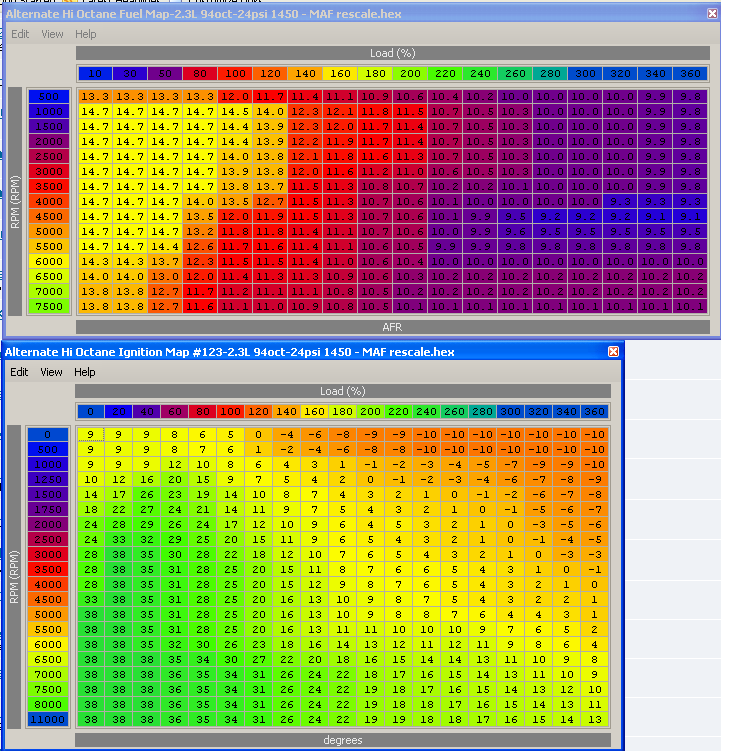
Timing and Fuel on E85 28 psi.
Knock Control, injector scaling, MAF scaling

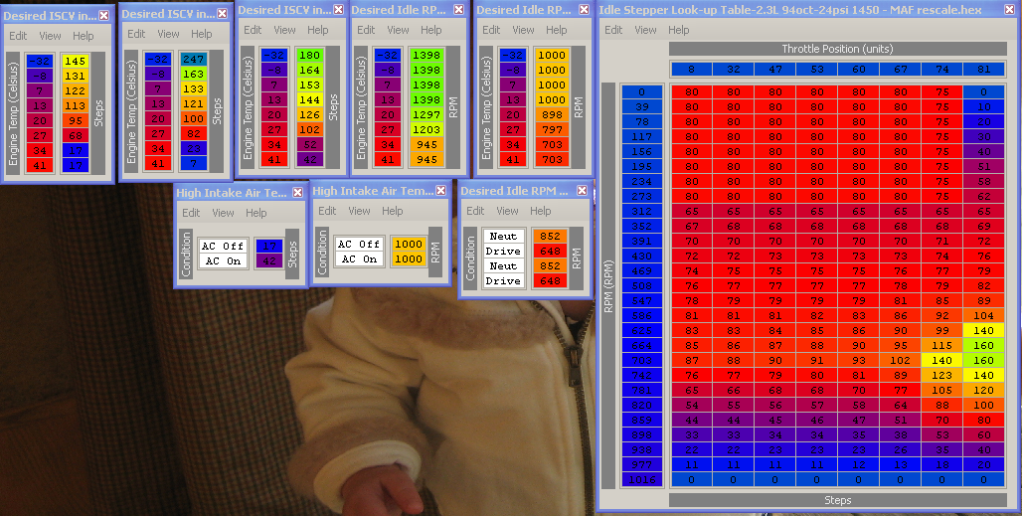
Idle Settings for Kelford Cams
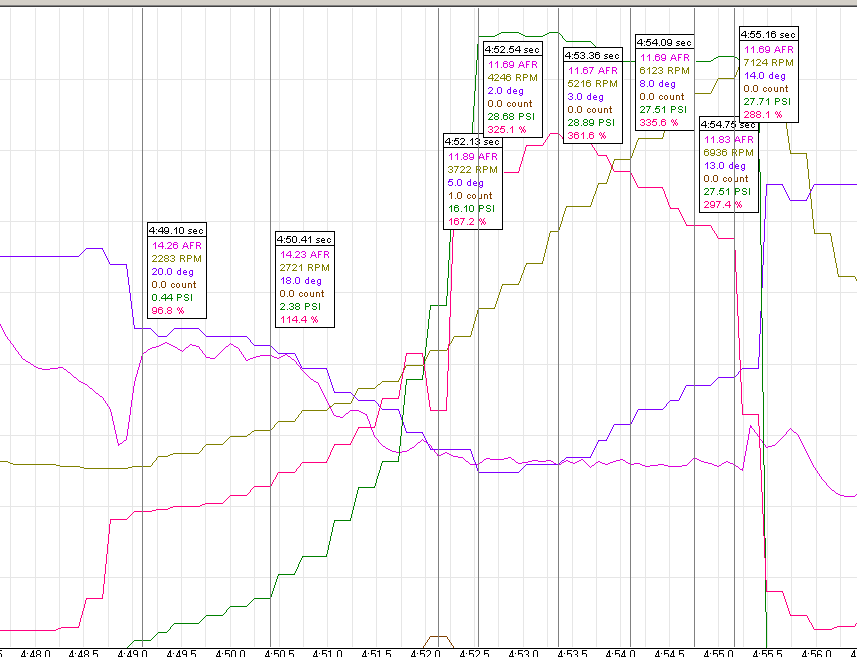
Datalog of a pull with the above tune. Spooling around 12.2 ish, powerband 11.8-11.7 AFR.
Here's the current status of the tune.
Timing and Fuel on E85 28 psi.
Knock Control, injector scaling, MAF scaling
Idle Settings for Kelford Cams
Datalog of a pull with the above tune. Spooling around 12.2 ish, powerband 11.8-11.7 AFR.

Evolved Member
Joined: Oct 2002
Posts: 2,788
Likes: 1
Ahh doh  you have a log right there... and yeah, from looking at the log, 2 degrees at peak boost. I thought I heard people say E-85 was close to c-16? (det resistance not octane rating) I'm puzzled... I guess if you had through the roof VE you could be making a lot of cylinder pressure but to me I don't get how an e85 / t3 Evo only runs that ignition advance on that fuel.
BTW, what is the actual octane rating of e85?
you have a log right there... and yeah, from looking at the log, 2 degrees at peak boost. I thought I heard people say E-85 was close to c-16? (det resistance not octane rating) I'm puzzled... I guess if you had through the roof VE you could be making a lot of cylinder pressure but to me I don't get how an e85 / t3 Evo only runs that ignition advance on that fuel.BTW, what is the actual octane rating of e85?


one recommendation, if you raise the load threshold for the knock control, you should be able to reduce the low load multiplier.
I had numbers very similar to yours on the stock load threshold table, but upping it to 100% up to 3500 rpm i was able to reduce the low load multiplier to 17. You have to ask yourself where knock control is most important to you.
this was my experience.
ps. screw you and your e85 and your 15 degrees at redline
I had numbers very similar to yours on the stock load threshold table, but upping it to 100% up to 3500 rpm i was able to reduce the low load multiplier to 17. You have to ask yourself where knock control is most important to you.
this was my experience.
ps. screw you and your e85 and your 15 degrees at redline

Ahh doh you have a log right there... and yeah, from looking at the log, 2 degrees at peak boost. I thought I heard people say E-85 was close to c-16? (det resistance not octane rating) I'm puzzled... I guess if you had through the roof VE you could be making a lot of cylinder pressure but to me I don't get how an e85 / t3 Evo only runs that ignition advance on that fuel.
BTW, what is the actual octane rating of e85?
you have a log right there... and yeah, from looking at the log, 2 degrees at peak boost. I thought I heard people say E-85 was close to c-16? (det resistance not octane rating) I'm puzzled... I guess if you had through the roof VE you could be making a lot of cylinder pressure but to me I don't get how an e85 / t3 Evo only runs that ignition advance on that fuel.BTW, what is the actual octane rating of e85?
Fathouse
Thread Starter
Evolved Member
iTrader: (62)
Joined: Feb 2004
Posts: 3,336
Likes: 6
From: Redmond - Lake Tapps ,WA
It is conservative since my car gets driven very hard at the track. I also haven't dialed it in for timing really. These are just values I know to be safe. I'll get it on the dyno at some point to really see what's up. But it would be more aggressive if it was a street pull or drag race tune.
E85 is tricky at peak torque in regards to timing. But after that up to redline is where it can handle loads of timing. Basically until you pass MBT.
E85 is tricky at peak torque in regards to timing. But after that up to redline is where it can handle loads of timing. Basically until you pass MBT.
Evolved Member
Joined: Oct 2002
Posts: 2,788
Likes: 1
It is conservative since my car gets driven very hard at the track. I also haven't dialed it in for timing really. These are just values I know to be safe. I'll get it on the dyno at some point to really see what's up. But it would be more aggressive if it was a street pull or drag race tune.
E85 is tricky at peak torque in regards to timing. But after that up to redline is where it can handle loads of timing. Basically until you pass MBT.
E85 is tricky at peak torque in regards to timing. But after that up to redline is where it can handle loads of timing. Basically until you pass MBT.
Why wait to tune the ignition map on a dyno when you have a GPS datalogger? And why is it that E85 would be a bad fuel at peak torque but a good fuel at upper rpm? Have you pushed ignition timing beyond what your current map is at? Have you seen any knock on e85? Have you added ignition but not gone faster on e85?

You need to tune ignition timing on a dyno because cylinder pressure is directly proportional to power output. Rule of thumb: by decreasing power 1% from MBT you'll cut the cylinder pressure in half. You can't find that unless you're on a dyno.
Thread Starter
Evolved Member
iTrader: (62)
Joined: Feb 2004
Posts: 3,336
Likes: 6
From: Redmond - Lake Tapps ,WA
^^^^ Word. This is why I'm waiting for zee dyno to really find my timing, and I'm pretty sure the values currently in there are not past the threshold. Now I just need to stop throwing up (stomach virus) and figure out why my car "zings" like a whistle under boost.
If the turbo is the problem I've already got CBRD lined up to build me a TAK 33R from my existing GT3076R parts.
If the turbo is the problem I've already got CBRD lined up to build me a TAK 33R from my existing GT3076R parts.

Thread Starter
Evolved Member
iTrader: (62)
Joined: Feb 2004
Posts: 3,336
Likes: 6
From: Redmond - Lake Tapps ,WA
11.8, I feel that's a good road race value for E85 based on conversations with Bryan at GST and JohnBradley. Typical street tunes on E85 shoot for 12.0.
Last edited by jid2; Jul 12, 2009 at 09:48 PM.
Thread Starter
Evolved Member
iTrader: (62)
Joined: Feb 2004
Posts: 3,336
Likes: 6
From: Redmond - Lake Tapps ,WA
So I put on a little classic Weezer, the Pinkerton Album, and got some stuff done in the garage. After a datalogging run which came up with only positive data, but still an audible problem with the turbo I started ripping the turbo out to see if something was fishy on the turbine side. So I pulled all the easy stuff off, drained the radiator and pulled it and was ready to unbolt the manifold from the head when I noticed something at the wastegate. One of the bolts holding the wastegate to the manifold was visibly loose. A little closer inspection showed the gasket clearly loose. This made me happy, as it looked like this could be the problem. So I took off the wastegate and checked things out. Sure enough the gasket had broke. It looked like the bolt loosened and air was escaping past the gasket. since the gasket was thin stainless steel the gasket was resonating like the reed on a saxophone, and this was creating the loud "zinging" sound I was hearing at high boost.
I replaced the gasket and put everything back together and went out for a test drive - Problem Solved! That's cool - because I didn't really have the money to be buying a new turbo, as cool as the TAK 33R would be. It would have kept me off the track for over a month at least recovering from the hit.
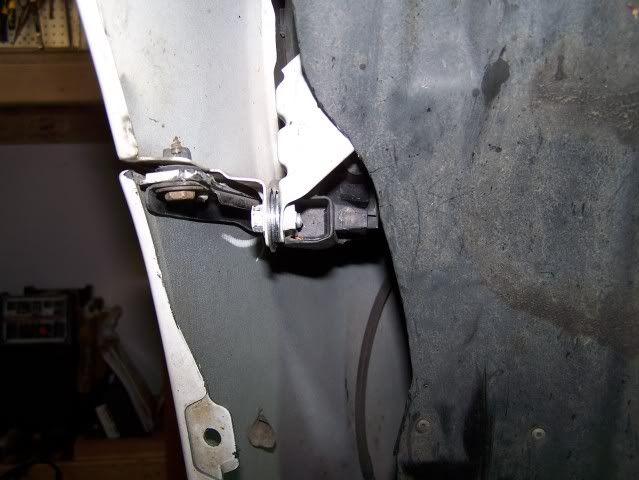
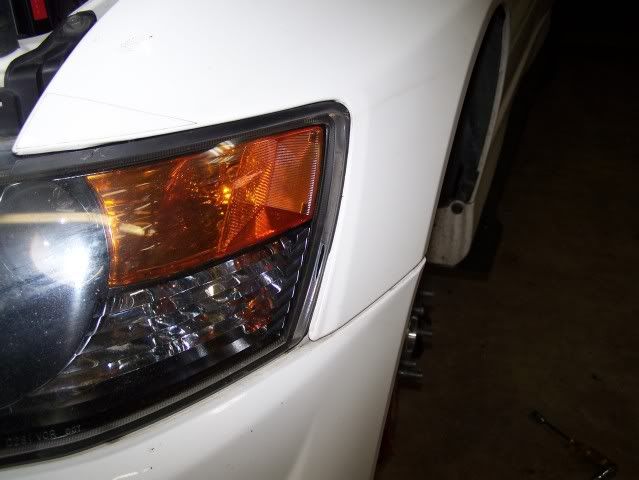
I also made some more front fender revisions. I cutoff the remaining tab for the fender liner as it was rubbing. I also installed some washers under the front mounting point to create more width in the front of the fender. This worked pretty well. Hopefully it's enough. If not I'll go in and ad spacers to the rear of the fender as well to push it out.
BUT, there was bad stuff going on as well. I found oil leaking. I'm not sure exactly where it's coming from but it was all over the filter housing and oil pump side of the motor. I cleaned it up and will be looking for a source, most likely the plug from the eliminated balance shaft, or somewhere on the oil pump housing. Whatever it is, it's freaking lame. My best judgment wants to fix it ASAP. Another part of me wants to ignore it for at least one track day or so.
This kid loves to do whatever I do. She's checking the progress of the coolant draining. Too funny.

Leaky wastgate stuff.

Fender spacing up front.
From outside this is about the limit before you create a gap at the headlight.
I replaced the gasket and put everything back together and went out for a test drive - Problem Solved! That's cool - because I didn't really have the money to be buying a new turbo, as cool as the TAK 33R would be. It would have kept me off the track for over a month at least recovering from the hit.
I also made some more front fender revisions. I cutoff the remaining tab for the fender liner as it was rubbing. I also installed some washers under the front mounting point to create more width in the front of the fender. This worked pretty well. Hopefully it's enough. If not I'll go in and ad spacers to the rear of the fender as well to push it out.
BUT, there was bad stuff going on as well. I found oil leaking. I'm not sure exactly where it's coming from but it was all over the filter housing and oil pump side of the motor. I cleaned it up and will be looking for a source, most likely the plug from the eliminated balance shaft, or somewhere on the oil pump housing. Whatever it is, it's freaking lame. My best judgment wants to fix it ASAP. Another part of me wants to ignore it for at least one track day or so.
This kid loves to do whatever I do. She's checking the progress of the coolant draining. Too funny.
Leaky wastgate stuff.
Fender spacing up front.
From outside this is about the limit before you create a gap at the headlight.
Last edited by jid2; Jul 12, 2009 at 10:12 PM.
Thread Starter
Evolved Member
iTrader: (62)
Joined: Feb 2004
Posts: 3,336
Likes: 6
From: Redmond - Lake Tapps ,WA
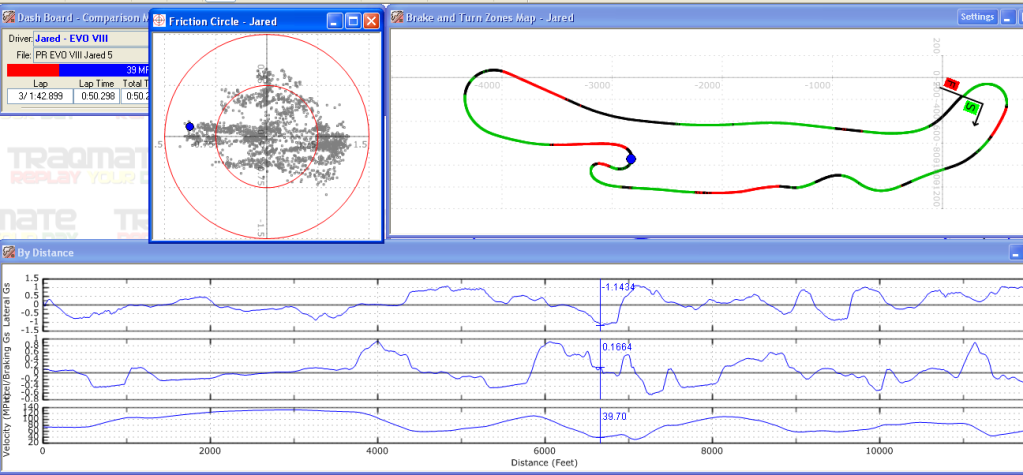
Some data from the track.
Speed through turn 1: 133 mph
Max braking G force: .9
Max turning G's: 1.17
When you are awesome you paint an arc around the friction circle at max grip level. For now I dip into the max areas and transition from brakes/turning and so forth under the grip limit.
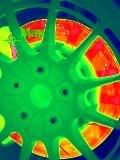
Thermal images of the brakes, trying out some stuff for later testing. Looking to make a data comparison to stock rotors.

Speed through turn 1: 133 mph
Max braking G force: .9
Max turning G's: 1.17
When you are awesome you paint an arc around the friction circle at max grip level. For now I dip into the max areas and transition from brakes/turning and so forth under the grip limit.
Thermal images of the brakes, trying out some stuff for later testing. Looking to make a data comparison to stock rotors.
