


Injector "gunk" and E-85


EvoM Guru
iTrader: (50)
Joined: Mar 2006
Posts: 9,675
Likes: 132
From: Tri-Cities, WA // Portland, OR
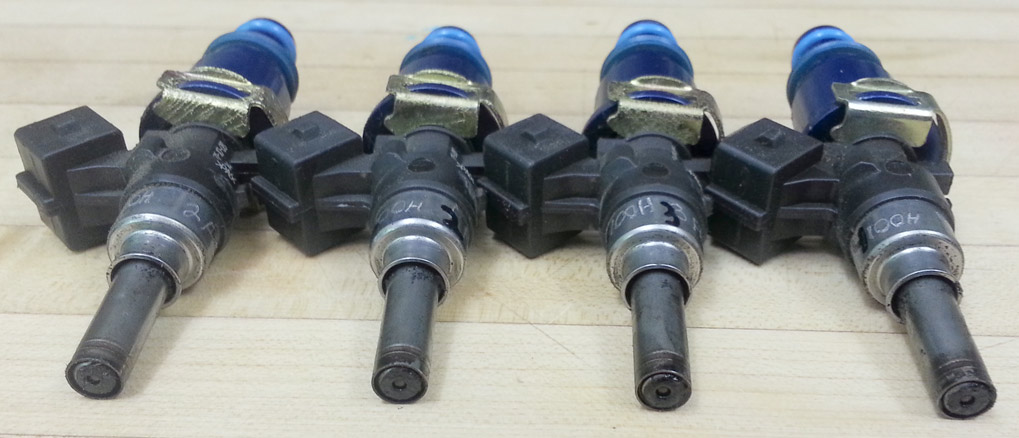
here are my fic1100s after ~2 years on nothing but e85. about a year of that has been on vta crankcase setup. lookin' pretty good. they are at a local shop now being flow tested before and after cleaning.
EvoM Guru
iTrader: (50)
Joined: Mar 2006
Posts: 9,675
Likes: 132
From: Tri-Cities, WA // Portland, OR
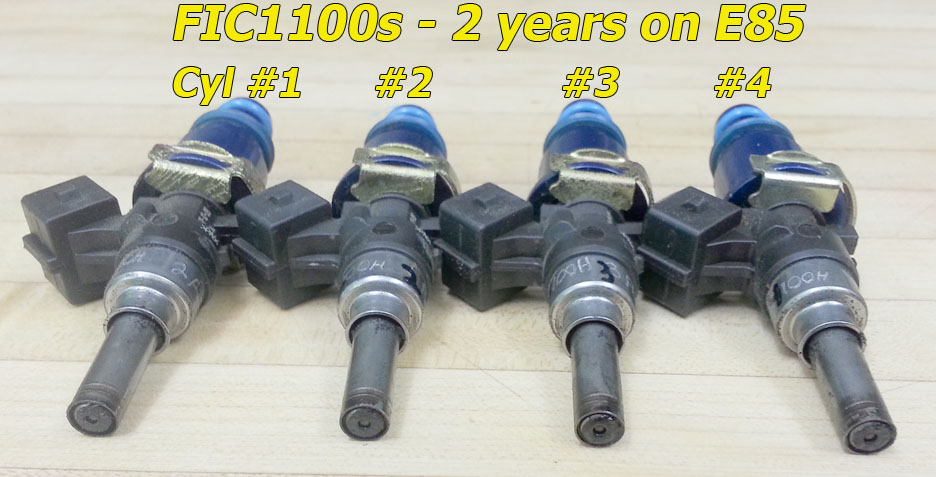
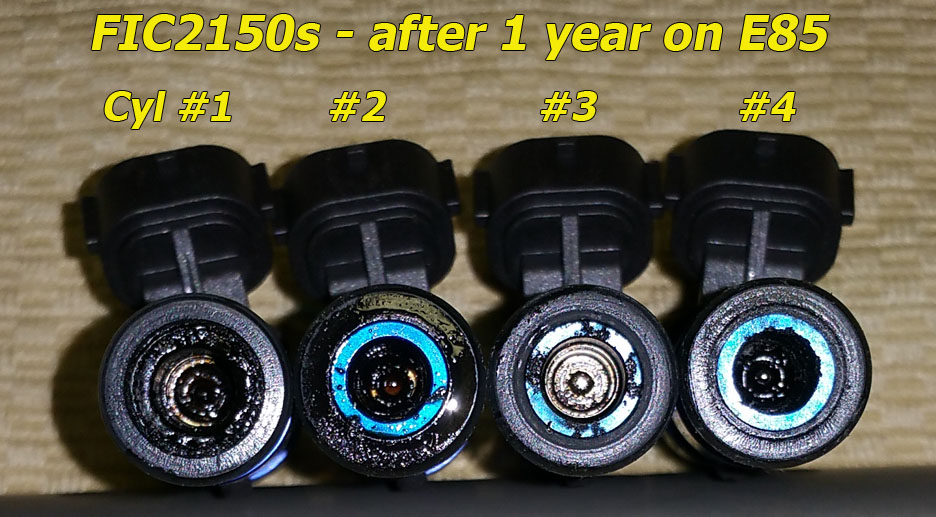
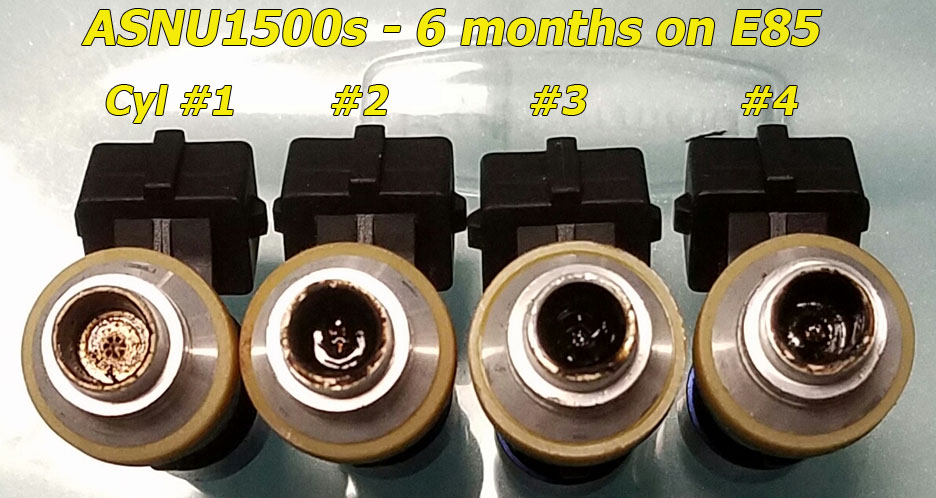
Well, I had minimal gunk issues after few years on E85 with FIC1100s (first picture), but the gunk issue has been hitting my Evo pretty consistently in the last few years. My FIC2150s did not fare too well after maybe a year and 5K miles on E85 (second picture). The issue has been even worse for my ASNU1500s after maybe 6 months and 2.5K miles on E85 (third picture). For FIC2150s and ASNU1500s, its fascinating that one injector in each set was not appreciably gunked up. It was a different cylinder each time too. I have no explanation for it. All three sets of injectors only saw E85 was from Jay's garage in downtown Portland.
There has been a lot of discussion about the possibility that the gunk is caused by an additive in the gasoline portion of E85 plates out on the injectors in E85 applications. The additive that's been suggested is PIB (polyisobutene). A fairly recent research article (see attached) however indicates that the gunk is due more to PCV and oil blowby gasses into the cylinder. My current setup does not have PCV, so that would leave blowby (or suction) oil reaching the fuel injectors, but I find it hard to believe that there is enough reversion for blowby oil to make its way all the way to the fuel injector. Maybe its oil getting past the valve guide seals? Seems hard to believe as well because when I swapped out cams about a year ago, I had all the seals checked. Based on these observations, I think the gunk can be caused both by undesirable additives in fuel and by oil vapor from PCV recirc.
Also, one thing that I'm beginning to believe is that the gunk buildup is most likely to occur in hot weather. I went several months on the ASNU1500s without any issues, and as soon as the weather got hot, I started having problems.
Anyhow, that same article does show that a sufficient amount of another fuel additive called PEA (polyetheramine) is effective at dissolving the gunk. So the question that I'm contemplating is whether at every fill up I can routinely include some fuel injector additive that contains PEA. I've gone through the MSDS sheets of all the major aftermarket fuel treatments to find out which ones contain PEA. The current amounts for the fuel treatments that actually have it are:
- Amsoil Performance Improver: 25-50% by volume (exact amount is noted as trade secret)
- Gumout Regane Complete Fuel System Cleaner: 10-30%
- Gumout Regane High Mileage Fuel System Cleaner: 10-30%
- Gumout other fuel additives: 0%
- Redline SI-1 Fuel Injector Cleaner: 20-30%
- 3M Max Strength Fuel System Cleaner: 30-60%
- BG 44K: 0%
- BG Supercharger: 0%
UPDATE:
- Lucas Oil Safeguard Ethanol Fuel Conditioner: 0%
- Royal Purple Total Fuel System Cleaner: "high" PEA, ethanol compatible, safe for continual use
- Champion eGuard Fuel Treatment: "high" PEA, made for ethanol, safe for continual use, but Champion pointed out that PEA will thicken motor oil
The key questions for long term regular usage are whether any of these products are soluble in E85 and whether there are any long term usage compatibility issues. Amsoil says that while Performance Improver is soluble in E85, but if used in every tank, it will cause any seals to degrade. Presumably this is means rubber and synthetic rubber. 3M also said that their cleaner will also cause seal damage if used regularly. I just got off phone with Redline, and they said that SI-1 has insoluble elements that will plate out a gooey substance on the bottom of the fuel tank. Its unfortunate for the SI-1 because its one of the few additives that is made for continual usage. UPDATE: After a bit more research, I have found that Royal Purple and Champion both have PEA-containing products that are safe for continual usage and are either compatible with or made for ethanol. Champion tech did however note that PEA will cause motor oil to thicken. So perhaps these latter two products will provide an additive-based solution to this issue.
On a side note, Redline makes a product SI-Alcohol that is sold only in Sweden and is specifically meant to address the gunk issue. Unfortunately, Redline told me that its very unlikely that it would ever be sold in the USA.
There has been a lot of discussion about the possibility that the gunk is caused by an additive in the gasoline portion of E85 plates out on the injectors in E85 applications. The additive that's been suggested is PIB (polyisobutene). A fairly recent research article (see attached) however indicates that the gunk is due more to PCV and oil blowby gasses into the cylinder. My current setup does not have PCV, so that would leave blowby (or suction) oil reaching the fuel injectors, but I find it hard to believe that there is enough reversion for blowby oil to make its way all the way to the fuel injector. Maybe its oil getting past the valve guide seals? Seems hard to believe as well because when I swapped out cams about a year ago, I had all the seals checked. Based on these observations, I think the gunk can be caused both by undesirable additives in fuel and by oil vapor from PCV recirc.
Also, one thing that I'm beginning to believe is that the gunk buildup is most likely to occur in hot weather. I went several months on the ASNU1500s without any issues, and as soon as the weather got hot, I started having problems.
Anyhow, that same article does show that a sufficient amount of another fuel additive called PEA (polyetheramine) is effective at dissolving the gunk. So the question that I'm contemplating is whether at every fill up I can routinely include some fuel injector additive that contains PEA. I've gone through the MSDS sheets of all the major aftermarket fuel treatments to find out which ones contain PEA. The current amounts for the fuel treatments that actually have it are:
- Amsoil Performance Improver: 25-50% by volume (exact amount is noted as trade secret)
- Gumout Regane Complete Fuel System Cleaner: 10-30%
- Gumout Regane High Mileage Fuel System Cleaner: 10-30%
- Gumout other fuel additives: 0%
- Redline SI-1 Fuel Injector Cleaner: 20-30%
- 3M Max Strength Fuel System Cleaner: 30-60%
- BG 44K: 0%
- BG Supercharger: 0%
UPDATE:
- Lucas Oil Safeguard Ethanol Fuel Conditioner: 0%
- Royal Purple Total Fuel System Cleaner: "high" PEA, ethanol compatible, safe for continual use
- Champion eGuard Fuel Treatment: "high" PEA, made for ethanol, safe for continual use, but Champion pointed out that PEA will thicken motor oil
The key questions for long term regular usage are whether any of these products are soluble in E85 and whether there are any long term usage compatibility issues. Amsoil says that while Performance Improver is soluble in E85, but if used in every tank, it will cause any seals to degrade. Presumably this is means rubber and synthetic rubber. 3M also said that their cleaner will also cause seal damage if used regularly. I just got off phone with Redline, and they said that SI-1 has insoluble elements that will plate out a gooey substance on the bottom of the fuel tank. Its unfortunate for the SI-1 because its one of the few additives that is made for continual usage. UPDATE: After a bit more research, I have found that Royal Purple and Champion both have PEA-containing products that are safe for continual usage and are either compatible with or made for ethanol. Champion tech did however note that PEA will cause motor oil to thicken. So perhaps these latter two products will provide an additive-based solution to this issue.
On a side note, Redline makes a product SI-Alcohol that is sold only in Sweden and is specifically meant to address the gunk issue. Unfortunately, Redline told me that its very unlikely that it would ever be sold in the USA.
Last edited by mrfred; Sep 8, 2016 at 08:48 AM.



I primarily run pump for this reason, with occasional e85 use on track days.
Sounds like i should be okay. I'm told pump gas cleans things up. We'll see.
Two people I know have lost engines due to this. I literally can't afford to risk it. LOL
Sounds like i should be okay. I'm told pump gas cleans things up. We'll see.
Two people I know have lost engines due to this. I literally can't afford to risk it. LOL

Interesting, and I'm still not seeing any of this after almost eight years now on E85.
Never ran FIC injectors though.
I'll pull my ID's since my car is down and check em out again, they where clean last year.
Never ran FIC injectors though.
I'll pull my ID's since my car is down and check em out again, they where clean last year.
EvoM Guru
iTrader: (50)
Joined: Mar 2006
Posts: 9,675
Likes: 132
From: Tri-Cities, WA // Portland, OR

I don't think thiis is anything specific to FIC injectors. Which IDs are you running?
It takes an entire tank? Lucky I use a lot, i guess. LOL.
My one concern is: I've hardly driven the car lately, so it's had e85 in it for almost a year now (very, very little miles). I'm kinda worried and would like to run some pump gas through it asap.
I'm glad you posted this. I'm sick of the retards in my area telling me how I'm making **** up and hating on e85. Not that the opinion of those particular people mean much to me LOL. Not that proof will change their minds, or anything
My one concern is: I've hardly driven the car lately, so it's had e85 in it for almost a year now (very, very little miles). I'm kinda worried and would like to run some pump gas through it asap.
I'm glad you posted this. I'm sick of the retards in my area telling me how I'm making **** up and hating on e85. Not that the opinion of those particular people mean much to me LOL. Not that proof will change their minds, or anything
ID1kcc.
Will be using ID 1300cc for my new build.
btw, a reminder, a blast from the past that I posted when I had my Evo 8: https://www.evolutionm.net/forums/e8...years-e85.html
and an update two years later after I took the injectors out and had them tested: https://www.evolutionm.net/forums/e8...l#post10784645
All that said, you even said you haven't had and issues until recently. So who knows, I will pull my injectors, my car isn't going anywhere right now. but I have to say 8 years of use without incident is quite a record....
Have you asked the station if they have changed providers or if the provider has changed anything?
Will be using ID 1300cc for my new build.
btw, a reminder, a blast from the past that I posted when I had my Evo 8: https://www.evolutionm.net/forums/e8...years-e85.html
and an update two years later after I took the injectors out and had them tested: https://www.evolutionm.net/forums/e8...l#post10784645
All that said, you even said you haven't had and issues until recently. So who knows, I will pull my injectors, my car isn't going anywhere right now.
but I have to say 8 years of use without incident is quite a record....Have you asked the station if they have changed providers or if the provider has changed anything?


EvoM Guru
iTrader: (50)
Joined: Mar 2006
Posts: 9,675
Likes: 132
From: Tri-Cities, WA // Portland, OR
Interestingly, it ran fine under light load. Trims were just going strongly positive, and it was misfiring when transitioning into boost. My FIC1100s got gunked up once, and in that case there was no high load misfire, but trims went somewhat positive, and it would miss on cold start. So very important to routinely check fuel trims.
EvoM Guru
iTrader: (50)
Joined: Mar 2006
Posts: 9,675
Likes: 132
From: Tri-Cities, WA // Portland, OR
btw, here are my piston tops I scope'd four months ago after the engine ate a plug. They are clean, other than the nicks and oil in #4 from the exploded plug. 
That is 19,000 miles of E85 usage.
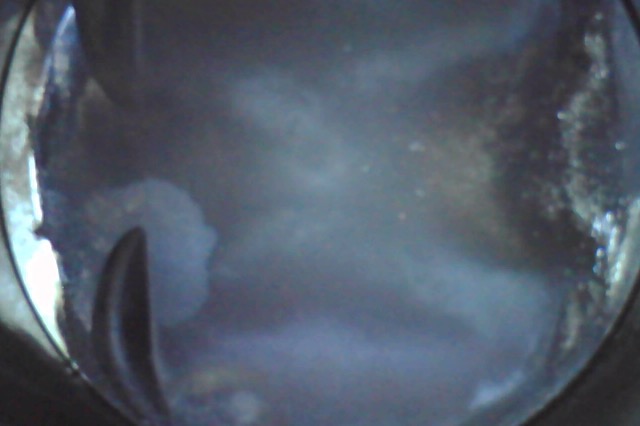
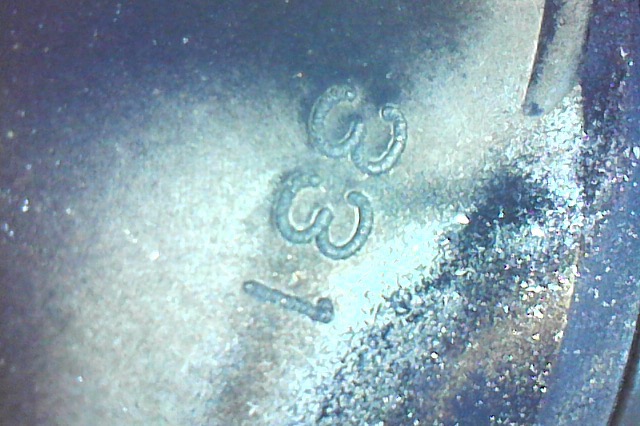
That is 19,000 miles of E85 usage.


Ive recently heard of issues in MI. I should pull my injectors and look however right now it isnt causing me a problem.
Mainly it comes down to the molecular composition of the fluid. Additives are used in some states while not used in others. The additives are causing the build up issue.
My guess, additives are needed in "cold" states.
Mainly it comes down to the molecular composition of the fluid. Additives are used in some states while not used in others. The additives are causing the build up issue.
My guess, additives are needed in "cold" states.

EvoM Community Team Leader


Joined: Aug 2005
Posts: 5,690
Likes: 708
From: West Coast
California does its own gasoline refining because there are regulations that require a "special blend" of "cleaner burning" fuel be sold in our state. I wonder if maybe the lack of gunk has something to do with this "cleaner blend" or maybe overall quality control is just tighter.

